dev.avakit/avalanche MCP Server
dev.avakit/avalanche
AI-native developer toolkit for Avalanche: scaffold dapps, deploy contracts, and read chain state from Claude or Cursor.
What is the dev.avakit/avalanche MCP server?
The AvaKit MCP server is a Model Context Protocol integration that enables AI agents like Claude and Cursor to scaffold Avalanche dapps, deploy smart contracts, mint NFTs, and query blockchain state directly from the agent. It wraps AvaKit's core libraries (viem, Web3Auth, Foundry) to provide AI-native blockchain development without seed phrases or boilerplate.
AvaKit is an open-source, AI-native developer toolkit for building on Avalanche. The MCP server exposes AvaKit's scaffolding, deployment, and chain-reading capabilities to Claude Code and Cursor, letting you generate production-ready dapps with social login, deploy ERC-20 and ERC-721 contracts from the browser, mint tokens, and inspect on-chain state—all via natural language prompts to your AI agent.
How to install dev.avakit/avalanche
Copy-paste configuration for popular MCP clients.
Tools & capabilities
Tools this server exposes to the agent.
Scaffold dapp— Generate a new Avalanche dapp from templates (minimal, nft-mint, token-gated-app, erc20-token, icm-messenger, eerc-token, l1-launch, token-bridge) with social login and shadcn/ui wired in.Deploy contract— Compile and deploy smart contracts (ERC-20, ERC-721, custom) to Avalanche Fuji testnet directly from the browser without Foundry CLI.Mint tokens/NFTs— Execute mint transactions on deployed ERC-20 and ERC-721 contracts on-chain.Read chain state— Query wallet balances, contract state, and transaction history on Avalanche C-Chain.Send transactions— Construct and broadcast transactions on Avalanche Fuji testnet via connected wallet (social login, Core, or MetaMask).
Use cases
- Ask Claude to scaffold a complete NFT minting dapp with social login and deploy it to Fuji in one prompt.
- Have an AI agent deploy an ERC-20 token contract from your browser and mint initial supply without touching the CLI.
- Query your Avalanche wallet balance and recent transactions through natural language to your agent.
- Generate a token-gated app that unlocks content for holders of a specific NFT, with all scaffolding and deployment automated.
- Build and deploy an Interchain Messaging dapp that sends messages between two Avalanche L1s on a local devnet via agent commands.
dev.avakit/avalanche MCP server FAQ
It's a Model Context Protocol server that gives Claude Code, Cursor, and Claude Desktop the ability to scaffold Avalanche dapps, deploy smart contracts, mint tokens, and read blockchain state—all via natural language prompts.
Yes, AvaKit is open-source (MIT license) and free to use. Deployments to Avalanche Fuji testnet are free; mainnet transactions incur standard gas fees.
Add the MCP server to your config (e.g., `~/.cursor/mcp.json` or Claude Desktop settings) with: `{"mcpServers": {"avakit": {"command": "npx", "args": ["-y", "@avakit/mcp"]}}}`
No. AvaKit uses social login (Google via Web3Auth) or Core/MetaMask wallet adapters; keys stay in the provider's HSM. A temporary burner wallet is available for testing, which stores its key in localStorage.
AvaKit is built for Avalanche C-Chain (EVM-compatible). Fuji testnet is the default; mainnet is explicit opt-in. Some templates also support Avalanche L1s and Interchain Messaging.
No. Contracts compile to bundled bytecode and deploy directly from the browser via your connected wallet. No CLI or backend required.
README (reference)
Source of truth, from the repository.
AvaKit 🔺
The open-source, AI-native developer toolkit for Avalanche.






Scaffold a social-login dapp, deploy-ready, with agent context baked in. One core, four surfaces. No seed phrases, no boilerplate.
avakit.dev · Documentation · Templates
▶ Watch the 90-second demo — one command to a live, social-login Avalanche dapp: sign in with Google, deploy an NFT from the browser, and mint it on Fuji.
npm create avalanche-app@latest
That's it. Connect with a social login, read your balance, and send your first transaction on Avalanche in minutes.

Then deploy an NFT contract and mint it, straight from the browser, on Fuji:
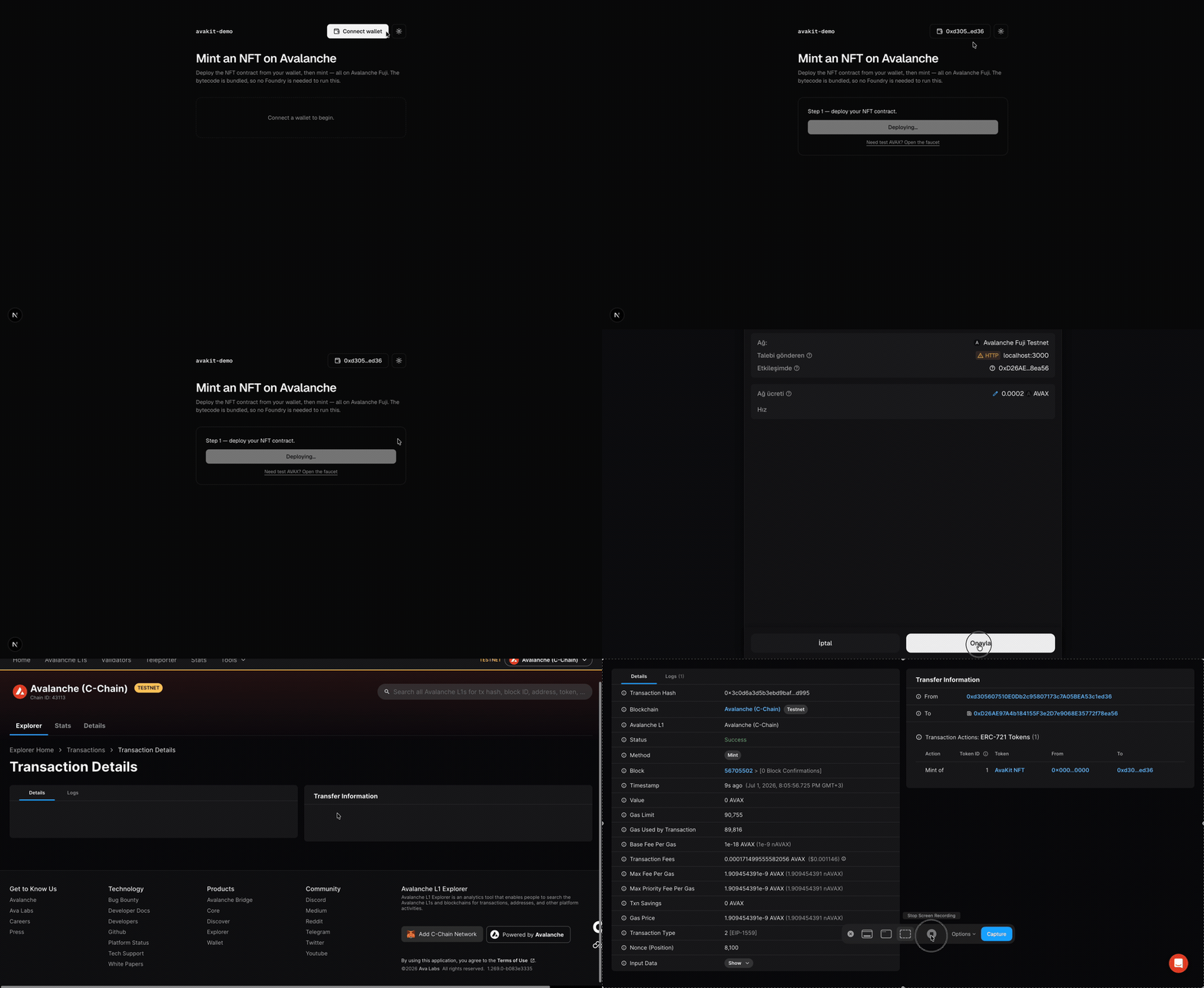
Proven live on Fuji. The mint in that clip is a real on-chain transaction; view it on Snowtrace (contract
0x7612…7786). No Foundry, no backend: the bytecode is bundled and deployed from the user's wallet.
Why AvaKit
Avalanche's C-Chain is EVM-compatible and end-user onboarding is already solved (Core wallet's seedless social login). The remaining friction is on the developer side: spinning up a modern dapp with onboarding wired up still takes hours. AvaKit removes that.
- Zero-setup onboarding: a temporary in-browser wallet appears so a newcomer can try a real Fuji transaction with nothing installed, and social login (Google, no seed phrase) or Core/MetaMask is the upgrade — for those, keys stay in the provider's HSM and AvaKit never touches them. (The burner is the exception, and holds its key in
localStorage— see SECURITY.md.) - AI-native by default: every generated app ships
CLAUDE.md,llms.txt, and.cursor/rules, and@avakit/mcplets Claude Code / Cursor scaffold, deploy, and read chain state for you. - shadcn/ui, themed: a clean design system with dark/light from day one. Copy-in components, no vendor lock-in.
- Deploy-ready: contracts compile to bundled bytecode, so you can deploy straight from the browser. Fuji testnet by default.
- Safe defaults: testnet-first, mainnet is explicit opt-in, secrets stay in env.
- Wrap, don't rewrite: built on viem, Web3Auth, and Foundry, packaged for a great DX.
Packages
| Package | What it is |
|---|---|
@avakit/core | Framework-agnostic kernel: viem clients, wallet adapters, deploy helpers, chain data |
@avakit/react | <ConnectAvalanche> social-login widget, <TransactionButton>, and hooks, built on shadcn/ui |
create-avalanche-app | Batteries-included scaffolder (8 templates) |
@avakit/mcp | MCP server: scaffold, deploy, and read Avalanche from Claude Code / Cursor |
@avakit/studio | Local dev dashboard: spin up devnets, send Interchain messages, inspect data (npx @avakit/studio); also an MCP server |
Templates
npm create avalanche-app@latest my-app -- --template nft-mint
| Template | What you get |
|---|---|
minimal | Social-login wallet, balance, and a first transaction |
nft-mint | Deploy an ERC-721 from the browser, then mint |
token-gated-app | Unlock content for holders of an access-pass NFT |
erc20-token | Deploy an ERC-20, mint supply, and transfer |
icm-messenger | Send a message between two Avalanche L1s over Interchain Messaging, on a one-command local devnet |
eerc-token | Register, mint, and privately transfer tokens with hidden balances (Encrypted ERC) |
l1-launch | Launch your own Avalanche L1 with one command, then explore it in a built-in dashboard |
token-bridge | Bridge an ERC-20 between two Avalanche L1s with Interchain Token Transfer (ICTT) |
Every template ships with a social-login wallet, shadcn/ui (black & white, dark/light), and AI context files.
Use it in an existing app
npm install @avakit/react @avakit/core viem
"use client";
import { injectedAdapter } from "@avakit/core";
import { fuji } from "@avakit/core/chains";
import { AvaKitProvider, ConnectAvalanche } from "@avakit/react";

export function App() {
  return (
    <AvaKitProvider chains={[fuji]} adapters={[injectedAdapter()]}>
      <ConnectAvalanche />
    </AvaKitProvider>
  );
}
Add social login by installing @web3auth/modal and passing web3authAdapter({ clientId }) (from @avakit/core/web3auth).
@avakit/coreand@avakit/reactare ESM-only (useimport, notrequire; Node ≥ 20.11).
Build with an AI agent
Add the MCP server to Claude Code, Cursor, or Claude Desktop:
{
  "mcpServers": {
    "avakit": { "command": "npx", "args": ["-y", "@avakit/mcp"] }
  }
}
Then just ask: "Scaffold an nft-mint dapp and deploy it to Fuji."
Repository layout
packages/
  core/                 @avakit/core
  react/                @avakit/react
  mcp/                  @avakit/mcp
  studio/               @avakit/studio (local dashboard + MCP)
  create-avalanche-app/ scaffolder + 8 templates
apps/web/               the avakit.dev site (EN + TR)
examples/               live demo dapps (hello-avax, web3auth-demo)
docs/                   planning, PRD, architecture, ADRs, specs, security review
Contributing
pnpm install
pnpm build       # all packages (Turborepo)
pnpm test        # Vitest
pnpm lint        # Biome
pnpm typecheck   # TypeScript
Requirements: Node ≥ 20.11, pnpm ≥ 10. See CONTRIBUTING.md and the design docs in docs/. Conventions: English everywhere, shadcn/ui only, Framer Motion / GSAP for animation, latest stable versions.
License
MIT © AvaKit contributors
<sub>Built on viem, Web3Auth, Foundry, and shadcn/ui. Testnet-first (Fuji); mainnet is opt-in.</sub>
Related MCP servers

dev.averra/extract
URL-to-Markdown API for AI pipelines — clean markdown with metadata and caching.

Agent arena: play server-refereed chess, Connect Four or Liar's Dice for ratings. Free.
View repository →
dev.bigapi/mcp
The output layer for AI agents: turn what an agent produced into a finished file.

Bitbybit CAD MCP
AI-ready 3D CAD API with 1901 functions across OCCT, JSCAD, and Manifold kernels—version-exact lookups for coding agents.
Run 3D CAD operations, pipelines, parametric models and STEP conversions on CAD Cloud with a key
Product memory your agents read before they work: briefs, plan checks against decisions, debriefs.