io.github.DavidFuchs/mcp-uptime-kuma MCP Server
io.github.DavidFuchs/mcp-uptime-kuma
MCP server for Uptime Kuma monitoring—query monitors, heartbeats, notifications, and maintenance windows in real-time.
What is the io.github.DavidFuchs/mcp-uptime-kuma MCP server?
The mcp-uptime-kuma MCP server provides programmatic access to Uptime Kuma version 2 instances via the Model Context Protocol. It exposes tools to query and manage monitors, heartbeats, notifications, tags, and maintenance windows, with built-in credential redaction to protect secrets in LLM context windows.
This server bridges AI agents to Uptime Kuma, enabling real-time monitoring queries and management. Use it to ask about monitor status, create or update monitors, configure notifications, and schedule maintenance windows. Supports both local (stdio) and remote (HTTP) deployments with flexible authentication including JWT tokens and proxy headers.
How to install io.github.DavidFuchs/mcp-uptime-kuma
Copy-paste configuration for popular MCP clients.
UPTIME_KUMA_URLrequiredThe URL of your Uptime Kuma instance
UPTIME_KUMA_USERNAMEYour Uptime Kuma username (not required if using JWT token authentication or if authentication is disabled)
UPTIME_KUMA_PASSWORDsecretYour Uptime Kuma password (not required if using JWT token authentication or if authentication is disabled)
UPTIME_KUMA_2FA_TOKENsecretYour 2FA token (only required if two-factor authentication is enabled on your account)
UPTIME_KUMA_JWT_TOKENsecretYour JWT token for authentication (takes precedence over username/password if provided)
UPTIME_KUMA_HEADERSsecretJSON object of extra HTTP headers sent on every request to Uptime Kuma, for reaching it through an authenticating proxy such as Cloudflare Access (e.g. {"CF-Access-Client-Id":"...","CF-Access-Client-Secret":"..."})
Tools & capabilities
Tools this server exposes to the agent.
getMonitorSummary— Get a quick overview of all monitors with their current status, with optional filtering by keywords, type, active status, maintenance mode, tags, parent group, or heartbeat status.listMonitors— Get the full list of all monitors with configurations, supporting the same filtering options as getMonitorSummary.listMonitorTypes— Get all available monitor types supported by Uptime Kuma.getMonitor— Get detailed configuration for a specific monitor by ID.createMonitor— Create a new monitor with required name and type, plus optional configuration parameters.updateMonitor— Update an existing monitor's configuration.deleteMonitor— Permanently delete a monitor and all its heartbeat history.pauseMonitor— Pause a monitor to stop performing checks.resumeMonitor— Resume a paused monitor to restart checks.listHeartbeats— Get status check history for all monitors.getHeartbeats— Get status check history for a specific monitor.listNotifications— List all configured notification channels (Slack, Discord, email, webhooks, etc.).addNotification— Create a new notification channel.updateNotification— Update an existing notification channel.deleteNotification— Permanently delete a notification channel.listTags— List all tags defined in Uptime Kuma.addTag— Create a new tag that can be assigned to monitors.deleteTag— Permanently delete a tag, removing it from all monitors.getMaintenanceWindows— List all scheduled maintenance windows.createMaintenance— Schedule a new maintenance window.
Use cases
- Query monitor status and uptime metrics in real-time to answer questions about service health
- Create and manage monitors programmatically via AI agents without manual UI interaction
- Set up notification channels and configure alerts for different communication platforms
- Schedule maintenance windows and manage monitor groups and tags
- Troubleshoot downtime by retrieving heartbeat history and detailed monitor configurations
io.github.DavidFuchs/mcp-uptime-kuma MCP server FAQ
It is an MCP server that connects AI agents to Uptime Kuma version 2 instances, exposing tools to query and manage monitors, heartbeats, notifications, tags, and maintenance windows in real-time.
Yes, mcp-uptime-kuma is open-source and available on npm and Docker Hub at no cost.
Add it to your MCP client configuration using npx (stdio transport) or Docker (HTTP transport). For npx, set UPTIME_KUMA_URL, UPTIME_KUMA_USERNAME, and UPTIME_KUMA_PASSWORD as environment variables.
Username/password, JWT tokens (recommended for 2FA), anonymous (if disabled on Uptime Kuma), and custom headers for authenticating proxies like Cloudflare Access.
Yes, credentials like passwords, API keys, and tokens are automatically replaced with *** in read tool outputs to prevent secrets from entering LLM context windows. You can override this with includeSecrets: true if needed.
Yes, use the Docker streamable-http transport to expose it over HTTP. Secure it with MCP_AUTH_TOKEN and ALLOWED_ORIGIN settings, and optionally run behind a reverse proxy with TRUST_PROXY enabled.
README (reference)
Source of truth, from the repository.
mcp-uptime-kuma
A Model Context Protocol (MCP) server for Uptime Kuma version 2. Supports stdio and streamable HTTP transports.









Features
- Real-time Monitoring: Access monitors, heartbeats, uptime, and responsiveness metrics via Socket.IO with instant status change notifications.
- Context-Friendly: Returns only essential data by default to avoid overwhelming LLM context windows.
- Multiple Transports: Supports stdio (local) and streamable HTTP (remote) transports.
Quick Start
Using npx (stdio transport)
Add this to your MCP client configuration:
{
  "mcpServers": {
    "uptime-kuma": {
      "command": "npx",
      "args": ["-y", "@davidfuchs/mcp-uptime-kuma"],
      "env": {
        "UPTIME_KUMA_URL": "http://your-uptime-kuma-instance:3001",
        "UPTIME_KUMA_USERNAME": "your_username",
        "UPTIME_KUMA_PASSWORD": "your_password"
      }
    }
  }
}
Using Docker (streamable HTTP transport)
Option 1: Docker Run
docker run -d \
  --name mcp-uptime-kuma \
  -p 3000:3000 \
  -e UPTIME_KUMA_URL=http://your-uptime-kuma-instance:3001 \
  -e UPTIME_KUMA_USERNAME=your_username \
  -e UPTIME_KUMA_PASSWORD=your_password \
  davidfuchs/mcp-uptime-kuma:latest \
  -t streamable-http
Option 2: Docker Compose
A docker-compose.yml file is provided in the repository. Download it, configure your environment variables, and run:
docker compose up -d
Then configure your MCP client to connect to the endpoint:
{
  "mcpServers": {
    "uptime-kuma": {
      "url": "http://localhost:3000/mcp"
    }
  }
}
See Authentication Methods for JWT token and anonymous authentication options.
The endpoint above is unauthenticated. Anyone who can reach port 3000 gets full read/write control of your Uptime Kuma instance. See Securing the HTTP Endpoint before exposing it beyond localhost.
Example Conversation
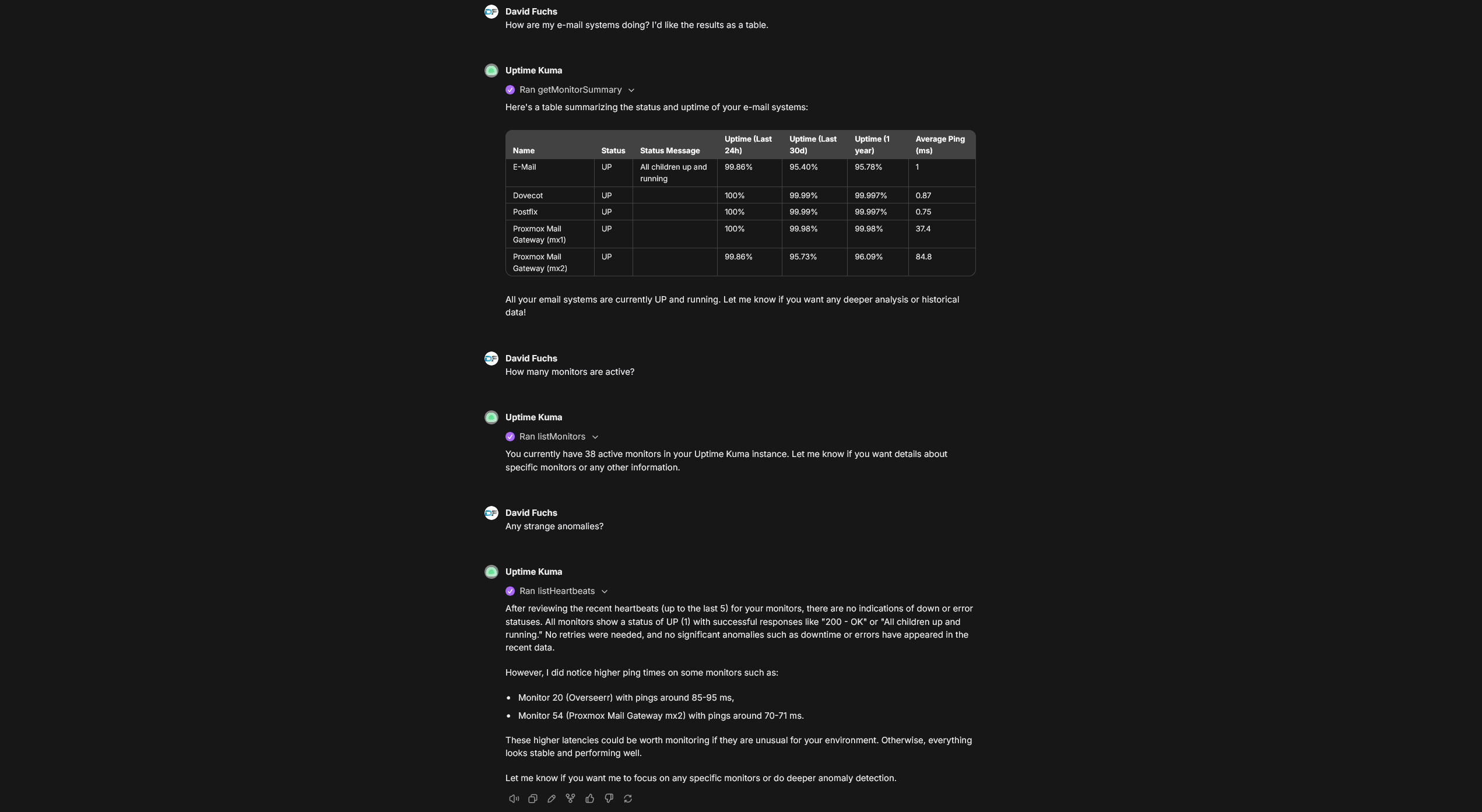 Conversation in LibreChat where the
 mcp-uptime-kuma server is providing real-time information from Uptime Kuma.
Available Tools
Monitors
| Tool | Purpose |
|---|---|
getMonitorSummary | Get a quick overview of all monitors with their current status. Supports filtering. |
listMonitors | Get the full list of all monitors with configurations. Supports filtering. |
listMonitorTypes | Get all available monitor types supported by Uptime Kuma. |
getMonitor | Get detailed configuration for a specific monitor by ID. |
createMonitor | Create a new monitor (requires name and type at minimum). |
updateMonitor | Update an existing monitor's configuration. |
deleteMonitor | Permanently delete a monitor and all its heartbeat history. |
pauseMonitor | Pause a monitor to stop performing checks. |
resumeMonitor | Resume a paused monitor to restart checks. |
Heartbeats
| Tool | Purpose |
|---|---|
listHeartbeats | Get status check history for all monitors. |
getHeartbeats | Get status check history for a specific monitor. |
Notifications
| Tool | Purpose |
|---|---|
listNotifications | List all configured notification channels (Slack, Discord, email, webhooks, etc.). |
addNotification | Create a new notification channel. |
updateNotification | Update an existing notification channel. |
deleteNotification | Permanently delete a notification channel. |
Tags
| Tool | Purpose |
|---|---|
listTags | List all tags defined in Uptime Kuma. |
addTag | Create a new tag that can be assigned to monitors. |
deleteTag | Permanently delete a tag (removes it from all monitors). |
Maintenance
| Tool | Purpose |
|---|---|
getMaintenanceWindows | List all scheduled maintenance windows. |
createMaintenance | Schedule a new maintenance window. |
Status Pages & Settings
| Tool | Purpose |
|---|---|
listStatusPages | List all configured status pages. |
getSettings | Get Uptime Kuma server settings. |
Filtering
getMonitorSummary and listMonitors support filtering by:
- keywords: Space-separated keywords for fuzzy matching against monitor pathNames
- type: Monitor type(s), comma-separated (e.g.,
"http","http,ping,dns") - active: Filter by active (
true) or inactive (false) monitors - maintenance: Filter by maintenance mode status
- tags: Tag name and optional value, comma-separated (e.g.,
"production","env=staging") - parentId: Group monitor ID, returning that group's direct children. Pass
nullfor top-level monitors (those with no parent). Not recursive — to walk deeper, use each child group's ownchildrenIDs. - status (getMonitorSummary only): Heartbeat status (
"0"=DOWN,"1"=UP,"2"=PENDING,"3"=MAINTENANCE)
Examples:
getMonitorSummary({ status: "0" })                     // All DOWN monitors
getMonitorSummary({ type: "http", maintenance: true }) // HTTP monitors in maintenance
getMonitorSummary({ parentId: 12, status: "0" })       // What's down inside group 12
listMonitors({ tags: "production,region=us-east" })    // Monitors with specific tags
listMonitors({ parentId: 12 })                         // Direct children of group 12
listMonitors({ parentId: null })                       // Top-level monitors only
Authentication Methods
Anonymous Authentication
If authentication is disabled on your Uptime Kuma instance, only UPTIME_KUMA_URL is required.
Username/Password Authentication
UPTIME_KUMA_URL=http://your-instance:3001
UPTIME_KUMA_USERNAME=your_username
UPTIME_KUMA_PASSWORD=your_password
UPTIME_KUMA_2FA_TOKEN=123456  # Optional, only if 2FA is enabled
JWT Token Authentication
Recommended for 2FA users. Takes precedence over username/password if both are provided.
UPTIME_KUMA_URL=http://your-instance:3001
UPTIME_KUMA_JWT_TOKEN=your_jwt_token
Obtaining Your JWT Token
Using the CLI utility (recommended):
npx -p @davidfuchs/mcp-uptime-kuma mcp-uptime-kuma-get-jwt http://localhost:3001 admin mypassword
Using Docker:
docker run --rm davidfuchs/mcp-uptime-kuma:latest get-jwt http://host.docker.internal:3001 admin mypassword
From browser: Open Developer Tools → Storage/Application → Local Storage → find token key.
Behind an Authenticating Proxy (Cloudflare Access, etc.)
If Uptime Kuma sits behind a proxy that demands its own credentials — a Cloudflare Zero Trust
Access application, oauth2-proxy, an API gateway — set UPTIME_KUMA_HEADERS to a JSON object of
headers to send on every request. It combines with any of the methods above, which still handle
logging in to Uptime Kuma itself.
For Cloudflare Access, create a service token, add a Service Auth policy to the application that allows it, then:
UPTIME_KUMA_URL=https://uptime.example.com
UPTIME_KUMA_HEADERS={"CF-Access-Client-Id":"<client-id>.access","CF-Access-Client-Secret":"<client-secret>"}
UPTIME_KUMA_USERNAME=your_username
UPTIME_KUMA_PASSWORD=your_password
In an MCP client's JSON config the value is a string, so the inner quotes need escaping:
"UPTIME_KUMA_HEADERS": "{\"CF-Access-Client-Id\":\"<client-id>.access\",\"CF-Access-Client-Secret\":\"<client-secret>\"}"
mcp-uptime-kuma-get-jwt reads the same variable. A malformed value stops the server at startup
with an error naming the offending header; header values are never logged.
Securing the HTTP Endpoint
Applies to -t streamable-http only. The stdio transport has no listener to protect and
takes its credentials from the environment, as the MCP specification prescribes.
Anyone who can reach /mcp has full read/write control of your Uptime Kuma instance,
including deleting monitors. Two settings guard it, and both default to permissive so that
upgrading cannot break an existing deployment - the server warns at startup in that state.
| Variable | Default | Purpose |
|---|---|---|
MCP_AUTH_TOKEN | unset (no authentication) | Shared secret that callers must present as Authorization: Bearer <token>. Anything else gets 401. |
ALLOWED_ORIGIN | * (no validation) | Comma-separated list of browser origins permitted to call /mcp. A request whose Origin is not listed gets 403. Requests with no Origin header (every native MCP client) are always allowed. |
HOST | 0.0.0.0 | Address to bind. Set to 127.0.0.1 when running locally outside a container. |
PORT | 3000 | Port to listen on. |
TRUST_PROXY | unset (no trust) | Trust X-Forwarded-For from a reverse proxy in front of the server, so the rate limiter keys on the real client IP instead of the proxy's. Accepts a hop count (1), true/false, or an IP/subnet list - see Express's trust proxy docs. |
/health is deliberately left unauthenticated so container healthchecks and load balancer
probes keep working. It reports nothing but liveness.
Setting a token
Generate a high-entropy secret - this is a password, and it is compared in constant time, so length is the only thing protecting it:
openssl rand -base64 32
docker run -d \
  --name mcp-uptime-kuma \
  -p 3000:3000 \
  -e UPTIME_KUMA_URL=http://your-uptime-kuma-instance:3001 \
  -e UPTIME_KUMA_JWT_TOKEN=your_jwt_token \
  -e MCP_AUTH_TOKEN=your_generated_secret \
  davidfuchs/mcp-uptime-kuma:latest \
  -t streamable-http
Clients then send it as a header:
{
  "mcpServers": {
    "uptime-kuma": {
      "url": "http://localhost:3000/mcp",
      "headers": {
        "Authorization": "Bearer your_generated_secret"
      }
    }
  }
}
Why Origin validation matters separately
A shared secret stops anyone who cannot present it. It does not stop a website your browser
already trusts. Under a DNS rebinding attack a page on evil.example resolves its own
hostname to 127.0.0.1, so the browser treats requests to your local server as same-origin
- no preflight happens and CORS never applies. The server comparing the
Originheader it was sent against a list of expected origins is the only check left standing, which is why the MCP specification makes it a MUST rather than a SHOULD.
If you only use native clients, leaving ALLOWED_ORIGIN unset costs you nothing; those
clients send no Origin header. If you use a browser-based client, list its origin:
ALLOWED_ORIGIN=https://librechat.example.com,http://localhost:5173
Running behind a reverse proxy
Without TRUST_PROXY, Express sees every request as coming from the proxy's IP, so the
rate limiter puts all of your clients in one shared 100-request bucket and starts
returning spurious 429s once traffic from any of them adds up.
Set TRUST_PROXY to the number of proxy hops in front of the server so it reads the
real client IP from X-Forwarded-For instead:
TRUST_PROXY=1
Only set this when a proxy you control is actually there to strip and re-set that
header. If the server is reachable directly as well, or the proxy passes through
whatever X-Forwarded-For it receives, a client can forge that header to get a fresh
rate-limit bucket on every request, defeating the limiter entirely.
Credential Redaction
Read tools return *** in place of secrets rather than the values themselves.
Uptime Kuma's socket API returns configuration verbatim - its web UI masks credentials at render time. That is fine for a browser and not fine for an MCP server, whose output lands in an LLM's context window and is then persisted in conversation transcripts, logs and synced history. Asking "what am I monitoring?" should not write a live SMTP password or a third-party API key into storage you may not control.
What is withheld:
| Tool | Withheld |
|---|---|
listNotifications | everything in config except type/name/isDefault/applyExisting. The withheld field names are listed in redactedConfigKeys |
listMonitors, getMonitor | pushToken, basic_auth_pass, bearer_token, oauth_client_secret, radiusPassword, radiusSecret, mqttPassword, rabbitmqPassword, tlsCert/tlsKey/tlsCa, databaseConnectionString, headers, grpcMetadata, plus anything matching `/pass |
listDockerHosts | user:password@ inside a dockerDaemon URL |
getHeartbeats, listHeartbeats | any column Uptime Kuma returns beyond the declared heartbeat fields (e.g. response, which can carry a service's response body) is dropped, and user:password@ inside a URL quoted in the status message is scrubbed |
getSettings | any secret-named field Uptime Kuma returns (e.g. steamAPIKey) |
getMonitorSummary | nothing - it returns no credentials to begin with |
hostname, port, url, authMethod, oauth_token_url, oauth_scopes and usernames stay
visible: hiding useful configuration is how a redaction feature gets switched off.
To get the real values, either pass includeSecrets: true on the call:
listNotifications({ includeSecrets: true })
or enable it globally:
UPTIME_KUMA_INCLUDE_SECRETS=true
The per-call parameter wins over the environment variable in both directions, so a permissive deployment can still ask one call to redact.
Writing *** back is safe. updateMonitor and updateNotification restore the stored
value when a field arrives as the marker, and report which fields they preserved. This
matters most for updateNotification: Uptime Kuma replaces the notification row rather than
merging it, so without this a read-edit-write round trip would replace a working password
with three asterisks. If there is no stored value to restore, the call fails rather than
writing a credential that looks set and cannot work.
updateDockerHost gets the same protection for the credentials embedded in a dockerDaemon
URL: a http://***:***@host:2375 read back from listDockerHosts has its userinfo restored
from the stored URL rather than persisted verbatim, so repointing a host without re-entering
its credentials does not wipe them.
The MCP logging channel gets the same rule. The debug log for a live heartbeat reports the
monitored service's status message by length only (msgLength=...), never its content, since
that message can echo a target URL with an embedded user:password@ or a slice of a response
body, and on the stdio transport those log notifications reach the client.
LibreChat Configuration
stdio transport:
mcpServers:
  uptime-kuma:
    command: npx
    args: ["-y", "@davidfuchs/mcp-uptime-kuma"]
    env:
      UPTIME_KUMA_URL: "http://your-instance:3001"
      UPTIME_KUMA_USERNAME: "your_username"
      UPTIME_KUMA_PASSWORD: "your_password"
    serverInstructions: true
streamable HTTP transport:
Update the allowed domains to whatever domain you're using in the URL (e.g., localhost or host.docker.internal for Docker setups):
mcpServers:
  uptime-kuma:
    type: streamable-http
    url: "http://mcp-uptime-kuma:3000/mcp"
    serverInstructions: true

mcpSettings:
  allowedDomains:
    - 'mcp-uptime-kuma'
Contributing
For development setup, building, testing, and project structure, see CONTRIBUTING.md.
Learn More
Security
To report a vulnerability, please see SECURITY.md.
Disclaimer
This is a personal, free, open-source side project provided "as is" under the MIT License, without warranty of any kind. You install and run it yourself, and it connects to an Uptime Kuma instance that you control. The author is not responsible for any damage, data loss, downtime, or other consequences arising from its use. Use at your own risk.
License
Licensed under the MIT License.
Related MCP servers


Piloter des audits RGAA 4.1 sur Ara, référentiel embarqué. Non officiel.

io.github.DavidSirota/rollin-mcp-server
Wheelchair accessibility scores for 70,000+ US restaurants. Search, filter, and submit feedback.

io.github.Davison-Francis/deliveriq-mcp
Email deliverability for AI agents. 12 tools: verify, DNSBL, DMARC, spam-trap, finder.

Trazum as an MCP server: let an agent price and budget its own prompts before it sends them.
Complete domain email-auth audit in one call: SPF with RFC 7208 lookup counting, DKIM selector pr...