io.github.EduBase/MCP MCP Server
io.github.EduBase/MCP
Connect Claude and other AI agents to your EduBase learning platform to manage questions, quizzes, exams, and results.
What is the io.github.EduBase/MCP MCP server?
The EduBase MCP server is a Model Context Protocol implementation that allows AI agents like Claude to interact with your EduBase educational platform account. It exposes tools for managing questions, quizzes, exams, users, classes, and results, supporting stdio, SSE, and streamable HTTP transport protocols.
EduBase MCP enables AI-assisted workflows for educational content management. You can use Claude to collaboratively create and upload questions, schedule exams, analyze user results, manage users and classes, and perform other administrative tasks on your EduBase instance. The server supports flexible toolset configuration to expose only the capabilities you need.
How to install io.github.EduBase/MCP
Copy-paste configuration for popular MCP clients.
EDUBASE_API_URLThe base URL of the EduBase API (default: https://www.edubase.net/api)
EDUBASE_API_APPrequiredThe integration app ID for EduBase
EDUBASE_API_SECRETrequiredsecretThe secret key for the EduBase API
EduBase-Api-AppThe integration app ID for EduBase
EduBase-Api-SecretsecretThe secret key for the EduBase API
Tools & capabilities
Tools this server exposes to the agent.
edubase_get_user_me— Retrieve current user informationedubase_post_content_tag— Tag content (questions, quizzes, exams, etc.)edubase_post_content_permission— Manage user permissions on contentedubase_post_content_transfer— Transfer ownership of contentedubase_enable_toolsets— Enable additional toolsets on demand (when dynamic toolsets mode is enabled)edubase_list_toolsets— List available toolsetsedubase_filebin— Upload temporary files
Use cases
- Collaboratively create and upload quiz questions and exams with Claude's assistance
- Schedule exams and manage exam settings and user access
- Analyze quiz and exam results to identify learning patterns
- Manage users, groups, and class memberships across your organization
- Export and download quiz/exam results and certificates
- Tag and organize educational content for better discoverability
io.github.EduBase/MCP MCP server FAQ
It's a Model Context Protocol server that connects AI agents like Claude to your EduBase educational platform, allowing you to manage questions, quizzes, exams, users, and results through natural conversation.
The MCP server itself is free to use if you have an EduBase account. You need valid EduBase API credentials (App ID and Secret key) obtained from your EduBase dashboard's Integrations menu.
Add it to your claude_desktop_config.json using either npx (@edubase/mcp), Docker, or as a remote server. You'll need to configure EDUBASE_API_URL, EDUBASE_API_APP, and EDUBASE_API_KEY environment variables with your EduBase credentials.
The server supports API key authentication (App ID and Secret), Bearer token authentication for remote servers, and OAuth 2.1 when EDUBASE_OAUTH is enabled, allowing users to authorize via their EduBase account.
Yes. Use the EDUBASE_TOOLSETS environment variable to enable only specific toolsets (questions, quizzes, exams, results, users, classes, organizations, integrations, tags, permissions, metrics, files), or set EDUBASE_READONLY=true to expose only read tools.
Yes. You can host the MCP server with SSE or streamable HTTP transport and connect to it remotely over HTTPS. Clients can authenticate with Bearer tokens or OAuth 2.1.
README (reference)
Source of truth, from the repository.
EduBase MCP server


This repository contains the implementation of the Model Context Protocol (MCP) server for the EduBase platform. It allows MCP clients (for example Claude Desktop) and LLMs to interact with your EduBase account and perform tasks on your behalf. It supports stdio, SSE and streamable HTTP transport protocols.
What is EduBase?
EduBase is an innovative, modular, online educational platform that makes learning more enjoyable, simpler and interactive, suitable for educational institutions or enterprises.
Why choose EduBase?
EduBase revolutionizes digital learning with its unique combination of features:
- Advanced Quiz System with parametrization allowing infinite variations of the same question, real-time cheating detection, beautiful LaTeX typesetting, advanced STEM-support and automatic grading
- Unified Learning Environment that centralizes all your educational content — videos, exams, documents, and SCORM modules — in one intuitive system
- Enterprise-Grade Security with features like SSO integration, fine-grained access controls, comprehensive auditing, and GDPR compliance
- Integration with your existing systems through LTI, comprehensive API, and custom integration options
- AI-Assisted Tools, such as EduBase Assistant, that can instantly transform your existing content into interactive quizzes and assessments, or translate your materials from one language to another
From higher education institutions to corporate training departments, EduBase scales to meet your specific needs while maintaining an intuitive user experience across all devices.
Demo video
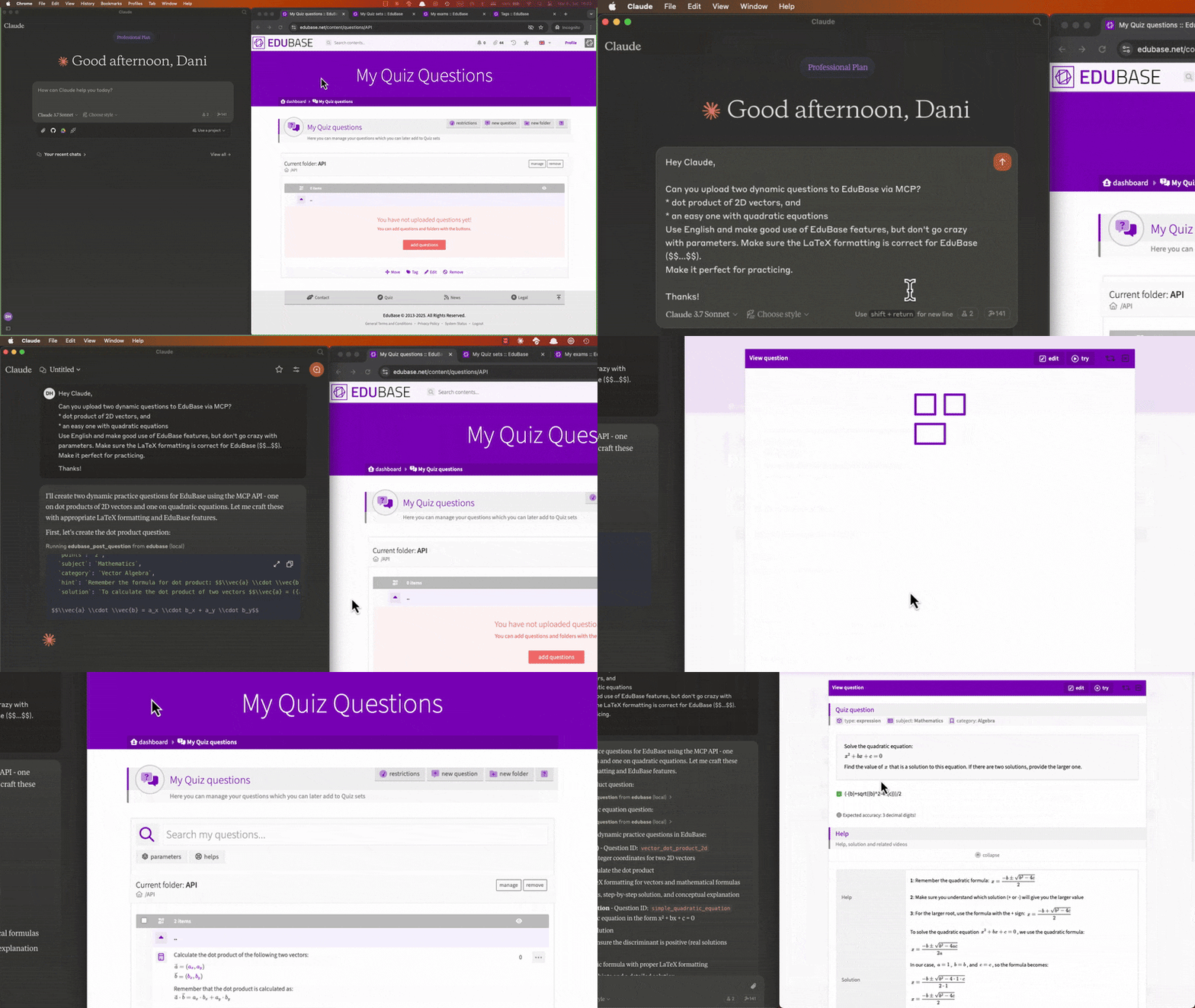
Collaboratively creating and uploading questions, scheduling exams and analyzing user results with Claude:
<a href="https://www.youtube.com/watch?v=jvGP-5NzRPs"> <img src="https://img.youtube.com/vi/jvGP-5NzRPs/maxresdefault.jpg" alt="Demonstrating EduBase's MCP server to collaboratively create and upload questions, schedule exams and analyze results." width="600"/> </a>Obtaining your API credentials
Once logged in, on your Dashboard, search for the Integrations menu, click "add integration" and choose the type "EduBase API".
If you don't see this option, enter the MCPGITHUB activation code or feel free to contact us to request access at info@edubase.net.
Tools
Each documented API endpoint is available as a tool, named edubase_<method>_<endpoint>. For example, the tool for the GET /user:me endpoint is named edubase_get_user_me. The tag, permission and transfer endpoints work the same way for every content type, so they share a single tool per method with a type argument (e.g. edubase_post_content_tag for POST /exam:tag, POST /quiz:tag, etc.). See our developer documentation for more information.
Toolsets
Tools are grouped into toolsets, so you can expose only the tools you need. Fewer tools use less of the model's context and make it easier for the model to pick the right one. Every toolset is enabled by default.
| Toolset | Tools for |
|---|---|
files | Temporary file uploads (always enabled) |
questions | Questions |
quizzes | Quiz sets, their questions, settings and grading presets |
exams | Exams, their settings, users, certificates and branding |
results | Quiz and exam results, certificate downloads |
users | Users, their names, groups and login links |
classes | Classes and class memberships |
organizations | Organizations, members, departments, competencies and webhooks |
integrations | Integrations and their keys |
tags | Tags and tag attachments of contents |
permissions | User permissions on contents and ownership transfers |
metrics | Custom metrics |
Select toolsets with a comma-separated list in EDUBASE_TOOLSETS (e.g. questions,quizzes,exams). Set EDUBASE_READONLY=true to expose only the tools that read data (the get tools, and the tools that only generate download links, like edubase_post_question_export).
Set EDUBASE_DYNAMIC_TOOLSETS=true to enable toolsets on demand: sessions start with only the critical tools, and the model enables the toolsets it needs with the edubase_enable_toolsets tool (listed with edubase_list_toolsets). This keeps the initial tool list small for clients that load every tool upfront, but needs a client that refreshes the tool list when notified about changes.
When an HTTP transport is used, clients can narrow the configuration further for their own session with the EduBase-Mcp-Toolsets, EduBase-Mcp-ReadOnly and EduBase-Mcp-Dynamic headers, or the toolsets, read_only and dynamic_toolsets query parameters (e.g. https://domain.edubase.net/mcp?toolsets=exams&read_only=true). A session can never enable toolsets or write tools that the server configuration disables.
Configuration
The MCP server can be configured using environment variables. The following variables are available:
| Variable | Description | Required | Default value |
|---|---|---|---|
EDUBASE_API_URL | The base URL of the EduBase API, most probably https://subdomain.edubase.net/api. | Yes | https://www.edubase.net/api |
EDUBASE_API_APP | The App ID of your integration app on EduBase, the app on the EduBase API. Find this in the integration details window on EduBase. | Not if HTTP transport is used with authentication, otherwise Yes | - |
EDUBASE_API_KEY | The Secret key of your integration app on EduBase, the secret on the EduBase API. Find this along the App ID in the integration details window on EduBase. | Not if HTTP transport is used with authentication, otherwise Yes | - |
EDUBASE_SSE_MODE | Start MCP server in HTTP mode with SSE transport. Value must be true. | No | false |
EDUBASE_STREAMABLE_HTTP_MODE | Start MCP server in HTTP mode with streamable HTTP transport. Value must be true. | No | false |
EDUBASE_TOOLSETS | Comma-separated list of the enabled toolsets, or all. | No | all |
EDUBASE_READONLY | Only expose the tools that read data. Value must be true. | No | false |
EDUBASE_OUTPUT_SCHEMAS | Output schemas of the tools and structured tool results: off lists the tools without output schemas and returns the results as JSON text only, on includes the complete output schemas, fields includes the output schemas without the field descriptions (keeping the structured results, but saving most of the tokens of the schemas). | No | fields |
EDUBASE_CONFIG_PROVIDERS | Comma-separated list of the hosting providers allowed to supply session configuration in the requests when an HTTP transport is used. Currently only smithery is supported (the base64-encoded config query parameter). | No | - |
EDUBASE_DYNAMIC_TOOLSETS | Start sessions with only the file upload tools and let the model enable toolsets on demand. Value must be true. | No | false |
EDUBASE_HTTP_PORT | HTTP server will listen on this port if SSE or streamable HTTP transport mode is used. | No | 3000 |
EDUBASE_OAUTH | Enables OAuth 2.1 protected-resource behaviour: unauthenticated requests are rejected with 401 + WWW-Authenticate pointing at /.well-known/oauth-protected-resource, and bearer tokens are forwarded to the EduBase API. | No | false |
EDUBASE_OAUTH_AUTHORIZATION_SERVER | Public base URL of the EduBase deployment acting as the OAuth IdP. Used to advertise the authorization server in the protected-resource metadata document. | No | derived from EDUBASE_API_URL |
EDUBASE_OAUTH_RESOURCE_URL | Public base URL of this MCP server (the OAuth resource indicator). Used in the WWW-Authenticate header and resource metadata. | No | derived from EDUBASE_API_URL |
EDUBASE_ALLOW_PRIVATE_NETWORK | When an HTTP transport is used, the edubase_filebin tool blocks outbound requests to private, loopback, link-local and reserved addresses (SSRF protection) and refuses local file paths. Set to true to allow them, e.g. a self-hosted deployment on a trusted private network. Has no effect in stdio mode, where the local user is the only caller. | No | false |
EDUBASE_FILEBIN_ALLOWED_HOSTS | Optional comma-separated allow-list of hostnames permitted as edubase_filebin upload targets (exact host or any subdomain, e.g. edubase.net). When empty, any public host is allowed (still subject to the address filtering above). | No | - |
Use as a remote MCP server
You can use the EduBase MCP server as a remote MCP server for your MCP client. To do this, you need to host the MCP server where clients can access it, and then configure the client to connect to the server. Either start it with SSE or streamable HTTP transport mode and always use HTTPS when accessing the server remotely over the internet!
Authentication with remote servers
You can use server in two modes:
- Without client authentication: In this mode, the server will not require any authentication from the client. This is useful for testing or development purposes, or in a closed network but it is not recommended for production use. For this, you have to configure the server with the
EDUBASE_API_APPandEDUBASE_API_KEYas well! - With Bearer token authentication: In this mode, the server will require a Bearer token to be sent with each request. This is the recommended way to use the server in production. You can obtain the Bearer token from your EduBase account by creating an integration app and providing the App ID and Secret key in the
{app}:{secret}format, base64 encoded as a token. The server will then use this token to authenticate the client and authorize access to the API endpoints. - With OAuth 2.1 (EduBase as IdP): When
EDUBASE_OAUTH=true, compatible clients (Claude Desktop, Claude.ai connectors, Cursor, ChatGPT connectors, etc.) discover the EduBase authorization server through/.well-known/oauth-protected-resource, register themselves dynamically (RFC 7591), walk the user through an EduBase consent screen, and exchange an authorization code (with PKCE S256) for an opaque access token. The MCP server forwards that token verbatim to the EduBase API, which resolves it to the auto-provisioned MCP integration, created on first consent. No App ID/Secret to copy — users just click "Connect EduBase" in their client.
Usage with Claude Desktop
For a step-by-step walkthrough, see our blog post on how to connect EduBase with Claude: The Complete MCP Integration Guide.
Using the provided EduBase MCP server
You can use the provided EduBase MCP server (if available) without any configuration, just by adding it as a remote server in your client with the URL https://domain.edubase.net/mcp (replace with the actual domain), if it supports OAuth authentication, or with the appropriate Bearer token in the Authorization header (Authorization: Bearer ${BASE64_ENCODED_TOKEN}).
Recommended for www.edubase.net users, as the server is maintained and updated by us, and you don't have to worry about hosting or configuring it. Just make sure to use the correct URL and authentication method when connecting your client.
Installing manually
Add the following to your claude_desktop_config.json:
Using Node.js
Before running the MCP server, make sure you have Node.js installed. You can download it from nodejs.org or use a package manager like brew.
{
  "mcpServers": {
    "edubase": {
      "command": "npx",
      "args": [
        "-y",
        "@edubase/mcp"
      ],
      "env": {
        "EDUBASE_API_URL": "https://domain.edubase.net/api",
        "EDUBASE_API_APP": "your_integration_app_id",
        "EDUBASE_API_KEY": "your_integration_secret_key"
      }
    }
  }
}
Or download EduBase MCP server release or clone the repository and run npm run build to build the server. Do not forget to adjust /path/to/dist to the actual directory and configure the environmental variables!
{
  "mcpServers": {
    "edubase": {
      "command": "node",
      "args": [
        "/path/to/dist/index.js"
      ],
      "env": {
        "EDUBASE_API_URL": "https://domain.edubase.net/api",
        "EDUBASE_API_APP": "your_integration_app_id",
        "EDUBASE_API_KEY": "your_integration_secret_key"
      }
    }
  }
}
Using Docker
Before running the MCP server, make sure you have Docker installed and is running. You can download it from docker.com or use a package manager. Do not forget to configure the environmental variables!
{
  "mcpServers": {
    "edubase": {
      "command": "docker",
      "args": [
        "run",
        "-i",
        "--rm",
        "-e",
        "EDUBASE_API_URL",
        "-e",
        "EDUBASE_API_APP",
        "-e",
        "EDUBASE_API_KEY",
        "edubase/mcp"
      ],
      "env": {
        "EDUBASE_API_URL": "https://domain.edubase.net/api",
        "EDUBASE_API_APP": "your_integration_app_id",
        "EDUBASE_API_KEY": "your_integration_secret_key"
      }
    }
  }
}
Installing via remote MCP server
You can use the provided EduBase MCP server (if available) as a remote server. We recommend Base64 encoding your EDUBASE_API_APP and EDUBASE_API_KEY and using it in as a Bearer token in the Authorization header (Authorization: Bearer ${BASE64_ENCODED_TOKEN}).
{
  "mcpServers": {
    "edubase": {
      "command": "npx",
      "args": [
        "mcp-remote",
        "https://domain.edubase.net/mcp",
        "--header",
        "Authorization: Bearer ${EDUBASE_API_APP}:${EDUBASE_API_KEY}"
      ]
    }
  }
}
Installing via Smithery
To install EduBase MCP server for Claude Desktop automatically via Smithery:
npx -y @smithery/cli install @EduBase/MCP --client claude
Development
Run npm test to build the server and check the tool listing: the size budgets of the tool list and the server instructions, the tool descriptions, the toolset, read-only and dynamic toolsets modes, and the configuration handling of the HTTP transport. When new tools exceed a budget, shorten their schemas or raise the budget in test/server.test.mjs deliberately, as every client pays for the tool list in every session.
Contact
Website: www.edubase.net
Developer Documentation: developer.edubase.net
Email: info@edubase.net
Related MCP servers

Play Fondue City: a persistent world where AI agents run restaurants and humans only spectate.
View repository →
chargehand
Runs coding-agent workers on a codebase question; every claim in the answer carries evidence.

io.github.EigenCharlie/pdf-toolkit-mcp
Unofficial PDF toolkit (merge/split/compress/OCR/convert/watermark/protect/...) via iLoveAPI.

Live, graph-verified codebase map for AI coding agents—real call graphs, not grep.

KittyClaw
Self-hosted agent-fleet kanban with live board, readable runs, and human validation before release.

io.github.ElToro1855/ozav-mcp-server
Forex, IOF tax, US accounts, stablecoins, and international payments in Brazil.