u-he Preset Randomizer MCP Server
io.github.Fannon/u-he-preset-randomizer
Generate, randomize, and manage u-he synthesizer presets via AI conversation or CLI.
What is the u-he Preset Randomizer MCP server?
The u-he Preset Randomizer MCP server lets you generate, randomize, and merge u-he synthesizer presets through natural language instructions in Claude or other AI assistants. It analyzes your existing preset library to create new presets based on real parameter distributions, supporting three modes: fully random generation, randomization of existing presets, and merging multiple presets together.
This tool generates creative new presets for u-he synthesizers (Diva, Repro, Zebra, etc.) by analyzing your preset library and creating variations through randomization and merging. Use it to explore new sound design possibilities, create preset variations, or generate inspiration when you're stuck. The MCP server interface lets you interact conversationally with Claude to search presets, generate variations, and manage your sound library without leaving your AI assistant.
How to install u-he Preset Randomizer
Copy-paste configuration for popular MCP clients.
UHE_CUSTOM_FOLDEROptional override for preset root discovery when synths are stored outside default locations.
DEBUGEnable verbose logging for troubleshooting.
Tools & capabilities
Tools this server exposes to the agent.
Search and browse presets— Search and browse your u-he preset libraries conversationally by synth, folder, category, author, or favorites.Generate random presets— Generate fully random presets based on statistical distributions from your existing preset library.Randomize existing presets— Create variations of existing presets with customizable randomness percentage (0-100).Merge presets— Combine multiple presets together with random ratios to create hybrid sounds.Get preset explanations— Receive detailed explanations of what makes presets unique and their characteristics.Stateful session management— Select a synth once and explore presets freely without re-selecting.
Use cases
- Generate 5 variations of a bass preset with 30% randomness to explore similar sound design directions
- Merge your favorite pad presets to create hybrid sounds combining their characteristics
- Search for all 'bass' presets in Diva and get explanations of what makes them unique
- Create 10 fully random Repro presets based on your existing library's parameter distributions
- Browse presets by category or author to understand your sound design patterns
u-he Preset Randomizer MCP server FAQ
It's an MCP server that lets you generate, randomize, and merge u-he synthesizer presets through natural conversation with Claude. It analyzes your actual preset library to create new presets based on real parameter distributions.
It works with all u-he synths on all platforms. Simpler synths like Diva and Repro work best; more modular synths like Zebra and Bazille work but may produce more varied results.
Add the server to your Claude Desktop config at ~/Library/Application Support/Claude/claude_desktop_config.json with the command 'u-he-mcp-server', then restart Claude.
Yes, the u-he Preset Randomizer is open-source and free to use. It requires Node.js to be installed on your system.
No authentication is required. The tool works directly with your local u-he preset files and doesn't require any external services or API keys.
Generated presets are saved to your u-he synth's preset directory under a '/RANDOM' folder in your user presets, ready to load in your DAW.
README (reference)
Source of truth, from the repository.
u-he-preset-randomizer
Generate u-he synth presets through randomization and merging of your existing presets (genetics like).
This tool can generate random presets in three different modes:
- Generate fully random presets based on real values and value distributions in your preset library
- Randomize existing presets, with a customizable amount of randomness
- Merge multiple presets together, with randomness introduced by different ratios between them.
The randomization / merging approach is very generic as it analyzes your actual preset library and bases the random values on the resulting statistical distributions.
There are optional flags / modes that that affect the randomization:
- Narrow down the analyzed presets that are the basis for random generation.
- E.g. by only using a sub-folder, a certain tag category, author or a favorite file export.
- This will influence / limit the range of values in the generated presets.
- Use
stablemode for more reliable, but slightly less random results - Use
binarymode, see--binaryCLI arguments documentation.
It should work for all u-he synths on all platforms. Some synths may work better, due to their simpler architecture (e.g. u-he Diva, Repro). More modular synths like Bazille or Zebra also work, but you'll get more "varied" results or broken presets.
How to use
This is a CLI application that you need to run in your terminal / command line.
First you need to install the Node.js runtime.
Then you can open your Terminal / Console / Command Prompt and start it by entering a command, optionally with some arguments.
They start with npx u-he-preset-randomizer@latest, which will download and run the latest version of this tool:
npx u-he-preset-randomizer@latest
This will start the tool in interactive mode. It will guide you though the necessary choices. Alternatively, you can pass some arguments if you already know the choices (non interactive).
The generated patches will be put into your selected synth preset directory, under a /RANDOM folder in your user presets.
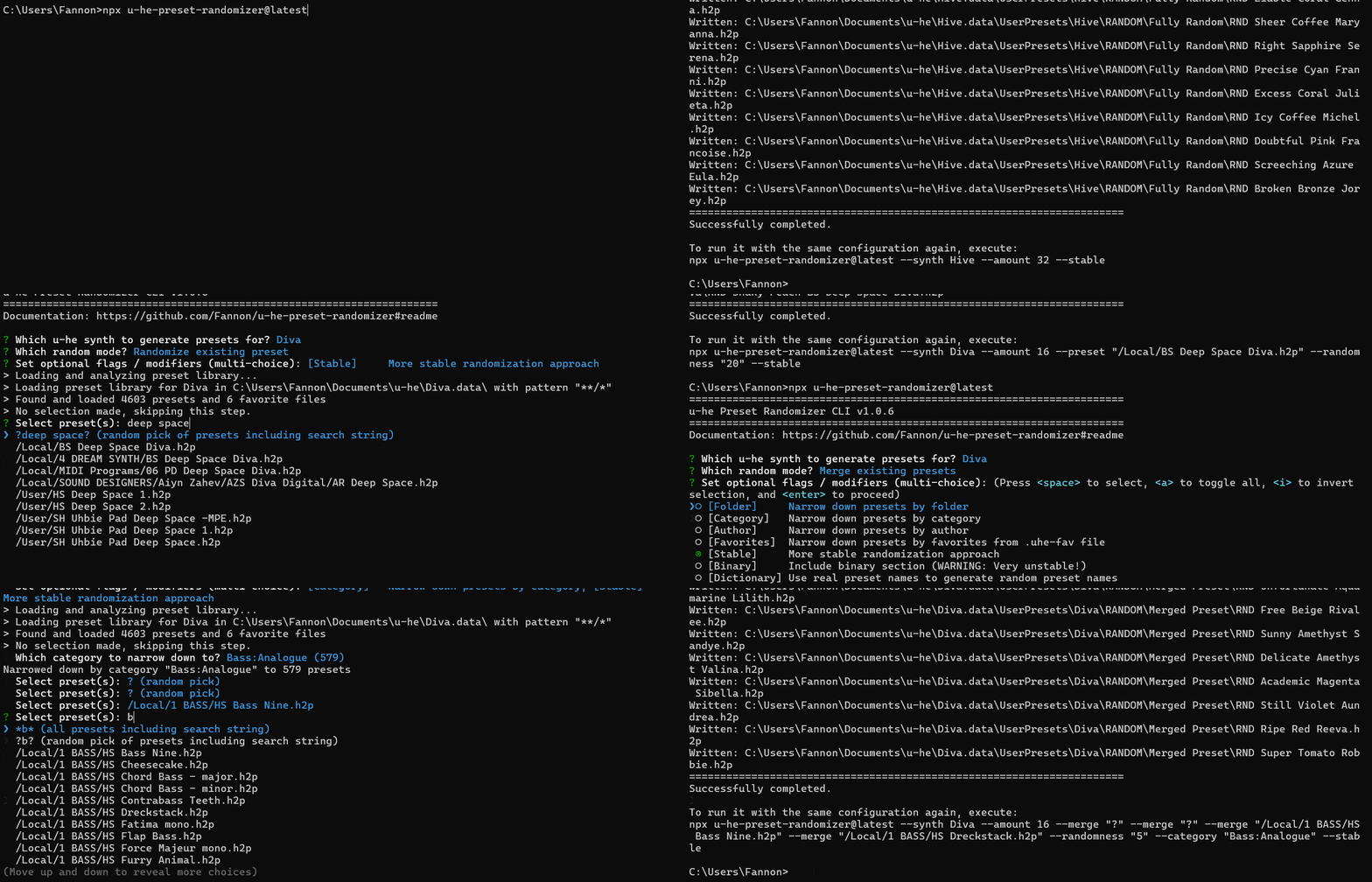
If you want to download the tool for offline use and manual updates:
# install it as a global CLI tool
npm i -g u-he-preset-randomizer

# Now you can run it without npx:
u-he-preset-randomizer
MCP Server Interface
In addition to the CLI, this tool provides a Model Context Protocol (MCP) server that allows AI assistants like Claude to interact with your u-he presets through natural conversation.
Features:
- 🔍 Search and browse your preset libraries conversationally
- 📝 Get detailed explanations of what makes presets unique
- 🎲 Generate random presets with natural language instructions
- 🔄 Create variations and merge presets through AI-assisted workflows
- 💾 Stateful sessions - select a synth once, then explore freely
Quick Setup for Claude Desktop:
Add this to your Claude Desktop config (~/Library/Application Support/Claude/claude_desktop_config.json on macOS):
{
  "mcpServers": {
    "u-he-preset-randomizer": {
      "command": "u-he-mcp-server"
    }
  }
}
Then you can ask Claude things like:
- "What synths do I have installed?"
- "Show me bass presets from Diva"
- "Create 5 variations of the '303 Bass' preset with 30% randomness"
- "Merge my favorite pad presets to create hybrid sounds"
📚 Read the full MCP Server documentation →
CLI Usage Examples
Generate Fully Randomized Presets
This command will run the randomizer to generate 3 fully randomized Diva presets. Random values will be based on real values (and their distribution) of your actual presets.
npx u-he-preset-randomizer@latest --synth Diva --amount 3
Randomize a particular Preset
This command will take one particular preset "HS Greek Horn" and create 5 random variations of it, with a 20% randomization ratio.
npx u-he-preset-randomizer@latest --synth Diva --amount 5 --preset "HS Greek Horn" --randomness 20
Merge multiple Presets together
This command will merge multiple presets together, with a random ratio on how much weight each one has in the "inheritance".
The following example will take three Diva presets (each indicated with --merge) and create 5 merged variants out of them.
npx u-he-preset-randomizer@latest --synth Diva --amount 5 --merge "HS Greek Horn" --merge "HS Strumpet" --merge "HS Baroqualog"
Tips & Tricks
- The u-he preset browser have the most flexibility in filtering and combining presets by category, tags, etc. You can use this to either copy them to a new folder or create a .uhe-fav file export and using this as narrow down selection in the CLI
- When merging presets, it's possible to select the same preset multiple times. Use this to assign "weights" between how strong a preset will influence the outcome.
CLI Arguments / Configuration
If you're unsure which values are correct to use, run the tool in interactive mode. Most config options here will be available with auto-complete or suggestions.
--synth: Choose the u-he synth. Not all synths have been tested, but the randomizer tries to be generic. The name must match the folder name convention of u-he. E.g.Diva,Hive,ZebraHZ.--amount: How many presets to generate. Positive integer number.--randomness: Amount of randomness (in percentage) to apply, when randomizing existing presets or resulting merged presets. Value needs to be between 0 and 100.--preset: If given, an existing preset will be used as a based and randomized by--randomnessratio.- Use "?" to choose random preset
- Use
?search string?to choose a random preset containing "search string" in its path and file name.
--merge: Can be provided multiple times, for each preset that should be part of the merging. Ratio between merged presets is random and NOT driven by the--randomnessparameter.- Use
?to choose random preset - Use
?search string?to choose a random preset containing "search string" in its path and file name. - Use
*to select all presets (careful! Better first reduce via--pattern.) - Use
*search string*to select all presets containing "search string" in its path and file name.
- Use
--pattern: Define a glob pattern, which presets should be loaded.- By default, it's
**/*which will load all presets from all sub-folders. - To select a subfolder, use e.g.
My Folder/**/* - To select presets starting with something, use e.g.
**/PD *
- By default, it's
--folder: narrow down presets by folder. Use/Local/or/User/as starting point.--category: narrow down presets by preset category (metadata)--author: narrow down presets by preset author (metadata)--favorites: narrow down presets by selection fia.uhe-favfile. The files must be located somewhere within your preset library.--stable: Uses more stable randomization approach- For fully random presets, it will randomize not per parameter, but per section (e.g. the entire OSC1 together)
- Only parameters with numeric non-binary assignments will be further randomized. Otherwise they stay consistent with the chosen base preset or a random starter preset.
--binary: Keep the binary part of the u-he presets. They will not be changed, but randomly generated presets will now include the binary section of either a random preset or the base preset that is randomized.- This contains advanced settings like MSEG curves, but this tool cannot really parse or modify it. Not every binary section seems to be compatible with other parameter adjustment, leading to invalid presets.
- ⚠ Using binary mode may lead to broken presets that may crash your synth plugin when loading. Use with care. For some synths this works better (Repro, Diva, Zebralette 3) and for some it frequently leads to invalid presets.
--binary-template: Uses curated binary section templates instead of random library presets. This is enabled by default for Zebralette 3.- Templates are stored in
src/templates/{synthName}/and are prefixed with a weight (e.g.,15-Basic Shapes.h2phas weight 15, making it 15x more likely to be selected than a01-prefixed template). - This approach is safer than
--binaryas the templates are tested to work well with randomized parameters.
- Templates are stored in
--dictionary: Creates random names from a dictionary of names used in the preset library--custom-folder: In case the installation folder is custom, it can be given here- E.g.
--custom-folder "C:/Audio/Plugin Installationen/u-he/"
- E.g.
--debug: Enables some optional debug logging and file exporting
Soundsets
| Cover | Links | Description |
|---|---|---|
| <img src="https://github.com/Fannon/u-he-preset-randomizer/assets/470980/afcf03b9-f2c1-4f60-bfae-f341c4fdb24c" alt="Diva Generated Vol. 1" width="256"/> | Diva Generated Vol. 1 (ZIP), Audio Demo (YouTube) | 50 randomly generated presets for u-he Diva, curated, modified and tagged by Simon Heimler in 2024. |
| <img src="./soundsets/Repro-5 Generated/Repro-5 Generated Cover.png" alt="Repro-5 Generated " width="256"/> | Repro-5 Generated (ZIP), Audio Demo (YouTube) | 42 randomly generated presets for u-he Repro, curated, modified and tagged by Simon Heimler in 2024. |
| <img src="./soundsets/Repro-1 Generated Vol. 1/Repro-1 Generated Vol. 1.png" alt="Repro-1 Generated Vol. 1" width="256"/> | Repro-1 Generated Vol. 1 (ZIP), | 28 randomly generated presets for u-he Repro, curated, modified and tagged by Simon Heimler in 2024. |
Developer Guide
To run this tool locally in developer mode, you need Node.js and Bun installed. Check out the repo and:
npm i
npm run build

# Run the CLI in development mode (using Bun):
bun run dev --synth Diva --amount 3

# Run tests:
bun test

# Maintenance scripts
npm run clean      # remove dist output and incremental build cache
npm run build:dist # emit declarations + source maps for npm publish (runs automatically via prepublishOnly)
The AGENTS.md provides more context how the project works from development perspective.
I've also exposed the u-he preset parser / serializer functions in the NPM module, so they could be used programmatically by other projects. However, you might inherit more dependencies than necessary if you're just interested in the parser. See ./src/parser.ts.
Help / Feedback
Please use the related KVR Thread or create a GitHub issue.
Related MCP servers

Glass-box statistical analysis for agents: 19 methods, cited findings, measured error rates.

Arsenal Decision Engine
R_net LP risk evaluator for DeFAI agents. IL + Breakeven Corridor O(1). L402 Lightning paywall.

web3ctx
Version-true web3 docs, ABIs and human-validated integration recipes over MCP.

4,372 pre-production checks: security, performance, scale, integrations, post-launch.
View repository →
Security-first MCP server for PostgreSQL, SQLite, MySQL, DuckDB with SQL injection prevention.

io.github.FastAlertNow/mcp-server
Official MCP server for FastAlert, providing tools to list channels and send notifications.