Cloud FinOps Skill & MCP MCP Server
io.github.OptimNow/cloud-finops
FinOps knowledge and MCP server for AI agents: AWS/Azure/GCP/OCI cost optimization, AI spend management, and waste detection playbooks.
What is the Cloud FinOps Skill & MCP MCP server?
The Cloud FinOps Skill & MCP is an open-source FinOps knowledge base and MCP server that equips AI agents with verified cloud cost optimization expertise across AWS, Azure, GCP, and OCI. It covers cloud cost management, AI/GenAI economics, infrastructure optimization, and named-pattern waste detection playbooks grounded in enterprise delivery experience. Available as both a skill (pushed into model context) and an MCP server (fetched on demand).
This server provides FinOps practitioners, cloud engineers, and AI-assisted cost analysis teams with structured, verified knowledge on cloud cost optimization, AI platform billing, data platform economics, and waste detection. Rather than relying on general-purpose LLM knowledge (which often contains billing errors), it injects curated FinOps doctrine covering the FinOps Framework, commitment strategy, allocation, chargeback, anomaly management, and provider-specific mechanics for AWS, Azure, GCP, and OCI. It includes interactive playbooks for detecting and addressing specific waste patterns.
How to install Cloud FinOps Skill & MCP
Copy-paste configuration for popular MCP clients.
Tools & capabilities
Tools this server exposes to the agent.
Waste Pattern Lookup— Search and retrieve named-pattern waste detection runbooks across AWS, Azure, GCP, and cross-cloud scenarios with detection queries and remediation steps.FinOps Framework Reference— Query the 22 FinOps Framework capabilities and retrieve reference documentation on commitment strategy, allocation, chargeback, and maturity models.AI & GenAI Economics— Access guidance on inference economics, unit economics, ROI, agentic FinOps, AI platform billing (Anthropic, AWS Bedrock, Azure OpenAI, GCP Vertex), and AI coding tool cost management.Cloud Provider Mechanics— Retrieve billing mechanics and optimization guidance specific to AWS (CUR, Savings Plans, RIs), Azure (Cost Management, Reservations, PTUs), GCP (CUDs, BigQuery), and OCI.Data Platform Economics— Query cost optimization and allocation guidance for Databricks (DBU/DBCU), Microsoft Fabric (F-SKUs), and Snowflake (warehouse governance).Playbook Discovery— Browse and search the full catalogue of waste-pattern runbooks, reference files, and FinOps doctrine organized by domain and provider.
Use cases
- Identify and remediate cloud waste patterns using named-pattern detection runbooks tailored to your provider (AWS, Azure, GCP, OCI).
- Calculate AI inference economics and unit costs for GenAI workloads, including Anthropic, Bedrock, Azure OpenAI, and open-weight model APIs.
- Design and implement cloud cost allocation, showback, and chargeback models aligned with the FinOps Framework and FOCUS standards.
- Optimize commitment purchasing strategy (Savings Plans, Reserved Instances, Compute Unit Discounts) with provider-specific mechanics and break-even analysis.
- Assess and improve FinOps maturity across your organization using the 22-capability FinOps Framework with contextual guidance for your vertical.
Cloud FinOps Skill & MCP MCP server FAQ
It is an open-source FinOps knowledge base available as both a skill (pushed into AI model context) and an MCP server (fetched on demand). It provides verified, curated guidance on cloud cost optimization, AI/GenAI economics, and waste detection across AWS, Azure, GCP, and OCI—correcting the confident but incorrect statements general-purpose LLMs often make about billing mechanics.
Yes. The skill and MCP server are open-source under CC BY-SA 4.0 license. The hosted MCP connector (cloud-finops-mcp.fly.dev) and OptimToken pricing hub are offered at no cost. Live pricing data comes from OptimToken (optimtoken.optimnow.io), which is also free to use.
For Claude Code: `/plugin marketplace add https://github.com/OptimNow/cloud-finops-skills.git` then `/plugin install cloud-finops@optimnow`. For Claude.ai/Desktop: download the latest release zip and upload via Settings > Skills > Upload zip. For Cursor and other editors: run `curl -sL https://raw.githubusercontent.com/OptimNow/cloud-finops-skills/main/install.sh | bash` or use the PyPI package `pip install cloud-finops-mcp` and add to your MCP client config.
No. The skill and MCP server are read-only and contain no code execution. They cannot see your cloud account. For questions like 'which of my RIs are expiring?', the server provides the detection query you run yourself against your own data exports or billing systems.
AWS (CUR, Savings Plans, RIs, SageMaker), Azure (Cost Management, Reservations, PTUs), GCP (CUDs, BigQuery), and OCI. It also covers data platforms (Databricks, Microsoft Fabric, Snowflake), AI platforms (Anthropic, AWS Bedrock, Azure OpenAI, GCP Vertex), and cross-cloud themes like Kubernetes, allocation, and chargeback.
No. The skill deliberately omits volatile price figures, which go stale within weeks. It covers durable billing mechanics instead. For current prices across 250+ models and compute instances, use the companion OptimToken connector (optimtoken.optimnow.io or the hosted MCP at https://ai-pricing-hub-mcp-9604f763.alpic.live/).
README (reference)
Source of truth, from the repository.
Cloud FinOps Skill & MCP
Open-source FinOps knowledge skill and MCP server for AI agents - Claude, ChatGPT, Gemini, Cursor, and any MCP-compatible client. Cloud cost optimisation across AWS, Azure, GCP and OCI, AI cost management and inference economics, Kubernetes, data platforms, allocation, chargeback, anomaly management, and named-pattern waste detection playbooks. Built by OptimNow, grounded in enterprise delivery experience.







Install in 5 seconds
| Tool | One-step install |
|---|---|
| <img src="https://img.shields.io/badge/-Claude%20Code-D97757?logo=anthropic&logoColor=white" alt="Claude Code" height="22"/> | At the Claude Code prompt: /plugin marketplace add https://github.com/OptimNow/cloud-finops-skills.git then /plugin install cloud-finops@optimnow. The plugin is the skill only; for the six retrieval tools, add the hosted MCP connector separately (row below) |
| <img src="https://img.shields.io/badge/-Claude.ai%20%2F%20Desktop-D97757?logo=anthropic&logoColor=white" alt="Claude.ai / Claude Desktop" height="22"/> | Download the latest release zip, then Settings -> Skills -> Upload zip |
| <img src="https://img.shields.io/badge/-ChatGPT-10A37F?logo=openai&logoColor=white" alt="ChatGPT" height="22"/> | Self-host: ./install.sh --tool chatgpt --grouped (a public Cloud FinOps GPT is on the Roadmap) |
| <img src="https://img.shields.io/badge/-Gemini-4285F4?logo=googlegemini&logoColor=white" alt="Gemini" height="22"/> | Self-host: ./install.sh --tool gemini (a public Cloud FinOps Gem is on the Roadmap) |
| <img src="https://img.shields.io/badge/-Cursor-000000?logo=cursor&logoColor=white" alt="Cursor" height="22"/> <img src="https://img.shields.io/badge/-Windsurf-3DDC91?logoColor=white" alt="Windsurf" height="22"/> <img src="https://img.shields.io/badge/-Codex-412991?logo=openai&logoColor=white" alt="Codex" height="22"/> <img src="https://img.shields.io/badge/-Aider-0F172A?logoColor=white" alt="Aider" height="22"/> <img src="https://img.shields.io/badge/-Copilot-181717?logo=githubcopilot&logoColor=white" alt="Copilot" height="22"/> <img src="https://img.shields.io/badge/-Kiro%20IDE-FF6F00?logoColor=white" alt="Kiro IDE" height="22"/> <img src="https://img.shields.io/badge/-Gemini%20CLI-4285F4?logo=googlegemini&logoColor=white" alt="Gemini CLI" height="22"/> | One-liner: curl -sL https://raw.githubusercontent.com/OptimNow/cloud-finops-skills/main/install.sh | bash -s -- --tool <name> |
| <img src="https://img.shields.io/badge/-Auto--detect-555555?logo=gnubash&logoColor=white" alt="Auto-detect" height="22"/> | curl -sL https://raw.githubusercontent.com/OptimNow/cloud-finops-skills/main/install.sh | bash |
| <img src="https://img.shields.io/badge/-MCP%20hosted-7C3AED?logoColor=white" alt="MCP hosted" height="22"/> | Nothing to install: claude mcp add --transport http cloud-finops https://mcp.optimnow.io/mcp. For Claude.ai / Desktop, Settings -> Connectors -> Add custom connector with exactly that URL (exactly that form, /mcp with no trailing slash - the widget sandbox domain is derived from it) |
| <img src="https://img.shields.io/badge/-MCP%20package-7C3AED?logoColor=white" alt="MCP package" height="22"/> | pip install cloud-finops-mcp then add to your MCP client config (Claude Code / Cursor / Codex / Windsurf / Cline). Snippets: ./install.sh --tool mcp |
Full options, troubleshooting, and the model-agnostic API loader: see
INSTALLATION.md. A version-tagged zip
(cloud-finops-vX.Y.Z.zip) is attached to every
GitHub release.
What is a Skill? What is an MCP server?
A Skill is a structured knowledge folder you attach to an AI agent. Without it, general-purpose LLMs make confident but incorrect statements on FinOps topics - they miscalculate PTU break-even rates, confuse Azure and AWS reservation mechanics, and give advice that ignores how billing actually works. The answers sound plausible; they are wrong on the details that matter. The skill corrects that by injecting verified, curated FinOps knowledge directly into the model's context. The closest analogy is RAG, minus the infrastructure: no vector database, no embedding pipeline - you copy a folder and the model gains structured expertise. The same files work with Claude, GPT, Gemini, or any other model.
An MCP server (MCP: Model Context Protocol, the open standard that lets an AI client call external tools at run time) exposes the same library the other way round - as read-only tools the model queries on demand. Actual retrieval: one URL to paste, nothing to install.
Who this is for: FinOps practitioners building or evaluating AI-assisted cost analysis, cloud engineers who want a cost-aware assistant in their workflow, developers building internal FinOps agents, and Finance / IT managers evaluating the AI tooling their teams deploy. If you can copy a folder and follow the installation steps, you can use this.
Skill + installer, or MCP?
Same content, two delivery shapes - and they behave differently, because of how models use them (field-tested with the same battery of practitioner questions through both):
- Pushed into context - as a native skill (Claude Code, Claude.ai / Desktop, Kiro),
or as rules files written by
install.shfor tools without skill support (Cursor, Windsurf, Codex, Aider, Copilot, Gemini). The guidance is already there when the model reasons, with no per-question decision to make - which is why this surface grounds both advisory answers (commitment sizing, chargeback design, allocation methodology) and symptom questions ("my NAT gateway processes 10TB/month to S3"), where the measured probe runs show it handing over the matching runbook first try. - Fetched on demand - the MCP server. The model must decide to call a tool per question, and that decision is this surface's real limit. Measured behaviour (August 2026 probe cycles): lookup and discovery questions ("show me the idle waste runbooks") route reliably; advisory and specific-symptom questions route since the tool descriptions carry imperative routing rules, though not on every phrasing. Its strengths: distribution (paste one URL - the right path for non-technical users and for hosts with neither skill support nor an installer target), faceted queries over the library's metadata, and interactive widgets on hosts that render MCP Apps.
- Both is legitimate. Skill loaded for the doctrine, connector added for the widgets or for hosts where the skill is not loaded. Details on the six tools: MCP server below.
What to expect in practice, on either surface. Neither the skill nor the server can see your cloud account. For "which of my X" questions ("which of my RIs are about to expire?") the deliverable is the playbook's detection query, which you run yourself - and the measured behaviour is that models tend to ask you for a data export instead of volunteering that runbook. The reliable way to get it is to ask explicitly: "check the playbook library" or "show me the runbook for this". Routing is also probabilistic, not guaranteed - the same question phrased two ways can ground differently - so when an answer arrives without a visible tool call or file read, asking for the library by name is the one-turn fix.
Using a non-Claude model through an API? Add the response contract from INSTALLATION.md ("API integration / Recommended response contract") to your system prompt so answers stay structured and billing-grounded.
Plugin and connector
The Claude plugin built from this repository contains text files only: the skill
instructions in SKILL.md, the reference files and the playbooks. It runs no code,
declares no MCP server and sends no data anywhere. Installing it puts FinOps
knowledge into the model's context, and nothing else.
The hosted MCP connector is optional and is installed separately: as a custom
connector in Claude.ai or Claude Desktop, or with claude mcp add in Claude Code
(the "MCP hosted" row in the install table above). It serves the same library
through six read-only tools and, on hosts that render MCP Apps, as interactive
views. It is offered separately, as an MCP connector, not as part of the plugin,
on purpose: the two carry the same content, and a plugin that also declared the
server would load the tool definitions in every session next to the skill and put
the same library into context twice. Use the plugin when you want the doctrine
loaded up front, the connector when you want on-demand retrieval or the views, and
both only when you want both.
Live prices come from OptimToken, not from this repo
This skill carries billing mechanics, which stay true for years. It deliberately does not carry current price figures, which go stale inside a packaged skill within weeks. Those live in OptimToken - LLM token rates for 250+ models and compute instance rates across seven clouds, each figure carrying its own as-of date:
| <img src="https://img.shields.io/badge/-OptimToken%20web-7C3AED?logoColor=white" alt="OptimToken web" height="22"/> | optimtoken.optimnow.io - compare model and instance prices in the browser, no setup |
| <img src="https://img.shields.io/badge/-OptimToken%20MCP-7C3AED?logoColor=white" alt="OptimToken MCP" height="22"/> | Hosted, nothing to install. Point your client at https://ai-pricing-hub-mcp-9604f763.alpic.live/ - config snippets in INSTALLATION.md |
Recommended setup on Claude: install the skill and add the OptimToken connector next to it. The skill carries the doctrine and routes pricing questions to the hub, so they get answered with a dated figure and its source rather than from a number the model remembers.
What this skill covers
| Domain family | What is covered |
|---|---|
| AI & GenAI economics | FinOps for AI (inference economics, unit economics, ROI), agentic FinOps (agent cost anatomy, x402 / MPP), AI value management (Investment Council, stage gates), GenAI capacity planning (provisioned vs shared, spillover), self-hosted vs managed inference, open-weight vendor APIs (DeepSeek, Qwen, Kimi, GLM), AI coding tools (Cursor, Claude Code, Copilot, Windsurf, Codex) |
| AI platform billing | Anthropic (Fast mode, long-context cliffs, prompt caching), AWS Bedrock, Azure OpenAI Service (PTUs, spillover), GCP Vertex AI |
| Cloud providers | AWS (CUR / Data Exports, rightsizing, SageMaker, Savings Plans / RIs / EDP, billing hierarchy and separate invoices per business unit, pattern catalogue), Azure (Cost Management, Reservations, AHB, EA-to-MCA, pattern catalogue), GCP (CUDs, BigQuery), OCI |
| Data platforms | Databricks (DBU / DBCU, allocation), Microsoft Fabric (F-SKUs, CU smoothing), Snowflake (warehouses, Cortex governance) |
| FinOps disciplines | The FinOps Framework (22 capabilities, maturity model), tagging governance, allocation and showback (FOCUS), chargeback (Finance / tax prerequisites), anomaly management, KPIs and benchmarking, workload onboarding and M&A, Kubernetes (EKS / GKE / AKS) |
| SaaS & licensing | SaaS asset management (SMPs, shadow IT, renewals), ITAM collaboration (BYOL, marketplace governance, entitlements) |
| GreenOps | Cloud carbon measurement, carbon-aware workloads, region selection, GHG Protocol reporting |
| Waste detection | OptimNow's eight-category waste taxonomy, two-signal classification, three-tier confidence, WasteLine appliance for AWS - plus named-pattern runbooks across AWS, Azure, GCP and cross-cloud (full catalogue in playbooks/README.md) |
The per-file catalogue with routing lives in SKILL.md - one row per reference, one row per playbook family.
Coverage, published deliberately
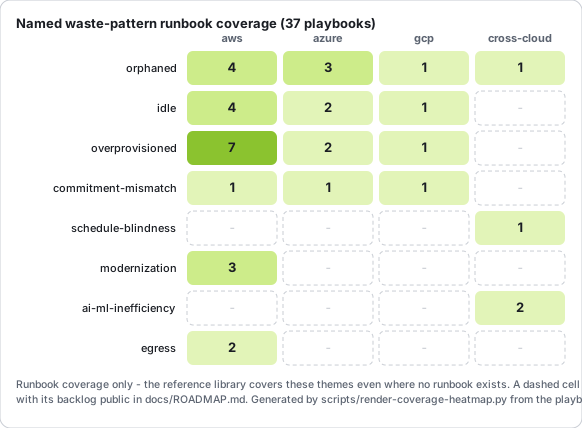
Coverage has two structural surfaces, answering different questions. The first is the named waste-pattern runbooks: which specific, detectable waste patterns have a ready-made playbook, per provider. A dashed cell is a known hole in the runbook catalogue, with its prioritised backlog public in docs/ROADMAP.md - it does not mean the skill cannot answer on that theme, because the reference library covers the underlying mechanics even where no runbook exists.
The second surface is the reference library mapped to the FinOps Framework: which of the 22 Framework capabilities have a reference that owns them. This is where commitment strategy, chargeback, allocation and the other advisory themes live - none of which need a runbook to be answerable.
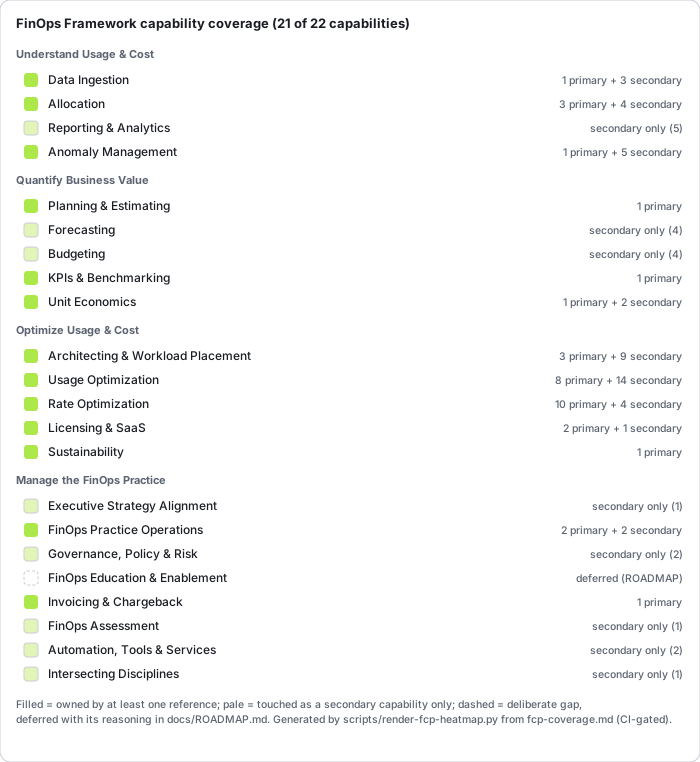
Both maps regenerate from file frontmatter and CI fails if either drifts (details in playbook-coverage.md and fcp-coverage.md). A third, behavioural surface - does the library actually ground answers to real practitioner questions - is measured with a rotating probe battery on the maintainer side; gaps it finds land in the same public backlog.
Design principles
- AI cost management is a first-class domain. Most FinOps resources treat AI workloads as an edge case. This skill treats them as a primary concern, with dedicated reference files for each major AI platform.
- Visibility before optimisation. The skill follows a consistent sequence: establish what you are spending, understand what is driving it, then act. It does not recommend optimisation steps before the visibility preconditions are met.
- Provider-mechanics-first, vendor-claim-skeptical. Guidance is grounded in how billing actually works (CUR columns, Azure cost-management semantics, BigQuery export, FOCUS conformance) rather than in vendor marketing or framework positioning. Vendor sustainability and savings claims are read critically, with primary sources cited.
- Maturity is contextual, not aspirational. Verticals where cloud is not a revenue generator do not need to reach Run; Crawl plus selective Walk is the right state when cloud is a cost centre. Verticals where cloud IS the product need Run because cloud efficiency directly drives gross margin. Pushing every organisation toward the same maturity ceiling is malpractice.
- Connect cost to business value. Every recommendation answers the CFO test: what business outcome does this protect or unlock. Cost reduction without a value lens is a leak.
- Mechanics live here, price figures do not. Billing mechanics are durable; absolute prices are volatile and go stale inside a packaged file. Current-price questions route to OptimToken (see above), and any figure a reference does quote carries its date and source inline.
- FinOps is an operating discipline, not a culture. The discipline lives in allocation, anomaly management, commitment management, rightsizing, and governance, all of which produce measurable outputs. "Culture of FinOps" framing tends to substitute slideware for those outputs. In the agentic era this matters more, not less: agents execute discipline, not culture.
These principles will grow into a skills/cloud-finops/doctrine/ directory of
opposable theses with their own primary sources.
Usage examples
These questions illustrate what the skill is designed to answer accurately - a general-purpose LLM without it produces plausible but unreliable answers to most of them, particularly on billing mechanics and capacity economics.
<div> <a href="https://www.loom.com/share/cc76d419adc64b1784e58621d6934d3e"> <p>Cloud FinOps skill - Watch Video</p> </a> <a href="https://www.loom.com/share/cc76d419adc64b1784e58621d6934d3e"> <img style="max-width:300px;" alt="Demo video: the Cloud FinOps skill answering practitioner questions in Claude" src="https://cdn.loom.com/sessions/thumbnails/cc76d419adc64b1784e58621d6934d3e-906aded8593a48f3-full-play.gif#t=0.1"> </a> </div>- "We're spending $40K/month on AWS Bedrock and have no idea which features are driving it. Where do we start?"
- "How do I calculate the break-even utilisation rate for provisioned throughput - and should we choose Azure OpenAI PTUs or Bedrock provisioned capacity for 500K requests/day?"
- "Our monthly bill jumped from $12K to $38K after a developer enabled Fast mode in Claude Code. How do I get this under control?"
- "Should we self-host Llama 4 on rented H100s instead of paying per token - and what hidden costs do TCO calculators miss?"
- "We have $80K/month in EC2. Reserved Instances or Savings Plans - and what quick wins come first?"
- "Our client wants separate AWS invoices per business unit. Their AWS contact suggested Cost Categories - is that right?"
- "We're migrating from EA to MCA - what FinOps work do we need to do before the switch?"
- "Which VMs run for nothing, and which runbook finds them?"
- "We need to start reporting our cloud carbon emissions - where do we begin?"
Directory structure
cloud-finops-skills/
├── README.md                    <- This file
├── INSTALLATION.md              <- Per-tool setup, troubleshooting, API loader
├── CLAUDE.md / AGENTS.md        <- Project context for AI assistants and contributors
├── llms.txt                     <- LLM discovery index (cross-agent)
├── install.sh                   <- Cross-tool installer (12 targets)
├── mcp_server/                  <- cloud-finops-mcp PyPI package
└── skills/cloud-finops/         <- The skill - install this folder
    ├── SKILL.md                 <- Entry point + per-file routing catalogue
    ├── POWER.md                 <- Kiro IDE entry point (same references)
    ├── references/              <- The reference library, one file per domain
    └── playbooks/               <- Named-pattern runbooks (~3-8 KB each) + catalogue
MCP server (cross-tool, search-style retrieval)
Hosted (nothing to install) or from PyPI - both paths are in the
install table above. Also listed on the
MCP Registry as
io.github.OptimNow/cloud-finops, and on
PyPI.
Six read-only tools across two surfaces. The split is deliberate: the two content types have different shapes, and different questions attached to them.
References - the long-form provider and discipline files. Reach for these for billing mechanics, commitment strategy, allocation methodology, or any reasoning that spans patterns.
| Tool | What it answers |
|---|---|
list_references() | What guidance exists? The catalogue with its FinOps Framework facets and an approx_tokens size hint per file |
get_reference(name, section?) | One guide - mechanics, decision rules, worked examples. Whole, or a single H2/H3 section when the question is narrower than the file |
find_references(domain?, capability?, phase?, persona?, maturity?, persona_primary_only?) | "How should we size Savings Plans?" "What must be true before chargeback?" - routes a FinOps question to the guides that serve it (persona_primary_only cuts to the primary audience) |
Playbooks - small named-pattern runbooks, one waste pattern each. Reach for these for "how do I detect and fix this specific thing".
| Tool | What it answers |
|---|---|
list_playbooks() | What cloud waste can we hunt with a ready-made runbook? |
get_playbook(name) | The step-by-step runbook: symptoms, detection queries, fix, anti-pattern |
find_playbooks(scope?, service?, waste_category?, confidence?) | "Which VMs run for nothing?" "Why is the NAT bill so high?" "Which of my RIs are about to expire?" - finds the runbook for a specific waste suspicion. The server cannot see your account; the runbook's detection query is the answer it hands over |
Both listings carry approx_tokens per entry, because the references vary by more
than tenfold - roughly 2K tokens for the smallest, over 25K for the provider pattern
catalogues. The catalogues are enumerated lists, so an agent that wants one pattern
family passes section (get_reference("finops-aws-patterns", section="storage"))
and pays for that section instead of the whole file. Matching is case-insensitive and
partial; a phrase that matches no heading returns the file's available headings rather
than silently falling back to the full body.
The faceted queries are the reason this is a server and not just a folder of markdown: every file carries YAML frontmatter mapping it to a FinOps Framework capability, phase, persona and maturity gate, and a client that only fetches files cannot filter on any of it.
On hosts that support MCP Apps (SEP-1865), the tool results render as interactive widgets - a playbook explorer with facet filters and a coverage matrix, a playbook viewer with copyable detection queries and a checkable fix list, and a reference browser with a reading panel. Hosts without MCP Apps support get the plain results; nothing about the tools changes. Details in mcp_server/README.md.
Data handling
What the plugin runs, sends and fetches, so you can decide where it is appropriate to use it. Full policy in PRIVACY.md.
- The skill is static text.
SKILL.md, the references and the playbooks are markdown files read into the model's context. They run no code, call no network endpoint and carry no credentials. The playbooks contain detection queries (billing export SQL, CLI commands) that you run in your own cloud account; nothing in this repository reads a cloud account. - The hosted MCP connector, if you add it, sends tool calls to
mcp.optimnow.io(served by the Fly.io appcloud-finops-mcp; the formercloud-finops-mcp.fly.devhost still answers but is deprecated). It is not part of the plugin (see "Plugin and connector" above). When the model calls one of the six tools, the tool arguments (a reference or playbook name, a section phrase, facet filters such as domain or scope) travel over HTTPS to that server and the matching library content comes back. The server requires no account and no authentication, holds no database and no per-user state, and serves the same public files as this repository. Its application log records facet queries that matched nothing (the filter values, never conversation text) so coverage gaps can be reviewed; the hosting platform (Fly.io, Paris region) keeps the web server's standard access log. OptimNow does not sell, share or profile from either. On hosts that render MCP Apps, the widget HTML comes from the same origin and its content security policy allows no third-party domain. - Price lookups route to OptimToken. The skill and the server tell the model to fetch current prices from the OptimNow AI Pricing Hub (https://optimtoken.optimnow.io) instead of quoting a stale figure. That is a separate public site; whether the model opens it is its decision in the conversation.
- Nothing else. No telemetry, no analytics beacon, no update check, no package launcher, no credential read from your environment.
This skill is actively maintained
This is a living repository. Reference files are refreshed twice a month (around the 1st and the 15th), driven by an automated scan of around 30 data sources - cloud provider pricing pages, release notes, billing changelogs, and FinOps community publications. Changes are reviewed before being applied, so the content reflects verified updates rather than raw feed output.
AI cost management is moving particularly fast - new model releases, capacity options, and billing mechanics appear every few weeks. Watch or star this repo to be notified when updates are published.
Contributing
Practitioner experience is the highest-value contribution. Frameworks and vendor docs are already public; what is rare is "we tried X in production, this is what actually billed". Corrections to billing mechanics, new or improved playbooks, real-world counter-examples, and adversarial review of the recommendations are all welcome - the repo is opinionated, and it should also be falsifiable.
The full guide - contribution types, process, conventions, and what we push back on - is in CONTRIBUTING.md. One check before anything else: if your change names another OptimNow tool (an MCP tool name, an endpoint URL, a provenance field), read DEPENDENCIES.md first - most cross-repo breakage here is documentation drift that no CI check catches.
Adapting this skill for your organisation
Fork this repository and customise the reference files for your organisation's context: your cloud stack, your internal policies, your tag taxonomy, your preferred methodology.
A fork gives you a stable base that you can pull upstream updates into at your own pace, without overwriting your customisations. Typical customisations include:
- Adding organisation-specific tag requirements to
finops-tagging.md - Replacing generic pricing examples with your negotiated rates
- Adding reference files for internal tools or platforms not covered here
- Adjusting the methodology file to reflect your team's own approach
About OptimNow
OptimNow is a boutique FinOps consultancy helping organisations connect cloud and AI spend to measurable business value. Based in France with European reach.
- Website: optimnow.io
- LinkedIn: OptimNow
- GitHub: github.com/OptimNow
Open-source tools built by OptimNow:
| Tool | What it does |
|---|---|
| OptimToken | Compare what 250+ models cost per request, with caching and batch factored in, plus compute instance rates across seven clouds. Also available as an MCP connector - this skill routes price questions here |
| AI ROI Calculator | Whether an AI project pays for itself: three-layer cost model, payback, break-even, sensitivity. Also an MCP server |
| AI Cost Readiness Assessment | Where your organisation stands on AI cost management |
| MCP for Tagging | Tag governance automation |
| FinOps Maturity Assessment | Crawl / Walk / Run positioning |
Acknowledgements
This skill incorporates content derived from the following sources:
- FinOps Foundation - framework definitions, capability descriptions, and maturity model structure are based on the FinOps Framework.
- Point Five - cloud optimisation recommendations informed several provider-specific best practices and quick-win patterns.
- Tokenomics Foundation - the token complexity classes in the agentic FinOps reference are adapted from Big-T Notation by Dan Neff (Adobe), published by the Tokenomics Foundation under CC BY 4.0.
All referenced content has been adapted with additional context from OptimNow's consulting delivery experience. Any errors or opinionated interpretations are our own.
This skill is independently maintained and is not affiliated with or endorsed by the FinOps Foundation.
License
Licensed under CC BY-SA 4.0. See LICENSE.md.
You are free to use, adapt, and redistribute this skill - including for commercial purposes - as long as you credit OptimNow and share any derivatives under the same license.
Related MCP servers

OptimToken
Compare LLM API pricing, estimate workload costs, and benchmark cloud compute. By OptimNow.
Editorial picks for e-bikes, power stations, EV chargers, and robot vacuums, by use case and budget

Extract database metadata from PostgreSQL, Snowflake, SQL Server, BigQuery, and Oracle.
Runtime AI-threat screening for coding agents: analyze, scan tool calls/outputs & docs (paid).

OrangePro
Find test gaps, generate grounded tests, and prove behavior with mutation testing.

io.github.Oratorian/discord-node-mcp
MCP server for controlling Discord servers via bot token