CloudBase MCP Server
io.github.TencentCloudBase/cloudbase-mcp
AI-native backend for databases, functions, storage, and hosting—integrated into AI IDEs via MCP.
What is the CloudBase MCP server?
The CloudBase MCP server connects AI coding tools (Cursor, Claude Code, CodeBuddy) to Tencent Cloud's managed backend platform. It exposes database, cloud functions, storage, authentication, and hosting operations through the Model Context Protocol, enabling AI agents to build and deploy full-stack applications from chat.
CloudBase MCP bridges AI code generation with production backend infrastructure. Instead of writing code that still needs manual backend setup, the AI can query and modify databases, deploy cloud functions, manage storage, handle authentication, and publish hosting—all from conversation. Designed for Web, WeChat Mini Programs, and backend services on Tencent Cloud.
How to install CloudBase
Copy-paste configuration for popular MCP clients.
X-TencentCloud-SecretIdsecretTencent Cloud SecretId for the China site. Optional: interactive clients can authorize via OAuth instead of static credentials.
X-TencentCloud-SecretKeysecretTencent Cloud SecretKey for the China site. Optional: interactive clients can authorize via OAuth instead of static credentials.
Tools & capabilities
Tools this server exposes to the agent.
Database operations— Query, create, update, and delete data in PostgreSQL and document databases; manage schemas and security rulesCloud functions— Author, deploy, invoke, and debug serverless functionsCloud Run— Deploy and manage containerized applicationsAuthentication— Configure login methods and manage user permissionsStorage— Upload, manage, and link object storage with database permissionsHosting— Deploy static sites and WeChat Mini ProgramsEnvironment & logs— Query environment metrics, resource usage, process logs, and deployment recordsLogin & auth— Authenticate to CloudBase and manage API credentials
Use cases
- Build a full-stack todo app with database, login, and permissions, then deploy to production
- Query and modify application data directly from chat without leaving the IDE
- Deploy cloud functions and Cloud Run services for backend logic
- Manage static site hosting and WeChat Mini Program releases
- Inspect logs, metrics, and deployment history to debug live applications
CloudBase MCP server FAQ
It's a Model Context Protocol server that gives AI coding tools (Cursor, Claude Code, CodeBuddy, etc.) access to Tencent Cloud's managed backend: databases, cloud functions, storage, auth, and hosting. You describe what you want in chat, and the AI can build and deploy it to your CloudBase environment.
CloudBase offers a free tier with limited resources. Pricing details and quotas are available at https://tcb.cloud.tencent.com/dev. You need your own CloudBase environment to use this MCP server.
Add this to .cursor/mcp.json: {"mcpServers": {"cloudbase": {"command": "npx", "args": ["@cloudbase/cloudbase-mcp@latest"]}}}. Or use the Plugin approach: npx plugins add TencentCloudBase/cloudbase-plugin.
Yes. You need a CloudBase environment (free tier available at https://tcb.cloud.tencent.com/dev) and Tencent Cloud credentials. The MCP server supports local login or HTTP headers with Secret ID/Key for hosted mode.
Create one free at https://tcb.cloud.tencent.com/dev. The MCP server requires an active environment ID to connect and manage backend resources.
Yes. The CloudBase AI CLI (npm i -g @cloudbase/cli && tcb ai) works from the command line. Any MCP-capable tool—Claude Code, Gemini CLI, OpenCode—can use this server.
README (reference)
Source of truth, from the repository.
CloudBase AI Toolkit
AI writes the code. CloudBase runs the backend.
The CloudBase integration layer for AI coding tools: Plugin installs the stack, Skills steer how code is written, MCP operates databases, functions, storage, and deploys from chat.
English · 简体中文 · Docs · Changelog · Issues



Recent updates
v2.28.x (2026-08)
- Env:
queryEnvadds metrics (DescribeCurveData) and resource-usage query - Cloud Run:
getProcessLog, traffic/deploy-record query, image-deploynext_step,initEnvVPC/tcbr fixes, and hide small-tenant create API - Registry:
@cloudbase/cloudbase-mcppublished to the Official MCP Registry - Skills / ops: ops-inspector v3 alarm playbooks; skill-inject metadata persistence and React fullstack routing
v2.27.x (2026-08)
- Tools:
downloadRemoteFileremoved (high error rate) — download remote assets with shellcurl/Invoke-WebRequestinstead (#908, #909) - Cloud Run:
manageCloudRununifies tcbr init-check + deploy and drops legacy tcb cloudrun APIs; app deployment skipstarget/.nextto avoid oversized zips - Skills: mini program SEO / search-optimization guidance merged into
miniprogram-development(#906) - Gateway / hosting: route-level enable support with disabled access URL detection; hosting skips deploy notifications when
accessUrlis empty - Docs: simplified quick start with externalized images (#905),
--cloudbase-api-keyCLI login, and CodeBuddy plugin marketplace install guide
Releases · Star · Watch → Releases
What it is
AI IDEs (Cursor, Claude Code, Codex, CodeBuddy, and others) are strong at generating code. What usually blocks you is the backend: schemas, permissions, functions, storage, environments, and release.
CloudBase is Tencent Cloud’s AI-native all-in-one backend (database, storage, auth, cloud functions, Cloud Run, and more). This repo is the Toolkit that connects that backend to AI tools:
| Piece | Role |
|---|---|
| Plugin | Installs MCP Server, Agent Skills, and Hooks together—less per-IDE wiring |
| Agent Skills | Scenario skills (Web / Mini Program / database / auth / functions, etc.) toward workable CloudBase practice |
| MCP | Login, query and change data, manage functions and hosting, read logs—from the conversation |
This repository ships the npm package @cloudbase/cloudbase-mcp, Skills, and AI plugins.
You still need your own CloudBase environment, and you should confirm sensitive actions the AI proposes. The Toolkit provides capability and path—not judgment.
Related repositories
Publishing and sync repos live under TencentCloudBase. Directly related to this Toolkit:
| Repository | Contents | Typical entry |
|---|---|---|
| CloudBase-AI-Toolkit (this repo) | MCP Server source; marketplace source for Claude Code / Codex | npx @cloudbase/cloudbase-mcp@latest |
| cloudbase-plugin | Open Plugin Spec publish repo (CI-synced): MCP + Skills + Hooks | npx plugins add TencentCloudBase/cloudbase-plugin · CNB fallback: npx plugins add https://cnb.cool/tencent/cloud/cloudbase/cloudbase-plugin.git |
| cloudbase-sites-plugin | Sites plugin: Vite Web create & deploy | npx plugins add TencentCloudBase/cloudbase-sites-plugin · CNB: https://cnb.cool/tencent/cloud/cloudbase/cloudbase-sites-plugin.git |
| cloudbase-skills | Agent Skills collection | npx skills add TencentCloudBase/cloudbase-skills · CNB: https://cnb.cool/tencent/cloud/cloudbase/cloudbase-skills.git |
| skills | Per-skill install catalog (also on skills.sh) | npx skills add tencentcloudbase/skills --skill <name> |
| awesome-cloudbase-examples | CloudBase examples and case studies | Browse / clone examples |
| OpenVibeCoding | Vibecoding template on CloudBase | Use as a project starter |
Prefer Plugin for the full stack; Skills alone when you only need knowledge constraints. For marketplace IDEs use this repo—do not also run npx plugins add on the same tool.
Quick start
Fastest way to get started
Copy this AI prompt into your AI IDE. The agent reads skill.md and completes the setup:
Set up CloudBase for me:
1. Open https://docs.cloudbase.net/skill.md and complete the setup following its instructions.
2. Tell me when you're done, and suggest the most relevant next step.
| Your tool | Suggested path |
|---|---|
| Claude Code / Codex (native marketplace) | Add this repo as marketplace, then install the cloudbase plugin (plugin docs) |
| Open Plugin Spec tools | npx plugins add TencentCloudBase/cloudbase-plugin |
| Prefer one CLI for many tools | CloudBase AI CLI: npm i -g @cloudbase/cli && tcb ai |
| CodeBuddy / WorkBuddy / ZCode (built-in) | Use the IDE’s built-in CloudBase plugin or connector; for CodeBuddy you can also install via plugin marketplace |
| Other MCP-capable IDEs | MCP config only (below) |
Plugin
npx plugins add TencentCloudBase/cloudbase-plugin
Details and IDE differences: AI plugin docs.
MCP only
{
  "mcpServers": {
    "cloudbase": {
      "command": "npx",
      "args": ["@cloudbase/cloudbase-mcp@latest"]
    }
  }
}
Hosted HTTP, self-hosted Cloud Mode, and plugin scoping: Install & connect.
</details>First prompts
Login to CloudBase
Use CloudBase Skills to build a todo app with login, database and permissions, then deploy
Skills shape structure and practice; MCP handles environment and resources. You should be able to verify data and APIs in your own environment—not only get local source files.
Supported AI IDEs
<img width="1200" alt="Supported AI IDEs" src="https://raw.githubusercontent.com/TencentCloudBase/CloudBase-AI-Toolkit/main/scripts/assets/ide-support-grid.png" />| Tool | Platform | Guide |
|---|---|---|
| CloudBase AI CLI | CLI | Guide |
| OpenClaw | CLI | Guide |
| WorkBuddy | Standalone IDE | Guide |
| ZCode | Standalone IDE (≥ 3.4.1 built-in) | Guide |
| Codex App | App | Guide |
| Cursor | Standalone IDE | Guide |
| WindSurf | IDE / plugins | Guide |
| CodeBuddy | Standalone IDE (built-in) | Guide |
| CLINE | VS Code plugin | Guide |
| GitHub Copilot | VS Code plugin | Guide |
| Trae | Standalone IDE | Guide |
| Tongyi Lingma | IDE / plugins | Guide |
| RooCode | VS Code plugin | Guide |
| Baidu Comate | Plugins | Guide |
| Augment Code | Plugins | Guide |
| Claude Code | CLI | Guide |
| Gemini CLI | CLI | Guide |
| Codex CLI | CLI | Guide |
| OpenCode | CLI | Guide |
| Qwen Code | CLI | Guide |
Full setup: IDE guides.
Capabilities
After setup, the AI can do typical backend work in your environment (confirm critical steps):
- Database: PostgreSQL and document DB, data models, CRUD, permissions and security rules
- Compute: author, deploy, invoke, and debug cloud functions / Cloud Run
- Auth & storage: login methods, object storage, permission linkage with data
- Release & ops: static hosting / Mini Program publish; inspect logs and redeploy
Fits Web, WeChat Mini Programs, and backend services. Platform overview: CloudBase docs.
Evaluation
Under controlled conditions, the same Todo application brief and frontend scaffold were used to compare two backend paths: a traditional cloud VM (self-managed runtime, process, and network exposure) and CloudBase (managed database, anonymous auth, and related backend services). An AI agent performed end-to-end development and verification. Given the model and task setup, the CloudBase path was more favorable in completion latency, token usage, and tool-call count. These outcomes are conditioned on the model, agent framework, and task definition, and should not be generalized beyond that scope.
Methods, data, and limits: Same-task evaluation: cloud VM vs CloudBase
Install & connect
Prerequisites
- Node.js v18.15.0+
- A CloudBase environment
- An AI tool that supports Plugin / Skills / MCP
Setup options
- Plugin (when the tool supports it)
npx plugins add TencentCloudBase/cloudbase-plugin - CloudBase AI CLI
npm i -g @cloudbase/cli && tcb ai - Manual MCP (write the IDE config file)
{
  "mcpServers": {
    "cloudbase": {
      "command": "npx",
      "args": ["@cloudbase/cloudbase-mcp@latest"]
    }
  }
}
{
  "mcpServers": {
    "cloudbase": {
      "command": "npx",
      "args": ["@cloudbase/cloudbase-mcp@latest"]
    }
  }
}
CloudBase is built in (MCP / Skills); manual config is usually unnecessary.
You can also install via the plugin marketplace: see the CodeBuddy setup guide.
</details>Others: IDE setup guide.
MCP connection modes
Local (default): npx on your machine—full features, including local filesystem upload/templates.
Hosted: IDE connects over HTTP to Tencent Cloud MCP; no local Node. Some local-file features are unavailable.
{
  "mcpServers": {
    "cloudbase": {
      "type": "http",
      "url": "https://tcb-api.cloud.tencent.com/mcp/v1?env_id=<env_id>",
      "headers": {
        "X-TencentCloud-SecretId": "<Tencent Cloud Secret ID>",
        "X-TencentCloud-SecretKey": "<Tencent Cloud Secret Key>"
      }
    }
  }
}
Hosted URLs can use site (domestic / intl) to pick the login site (e.g. domestic-site Singapore needs site=domestic), plus enable_plugins / disable_plugins to trim tools. Canonical names live in mcp/src/server.ts.
Self-hosted Cloud Mode: set CLOUDBASE_MCP_CLOUD_MODE=true (or MCP_CLOUD_MODE=true) so local file and process tools are disabled for remote callers.
| Scenario | Suggestion |
|---|---|
| Personal | Local npx |
| Team / zero ops | Hosted HTTP |
| Self-hosted MCP | Cloud Mode required |
Example
Online Gomoku: describe the need; get Web + cloud database / realtime and deploy.
Demo: Gomoku · More: tutorials
Docs
FAQ
<details> <summary>How is this different from Vercel / Netlify?</summary>Those focus on shipping frontends or containers. CloudBase provides backend building blocks (database, auth, functions). The Toolkit lets AI tools use them in chat. Deploy is only part of the path.
</details> <details> <summary>Can I use this without a GUI IDE?</summary>Yes. Any tool that can configure an MCP Server or install the matching Plugin / Skills works—including Claude Code, Gemini CLI, OpenCode. Support list
</details> <details> <summary>Where does my code go?</summary>Deploy targets your own CloudBase environment. In local mode MCP runs on your machine; code need not leave until you deploy. Cloud traffic uses HTTPS.
</details> <details> <summary>Is self-hosting the MCP server safe?</summary>Local npx is equivalent to running tools yourself. For remote hosts, set CLOUDBASE_MCP_CLOUD_MODE=true to disable local file/process tools. Tencent Cloud hosted HTTP includes this protection.
The Toolkit (including MCP) is open source under MIT. CloudBase has free quotas; usage beyond that is billed—see billing.
</details> <details> <summary>Login says environment does not exist?</summary>Confirm an environment exists and is healthy in the console, then login again and pick the right one.
</details> <details> <summary>Domestic site env at `ap-singapore` is treated as international?</summary>Both the domestic site (cloud.tencent.com) and the international site (tencentcloud.com) offer the ap-singapore region, so region alone is ambiguous. Without an explicit site, MCP defaults to intl for ap-singapore (backward compatible). Domestic-site Singapore users must set TCB_SITE=domestic (together with TCB_REGION=ap-singapore) in the MCP env, or add a .cloudbase/project.json at the project root:
{ "site": "domestic", "region": "ap-singapore", "envId": "your-env-id" }
Credentials are stored per site (credential.domestic / credential.intl) so domestic and international logins can coexist; legacy single-slot auth.json is read as domestic and migrated on first write.
Hosted mode: add site=domestic to the hosted URL (https://tcb-api.cloud.tencent.com/mcp/v1?env_id=<env_id>&site=domestic), since the URL is the only place hosted mode can carry the site (there is no MCP env block for HTTP servers).
Community
| Docs | docs.cloudbase.net |
| Issues | GitHub Issues |
| Releases | Changelog |
Activity
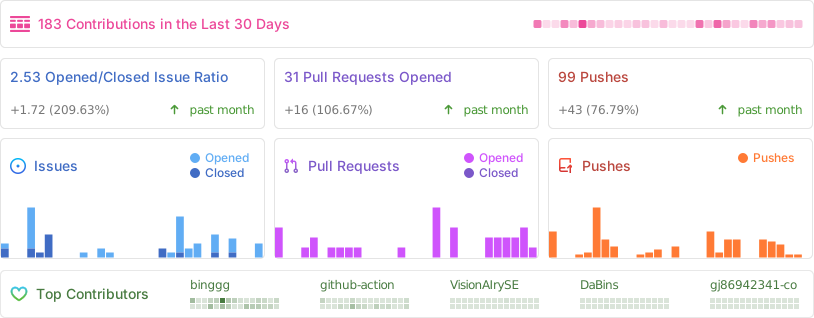
Contributors
<!-- Links --> <!-- Shields -->
Related MCP servers

Judged, citation-checked policy corpus over MCP. Keyless public reads; API key for AI tools.
View repository →
Security-first MCP server that connects any OpenAPI, GraphQL, gRPC or SOAP API to AI agents.

eyeot ERP
ERP français avec serveur MCP natif : plus de 1 800 actions métier auto-générées via OpenAPI.

Find and monitor ocean shipments and containers, and create new tracking requests.
View repository →
Read-only payment-boundary preflights plus an unsubmitted public quote-request draft tool.

Librarian
Deterministic ebook-to-markdown pipeline with MCP tools to browse, search, and read your books.