io.github.VictoriaMetrics-Community/mcp-victorialogs MCP Server
io.github.VictoriaMetrics-Community/mcp-victorialogs
MCP server for VictoriaLogs—query logs, explore streams, and access observability APIs with AI agents.
What is the io.github.VictoriaMetrics-Community/mcp-victorialogs MCP server?
The VictoriaLogs MCP Server is an implementation of the Model Context Protocol for VictoriaLogs that provides access to read-only VictoriaLogs APIs and embedded documentation. It enables AI agents to query logs, explore data streams, list fields, retrieve query statistics, and search documentation without requiring online access.
This MCP server integrates VictoriaLogs with AI agents like Claude and Cursor, exposing nearly all read-only VictoriaLogs APIs available in the Web UI. It's useful for engineers and automation tools that need to query logs, explore observability data, debug issues, and access VictoriaLogs documentation programmatically. The server supports multiple deployment modes (stdio, SSE, HTTP) and can be configured with authentication tokens and custom headers.
How to install io.github.VictoriaMetrics-Community/mcp-victorialogs
Copy-paste configuration for popular MCP clients.
VL_INSTANCE_ENTRYPOINTrequiredURL to VictoriaMetrics instance (it should be root URL of vmlingle or vlselect), for example http://localhost:9428 or https://play-vmlogs.victoriametrics.com
VL_INSTANCE_BEARER_TOKENrequiredsecretAuthentication token for VictoriaMetrics API
MCP_DISABLED_TOOLSComma-separated list of tools to disable
Tools & capabilities
Tools this server exposes to the agent.
Query logs— Execute queries against VictoriaLogs to retrieve and explore log dataList streams— Discover available log streams in your VictoriaLogs instanceList fields— View available fields within log streamsList field values— Retrieve possible values for specific log fieldsInstance parameters— Display configuration and parameters of your VictoriaLogs instanceQuery statistics— Get statistics for log queries as metricsDocumentation search— Search embedded VictoriaLogs documentation without online access
Use cases
- Query and analyze logs from your VictoriaLogs instance to troubleshoot issues and understand system behavior
- Explore available log streams and fields to understand your data structure and build effective queries
- Generate query statistics and metrics to monitor log ingestion and query performance
- Search VictoriaLogs documentation to learn API capabilities and query syntax while working with logs
- Combine log queries with other observability MCP servers for comprehensive debugging and monitoring workflows
io.github.VictoriaMetrics-Community/mcp-victorialogs MCP server FAQ
It's an MCP server that connects AI agents to VictoriaLogs instances, providing access to read-only APIs for querying logs, exploring streams and fields, retrieving statistics, and searching embedded documentation.
Yes, the VictoriaLogs MCP Server is open-source and free. You can also test it without installation using the public playground at https://play-vmlogs-mcp.victoriametrics.com/mcp.
Download the binary or build from source, then add the server to your MCP configuration file (mcp.json for Cursor, claude_desktop_config.json for Claude Desktop) with the VL_INSTANCE_ENTRYPOINT and optional authentication environment variables.
You need a VictoriaLogs instance URL (VL_INSTANCE_ENTRYPOINT). Optional authentication includes a bearer token (VL_INSTANCE_BEARER_TOKEN) and custom HTTP headers (VL_INSTANCE_HEADERS) for reverse proxy or special authentication scenarios.
The server supports three modes: stdio (default, for local use), SSE (Server-Sent Events), and HTTP (Streamable HTTP). It can be deployed as a binary, Docker container, or via Helm chart.
No. You can use pre-built binaries, Docker images, or install via `go install`. Go 1.26+ is only required if building from source.
README (reference)
Source of truth, from the repository.
VictoriaLogs MCP Server


The implementation of Model Context Protocol (MCP) server for VictoriaLogs.
This provides access to your VictoriaLogs instance and seamless integration with VictoriaLogs APIs and documentation. It can give you a comprehensive interface for logs, observability, and debugging tasks related to your VictoriaLogs instances, enable advanced automation and interaction capabilities for engineers and tools.
Features
This MCP server allows you to use almost all read-only APIs of VictoriaLogs, i.e. all functions available in Web UI:
- Querying logs and exploring logs data
- Showing parameters of your VictoriaLogs instance
- Listing available streams, fields, field values
- Query statistics for the logs as metrics
- UI with setup instructions and tools inspection on the root endpoint (only in Streamable HTTP mode)
In addition, the MCP server contains embedded up-to-date documentation and is able to search it without online access.
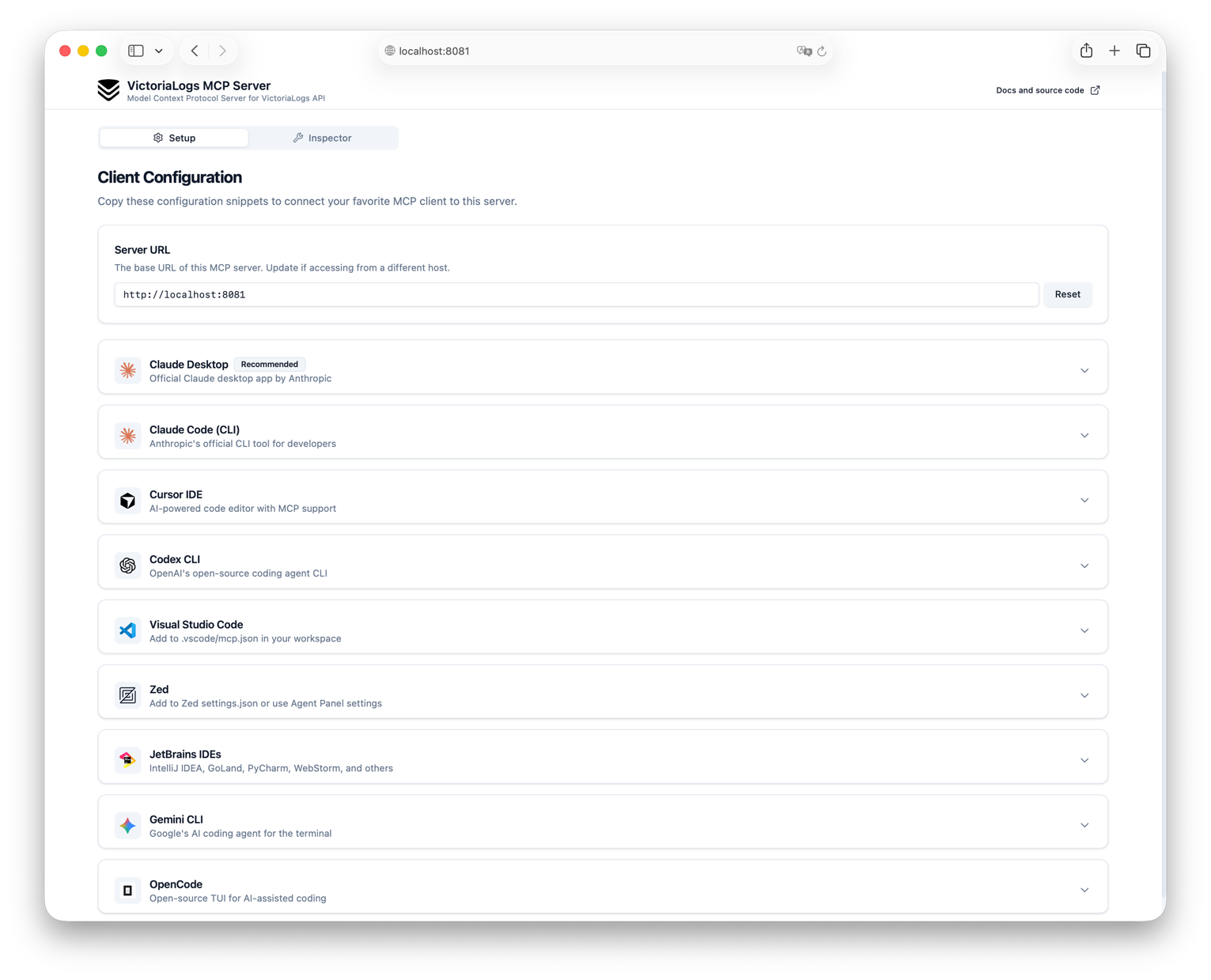
More details about the exact available tools and prompts can be found in the Usage section.
You can combine functionality of tools, docs search in your prompts and invent great usage scenarios for your VictoriaLogs instance. And please note the fact that the quality of the MCP Server and its responses depends very much on the capabilities of your client and the quality of the model you are using.
You can also combine the MCP server with other observability or doc search related MCP Servers and get even more powerful results.
Try without installation
There is a publicly available instance of the VictoriaMetrics MCP Server that you can use to test the features without installing it:
https://play-vmlogs-mcp.victoriametrics.com/mcp
Attention! This URL is not supposed to be opened in a browser, it is intended to be used in MCP clients.
It's available in Streamable HTTP Mode mode and configured to work with Public VictoriaLogs Playground.
Here is example of configuration for Claude Desktop:
Requirements
- VictoriaLogs instance: (single-node or cluster)
- Go 1.26 or higher (if you want to build from source)
Installation
Go
go install github.com/VictoriaMetrics/mcp-victorialogs/cmd/mcp-victorialogs@latest
Binaries
Just download the latest release from Releases page and put it to your PATH.
Example for Linux x86_64 (note that other architectures and platforms are also available):
latest=$(curl -s https://api.github.com/repos/VictoriaMetrics/mcp-victorialogs/releases/latest | grep 'tag_name' | cut -d\" -f4)
wget https://github.com/VictoriaMetrics/mcp-victorialogs/releases/download/$latest/mcp-victorialogs_Linux_x86_64.tar.gz
tar axvf mcp-victorialogs_Linux_x86_64.tar.gz
Docker
You can run VictoriaLogs MCP Server using Docker.
This is the easiest way to get started without needing to install Go or build from source.
docker run -d --name mcp-victorialogs \
  -e VL_INSTANCE_ENTRYPOINT=https://play-vmlogs.victoriametrics.com \
  -e MCP_SERVER_MODE=http \
  -e MCP_LISTEN_ADDR=:8081 \
  -p 8081:8081 \
  ghcr.io/victoriametrics/mcp-victorialogs
You should replace environment variables with your own parameters.
Note that the MCP_SERVER_MODE=http flag is used to enable Streamable HTTP mode.
More details about server modes can be found in the Configuration section.
See available docker images in github registry.
Also see Using Docker instead of binary section for more details about using Docker with MCP server with clients in stdio mode.
Source Code
For building binary from source code you can use the following approach:
-
Clone repo:
git clone https://github.com/VictoriaMetrics/mcp-victorialogs.git cd mcp-victorialogs -
Build binary from cloned source code:
make build # after that you can find binary mcp-victorialogs and copy this file to your PATH or run inplace -
Build image from cloned source code:
docker build -t mcp-victorialogs .
# after that you can use docker image mcp-victorialogs for running or pushing
Helm
Check out VictoriaLogs MCP Server Helm chart documentation for more details about installation using Helm.
Configuration
MCP Server for VictoriaLogs is configured via environment variables:
| Variable | Description | Required | Default | Allowed values |
|---|---|---|---|---|
VL_INSTANCE_ENTRYPOINT | URL to VictoriaLogs instance | Yes | - | - |
VL_INSTANCE_BEARER_TOKEN | Authentication token for VictoriaLogs API | No | - | - |
VL_INSTANCE_HEADERS | Custom HTTP headers to send with requests (comma-separated key=value pairs) | No | - | - |
MCP_PASSTHROUGH_HEADERS | HTTP header names to forward from incoming MCP requests to VictoriaLogs (comma-separated list). Overrides VL_INSTANCE_HEADERS on collision. Only applies in sse/http modes. | No | - | - |
VL_DEFAULT_TENANT_ID | Default tenant ID used when tenant is not specified in requests (format: AccountID:ProjectID or AccountID) | No | 0:0 | - |
MCP_SERVER_MODE | Server operation mode. See Modes for details. | No | stdio | stdio, sse, http |
MCP_LISTEN_ADDR | Address for SSE or HTTP server to listen on | No | localhost:8081 | - |
MCP_DISABLED_TOOLS | Comma-separated list of tools to disable | No | - | - |
MCP_HEARTBEAT_INTERVAL | Defines the heartbeat interval for the streamable-http protocol. <br /> It means the MCP server will send a heartbeat to the client through the GET connection, <br /> to keep the connection alive from being closed by the network infrastructure (e.g. gateways) | No | 30s | - |
MCP_LOG_FORMAT | Log output format | No | text | text, json |
MCP_LOG_LEVEL | Minimum log level | No | info | debug, info, warn, error |
Modes
MCP Server supports the following modes of operation (transports):
stdio- Standard input/output mode, where the server reads commands from standard input and writes responses to standard output. This is the default mode and is suitable for local servers.sse- Server-Sent Events. Server will expose the/sseand/messageendpoints for SSE connections.http- Streamable HTTP. Server will expose the/mcpendpoint for HTTP connections.
More info about transports you can find in MCP docs:
Сonfiguration examples
# For a public playground
export VL_INSTANCE_ENTRYPOINT="https://play-vmlogs.victoriametrics.com"

# Custom headers for authentication (e.g., behind a reverse proxy)
# Expected syntax is key=value separated by commas
export VL_INSTANCE_HEADERS="<HEADER>=<HEADER_VALUE>,<HEADER>=<HEADER_VALUE>"

# Forward specific headers from incoming MCP requests to VictoriaLogs
export MCP_PASSTHROUGH_HEADERS="X-Token,X-Access-Key"

# Server mode
export MCP_SERVER_MODE="sse"
export MCP_SSE_ADDR="0.0.0.0:8081"
export MCP_DISABLED_TOOLS="hits,facets"
Endpoints
In SSE and HTTP modes the MCP server provides the following endpoints:
| Endpoint | Description |
|---|---|
/ | Landing page with setup help and tool inspection (HTTP mode only) |
/sse + /message | Endpoints for messages in SSE mode (for MCP clients that support SSE) |
/mcp | HTTP endpoint for streaming messages in HTTP mode (for MCP clients that support Streamable HTTP) |
/metrics | Metrics in Prometheus format for monitoring the MCP server |
/health/liveness | Liveness check endpoint to ensure the server is running |
/health/readiness | Readiness check endpoint to ensure the server is ready to accept requests |
Setup in clients
Cursor
Go to: Settings -> Cursor Settings -> MCP -> Add new global MCP server and paste the following configuration into your Cursor ~/.cursor/mcp.json file:
{
  "mcpServers": {
    "victorialogs": {
      "command": "/path/to/mcp-victorialogs",
      "env": {
        "VL_INSTANCE_ENTRYPOINT": "<YOUR_VL_INSTANCE>",
        "VL_INSTANCE_BEARER_TOKEN": "<YOUR_VL_BEARER_TOKEN>",
        "VL_INSTANCE_HEADERS": "<HEADER>=<HEADER_VALUE>,<HEADER>=<HEADER_VALUE>"
      }
    }
  }
}
See Cursor MCP docs for more info.
Claude Desktop
Add this to your Claude Desktop claude_desktop_config.json file (you can find it if open Settings -> Developer -> Edit config):
{
  "mcpServers": {
    "victorialogs": {
      "command": "/path/to/mcp-victorialogs",
      "env": {
        "VL_INSTANCE_ENTRYPOINT": "<YOUR_VL_INSTANCE>",
        "VL_INSTANCE_BEARER_TOKEN": "<YOUR_VL_BEARER_TOKEN>",
        "VL_INSTANCE_HEADERS": "<HEADER>=<HEADER_VALUE>,<HEADER>=<HEADER_VALUE>"
      }
    }
  }
}
See Claude Desktop MCP docs for more info.
Claude Code
Run the command:
claude mcp add victorialogs -- /path/to/mcp-victorialogs \
  -e VL_INSTANCE_ENTRYPOINT=<YOUR_VL_INSTANCE> \
  -e VL_INSTANCE_BEARER_TOKEN=<YOUR_VL_BEARER_TOKEN> \
  -e VL_INSTANCE_HEADERS="<HEADER>=<HEADER_VALUE>,<HEADER>=<HEADER_VALUE>"
See Claude Code MCP docs for more info.
Codex
Codex CLI and the IDE extension use the same MCP configuration file: ~/.codex/config.toml
(or .codex/config.toml in a trusted project).
Run the command:
codex mcp add victorialogs \
  --env VL_INSTANCE_ENTRYPOINT=<YOUR_VL_INSTANCE> \
  --env VL_INSTANCE_BEARER_TOKEN=<YOUR_VL_BEARER_TOKEN> \
  --env VL_INSTANCE_HEADERS="<HEADER>=<HEADER_VALUE>,<HEADER>=<HEADER_VALUE>" \
  -- /path/to/mcp-victorialogs
Or add the following to your Codex ~/.codex/config.toml file:
[mcp_servers.victorialogs]
command = "/path/to/mcp-victorialogs"

[mcp_servers.victorialogs.env]
VL_INSTANCE_ENTRYPOINT = "<YOUR_VL_INSTANCE>"
VL_INSTANCE_BEARER_TOKEN = "<YOUR_VL_BEARER_TOKEN>"
VL_INSTANCE_HEADERS = "<HEADER>=<HEADER_VALUE>,<HEADER>=<HEADER_VALUE>"
If you run the server in Streamable HTTP mode, you can register it with:
codex mcp add victorialogs --url http://localhost:8081/mcp
See Codex MCP docs for more info.
Visual Studio Code
Add this to your VS Code MCP config file:
{
  "servers": {
    "victorialogs": {
      "type": "stdio",
      "command": "/path/to/mcp-victorialogs",
      "env": {
        "VL_INSTANCE_ENTRYPOINT": "<YOUR_VL_INSTANCE>",
        "VL_INSTANCE_BEARER_TOKEN": "<YOUR_VL_BEARER_TOKEN>",
        "VL_INSTANCE_HEADERS": "<HEADER>=<HEADER_VALUE>,<HEADER>=<HEADER_VALUE>"
      }
    }
  }
}
See VS Code MCP docs for more info.
Zed
Add the following to your Zed config file:
  "context_servers": {
    "victorialogs": {
      "command": {
        "path": "/path/to/mcp-victorialogs",
        "args": [],
        "env": {
                  "VL_INSTANCE_ENTRYPOINT": "<YOUR_VL_INSTANCE>",
        "VL_INSTANCE_BEARER_TOKEN": "<YOUR_VL_BEARER_TOKEN>",
        "VL_INSTANCE_HEADERS": "<HEADER>=<HEADER_VALUE>,<HEADER>=<HEADER_VALUE>"
      }
      },
      "settings": {}
    }
  }
}
See Zed MCP docs for more info.
JetBrains IDEs
- Open
Settings->Tools->AI Assistant->Model Context Protocol (MCP). - Click
Add (+) - Select
As JSON - Put the following to the input field:
{
  "mcpServers": {
    "victorialogs": {
      "command": "/path/to/mcp-victorialogs",
      "env": {
        "VL_INSTANCE_ENTRYPOINT": "<YOUR_VL_INSTANCE>",
        "VL_INSTANCE_BEARER_TOKEN": "<YOUR_VL_BEARER_TOKEN>",
        "VL_INSTANCE_HEADERS": "<HEADER>=<HEADER_VALUE>,<HEADER>=<HEADER_VALUE>"
      }
    }
  }
}
Windsurf
Add the following to your Windsurf MCP config file.
{
  "mcpServers": {
    "victorialogs": {
      "command": "/path/to/mcp-victorialogs",
      "env": {
        "VL_INSTANCE_ENTRYPOINT": "<YOUR_VL_INSTANCE>",
        "VL_INSTANCE_BEARER_TOKEN": "<YOUR_VL_BEARER_TOKEN>",
        "VL_INSTANCE_HEADERS": "<HEADER>=<HEADER_VALUE>,<HEADER>=<HEADER_VALUE>"
      }
    }
  }
}
See Windsurf MCP docs for more info.
Using Docker instead of binary
You can run VictoriaLogs MCP Server using Docker instead of local binary.
You should replace run command in configuration examples above in the following way:
{
  "mcpServers": {
    "victorialogs": {
      "command": "docker",
        "args": [
          "run",
          "-i", "--rm",
          "-e", "VL_INSTANCE_ENTRYPOINT",
          "-e", "VL_INSTANCE_BEARER_TOKEN",
          "-e", "VL_INSTANCE_HEADERS",
          "ghcr.io/victoriametrics/mcp-victorialogs",
        ],
      "env": {
        "VL_INSTANCE_ENTRYPOINT": "<YOUR_VL_INSTANCE>",
        "VL_INSTANCE_BEARER_TOKEN": "<YOUR_VL_BEARER_TOKEN>",
        "VL_INSTANCE_HEADERS": "<HEADER>=<HEADER_VALUE>,<HEADER>=<HEADER_VALUE>"
      }
    }
  }
}
Usage
After installing and configuring the MCP server, you can start using it with your favorite MCP client.
You can start dialog with AI assistant from the phrase:
Use MCP VictoriaLogs in the following answers
But it's not required, you can just start asking questions and the assistant will automatically use the tools and documentation to provide you with the best answers.
Toolset
MCP VictoriaLogs provides numerous tools for interacting with your VictoriaLogs instance.
Here's a list of available tools:
| Tool | Description |
|---|---|
documentation | Search in embedded VictoriaLogs documentation |
facets | Most frequent values per each log field |
field_names | List of field names for the query |
field_values | List of field values for the query |
flags | View non-default flags of the VictoriaLogs instance |
hits | The number of matching log entries grouped by buckets |
query | Execute LogsQL queries |
stats_query | Querying log stats for the given time |
stats_query_range | Querying log stats on the given time range |
stream_field_names | List of stream fields for the query |
stream_field_values | List of stream field values for the query |
stream_ids | List of stream IDs for the query |
streams | List of streams for the query |
Prompts
The server includes pre-defined prompts for common tasks.
These are just examples at the moment, the prompt library will be added to in the future:
| Prompt | Description |
|---|---|
documentation | Search VictoriaLogs documentation for specific topics |
FAQ
Why is the MCP server using more resources than I would expect from a simple API proxy?
The server contains an embedded vector database with VictoriaMetrics documentation and blog posts for the documentation tool.
It helps to answer complex questions about VictoriaLogs without providing all data to LLM.
This is the main source of resource usage. To reduce it, add documentation to MCP_DISABLED_TOOLS environment variable to completely disable the vector database loading.
How to use one MCP server instance for several VictoriaMetrics instances?
You can use MCP_PASSTHROUGH_HEADERS parameter in the MCP Server together with Header-based routing in vmauth to route MCP calls between instances based on HTTP header values from your MCP client config.
Roadmap
- Support "Explain query" tool
- Support optional integration with VictoriaMetrics Cloud
- Add some extra knowledge to server in addition to current documentation tool:
- VictoriaMetrics blog posts
- Github issues
- Public slack chat history
- CRD schemas
- Implement multitenant version of MCP (that will support several deployments)
- Add flags/configs validation tool
- Enabling/disabling tools via configuration
Disclaimer
AI services and agents along with MCP servers like this cannot guarantee the accuracy, completeness and reliability of results. You should double check the results obtained with AI.
The quality of the MCP Server and its responses depends very much on the capabilities of your client and the quality of the model you are using.
Contributing
Contributions to the MCP VictoriaLogs project are welcome!
Please feel free to submit issues, feature requests, or pull requests.
Related MCP servers

MCP server for VictoriaMetrics providing API integration and read-only query capabilities for monitoring and observability.
MCP server for VictoriaTraces—query traces, explore services, and access observability data with embedded documentation.
AI-powered anomaly detection integration for VictoriaMetrics with model management and alert generation

MCP server for VictoriaLogs providing read-only API access, log querying, and embedded documentation search.
MCP server for VictoriaMetrics providing API access and embedded documentation for monitoring and observability tasks.