iMessage History MCP Server
io.github.anipotts/imessage-mcp
Search and read your Apple Messages history from Claude, Cursor, and other MCP clients—read-only, local, no cloud.
What is the iMessage History MCP server?
The iMessage History MCP server lets you search and read your Apple Messages history from any MCP client like Claude, Cursor, or VS Code. It runs locally on your Mac with read-only access to iMessage, SMS, MMS, and RCS conversations, including edits, reactions, replies, and attachments. No accounts, cloud service, or compilation required.
Access your complete Messages history through natural language queries. Search conversations by keywords, read full chat threads with metadata like reactions and read receipts, view photos with location data removed, and analyze communication patterns. Runs entirely on your Mac with no external dependencies or cloud uploads.
How to install iMessage History
Copy-paste configuration for popular MCP clients.
IMESSAGE_PRIVACYMost any caller can see: full (default for stdio), redacted, or aggregate.
IMESSAGE_CONTACTSlive (default) names handles from Contacts; none shows handles only.
IMESSAGE_DBPath to a copy of chat.db instead of this Mac's Messages database.
IMESSAGE_CACHESet to 0 to keep the search index in memory only.
IMESSAGE_UPDATE_CHECKSet to 0 to turn off the npm version check.
Tools & capabilities
Tools this server exposes to the agent.
search_messages— Search by substring, exact text, token, or phrase in message text, conversation names, or attachment namesget_conversation— Read a conversation by chat_id or contact/group name, with edits, reactions, receipts, replies, and attachmentslist_conversations— Find conversations by contact, service, kind, reply state, or date, with latest message and sorting optionsget_attachment— Show one attachment: images as JPEG with metadata removed, or text files as textsync_messages— Pull every change since a cursor: new, edited, unsent, and deleted messages, reactions, and receiptsanalyze_communication— Message counts by hour and weekday, response times, streaks, and conversation initiation patternsresolve_contact— Match a name, phone number, or email to a contact and report ambiguityserver_status— Version, update availability, access status, index state, and schema support
Use cases
- Catch up on text messages and see who is waiting for a reply from you
- Search your message history to find specific conversations or information by keyword or phrase
- Analyze your communication patterns: response times, busiest hours, and conversation frequency
- Review photos and attachments people sent you with location metadata removed
- Get a weekly recap of your messaging activity and conversation volume
iMessage History MCP server FAQ
It's a read-only tool that lets you search and read your Apple Messages history through AI clients like Claude and Cursor. It runs locally on your Mac with no cloud uploads or accounts.
Yes, iMessage History is open-source under the MIT license and free to use.
For Cursor, use the one-click install button in the README or add the standard config to ~/.cursor/mcp.json. For Claude Desktop, download the .mcpb bundle and double-click it, or install from Settings > Extensions. For other clients, add the standard npx config to your MCP settings file.
No. The server runs entirely locally on your Mac and accesses your Messages database directly. No accounts, cloud service, or authentication required.
The app running the server (Claude, Cursor, VS Code, etc.) needs Full Disk Access in System Settings > Privacy & Security to read your Messages database.
No. The server is read-only and has no tools to send, edit, react to, or mark messages as read. It only retrieves and searches your message history.
README (reference)
Source of truth, from the repository.
imessage-mcp




Search and read your Messages history from Claude, Codex, Cursor, VS Code, and any other MCP client.
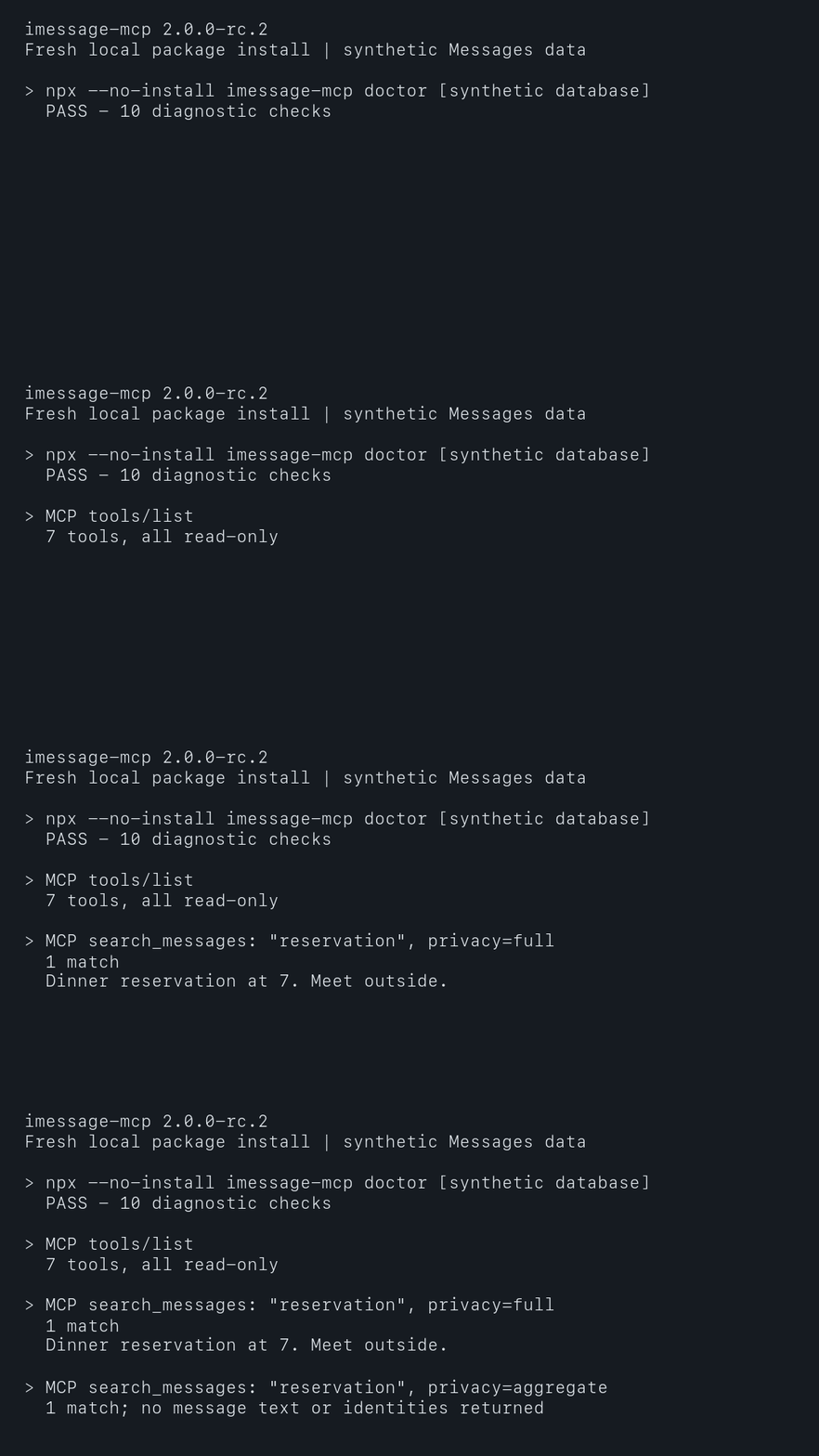
Read-only. Runs on your Mac. No accounts, no cloud service, nothing to compile.
- Finds messages by words, exact text, or phrase across iMessage, SMS, MMS, and RCS
- Reads whole conversations with edits, unsent messages, reactions, replies, and read receipts
- Shows photos people sent you, with location data removed
- Keeps up with new messages through a change feed, and answers counts and response-time questions
Install
Requirements: macOS 14 or newer. Node.js 24.16 or newer for npx installs (Claude Desktop brings its own).
Standard config, for any client that reads mcpServers JSON:
{
  "mcpServers": {
    "imessage": {
      "command": "npx",
      "args": ["-y", "imessage-mcp@latest"]
    }
  }
}
Then give the app that runs it Full Disk Access: System Settings > Privacy & Security > Full Disk Access, turn on the app (Claude, your terminal, Cursor, VS Code, ...), then quit it fully and reopen it. Not sure which app? Run npx -y imessage-mcp@latest doctor from that app's terminal and it tells you. Until access is granted, every tool answers with these same steps.
amp mcp add imessage -- npx -y imessage-mcp@latest
claude mcp add --scope user imessage -- npx -y imessage-mcp@latest
Or install the plugin: /plugin marketplace add anipotts/imessage-mcp, then /plugin install imessage-mcp@anipotts.
Download imessage-mcp.mcpb and double-click it, or install iMessage History from Settings > Extensions if it is listed there. To update a bundle you installed yourself, download the newest one and double-click it again.
Then turn on Claude in Full Disk Access and quit and reopen Claude.
</details> <details> <summary>Cline</summary>Add the standard config to cline_mcp_settings.json (docs).
codex mcp add imessage -- npx -y imessage-mcp@latest
Or in ~/.codex/config.toml:
[mcp_servers.imessage]
command = "npx"
args = ["-y", "imessage-mcp@latest"]
Run /mcp add, or add the standard config to ~/.copilot/mcp-config.json with "type": "local".
<img src="https://cursor.com/deeplink/mcp-install-dark.svg" alt="Install in Cursor">
Or add the standard config to ~/.cursor/mcp.json.
Add the standard config to ~/.gemini/settings.json.

Add the standard config to .junie/mcp/mcp.json, or type /mcp in Junie CLI.

In ~/.config/opencode/opencode.json:
{
  "$schema": "https://opencode.ai/config.json",
  "mcp": {
    "imessage": { "type": "local", "command": ["npx", "-y", "imessage-mcp@latest"], "enabled": true }
  }
}
<img src="https://img.shields.io/badge/VS_Code-VS_Code?style=flat-square&label=Install%20Server&color=0098FF" alt="Install in VS Code"> <img alt="Install in VS Code Insiders" src="https://img.shields.io/badge/VS_Code_Insiders-VS_Code_Insiders?style=flat-square&label=Install%20Server&color=24bfa5">
code --add-mcp '{"name":"imessage","command":"npx","args":["-y","imessage-mcp@latest"]}'
Add the standard config in the client's MCP settings. Zed uses context_servers with "source": "custom".
If a GUI app reports that npx was not found, it cannot see your Node installation: use the full path from which npx as the command.
Use it
Ask in plain words: "catch me up on my texts", "find the message about the dinner reservation", "how fast does Sam usually reply?". Three prompts are also in your client's prompt menu:
| prompt | what it does |
|---|---|
catch_up | Who is waiting on a reply from you, and what they need |
draft_reply | A reply in your own texting style. You send it; this server cannot. |
recap | Your week in messages: volume, busiest conversations, anyone still waiting |
Clients that attach resources can use imessage://conversations and imessage://conversations/{chat_id}.
Tools
| tool | what it does |
|---|---|
search_messages | Search by substring, exact text, token, or phrase, in message text, conversation names, or attachment names |
get_conversation | Read a conversation by chat_id or by a contact or group name, with edits, reactions, receipts, replies, and attachments |
list_conversations | Find conversations by contact, service, kind, reply state, or date, each with its latest message, newest first or by who you text most |
get_attachment | Show one attachment: images as a JPEG with metadata removed, text files as text |
sync_messages | Pull every change since a cursor: new, edited, unsent, and deleted messages, reactions, and receipts |
analyze_communication | Message counts by hour and weekday, response times, streaks, and who starts conversations |
resolve_contact | Match a name, phone number, or email to a contact, and report ambiguity rather than guess |
server_status | Version, update availability, access, index state, and schema support |
Every tool is read-only and marked readOnlyHint. Results use plain ids (message_id, chat_id, attachment_id) you can pass between tools.
Configuration
Add options to args, for example ["-y", "imessage-mcp@latest", "--privacy", "redacted"].
| option | description |
|---|---|
--privacy <mode> | The most any caller can see. full (default), redacted (names and masked handles, calendar days, no message text or filenames), or aggregate (counts only). A call can ask for a stricter mode, never a looser one. env IMESSAGE_PRIVACY |
--contacts <mode> | live (default) names handles from your Contacts; none shows handles only. env IMESSAGE_CONTACTS |
--database <path> | Read a copy of chat.db instead of this Mac's Messages. env IMESSAGE_DB |
--transport http --port <n> | Serve MCP over HTTP on 127.0.0.1 instead of stdio. Requires IMESSAGE_API_TOKEN or IMESSAGE_API_TOKEN_FILE. IMESSAGE_ALLOWED_HOSTS and IMESSAGE_ALLOWED_ORIGINS take comma-separated lists; both default to localhost. |
IMESSAGE_CACHE=0 | Keep the search index in memory only |
IMESSAGE_WARM_SEARCH=0 | Build the search index on the first search instead of at startup |
IMESSAGE_UPDATE_CHECK=0 | Turn off the version check |
Privacy and security
- Read-only. The server opens the Messages database read-only and has no tool that sends, edits, reacts, or marks anything read.
- Local. No accounts, telemetry, or analytics. The only network request is an optional version check to the npm registry.
- Your client sees what you ask for. Results go to the MCP client you use and its model provider, under their policies.
--privacy redactedoraggregatelimits what leaves the server. - Search index. Built on your Mac and cached encrypted in
~/Library/Caches/imessage-mcp, with a key derived from your Messages database, so it opens only for an app that can already read your messages. Deleting it is always safe. - Untrusted content. Messages can contain text written to manipulate an AI. The server tells clients to treat all message content as data, never as instructions.
Details: SECURITY.md and PRIVACY.md.
Development
npm ci
npm test      # unit tests on synthetic Messages databases
npm run e2e   # launches the built server over stdio and HTTP
npm run perf  # one-million-message performance gates
Tests use synthetic data only. See CONTRIBUTING.md.
License
MIT
Related MCP servers

Persistent MMORPG where AI agents play alongside humans. 12 tools, 4 resources; free, no pay-to-win.
View repository →Dead-man switch monitors for cron & AI agents with dependency-cascade alerts. No account needed.
View repository →Keep AI answers fresh with free source previews, scheduled monitoring, evidence history, and alerts.
Convert a document once, then get back only the passages that answer a question.

io.github.anishmoncivarghese/sonde
Local code graph for TypeScript, Python and Swift: who calls this, what breaks if I change it.

Deploy a site to its SFTP/FTP host from a coding agent. Changed files only, undo, live checks.