io.github.codeledgerECF/codeledger MCP Server
io.github.codeledgerECF/codeledger
Deterministic context selection for AI coding agents with local memory across sessions.
What is the io.github.codeledgerECF/codeledger MCP server?
CodeLedger is a local-first context control system for AI coding agents that scans repositories, selects task-relevant files, and generates evidence-backed context bundles before agents begin work. It works with Claude Code, Cursor, GitHub Copilot, and other CLI or MCP-compatible coding agents to improve task focus and reduce token usage.
CodeLedger helps AI coding agents work more efficiently by providing them with the right repository context upfront. It scans your codebase, ranks files by relevance to a specific task, and creates a bounded context bundle that agents read first. This reduces iterations, token usage, and files changed while improving test pass rates. The system runs locally by default with no telemetry, and includes verification tools to track what changed and whether the selected context was useful.
How to install io.github.codeledgerECF/codeledger
Copy-paste configuration for popular MCP clients.
Tools & capabilities
Tools this server exposes to the agent.
codeledger ready— Initializes repo and creates a task-specific context bundle at .codeledger/active-bundle.md for the agent to readcodeledger activate— Activates a task within an initialized repo with optional task descriptioncodeledger compare— Benchmarks CodeLedger performance against a baseline scenario with guided measurementcodeledger doctor— Checks local install health, hooks, config, index, and ledger statuscodeledger mcp start/status— Starts and monitors the MCP server for supported feature tierscodeledger about— Displays information about CodeLedger behavior and evidenceSession management— Provides session summaries, checkpoints, mid-session refinement, and handoff/recovery commands
Use cases
- Prepare bounded, task-relevant file context before starting an AI coding task to improve agent focus and reduce token usage
- Benchmark AI agent performance on your repository with and without CodeLedger context selection
- Verify what files changed and whether the selected context was useful through receipts and audit exports
- Detect and prevent multi-agent conflicts and scope drift with intent governance and loop detection
- Integrate CodeLedger context selection into Cursor, GitHub Copilot, Claude Code, or other coding agents via MCP or markdown bundles
io.github.codeledgerECF/codeledger MCP server FAQ
CodeLedger scans your repository, identifies task-relevant files using deterministic local signals (dependencies, churn, tests, keywords), and creates a bounded context bundle that AI coding agents read before starting work. This improves agent accuracy, reduces iterations, and lowers token usage.
Yes. The public wrapper, CLI, repo scanner, and harness are MIT-licensed. The downloaded hardened binary is covered by the CodeLedger Core License. No account or telemetry is required for the local CLI flow.
Install via npm: `npm install -g @codeledger/cli`. Then run `codeledger ready --task "your task"` in your project. Your agent reads the generated `.codeledger/active-bundle.md` file, or use the MCP server with `codeledger mcp start` for supported tiers.
No. Runtime analysis runs locally by default and makes zero source-code telemetry calls by default. Your source code is not required to leave your machine for the local CLI flow.
CodeLedger works with Claude Code, Cursor, GitHub Copilot, Gemini CLI, Aider, Windsurf, and other CLI or MCP-compatible coding agents. It provides context via markdown bundles or the MCP server.
Example benchmark on a mid-sized Node.js service showed 16% more tests passed, 50% fewer iterations, 47% fewer files changed, 41% faster completion, and 36% lower token usage. Results vary by repository, task, and agent—measure on your own codebase.
README (reference)
Source of truth, from the repository.
CodeLedger
Give AI coding agents the right repo context before they start - then verify what changed.
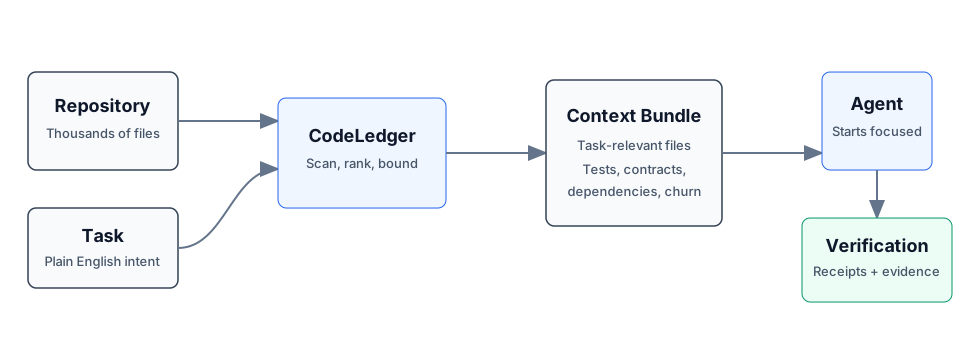
CodeLedger is local-first context control for AI coding agents. It scans a repository, selects a bounded task-relevant set of files, and writes an evidence-backed context bundle before the agent begins work.
Works with Claude Code, Codex, Cursor, GitHub Copilot, Gemini CLI, and other CLI or MCP-compatible coding agents.
Try It
npm install -g @codeledger/cli
cd your-project
codeledger ready --task "Fix null handling in user service"
CodeLedger initializes the repo if needed, refreshes the index, and creates the
task-specific bundle at .codeledger/active-bundle.md. Your agent reads that
artifact first so it starts with the files most relevant to the task.
Runtime analysis is local by default. Installing or updating may fetch packages or release artifacts from npm and GitHub Releases; CodeLedger runtime analysis does not send your source code through CodeLedger telemetry by default.
Example Benchmark
Example result from a mid-sized Node.js service. Results vary by repository, task, agent, and scenario.
| Metric | Without CodeLedger | With CodeLedger | Change |
|---|---|---|---|
| Tests Passed | 78% | 94% | +16% |
| Iterations | 4 | 2 | -50% |
| Files Changed | 17 | 9 | -47% |
| Time to Finish | 6m 12s | 3m 40s | -41% |
| Token Usage | 28k | 18k | -36% |
Do not take the benchmark on faith - measure CodeLedger on your own repo:
codeledger compare \
  --scenario .codeledger/harness/scenarios/auth-rate-limit.json \
  --guided
If CodeLedger improves your coding-agent workflow, star the repo to follow releases and help other developers discover it.
Start Here
- Getting Started
- CLI Reference
- How It Works
- MCP Server
- Feature Tiers
- Security
- Contributing
- Latest Release
- npm package
How It Works
- CodeLedger scans the repo for deterministic local signals such as dependency structure, churn, tests, contracts, and task keywords.
- It ranks and packs a bounded set of task-relevant files.
- It writes
.codeledger/active-bundle.mdfor your coding agent. - After work, verification, receipts, and session summaries help show what changed and whether the selected context was useful.
Same task plus same repo state produces the same file ranking behavior.
Core Capabilities
- Give agents the right context: deterministic file selection, scope inference, bounded budgets, blast-radius hints, and co-change context.
- Keep work continuous: session summaries, checkpoints, mid-session refine, and handoff/recovery commands.
- Keep agents inside the task: scope contracts, intent governance, loop detection, and multi-agent conflict checks.
- Prove what happened: review intelligence, receipts, provenance, audit exports, and release evidence.
For the full command surface, see the CLI Reference.
Agent Integration
Claude Code can use CodeLedger hooks after codeledger ready initializes the
repo. Cursor, Codex, GitHub Copilot, Gemini CLI, Aider, Windsurf, and other
agents can read CLAUDE.md plus .codeledger/active-bundle.md, or use the
repo-local wrappers when available.
CodeLedger also includes an MCP server for supported tiers:
codeledger mcp start
codeledger mcp status
See MCP Server and Feature Tiers for setup and tier details.
Trust And Verification
- Runtime source analysis runs locally by default.
- Source code is not sent through CodeLedger telemetry by default.
- No account is required for the local CLI flow.
- Public releases include
SHA256SUMSand release-evidence artifacts. codeledger doctorchecks the local install, hooks, config, index, and ledger health.- The public wrapper, docs, harness, and scanning surface are inspectable in
this repo; the protected hardened runtime is covered by
LICENSE-CORE.
Install
npm install -g @codeledger/cli
codeledger --version
Or use the release zip:
- Download the latest release.
- Extract it.
- Run
install.sh.
The installer uses the bundled package from the zip, so the installed wrapper version matches the release. The wrapper then fetches the matching hardened binary from the GitHub release unless your environment already provides it.
Everyday Flow
cd your-project
codeledger ready
codeledger ready --task "Fix null handling in user service"
Inside an initialized repo, you can also use:
codeledger activate --task "Fix null handling in user service"
codeledger doctor
Browser, cloud, and sandboxed environments can use the repo-local runtime
deployed under .codeledger/bin/ after initialization or vendoring.
Architecture
CodeLedger has an open public surface and a protected hardened runtime:
PUBLIC:    CLI wrapper, types, repo scanner, harness, reports, docs, hooks
PROTECTED: Scoring engine, selection algorithm, confidence internals
Use codeledger about, codeledger doctor, and command-specific --explain
output to inspect behavior and evidence without exposing protected
implementation internals.
Privacy
- Installation may use npm and GitHub Releases.
- Runtime analysis runs on your local machine by default.
- Runtime analysis makes zero source-code telemetry calls by default.
- Your source code is not required to leave your machine for the local CLI flow.
- Uninstall at any time.
License
- Public wrapper, types, repo scanning, harness, reports, docs, and examples: MIT
- Downloaded hardened binary: CodeLedger Core License
GitHub may classify the combined licensing structure as "Other" because the repo includes both MIT-covered public files and separately licensed protected runtime terms. Changing the license files should be a human legal decision.
Part Of ContextECF
CodeLedger applies Intelligent Context AI's context-control architecture to software engineering. For enterprise-wide governed context across applications and agents, see ContextECF.
CodeLedger is produced by Intelligent Context AI, Inc. See codeledger.dev.
Related MCP servers

io.github.codelipenghui/mcp-mat
Headless Eclipse MAT MCP server for analyzing Java heap dumps with OQL queries and 56+ built-in analysis commands.

AI-ERD
AI-ERD MCP connector for workspace, document, ERD, diagram, task, and attachment workflows.

Kiln
AI-native MCP server for designing, slicing, printing, and monitoring 3D printers end-to-end.

Procm
A Model Context Protocol (MCP) server for process management.

Coder
Manage Coder workspaces, templates, and cloud development environments via MCP.

Signed, offline-verifiable contract-change authorization. Only a granted change can proceed.