io.github.crabeye-ai/crabeye-mcp-bridge MCP Server
io.github.crabeye-ai/crabeye-mcp-bridge
Consolidate multiple MCP servers into one connection with tool discovery, namespacing, and execution policies.
What is the io.github.crabeye-ai/crabeye-mcp-bridge MCP server?
The Crabeye MCP Bridge is an MCP server that consolidates multiple upstream MCP servers behind a single STDIO interface, exposing just two tools: search_tools and run_tool. Instead of injecting hundreds of tool schemas into the context window, it discovers and indexes tools at startup, keeping them out of context until the assistant searches for them, with support for fuzzy search and per-tool execution policies.
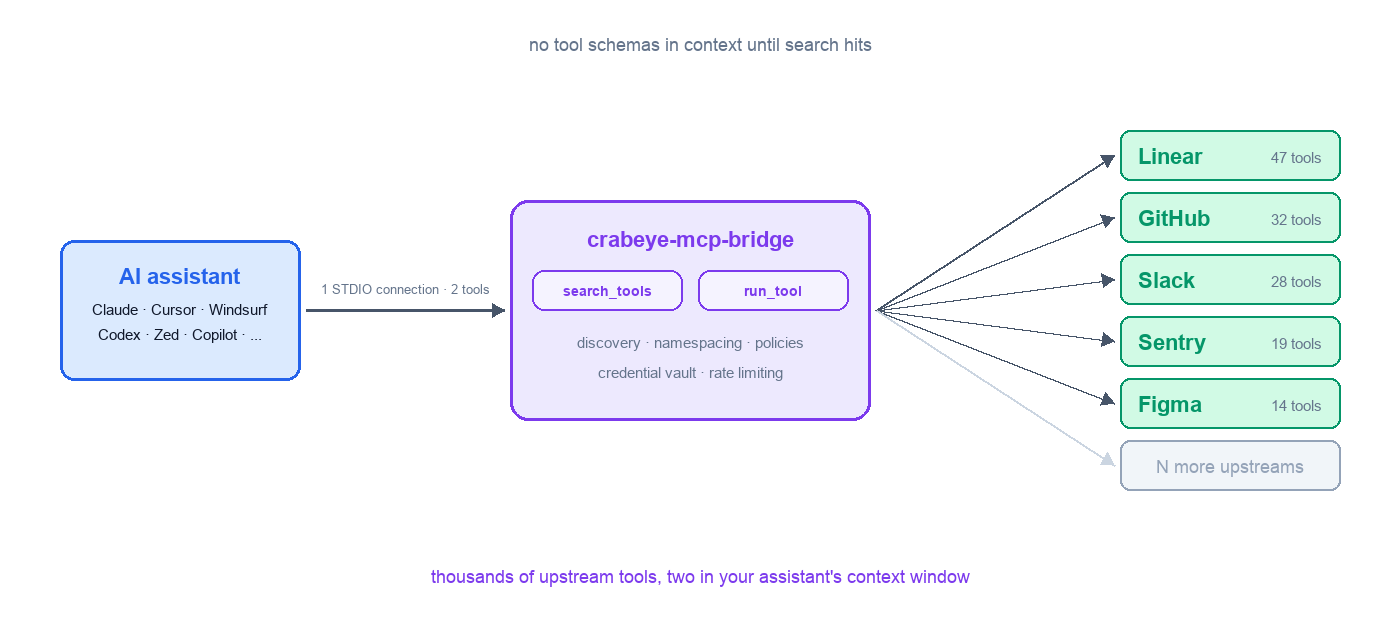
Crabeye MCP Bridge solves context bloat by multiplexing many MCP servers through a single connection. Rather than adding ten servers with a hundred tools each (burning tokens on unused schemas), the bridge fans out to all your upstream servers—Linear, GitHub, Slack, Sentry, Figma, etc.—and lets your assistant search and run tools on demand. You get a thousand tools ready to go without inflating the context window.
How to install io.github.crabeye-ai/crabeye-mcp-bridge
Copy-paste configuration for popular MCP clients.
Tools & capabilities
Tools this server exposes to the agent.
search_tools— Search and discover tools from all upstream MCP servers by name or fuzzy matching.run_tool— Execute a tool from any upstream MCP server with specified arguments and policies.
Use cases
- Consolidate 10+ MCP servers (GitHub, Linear, Slack, Sentry, Figma) into a single connection to reduce context bloat.
- Search for tools across all upstream servers without loading their full schemas into the context window.
- Control tool execution with per-tool and per-server policies (always, prompt, never) and rate limiting.
- Migrate existing MCP client configs (Claude Desktop, Cursor, VS Code Copilot, Windsurf, Zed) to the bridge with automatic discovery.
- Manage credentials securely with an encrypted store and OS-keychain-backed master key.
io.github.crabeye-ai/crabeye-mcp-bridge MCP server FAQ
It's an MCP server that multiplexes multiple upstream MCP servers through a single STDIO connection, exposing search_tools and run_tool instead of injecting all tool schemas into context. Tools are discovered and indexed at startup but stay out of the context window until searched.
Yes, the Crabeye MCP Bridge is open-source under the MIT license.
Run `npx @crabeye-ai/crabeye-mcp-bridge init` to auto-discover your existing MCP configs and set up the bridge. For manual setup, rename your mcpServers to upstreamMcpServers, add the bridge as a single entry point, and store secrets in the encrypted credential store.
The bridge itself does not require auth to run. However, your upstream MCP servers (GitHub, Linear, etc.) may require tokens. The bridge provides an encrypted credential store and supports ${credential:key} templates to manage secrets securely.
Yes. The bridge works with Claude Desktop, Cursor, VS Code Copilot, Windsurf, Zed, Cline, Roo Code, opencode, and Continue.dev. You can also install it as a Claude Code plugin.
The bridge supports per-tool, per-server, and global policies with three modes: always (run without approval), prompt (ask before running), and never (block execution). It also supports rate limiting.
README (reference)
Source of truth, from the repository.
Crabeye MCP Bridge
One MCP connection for all your tools — with discovery, namespacing, and execution policies.
Every MCP server you add to your AI assistant means another connection, another set of tool definitions injected into the context window, and no way to search or control them centrally. Wire up ten servers with a hundred tools each and your assistant is burning tokens on a thousand tool schemas before the conversation even starts — most of which it will never call.
crabeye-mcp-bridge consolidates all your upstream MCP servers behind a single STDIO interface and exposes exactly two tools to the assistant: search_tools and run_tool. Tools from every server are discovered, namespaced, and indexed at startup, but none of them touch the context window until the assistant actually searches for them. You can have a thousand tools ready to go without bloating the context, with fuzzy search to find them and per-tool execution policies to control what runs freely, what needs approval, and what is blocked.
Quick start
The fastest way to get started is with init, which discovers your MCP client configs and sets up the bridge automatically:
npx @crabeye-ai/crabeye-mcp-bridge init
This scans for config files from Claude Desktop, Cursor, VS Code Copilot, Windsurf, Zed, Cline, Roo Code, opencode, and Continue.dev, lets you pick which ones to use, and optionally injects the bridge entry. After that, just run npx @crabeye-ai/crabeye-mcp-bridge — no --config flag needed.
opencode and Continue.dev are surfaced as detect-only: their config schemas don't fit the rename-and-inject pipeline, so init prints a manual snippet for them instead of rewriting the file.
To undo, run npx @crabeye-ai/crabeye-mcp-bridge restore.
Manual setup
If you prefer to set things up manually, say your MCP client config looks like this today:
{
  "mcpServers": {
    "linear": {
      "command": "npx",
      "args": ["-y", "@anthropic/linear-mcp-server"]
    },
    "github": {
      "command": "npx",
      "args": ["-y", "@anthropic/github-mcp-server"],
      "env": {
        "GITHUB_TOKEN": "ghp_..."
      }
    }
  }
}
First, store your secrets in the encrypted credential store:
crabeye-mcp-bridge credential set github-pat ghp_abc123
Then rename mcpServers to upstreamMcpServers, add the bridge, and replace hardcoded tokens with ${credential:key} references:
{
  "mcpServers": {
    "bridge": {
      "command": "npx",
      "args": ["-y", "@crabeye-ai/crabeye-mcp-bridge", "--config", "/path/to/this/file.json"]
    }
  },
  "upstreamMcpServers": {
    "linear": {
      "command": "npx",
      "args": ["-y", "@anthropic/linear-mcp-server"]
    },
    "github": {
      "command": "npx",
      "args": ["-y", "@anthropic/github-mcp-server"],
      "env": {
        "GITHUB_TOKEN": "${credential:github-pat}"
      }
    }
  }
}
That's it. Your AI assistant now has access to all tools from all configured servers through a single connection. The bridge automatically excludes itself from mcpServers to avoid recursion, so pointing --config at the same file is safe.
The bridge also reads upstreamServers (shorthand), servers (VS Code Copilot), and context_servers (Zed) as input keys. See docs/configuration.md for the full priority order and self-exclusion rules.
Alternatively, you can add the bridge alongside your existing mcpServers entries without renaming anything — the bridge will pick up the other servers from mcpServers automatically (excluding itself). Disable the other MCP servers in your client so the assistant uses the bridge as the single entry point.
Install as a Claude Code plugin
Register the bridge's repo as a Claude Code marketplace, then install the plugin:
/plugin marketplace add crabeye-ai/crabeye-mcp-bridge
/plugin install crabeye-mcp-bridge@crabeye
Claude Code auto-registers the bridge as an MCP server. If you haven't configured upstreams yet, the bridge's startup error will surface in Claude Code's MCP server log — run npx @crabeye-ai/crabeye-mcp-bridge init in a terminal to discover and import existing MCP server configs from your other clients.
Features
- Discovery + search. Two meta-tools (
search_tools,run_tool) instead of N×M tool definitions in context. See docs/how-it-works.md. - Configuration. STDIO, HTTP, and SSE upstreams; categories; multi-source config keys. See docs/configuration.md.
- Authentication. Encrypted credential store, OS-keychain-backed master key,
${credential:key}templates, and a one-shotauth <server>OAuth flow for HTTP upstreams. See docs/auth.md. - Policies. Per-tool / per-server / global tool policies (
always/prompt/never), rate limiting, discovery modes. See docs/policies.md. - STDIO manager. STDIO upstreams routed through a per-user manager process so multiple bridges share a single subprocess per upstream. See docs/stdio-manager.md.
- CLI.
init,restore,credential,daemon,--validate. See docs/cli.md.
License
MIT
Related MCP servers

AgentLaunch
Plan and run paced startup, SaaS and AI directory launches from your agent, in your own Chrome.

katra
A committed markdown dev log and task graph that agents read and write over MCP.
mail-muncher
Filtered, read-only IMAP and Gmail archived to disk as .eml + markdown, served over MCP.

Trust + counterparty-risk layer for x402 A2A trades: reputation, pre-hire check, escrow, disputes

MCP server for Framedash game telemetry: query analytics, heatmaps, perf regressions, and alerts

io.github.crawde/chartforge
MCP server for ChartForge — generate stunning charts and diagrams from natural language