io.github.gnt-ai/gnt MCP Server
io.github.gnt-ai/gnt
Git-native policy layer for AI agents: approve rules via PR, agents check actions before acting.
What is the io.github.gnt-ai/gnt MCP server?
The gnt MCP server is a git-native policy enforcement layer that lets AI agents check planned actions against organization-approved rules before executing them. Rules live in your repository as markdown files, approved through pull requests, and agents call `check_action` over MCP to get allow/block/escalate verdicts with full audit trails.
gnt provides policy governance for AI agents by storing rules in your git repository and requiring agents to check actions against those rules before acting. Every rule approval is a merged PR, creating a complete audit trail. Use it to enforce guardrails on risky operations like refunds, deletions, or customer communications—without dashboards or manual approval workflows.
How to install io.github.gnt-ai/gnt
Copy-paste configuration for popular MCP clients.
Tools & capabilities
Tools this server exposes to the agent.
check_action— Checks a described action against approved rules and returns allowed, blocked, or needs_human verdict with cited rules and reason.search_rules— Semantic search over approved rules, optionally filtered by tag. Returns empty list if no rule covers the query.get_rule— Fetches one approved rule by id with its provenance: who approved it, when, and what source it came from.list_skill_packs— Lists every compiled skill pack version for your organization, newest first.get_skill_pack— Fetches a compiled skill pack's manifest and file list by id.
Use cases
- Block refunds over a threshold without manager approval
- Prevent bulk deletions without escalation to a human reviewer
- Enforce customer communication policies before agents send messages
- Search organization rules to understand what actions are permitted
- Audit every policy decision with git history and PR links
io.github.gnt-ai/gnt MCP server FAQ
gnt is a policy enforcement layer for AI agents. Rules live in your git repo as markdown files approved via PR, and agents call check_action over MCP before risky operations to get allow/block/escalate verdicts with full audit trails.
Yes. Self-hosting is free forever under Apache-2.0 (clone, run docker compose up, bring your own keys). The hosted version at gntai.dev offers managed OAuth connectors and usage-based AI features.
Add the remote MCP endpoint https://api.gntai.dev/mcp to your client config, or self-host by cloning the repo and running docker compose up. Use gnt login and gnt connect github to link your rules repository.
Yes. Run gnt login to store an API key locally (~/.gnt/credentials.json). For self-hosting, set GNT_API_URL to your own instance and configure required environment variables (ZEROENTROPY_API_KEY, STORE_INTERNAL_API_SECRET, etc.).
Rules are markdown files in your repo's rules/ directory. Approval is a merged pull request—no separate dashboard or publish step. Every rule includes frontmatter with approval metadata, owner, and PR link for full traceability.
The check_action verdict returns needs_human, the fail-closed default. gnt never guesses—it only allows actions explicitly covered by an approved rule.
README (reference)
Source of truth, from the repository.



Run the setup below once and every agent your team runs has a git-native rulebook it has to check over MCP before it acts, approved the same way your code already is: a merged pull request.
- Rules live in your repo as files and ship through normal PRs, not a dashboard click.
- Agents call
check_actionover MCP before anything risky (a refund, a delete, a message to a customer) and get back an allow/block/escalate verdict. - Every rule traces back to the git file and the PR that approved it, so "why did the agent do that" always has a paper trail.
Prefer not to run any of this yourself? The hosted version at gntai.dev does the same thing without you standing up a Postgres instance.
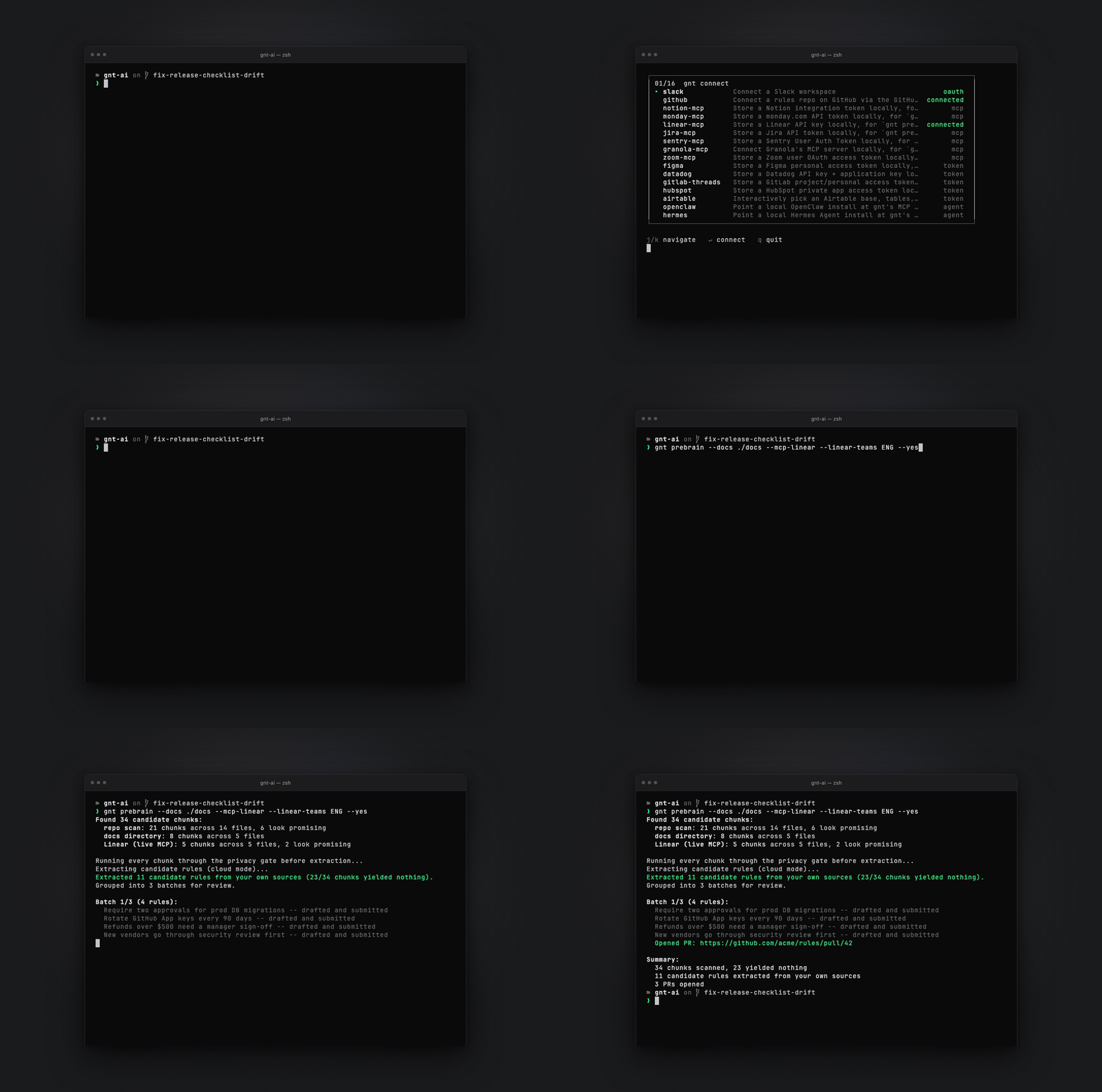
Get started (30 seconds)
npm install -g @gnt-ai/cli
gnt login
gnt connect github
gnt prebrain
# merge the opened PR on GitHub. that merge is the approval
Try it with Docker first
To see a real check_action response before installing Node or npm, clone
the repository and run the Docker-only demo:
./demo.sh
It builds the full local stack in an isolated gnt-demo Compose project,
seeds an approved refund rule, calls check_action, and prints a curl command
you can run again. Without an Anthropic key the real fail-closed path returns
needs_human; pass GNT_DEMO_ANTHROPIC_API_KEY=sk-ant-... ./demo.sh to opt in
to the model's grounded policy verdict. The demo uses deterministic local embeddings and
throwaway localhost-only secrets, so it does not need a ZeroEntropy key.
Nothing for
gnt prebrainto scan yet? Rungnt initfirst — it scaffoldsrules/locally with a couple of example rule files so there's something real to look at and edit, and points you atgnt prebrain --starter-packsfor a curated pack to start from instead.
That merge lands a rule file in your connected repo, shaped like this:
your-repo/
└── rules/
    ├── refund-approval-threshold.md
    └── contract-legal-cc.md
Each file is plain markdown with YAML frontmatter:
---
title: Never refund over $500 without a manager
status: approved
confidence: 0.91
owner_id: finance-team
source_citations: [...]
source: slack
tags: [refunds, finance]
last_validated_at: 2026-07-20
version: 1
superseded_by: null
approved_by: jane@company.com
approved_at: 2026-07-21T14:03:00Z
created_at: 2026-07-18T09:12:00Z
pr_number: 142
pr_url: https://github.com/your-org/your-repo/pull/142
---

Refunds over $500 need manager sign-off before they go out...
See it in action
There's no captured transcript to show yet (see the gap noted at the bottom of this README).
Here's the actual response shape a check_action call returns, straight from the tool's
contract:
{
  "verdict": "blocked",
  "reason": "Refund exceeds the $500 threshold without manager sign-off (rules/refund-approval-threshold.md)",
  "cited_rules": [
    { "id": "refund-approval-threshold", "title": "Never refund over $500 without a manager" }
  ],
  "rules_retrieved": 3
}
verdict is one of allowed, blocked, or needs_human. needs_human is the fail-closed
default: no approved rule covers the action, retrieval failed, or the check couldn't complete.
It never guesses.
What it does
One MCP endpoint, five tools:
| Tool | What it does |
|---|---|
check_action | Checks a described action against your approved rules before an agent takes it. Returns allowed, blocked, or needs_human with cited rules and a one-line reason. |
search_rules | Semantic search over your org's approved rules, optionally filtered by tag. An empty list means no approved rule covers the query. |
get_rule | Fetches one approved rule by id, with its provenance (who approved it, when, what it was cited from). |
list_skill_packs | Lists every compiled skill pack version for your org, newest first. |
get_skill_pack | Fetches a compiled skill pack's manifest and file list by id. |
Prerequisites
| Requirement | Check | Get it |
|---|---|---|
| Node >=22.13 | node --version | nodejs.org |
Install
| Method | Command |
|---|---|
| curl | curl -fsSL gntai.dev/install.sh | sh |
| npm | npm install -g @gnt-ai/cli |
gnt needs Node >=22.13. If the CLI fails to start with a version error, update Node first and confirm with
node --version.
Common commands
gnt login                # sign in, store an API key locally
gnt init                 # scaffold a local rules/ dir with example rule files
gnt connect github       # connect the repo your rules PRs open against
gnt prebrain             # scan sources, extract candidate rules, open PRs
gnt review               # review rules awaiting approval
gnt status               # show brain status
gnt pull                 # download the latest skill pack
gnt gaps                 # list uncovered queries with no approved rule
Config
| Variable | Default | What it controls |
|---|---|---|
GNT_API_URL | https://api.gntai.dev | API endpoint the CLI and MCP calls hit |
GNT_WEB_URL | https://gntai.dev | Web app used for gnt login's browser step |
GNT_CONFIG_DIR | ~/.gnt | Where credentials.json and local config live |
Privacy
- No analytics or telemetry dependency in the CLI or the web app.
gnt prebrain's default extraction mode is cloud, not on-device: your source text goes straight to Anthropic's API (or Vercel AI Gateway with zero-data-retention, if you configure it), never to gnt's own servers. Fully on-device extraction needs--mode localagainst a local Ollama daemon.- The extracted rule candidates still get sent to gnt's API to open the PR. Raw source text stays off gnt's servers in cloud mode; the resulting rule text doesn't.
- Rules live in your connected GitHub repo and in gnt's own database. The MCP tools read from gnt's store, not by cloning your repo on every call.
- Self-hosting:
apps/apionly sends error data to Sentry if you setSENTRY_DSNyourself. Leave it unset and nothing goes out.
Team setup
- Who writes rules: anyone with access to your connected repo, either through
gnt prebrain(batch-extracted from real sources) orgnt review(hand-proposed). - How approval works: merging the PR is the approval. There's no separate publish step.
- What gets committed:
rules/<rule-id>.mdfiles with the frontmatter shown above and a plain markdown body. - Catching a malformed rule before it's reviewed:
gnt rules lintchecks a rule file's frontmatter locally, andgnt-ai/gnt/.github/actions/lint-rulesruns the same check as a CI step on your rules repo's own PRs, so a bad frontmatter fails the PR instead of the review.
Troubleshooting
Self-hosting:
gnt login's browser step has nowhere to land.gnt loginopens a browser to a/cli-loginpage and polls the API for the resulting key — that page is served by the hosted product's web app, which isn't part of this repo. There's no CLI-only login flow (device code or otherwise) today, and nogntcommand to set a key manually. Self-hosting this stack currently means building your own thin frontend for that one route (it just needs to complete the sign-in flow and hand the CLI a key). This is a real, open gap in the self-host path, not a config issue — closing it properly means adding a CLI-only login flow.
ValueError: refusing to start: these settings still have their .env.example placeholder value...Achange-me-...string is still sitting inapps/api/.env. The error names every offending field; generate a real value for each and retry.
storefails to start withGNT_STORE_INTERNAL_API_SECRET is not set.apps/store/.envwasn't filled in, or wasn't picked up. Confirm the file exists at that exact path, not still named.env.example.
Every store-to-api call gets rejected with 401 or 403, even though both services are up.
STORE_INTERNAL_API_SECRET/APPROVAL_SIGNING_SECRETinapps/api/.envdon't byte-for-byte matchGNT_STORE_INTERNAL_API_SECRET/GNT_APPROVAL_SIGNING_SECRETinapps/store/.env. This fails closed by design. Regenerate both pairs so the two files agree.
A rule fails to save with an embedding or rerank error.
apps/store/.envis missingZEROENTROPY_API_KEY, or it's still empty. Get a real one from zeroentropy.dev.
Full command reference
gnt login
gnt logout
gnt init                 scaffold a local rules/ dir with example rule files (--dir <path>)
gnt connect <app>        github, slack, notion-mcp, monday-mcp, linear-mcp, jira-mcp,
                          sentry-mcp, granola-mcp, zoom-mcp, figma, datadog,
                          gitlab-threads, hubspot, airtable, openclaw, hermes
gnt disconnect <app>
gnt status
gnt billing
gnt review
gnt pull
gnt gaps
gnt prebrain              scan local sources, extract candidate rules, open batched draft
                           PRs (~60 flags for source paths and extraction mode, see
                           `gnt prebrain --help`; --mode cloud|local, cloud is the default)
gnt stale
gnt keys list|create|revoke|rotate
gnt webhook list|create|revoke
gnt org show|rename|invite|remove
Shell completion
# bash, add to ~/.bashrc
eval "$(gnt completion bash)"

# zsh, add to ~/.zshrc
eval "$(gnt completion zsh)"

# fish, add to ~/.config/fish/config.fish
gnt completion fish | source
Learn more
- Self-hosting walkthrough, including the production-hardening path:
docs/self-hosting/README.md - Security policy:
SECURITY.md
Self-hosting is a first-class, fully supported path — Apache-2.0 from day one, run it on your own infra with your own keys, or use the hosted version at gntai.dev. The homepage FAQ and the self-hosting docs both describe this same path; there is no "not today" caveat.
License
Copyright © 2026 gnt.ai. Licensed under Apache-2.0 — see LICENSE for the terms and NOTICE for the trademark rule on forks.
Why is this free?
Self-hosting gnt costs you nothing, forever — clone it, run docker compose up, bring your own keys. What we sell is the part self-hosting doesn't give you: hosting at gntai.dev, managed OAuth connectors (GitHub, Slack, Linear, Notion, Zendesk — no app-approval process on your end), and usage-based AI features. If you'd rather run it yourself, that's a fully supported, fully free path, not a crippled trial of the real thing.
Contributing
See CONTRIBUTING.md for dev setup and how to open a PR. Every commit needs a Signed-off-by trailer (git commit -s), the Developer Certificate of Origin instead of a CLA. No separate form, just the flag.
Thanks to everyone who's sent a PR:
<a href="https://github.com/gnt-ai/gnt/graphs/contributors"> <img src="https://contrib.rocks/image?repo=gnt-ai/gnt" alt="gnt contributors" /> </a> <div align="center">


Related MCP servers

EchoVault Memory
Local-first memory for coding agents; stores decisions, bugs, and context across sessions.

Agent reputation scoring: trust scores, Sybil detection, cross-chain identity for 133K+ agents
View repository →
Full text and amendment history of Hungarian acts: section-level search, point-in-time text, diffs.

Search, bid, and message clients on Freelancer.com from Claude. Multi-account support.

Is this transaction safe to sign? Decodes what it really does and answers allow, warn or block.

CN Scraper MCP
Search Chinese e-commerce and social platforms (Taobao, JD, Xiaohongshu, Zhihu, Weibo, Bilibili) with local-first login and anti-bot bypass.