io.github.ihorponom/agentpack MCP Server
io.github.ihorponom/agentpack
Repo-native task continuity for AI coding agents: a reviewed task-state ledger served over MCP.
What is the io.github.ihorponom/agentpack MCP server?
Agentpack is an MCP server that enables AI coding agents to maintain persistent task state across sessions by storing a local, reviewable ledger in `.agentpack/` within your repository. It allows agents to record decisions, evidence, and checkpoints while working, so the next session—whether the same agent, a different client, or days later—can load that state and continue without rebuilding context from scratch. The system is local-first, agent-oriented, and human-friendly, with no cloud dependencies or telemetry.
Agentpack solves the problem of AI agents losing context when sessions end or context windows are compacted. It maintains a task-scoped ledger with a Task Passport (goal, status, constraints, next actions), checkpoints, decisions, and verified source conclusions. Agents record durable state as they work; the next session loads it back and continues. It includes optional task gates to keep agents focused on their assigned scope, CLI tools for manual inspection and handoff, and integrations with Claude Code, Cursor, Codex, and Claude Desktop.
How to install io.github.ihorponom/agentpack
Copy-paste configuration for popular MCP clients.
Tools & capabilities
Tools this server exposes to the agent.
load_task_state— Load the current Task Passport, recent checkpoints, decisions, and reviewed source conclusions at session startrecord_decision— Record durable decisions and approaches that failed while working on a taskrecord_evidence— Store verification evidence and selectively cache reviewed source conclusions with file hashescreate_checkpoint— Create a checkpoint with status, next actions, and git state at a coherent task boundarytask_gate— Optional gate (native hooks plus pre-commit) that warns or blocks edits that bypass the active task scope
Use cases
- Resume an ongoing refactor or bugfix days later without re-reading files or re-explaining decisions
- Switch between Claude Code, Cursor, Codex, or another MCP client while maintaining full task context
- Split work across parts of a monorepo with scoped tasks, keeping agents focused on their assigned folder
- Hand off a task checkpoint to a teammate's agent or a different client for continuation
- Reduce token spend by avoiding re-reading unchanged files and re-discovering old decisions when context is compacted
io.github.ihorponom/agentpack MCP server FAQ
Agentpack is an MCP server that stores AI agent task state (goals, decisions, evidence, checkpoints) in a local `.agentpack/` ledger inside your repo. Any connected agent can load this state and continue working without rebuilding context.
Yes. Agentpack is open-source (npm package `agentpack-cli`), local-first with no cloud or telemetry, and requires only Node.js >= 20.
Run `npm install -g agentpack-cli`, then `agentpack init` in your repo, then `agentpack install claude --write` (or `cursor`, `codex`, `claude-desktop`). Restart your client. See docs/INTEGRATIONS.md for client-specific setup.
No. It operates entirely locally within your repo with no network calls, cloud services, or external authentication.
The optional task gate (native hooks in Claude Code/Cursor/Codex, plus a git pre-commit hook) warns when edits bypass the active task scope. Enable enforcement with `"gateMode": "block"` in `.agentpack/config.json` to prevent out-of-scope changes.
Yes. Use `agentpack resume --preset agent --query "<topic>"` from the CLI to inspect the task ledger, or read the plain files in `.agentpack/` directly. The ledger is human-friendly and reviewable.
README (reference)
Source of truth, from the repository.
Agentpack


Repo-native task continuity for AI coding agents.
Coding agents forget. Agentpack gives them the task state they need to continue.
Here it is live. Session 1: Claude Code investigates a flaky test and records what it learns through the Agentpack MCP tools. Session 2, next day, empty context: the agent loads the task state and picks up exactly where the first session stopped — no re-investigation:

Prefer to poke at it by hand? The same flow driven from the CLI is in docs/DEMOS.md.
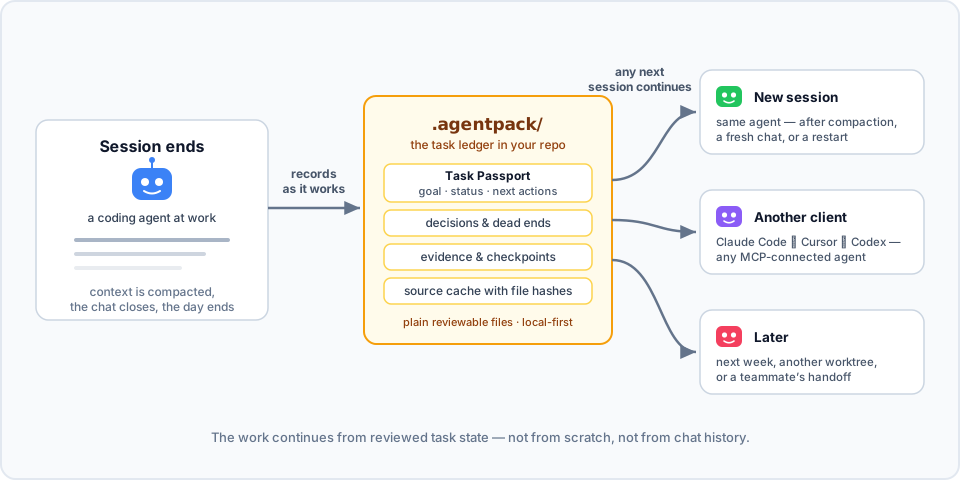
Every session ends the same way: the context window gets compacted, the chat closes, the task waits until tomorrow. The next session starts from zero — re-reading files, rediscovering decisions, retrying approaches that already failed.
Agentpack keeps a small, reviewable task ledger in .agentpack/ inside your repo. Connected agents record durable state as they work — the goal, decisions, dead ends, verification evidence, checkpoints — and the next session loads it back and continues. That next session can be the same agent after compaction, a different client, or you returning next week.
- Local-first. Plain files in your repo. No cloud, no telemetry, no network calls.
- Agent-oriented. A local MCP server plus generated project instructions (
AGENTS.md,CLAUDE.md, Cursor rules) tell agents when to load and record state. - Human-friendly. The same state is available through the CLI for inspection, debugging, and manual handoff.
Quick start
Requires Node.js >= 20.
npm install -g agentpack-cli

cd path/to/your/repo
agentpack init                     # once per repo
agentpack install claude --write   # per client: codex | claude | cursor | claude-desktop
Restart or reconnect the coding-agent client. From then on the agent loads Agentpack context at session start, records durable decisions, sources, and evidence while working, and checkpoints meaningful progress.
Run agentpack doctor to verify the setup, and agentpack resume --preset agent --query "<topic>" to inspect the task state yourself.
See docs/INTEGRATIONS.md for client-by-client setup, including what each installer writes and why.
Codex, Claude Code, and Cursor include an optional builder for implementation work. The main agent can use it when you ask or your instructions allow delegation, and explains what it will hand off before starting. Small tasks stay with the main agent.
How it works
- At session start, the agent loads compact Agentpack context: the current Task Passport, recent checkpoints, decisions, and reviewed source conclusions.
- While working, it records durable state — decisions worth keeping, approaches that failed, verification evidence — and selectively caches reviewed source conclusions with file hashes. A matching hash shows that the file is unchanged; it does not prove the conclusion is correct.
- At a coherent boundary, it creates a checkpoint with status, next actions, and git state.
- The next session — any MCP-connected agent — continues from that state instead of rebuilding it from chat history.
The ledger is task-scoped: a Task Passport carries the goal, status, constraints, write scope, next actions, and verification for the current task, with an explicit lifecycle (start, park, switch, finalize) for handoffs. An optional task gate (native Claude Code, Codex, and Cursor hooks plus a client-neutral pre-commit hook) warns — or in block mode, stops — when edits bypass the active task. The gate warns by default; opt into enforcement with "gateMode": "block" in .agentpack/config.json (modes and exit codes in docs/CLI.md).
Context is budgeted: resume output is compressed under a rough token estimate, so agents get the useful state back, not a pile of history.
When it helps
- The context window is compacted mid-task and the next turn needs the state back.
- You start a fresh chat or session on an ongoing task.
- You switch between Claude Code, Cursor, Codex, or another MCP client.
- You return to a refactor or bugfix days later.
- Another agent — or a teammate's agent — continues from your checkpoint.
- You split one session across parts of a monorepo (
api/,frontend/,cron/) with short scoped tasks, and the task gate keeps the agent from drifting outside the folder the current task owns.
A side effect: agents spend fewer tokens re-reading unchanged files and re-explaining old decisions.
Security posture
- Zero runtime dependencies, exact dev dependencies, committed lockfile,
ignore-scripts=true. - No telemetry and no network calls during normal CLI or MCP operation.
- Best-effort redaction of secret-looking values in stored context and handoff output.
- Releases are published from GitHub Actions with npm provenance (Trusted Publisher, no long-lived tokens); verify with
npm audit signatures.
See SECURITY.md for the full policy.
Documentation
- docs/INTEGRATIONS.md — safe setup for Codex, Claude Code, Cursor, Claude Desktop, and git hooks
- docs/CLI.md — full CLI reference, budgets, and manual fallback workflows
- docs/MCP.md — the MCP server contract and tool list
- docs/TASK-PASSPORT.md — task lifecycle, handoffs, and portable bundles
- docs/DEMOS.md — compact continuity demos you can run yourself
- docs/VISION.md — the strategic north star
Contributing / local development
Clone the repo and use Node 20+:
npm ci --ignore-scripts
npm test
npm run mcp:smoke
node dist/src/agentpack.js --help
This repo uses Agentpack on itself through MCP — docs/DOGFOOD.md describes the working protocol, docs/SETUP.md the full setup, and docs/RELEASING.md the release process.
Mirror: Codeberg. Issues, releases, and npm provenance stay on GitHub.
Related MCP servers

io.github.iinniitt/defi-guard-mcp
DeFi safety checks on Base before you sign: honeypot, owner-power scan, approval risk, Aave health.

io.github.ikop32-code/edgaralert
SEC insider trading alerts, Form 4 signals, 8-K events, and company research via EDGAR Alert API.

Wisepanel
Multi-agent deliberation across Claude, Gemini, and Perplexity. Stream and publish.

DoableClaw Research
AI research on companies and industries — one MCP tool per research domain.

Drive an Android emulator or device over adb: screenshot, inspect UI, tap, type, build and test.