io.github.infino-ai/code-context MCP Server
io.github.infino-ai/code-context
Local code search with hybrid keyword + semantic + SQL indexing for AI coding agents
What is the io.github.infino-ai/code-context MCP server?
The code-context MCP server is SuperGrep, a retrieval and inference offload tool for AI coding agents that indexes your repository locally and offers four search tools: find (exact keyword matching), search (ranked hybrid keyword + semantic), sql (read-only queries over the index), and ask (questions answered by small models on the Infino platform). It keeps keyword indexing on your machine while offloading embeddings and semantic search to the cloud, reducing token costs and improving answer quality especially for cheaper models.
SuperGrep helps AI agents find answers in code faster and cheaper by maintaining a hybrid index with both local keyword search and cloud-based semantic search capabilities. You can search across code, logs, test output, and other files using exact matching, ranked semantic search, SQL queries, or natural language questions. It's particularly useful for code review, large explorations across multiple repositories, and analyzing logs alongside source code.
How to install io.github.infino-ai/code-context
Copy-paste configuration for popular MCP clients.
CX_ROOTRepository root to serve. Optional - defaults to the working directory the server is launched in.
CX_INDEX_DIRWhere the index lives. Optional - defaults to .infino/ inside the repository root.
CX_AUTO_SYNCSet to 0 to disable the background staleness sync that runs as queries arrive.
CX_NO_EMBEDSet (1/true/yes) for keyword-only mode - skip the vector stage entirely.
CX_NO_RECEIPTSet (1/true/yes) to turn off local usage accounting: the per-call receipt on results and the cx usage ledger. Optional - on by default, computed locally, nothing leaves the machine.
Tools & capabilities
Tools this server exposes to the agent.
find— Exact string matching like grep -n, returning complete unranked results with repo-wide and per-file counts in tens of millisecondssearch— Ranked hybrid search fusing exact keyword matching with semantic similarity, returning results with code snippets and citationssql— Read-only SQL queries over the index, with ranked searches available as table-valued functions for aggregations and rankingsask— Natural language questions spanning the repository, answered by small models on the Infino service that return cited code rows rather than prose
Use cases
- Code review: find all callers of a function and understand what breaks if it changes
- Big explorations: run fifty parallel lookups across a codebase instead of spawning fifty subagents
- Multi-repository sessions: search across service, client, and shared library codebases without separate checkouts
- Log and issue analysis: index logs, test output, and issue exports alongside source code to diagnose failures
- CI failure diagnosis: search stack traces and logs efficiently without loading entire files into context
io.github.infino-ai/code-context MCP server FAQ
SuperGrep is a code search tool for AI agents that maintains a hybrid index: keyword search runs locally on your machine for speed, while semantic search and embeddings run on the Infino cloud platform. It offers four tools (find, search, sql, ask) that help agents locate and understand code without reading entire files into context.
Yes, SuperGrep offers a free account with no credit card required. The local tools (find and sql) work indefinitely on the free tier. The cloud tools (search and ask) have free credit that runs out over time, after which you can add billing details to continue.
Run two commands: `claude plugin marketplace add infino-ai/supergrep` and `claude plugin install code-context@infino-ai`. The first question in a directory will index it automatically. For cloud features, run `npx -y @infino-ai/code-context login --platform https://api.supergrep.infino.ai` once.
Local search (find, sql) requires no authentication. For cloud features (search, ask), you create a free account via `login` command with no email, password, or credit card—only a key stored locally at ~/.infino/key. Keep this key safe as it's your only way to sign back in.
SuperGrep indexes source code and also logs, test output, stack traces, CI output, configuration, and docs. It chunks .log, .out, .err, .jsonl, and .ndjson files at record boundaries so related information stays together.
Yes, one MCP server session can span multiple repositories. Each tool takes a path argument, so you can search across your service, client, and shared library codebases in the same session without separate checkouts.
README (reference)
Source of truth, from the repository.



SuperGrep
Retrieval + inference offload for AI coding agents. Help your agents find answers faster and at lower cost, while keeping the same answer quality. Particularly useful for cheaper models.
Try it live at infino.ai/supergrep - put a question to a real codebase and watch the same model answer it with and without SuperGrep, side by side, with the bill for each. Supergrep uses Infino for retrieval, which tightly integrates small language models with indexes for scalable agent retrieval on object storage.
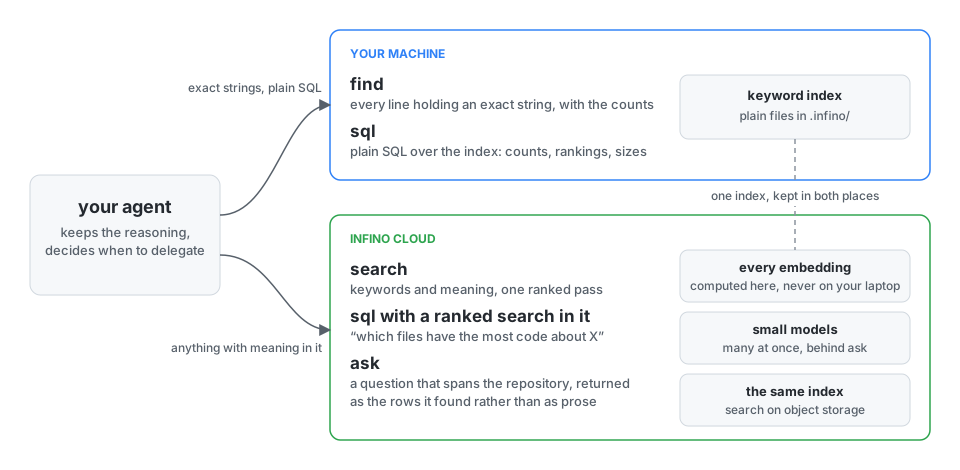
SuperGrep offers agents four tools over an Infino index, kept in two places. find and plain sql run on your machine, over the keyword index. Conversely, anything with meaning in it - search, a sql statement with a ranked search inside it, and ask - runs in the Infino cloud, so heavy compute and embeddings stays off your laptop. Infino also embeds inference models in its service, so several small models work the index at once and hand your agent the rows they found. Your agent keeps the reasoning, writes the answer, and decides when to use SuperGrep. No configuration.
| tool | what it does |
|---|---|
find | Every line containing an exact string, like grep -n: complete, unranked, with the repo-wide total and per-file counts. Tens of milliseconds from the index. |
search | One ranked pass fusing exact keyword matching with semantic similarity, so it works whether or not you know the words. Hits carry the code, cited path:line. |
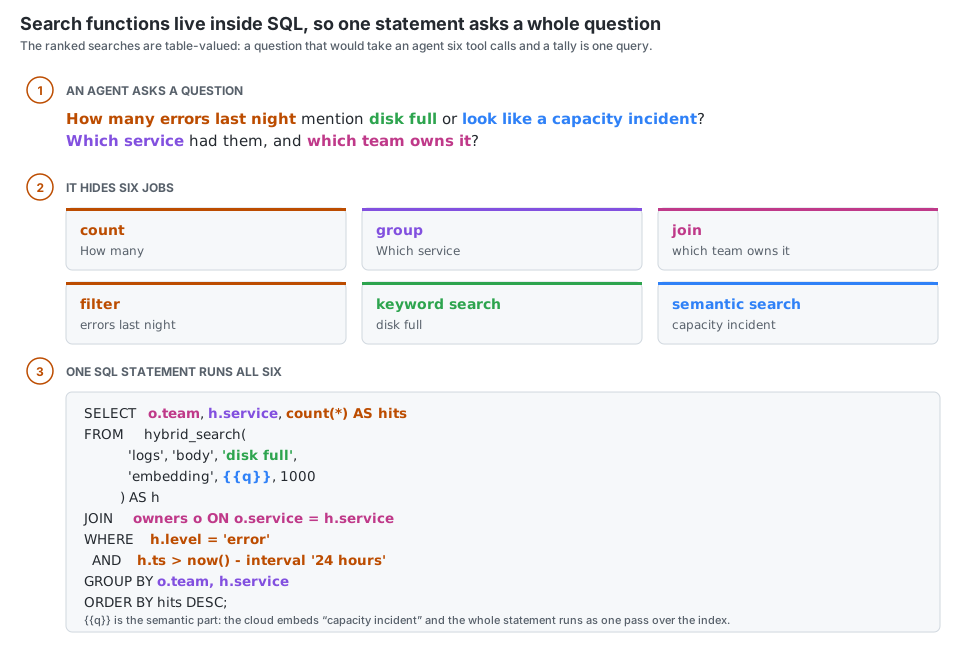
sql | Read-only SQL over the index. The ranked searches are table-valued, so "which files have the most code about X" ranks and tallies in one query. |
ask | A question that spans the repository, handed to small models on the Infino service that run the investigation against the index and return the rows they found, cited path:line, rather than prose. Several asks run at once. |
What people use it for
- Code review. The reviewer's question is "what else calls this, and what breaks if it changes".
findanswers with every caller and the counts in one call, andaskreads the paths that matter, so the review is about the change rather than about finding it. - Big explorations. "How does X work end to end" spawns fifty look-ups. With SuperGrep they run as fifty asks in parallel against the index, instead of fifty subagents reading the tree into your bill.
- Several codebases at once. Every local tool takes a repository path, so one session roams across every repo it touches - the service, the client, the shared library - without a checkout per question.
- Code, logs and issues together. Index the logs, the test output and the issue export beside the source, and "why did this integration test start failing?" is one question over all of them.
Your agent reaches for it on its own
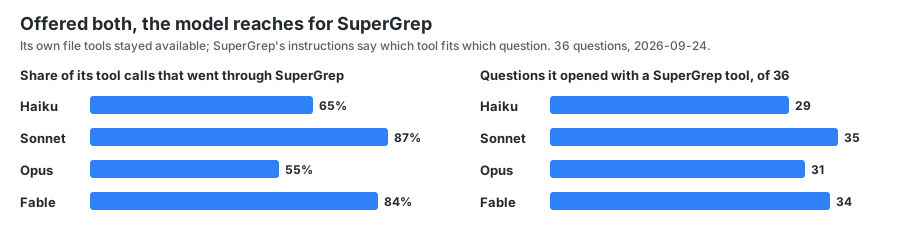
The model's own file tools stayed available throughout. What it had from SuperGrep was the server's instructions, which say which tool fits which kind of question; the choice on each call was the model's. The calls that are not SuperGrep are mostly Read: the model opens a file after the index has told it which one, rather than instead of asking. That is the shape you want - the index does the finding, and the model still opens what it needs to quote.
Go beyond code - index your entire laptop or any corpus
SuperGrep looks across all the files a question needs, not just the source. Logs, test output, stack traces, CI output, configuration and docs go in beside the code -
.log, .out, .err, .jsonl and .ndjson are chunked at record boundaries, so a stack trace stays with the message that explains it -
and the same four tools run over all of it: find for an exact stack frame, search for a failure you can only describe, sql to count and rank across a
run, ask for the question that spans several of them at once.
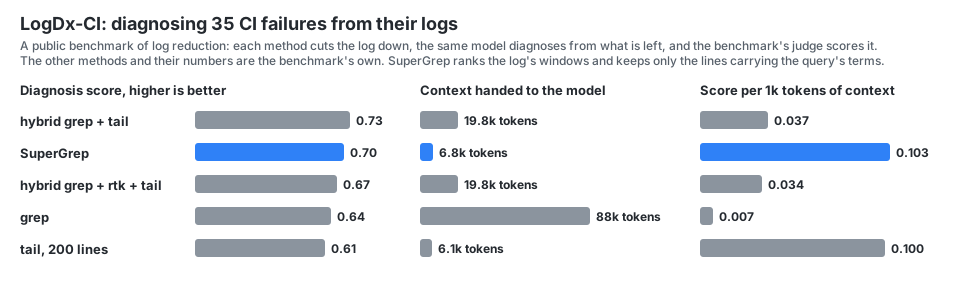
That matters most where a frontier model is weakest. A log is the pathological case for a context window - large, repetitive, mostly irrelevant, and paid for again on every turn it stays in the transcript. An index collapses it to the spans that matter before the model sees any of it. On a public benchmark of CI-failure diagnosis, scored by the benchmark's own judge, that puts SuperGrep second on the score and first by a distance on score per token of context:
For files that don't fit on your laptop - write them out to Parquet files in object storage and point SuperGrep at them without ever loading them onto your laptop (how). You can search them together with your code or laptop files using the same tools.
What it saves
The same model, the same 36 questions about a 256,000-line codebase, with and without SuperGrep. Every answer was checked against the code. Fully correct means every claim held and the whole question was answered. The bill is everything you pay: your model, its subagents, and SuperGrep.
<details> <summary>How the runs were set up</summary>Real agent runs through the Claude Agent SDK, the same minimal prompt in every arm, on the infino engine repository, measured 2026-09-24. Thirty-six questions in five categories: aggregation (10), comprehension (6), by meaning (6), pinpoint (8), known file (6). The file-tools arm is stock Claude Code: Glob, Grep, Read, LS, Bash, and the Agent tool with the built-in Explore subagent. The SuperGrep arm is the same plus the four tools above. The judge is Opus 5.5.
</details>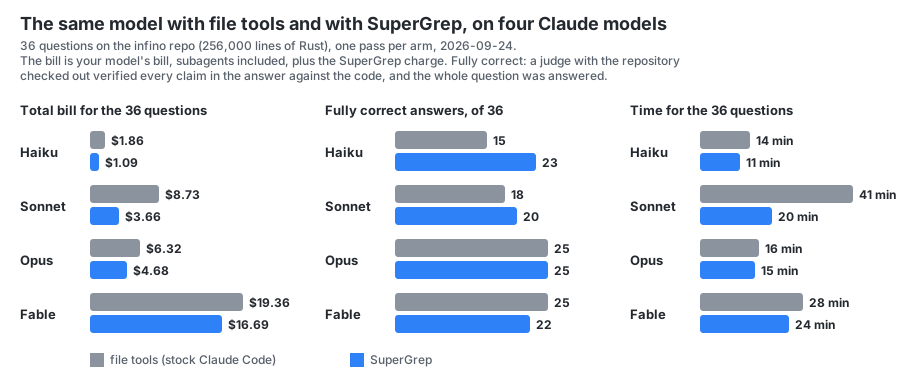
Your mileage will vary with the model.
- Cheaper on every model. Haiku 41% off the total bill, Sonnet 58%, Opus 26%, Fable 14%.
- Quality increases on the cheaper models. Haiku gets eight more fully correct answers with SuperGrep than without. On Sonnet, Opus and Fable the answers are level: the judge is itself a model, and graded four times the same answers came back with 19, 20, 17 and 23 claims it could not verify, so a difference under about six answers in 36 is noise, and those three are inside it.
- No surprise bills. On about a third of the questions, Sonnet with file tools sends a subagent off to read through the repository. That one question then costs four to five times as much and takes four times as long. With SuperGrep it asks the index instead. Over the 36 questions that is $3.66 against $8.73 and 20 minutes against 41, with 20 fully correct answers against 18.
- On your own code the gap is wider. These runs are on a public, open-source repository, because that is a test anyone can repeat - and the large models have seen it in training, which is a head start for reading files. On a private codebase the model has never seen, the index does more of the work, and the effect of SuperGrep is larger.
Where it wins, and where it does not
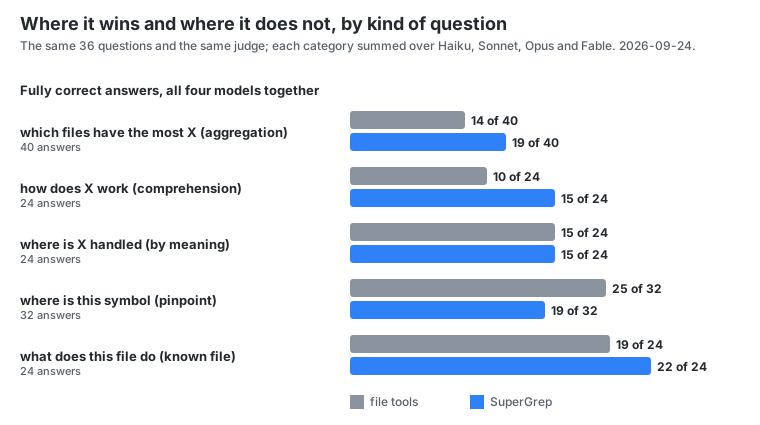
It wins on questions about the whole codebase: counts, rankings, every occurrence. Grep gives the first forty matches; an index gives the total. It loses on finding one named thing with a large model, which reads whole files well.
The cheapest model with SuperGrep against the most expensive without
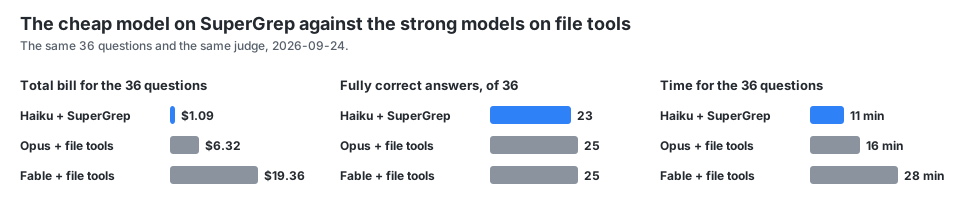
23 correct answers to their 25, for $1.09 instead of $6.32 (Opus) or $19.36 (Fable).
Install
Two commands, once per machine. You need Claude Code and node 22 or newer, on macOS or Linux.
claude plugin marketplace add infino-ai/supergrep
claude plugin install code-context@infino-ai
That is the setup. Open Claude Code in any directory - a repository, a folder of logs, your notes, anything - and ask a question. The first question indexes the directory, and find, sql and read answer from then on. Nothing is configured per directory, no account exists yet, and nothing has left your machine.
search and ask are the cloud half - the embeddings and the retrieval loop run on the Infino platform, over a copy of the index kept there - and they need an account. The first time a question needs them, Claude tells you the one command and does not run it, because it is yours to run. Once, in a terminal:
npx -y @infino-ai/code-context login --platform https://api.supergrep.infino.ai
A free account, no credit card required. There is no form, no email, no password and no card, and nothing is created without your say-so: the command tells you that the contents of the directories you use search and ask in will be uploaded to Infino, asks, and only on your yes creates the account and stores its key at ~/.infino/key, mode 600, readable only by you. No config file ever holds a key or a path to one. Infino is SOC 2 Type 2 certified.
Keep that key. Because the free account asks for no email and no card, the key is the only thing that identifies you: it is how you get back in, and nothing else can. Back it up somewhere safe. When you add your details in the Infino console the same account gains a sign-in, and keys can be managed from there.
Restart the session and every directory you open has all four tools. Each one gets its own database on your account, named after the directory and loaded the first time you use search or ask there - a directory you only ever find in is never uploaded. One server answers for every directory a session touches: the tools take a path, so a session that spans several projects names the one it means. When the free credit runs out, ask says so and tells you how to add billing details and a card to the same account; find and plain sql keep working throughout.
If you already have an Infino account
Sign in once per machine instead. The key comes from a file or standard input, never from an argument - argv is readable by every process on the machine - and --yes is the same agreement the sign-up asks for, since a piped key leaves no terminal to ask on:
npx -y @infino-ai/code-context login --db https://api.supergrep.infino.ai --yes < keyfile
Other MCP clients, and one entry per repository
Cursor, Codex CLI, Gemini CLI, Windsurf and Cline take the same server over stdio. cx install in a repository writes its entry into .mcp.json there (--config for another client's file); with the account stored it names the repository's database and nothing else, --local-only writes the keyword-only entry, and install --platform https://api.supergrep.infino.ai is the sign-up and the entry in one for a machine with no account. The reference has every flag, and CONTRIBUTING how to build from source.
Indexing it yourself
The first question in a directory indexes it and the MCP server keeps it current, so most of the time you never run an index by hand. When you want to - a first pass over a huge tree, a CI step, a corpus that is not a git repository - index is the command. (cx below is npx -y @infino-ai/code-context, or cx itself after npm install -g @infino-ai/code-context.)
cx index                      # bring the index up to date; incremental, full on first run
cx index ~/notes              # index some other directory
cx index --full               # force a full rebuild
cx index --watch              # keep watching the tree and sync on every change
cx index --no-embed           # keyword index only, skip the vector stage
cx index --max-files 1000000  # raise the cap past the 500,000 default; over it, the index is
                              # partial and says so, with the value to pass to get all of it
The index is plain files under .infino/ in the directory you indexed. Keyword search is live within seconds of the first cx index; semantic and hybrid search light up as the vectors finish backfilling behind it. cx status says what the index holds and how fresh it is.
Signed in, cx index loads the platform copy in the same pass - the directory's own database on your account, so ask sees the same content as find. To load a database you name instead:
cx index --db https://api.supergrep.infino.ai/<database>
--embed-provider platform (the default) has the platform fill that table's vectors with its own model, server-side; local embeds on this machine and ships the vectors instead.
Indexing from object storage
For a corpus too big for your laptop - years of logs, a document dump, anything you already keep in a bucket as Parquet or JSON - leave it there, point the platform at the bucket, and it builds the index from there. Nothing is copied, nothing is downloaded to your machine, and no row passes through your laptop or through the API.
1. Grant read on your bucket to Infino's service account - we give you its address - on the prefix you want indexed: roles/storage.objectViewer on GCS, s3:GetObject + s3:ListBucket on S3. Read only: the platform writes nothing there.
2. Submit the job. One POST, naming the bucket and prefix, and it returns straight away - the build runs on the platform, not in the request:
curl -sS -X POST https://api.supergrep.infino.ai/v1/hydrate/<database> \
  -H "authorization: Bearer $(cat ~/.infino/key)" \
  -H 'content-type: application/json' \
  -d '{
        "table": "logs",
        "source": { "kind": "bucket", "bucket": "<your-bucket>", "prefix": "exports/logs/" },
        "fts":    [ { "column": "message" } ],
        "embed":  { "column": "embedding", "source": ["message"] }
      }'
(A database that lives in your own bucket can also read shards staged under its own _source/ prefix: "source": { "kind": "prefix", "prefix": "_source/logs/" }.)
{ "job": "hydrate/<customer>/<database>/logs", "state": "pending" }
Leave fts and embed out and the job reads a sample and picks the roles itself. columns narrows which source columns are carried; no_embed: true builds no vector column at all.
3. Follow it. The reply carries the state, how far it has got, the schema it settled on, and what it has cost so far:
curl -sS "https://api.supergrep.infino.ai/v1/hydrate/<database>?table=logs" \
  -H "authorization: Bearer $(cat ~/.infino/key)"
States are pending, running, cancelling, stopped, succeeded, failed. A job that stopped - a cancel, or an outage that outlasted its budget - resumes from its own checkpoint rather than starting over:
# resume where it left off
curl -sS -X POST https://api.supergrep.infino.ai/v1/hydrate/<database> -H "authorization: Bearer $(cat ~/.infino/key)" \
  -H 'content-type: application/json' \
  -d '{"table":"logs","source":{"kind":"bucket","bucket":"<your-bucket>","prefix":"exports/logs/"},"resume":true}'

# stop a running job at its next commit boundary
curl -sS -X DELETE "https://api.supergrep.infino.ai/v1/hydrate/<database>?table=logs" \
  -H "authorization: Bearer $(cat ~/.infino/key)"
By default a job that fails for good drops its half-built table, so a partial table is never served; "on_failure": "keep" keeps what was committed.
The table is then searchable like any other. ask runs over it, and one question can span it and your code at once.
Note: Hydrate API needs to be enabled per account. Contact support@infino.ai to enable.
Learn more
License
Apache-2.0
Related MCP servers

Keyword, semantic, hybrid, and SQL retrieval for AI agents, local or on Infino Cloud.

Inflectiv
Search, build and manage Inflectiv datasets and AI agents, plus ChainAware on-chain intelligence.

CryptoAgentMail
Hosted email MCP for AI agents with inboxes, send/receive, memory, recovery, and credits.

Deploy localhost to a private, authenticated link from your AI coding agent.

Discover and publish AI agents via DNS using SVCB records (RFC 9460)

Web browsing & research for AI agents — fetch/read pages, structured extraction, Exa search.
View repository →