IWE MCP Server
io.github.iwe-org/iwe
Markdown knowledge base as queryable agent memory—structured retrieval without cloud or database.
What is the IWE MCP server?
IWE is a memory system that turns a directory of markdown files into a knowledge graph accessible to AI agents. It provides structured retrieval through an MCP server and CLI, letting agents query notes by hierarchy and relationships rather than similarity guessing, while keeping all data local and version-controlled in git.
IWE organizes your markdown notes as a connected graph with inclusion links (nesting) and cross-references, making them queryable by structure. AI agents can retrieve notes with full parent context in a single call, search with fuzzy and full-text ranking, and make guarded edits validated against schemas. It works alongside Claude, Cursor, and other tools via MCP, and includes IDE features (search, refactor, rename, autocomplete) for VS Code, Neovim, Zed, and Helix.
How to install IWE
Copy-paste configuration for popular MCP clients.
Tools & capabilities
Tools this server exposes to the agent.
find— Search notes with fuzzy and full-text ranking, plus filters over frontmatter and graph edges.retrieve— Get a document with its linked context (parents, children, cross-references) in one call.tree— Show the hierarchy from any starting point.update— Guarded edits with scope validation: frontmatter changes and targeted block operations.schema— Infer the store's schemas or validate documents against them; supports Open Knowledge Format (OKF).new— Create new notes.extract— Pull sections into new notes.inline— Embed note content back into parent.rename— Rename files with automatic link updates.delete— Remove notes.squash— Merge notes.stats— Analyze the knowledge graph; flag near-duplicates and graph hygiene issues.normalize— Standardize document format.export— Export notes in various formats.
Use cases
- Store and retrieve agent memory as structured markdown—decisions, corrections, and in-flight state—without re-reading a flat file each session.
- Query your notes by structure: 'all drafts under this subtree', 'every accepted decision in Q1', 'notes mentioning this person'.
- Give AI agents IDE-like navigation over your knowledge: parent context, children, cross-references, and link-safe refactoring.
- Validate agent writes against document schemas and scope guards before they touch your files.
- Organize notes with multiple parents (e.g., a 'Meditation' note under both 'Health' and 'Productivity') without duplication.
IWE MCP server FAQ
IWE is a markdown-based knowledge graph system that lets you and AI agents query your notes by structure and relationships. You write plain markdown in a local directory, link notes together, and agents retrieve full context in a single call—no cloud, no database, no lock-in.
Yes, IWE is open source under the Apache License 2.0. The CLI, LSP server, and MCP server are all free to install and use.
Install the CLI (via Homebrew, npm, or Cargo), then add the MCP server to your config with `iwec` as the command and your notes directory as the working directory. For Claude Desktop or Cursor, point to the MCP server in your mcpServers config; you can also use `npx -y @iwe-org/mcp` to fetch it on demand.
No. IWE runs entirely locally against the notes directory it is started in. All data stays on your machine and can be version-controlled with git.
IWE includes LSP integration for VS Code, Neovim, Zed, and Helix, providing search, navigation, autocomplete, refactoring, and other IDE features.
Yes, via the `update` command. All agent writes are validated: mutations declare their scope (how many documents and blocks they may touch), and changes are checked against document schemas before being written. Mismatches abort with offending blocks named.
README (reference)
Source of truth, from the repository.
IWE - Memory system for you and your AI agents
Turn your thinking into queryable context








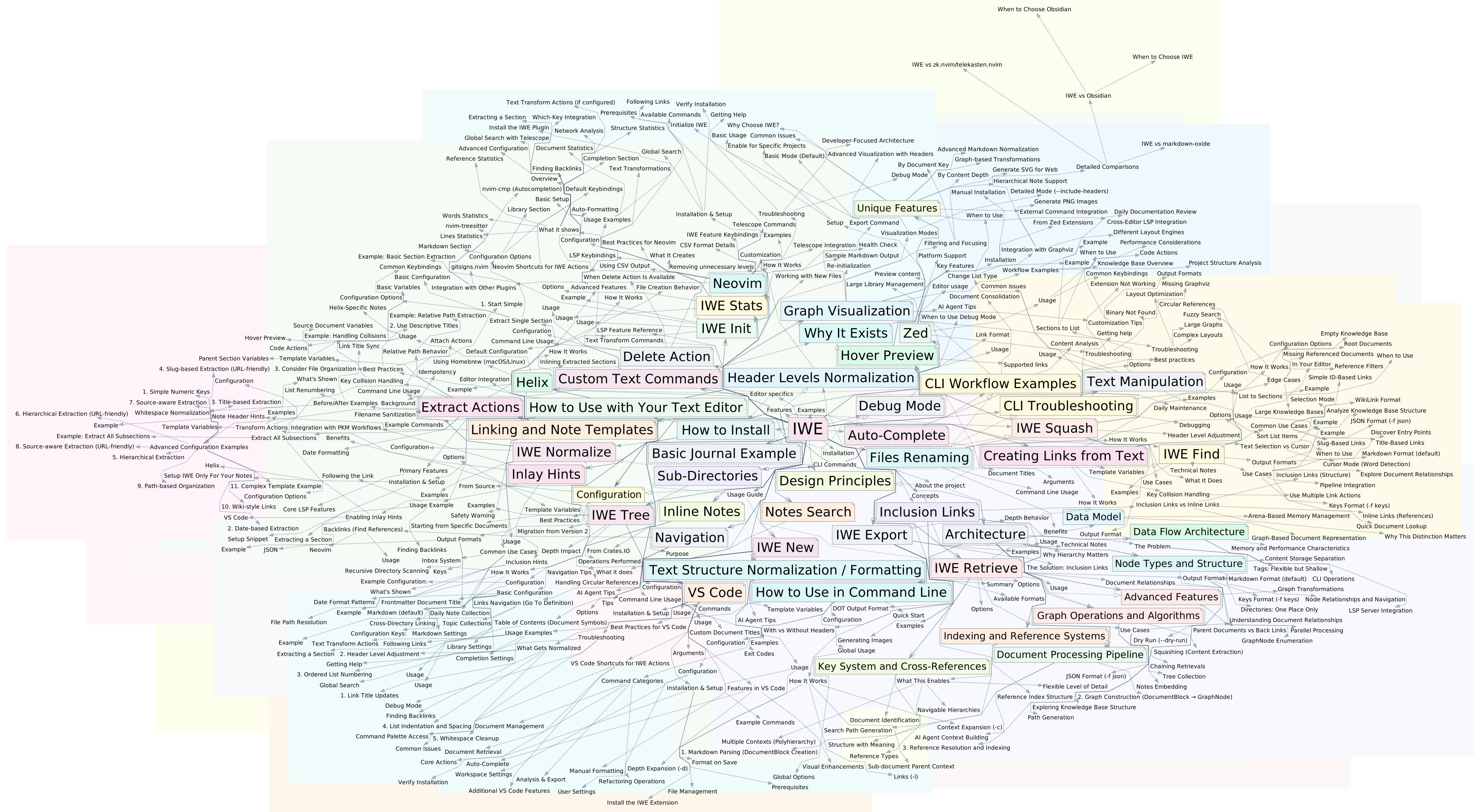
IWE turns a directory of markdown files into a knowledge graph — a connected structure you browse from your editor and your AI queries from the command line. Same files, same links, two interfaces. No cloud, no database, no lock-in. Version everything with git.
IWE is for people who want database-style queries on their notes — "all drafts under this subtree", "every accepted decision in Q1" — without moving them into an actual database. Write in Markdown, structure with links, give AI agents the tools to navigate your knowledge. IWE itself has no built-in AI — it works alongside Claude, Codex, Gemini, and any tool that speaks the Model Context Protocol.
What You Get
- Plain markdown, full ownership. Your notes are
.mdfiles in a local directory. Read them, edit them,git pushthem. Nothing proprietary. - A graph, not a folder tree. Link notes together and the same note can belong to multiple topics without copying the file. (How linking works)
- IDE features for your editor. Real LSP integration with VS Code, Neovim, Zed, and Helix — search, refactor, rename, autocomplete.
- Structured access for AI agents. CLI tools and an MCP server give agents parent context and structural navigation over the same notes you edit by hand — retrieval by structure, not similarity guessing.
- Speaks OKF. An Open Knowledge Format bundle is markdown with YAML frontmatter — the format IWE already manages.
iwe init --okfscaffolds a conformant bundle,iwe schema validatechecks conformance mechanically, andiwe find --filter '{type: …}'queries OKF frontmatter directly. - Fast. Built in Rust, processes 20,000 files in under a second.
Instructions Aren't Memory
Agents ship with an instructions file — CLAUDE.md, AGENTS.md — and it's tempting to let memory accumulate there too. It doesn't hold. Instructions are rules; memory is what builds up: decisions, corrections, the state of everything in flight. Kept in one flat file, the agent appends, contradictions pile up side by side each looking authoritative, and every session re-reads the whole thing.
IWE stores memory as many small linked documents, so the agent asks instead of re-reading. Most recall is a structured question — what's still open, what did we decide about X, which notes mention this person — answered by a query and one retrieve call that expands the linked context. The rest of the graph stays out of the context window. And because it's markdown in git, the memory is inspectable: open what the agent believes, diff what changed, git-blame when.
How It Works
IWE treats your notes as a connected structure. You organize them with two types of links:
- Nesting — a link on its own line means "this topic includes that subtopic." Your notes form a tree you can browse and refactor. IWE calls these inclusion links.
- Cross-references — regular inline links connect notes across topics, creating a web of relationships.
- Multiple parents — the same note can live under several places at once. A "Meditation" note can belong to both "Health" and "Productivity" without duplicating the file.
- Context from parents — when you retrieve a note, IWE can include context from the notes above it in the hierarchy.
This structure makes retrieval powerful — whether you're browsing in your editor or an agent is querying via CLI, ask for a topic and get its full context in a single call.
Working with AI
IWE gives AI agents structured access to your notes through two interfaces: a CLI for scripting and shell-based workflows, and an MCP server for native connection with AI tools. Both expose the same operations — search, retrieve, create, refactor — so you can choose whichever fits your setup.
IWE pairs search with structure: built-in fuzzy and full-text search finds the entry point, and the graph turns a hit into usable context — parent context, children, cross-references, link-safe refactoring. It also composes cleanly with any external tooling you already use (ripgrep, full-text, vector): whatever finds the note, IWE supplies the context around it.
What the Engine Checks
Agent writes are checked, not trusted:
- Declared scope. A mutation carries
expectguards stating how many documents and blocks it may touch. The whole update validates before anything is written; a mismatch aborts with the offending blocks named. Over MCP the guards are mandatory — an edit that won't declare its blast radius is refused. - Schemas. Frontmatter and document structure are validated against per-type document schemas — required fields, enums, ISO dates, required sections. A schema-violating MCP write is rejected with the violation named; from the CLI,
iwe schema validateruns the same checks on demand. - Graph hygiene. Mutations surface warnings for what they disturbed — dangling links, orphan pages — and
iwe stats similarityflags near-duplicates.
Integration Server (MCP)
IWE includes a server (iwec) that lets AI tools like Claude Desktop, Cursor, and Windsurf work directly with your notes using the Model Context Protocol. The server watches your files for changes, so edits you make in your editor are reflected immediately.
Command-Line Tools
The CLI lets you (and AI agents) work with your notes from the terminal or in scripts.
Example: preparing context for an AI conversation
iwe find --fuzzy auth

iwe retrieve --key authentication --expand-includes 2

iwe tree --key oauth
Core commands:
| Command | What it does |
|---|---|
find | Search with fuzzy and full-text ranking, plus filters over frontmatter and graph edges |
retrieve | Get a document with its linked context in one call |
tree | Show the hierarchy from any starting point |
update | Guarded edits: frontmatter changes and targeted block operations |
schema | Infer the store's schemas, or validate documents against them |
The full set — new, extract, inline, rename, delete, squash, stats, normalize, export and more — is in the CLI Reference.
More information: Working with AI · CLI Reference · MCP Server
Editor Integration
IWE gives your editor IDE-like features for markdown notes. It works with VS Code, Neovim, Zed, Helix, and any editor that supports the Language Server Protocol (LSP).
- Search — find notes by title or content
- Navigate — go to definition, find references (backlinks)
- Preview — hover over links to see content
- Auto-complete — link suggestions as you type
- Inlay hints — show parent references and link counts
- Extract — pull sections into new notes
- Inline — embed note content back into parent
- Rename — rename files with automatic link updates
- Format — normalize documents, update link titles
- Transform — pipe text through external commands
- Templates — create notes from templates (daily notes, etc.)
- Outline conversion — switch between headers and lists
More information: Editor Features
Quick Start
-
Install the CLI and LSP server:
Using Homebrew (macOS/Linux):
brew tap iwe-org/iwe
brew install iwe
Or using npm (macOS/Linux/Windows):
npm install -g @iwe-org/iweOr using Cargo:
cargo install iwe iwes iwecOr from conda-forge (community-maintained — thanks, salim-b):
conda install -c conda-forge iwe -
Initialize your workspace:
cd ~/notes iwe init -
Pick your path:
Set up your editor — VS Code · Neovim · Helix · Zed
Connect your AI agent — point it at the MCP server.
iwecserves the directory it runs in, so set the working directory to your notes:{ "mcpServers": { "iwe": { "command": "iwec", "cwd": "~/notes" } } }No install needed —
npxfetches the server on demand:{ "mcpServers": { "iwe": { "command": "npx", "args": ["-y", "@iwe-org/mcp"], "cwd": "~/notes" } } }Or hand the setup to the agent — paste this into Claude Code or any agent with shell access:
Set up IWE for my notes: install it (brew tap iwe-org/iwe && brew install iwe,
npm install -g @iwe-org/iwe, or cargo install iwe iwes iwec), run `iwe init`
in my notes directory, then add the `iwec` MCP server with its working
directory set to that folder.
Docs: https://iwe.md/docs/agentic/
Documentation
- Getting Started — Installation and setup
- Usage Guide — Editor features and workflows
- CLI Reference — Command-line tools
- Working with AI — AI agent integration
- MCP Server — Native AI tool integration via Model Context Protocol
- OKF — Open Knowledge Format: scaffold, validate, and query conformant bundles
- Configuration — Settings and customization
- Examples — Example projects and case studies
Get Involved
IWE is open source and community-driven. Join the discussions, report issues, or contribute to the documentation.
Community: Twitter/X · Reddit · Discussions
Editor plugins: VS Code · Neovim · Zed
Workspace templates: marketing-workspace — campaign memory for a marketing agent · dev-workspace — project memory for a coding agent. Both ship as conformant OKF v0.2 bundles, validated in CI on every commit.
Agentic skills: iwe-org/skills — agentic AI skills for knowledge graph management. Contributors welcome.
Building on IWE: projects already embed IWE — as an agent-memory backend, as the graph layer of an LLM wiki engine, in research tooling. The practical integration surfaces today are the CLI and the MCP server; the liwe library is published but not yet API-stable, so pin your version if you build against it. A declared, stable integration surface is on the roadmap — if you're building on IWE, tell us what you depend on, so we know what not to break.
License
Related MCP servers

codebase-synapse
Indexes codebase into a local knowledge graph with 40+ AI tools and codebase-guard.


AVCS
AI-native version control where intent, operation, evidence and decision are first-class objects.

OpenClaw Agent Instruction Registry
Search and retrieve agent instruction files: system prompts, skills, workflows, and safety filters.
Search, fetch docs, and ask questions about any open-source repo via codewiki.google

iz-tolk-mcp — Tolk Compiler for TON
Tolk smart contract compiler for TON — compile, check, and deploy from AI assistants