io.github.keshrath/agent-tasks MCP Server
io.github.keshrath/agent-tasks
Pipeline-driven task management for AI coding agents with stages, dependencies, and real-time kanban dashboard.
What is the io.github.keshrath/agent-tasks MCP server?
The agent-tasks MCP server is a pipeline-driven task management system designed for multi-agent AI collaboration on codebases. It provides stage-gated workflows (backlog → spec → plan → implement → test → review → done), dependency tracking, approval workflows, artifact versioning, and a real-time kanban dashboard. Built for AI coding agents like Claude Code and Aider, it works via MCP, REST API, or WebSocket.
agent-tasks solves the coordination problem when multiple AI agents work on the same codebase. Instead of a flat todo list, tasks flow through configurable pipeline stages with dependencies, approvals, and visibility. Agents can claim tasks, advance them through stages, attach versioned artifacts (specs, code, decisions, learnings), comment asynchronously, and see real-time progress on a kanban dashboard. It integrates with Claude Code's TodoWrite, syncs with agent-comm for heartbeat-based cleanup, and bridges to agent-knowledge for persistent decision and learning capture.
How to install io.github.keshrath/agent-tasks
Copy-paste configuration for popular MCP clients.
Tools & capabilities
Tools this server exposes to the agent.
task_create— Create a new task with title, description, priority, tags, and project assignment.task_get— Retrieve a single task with its subtasks, artifacts, and comments.task_list— List tasks with filtering by status, stage, project, assignee, and full-text search; supports 'next' parameter for agent affinity routing.task_delete— Delete a task.task_update— Update task metadata: title, description, priority, tags, project, assignment, and dependencies.task_stage— Manage task lifecycle: claim, advance, regress, complete, fail, or cancel a task.task_artifact— Attach versioned artifacts to tasks: general documents, decisions, learnings, or comments with automatic versioning and diff viewing.task_config— Query and configure pipeline stages, session management, cleanup rules, and stage gates.
Use cases
- Coordinate multiple AI agents on a shared codebase by routing tasks through a structured pipeline with dependencies and approvals.
- Capture and propagate learnings and decisions across tasks and agents, with automatic knowledge bridge integration.
- Track task progress in real-time with a kanban dashboard, including drag-and-drop stage transitions and inline task creation.
- Manage artifact versions (specs, code, decisions) per stage with automatic diff viewing and approval gates.
- Auto-fail stale tasks from dead agents using heartbeat data from agent-comm, keeping the pipeline clean.
io.github.keshrath/agent-tasks MCP server FAQ
agent-tasks is a pipeline-driven task management MCP server for AI coding agents. It provides stage-gated workflows, dependency tracking, approval workflows, artifact versioning, and a real-time kanban dashboard to coordinate multi-agent collaboration on codebases.
Yes, agent-tasks is open-source under the MIT license and free to use.
Install via npm (`npm install -g agent-tasks`), then add it to your MCP client config with `command: npx` and `args: ["agent-tasks"]`. The dashboard auto-starts at http://localhost:3422 on first connection.
Pipeline stages, task dependencies with cycle detection, approval workflows, multi-agent roles (collaborator, reviewer, watcher), subtask hierarchies, threaded comments, artifact versioning, full-text search, real-time kanban dashboard, and integration with agent-comm (heartbeat cleanup) and agent-knowledge (decision/learning persistence).
No, agent-tasks does not require authentication. It runs locally with a SQLite database (default: ~/.agent-tasks/agent-tasks.db) and optional soft dependencies on agent-comm and agent-knowledge for enhanced features.
agent-tasks supports three transport layers: MCP (stdio for AI agents), REST API (HTTP with 18 endpoints), and WebSocket (real-time events).
README (reference)
Source of truth, from the repository.
agent-tasks





Pipeline-driven task management for AI coding agents. An MCP server with stage-gated pipelines, multi-agent collaboration, and a real-time kanban dashboard. Tasks flow through configurable stages — backlog, spec, plan, implement, test, review, done — with dependency tracking, approval workflows, artifact versioning, and threaded comments.
Built for AI coding agents (Claude Code, Codex CLI, Gemini CLI, Aider) but works equally well with any MCP client, REST consumer, or WebSocket listener.
| Light Theme | Dark Theme |
|---|---|
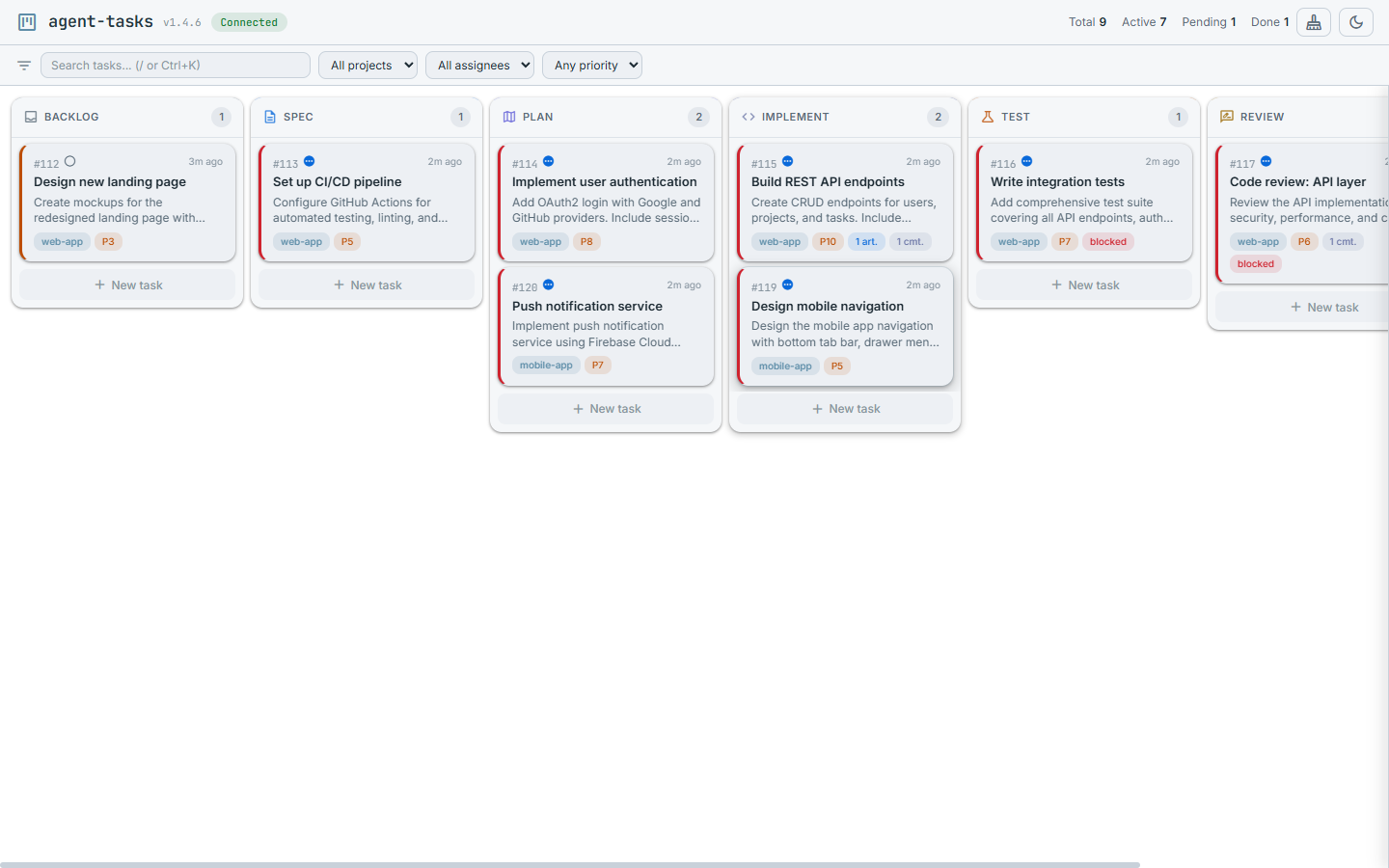 | 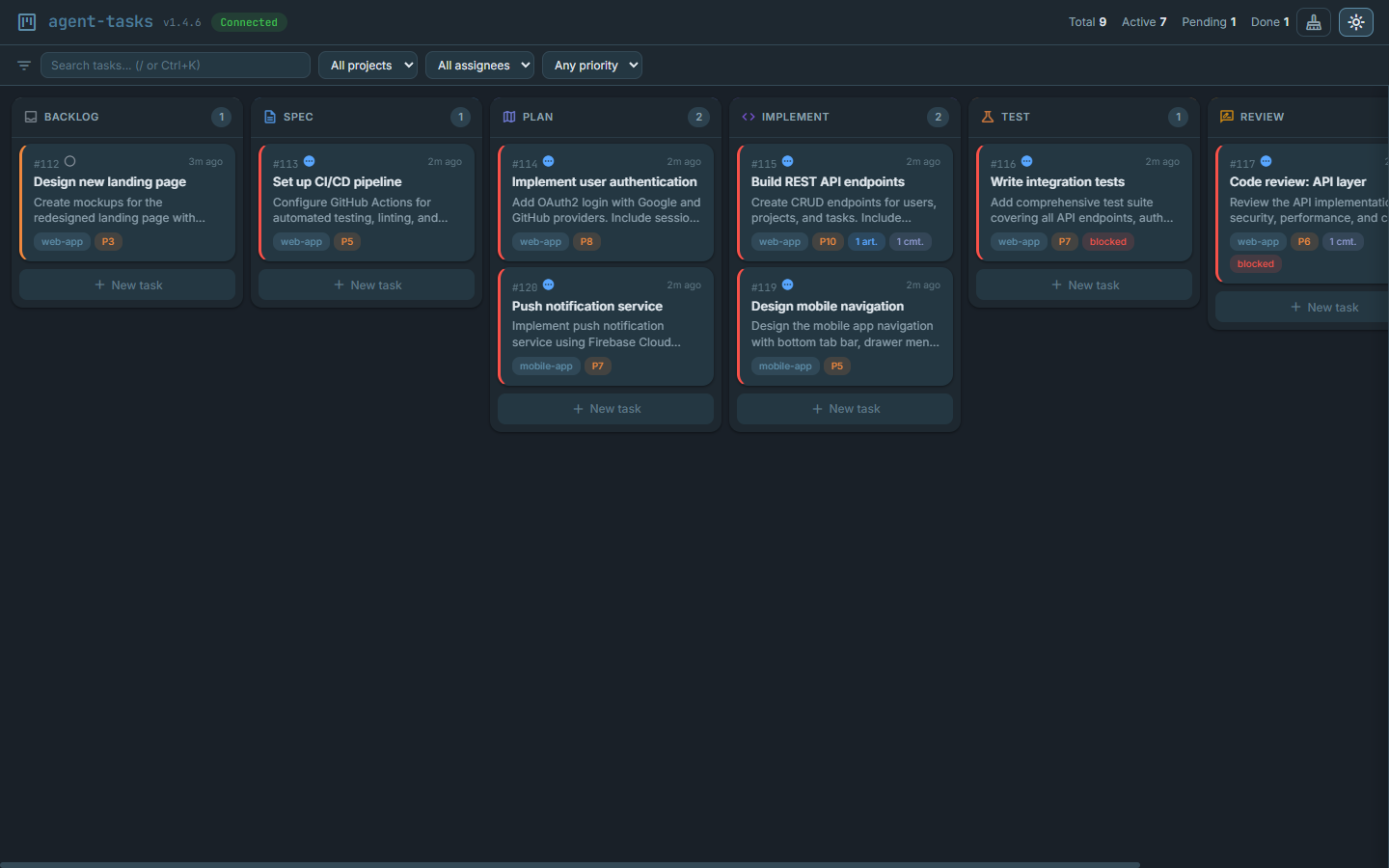 |
Why agent-tasks?
When you run multiple AI agents on the same codebase, they need a shared task pipeline — not just a flat todo list. They need stages, dependencies, approvals, and visibility.
Features
- Pipeline stages — configurable per project:
backlog>spec>plan>implement>test>review>done - Task dependencies — DAG with automatic cycle detection; blocks advancement until resolved
- Approval workflows — stage-gated approve/reject with auto-regress on rejection
- Multi-agent collaboration — roles (collaborator, reviewer, watcher), claiming, assignment
- Subtask hierarchies — parent/child task trees with progress tracking
- Threaded comments — async discussions between agents on any task
- Artifact versioning — per-stage document attachments with automatic versioning and diff viewer
- Full-text search — FTS5 search across task titles and descriptions
- Real-time kanban dashboard — drag-and-drop, side panel, inline creation, dark/light theme
- 3 transport layers — MCP (stdio), REST API (HTTP), WebSocket (real-time events)
- TodoWrite bridge — intercepts Claude Code's built-in TodoWrite and syncs to the pipeline
- Stage gates — configurable per-project gates with per-stage rules: require named artifacts, minimum artifact counts, comments, or approvals before advancing
- Decisions log — structured decision artifacts (chose X over Y because Z) via
task_artifact(type: "decision") - Learnings propagation —
task_artifact(type: "learning")captures insights (technique, pitfall, decision, pattern); auto-propagated to parent and sibling tasks on completion - Agent affinity —
task_list(next: true)prefers routing tasks to agents with related history (parent, dependency, project) as a tie-breaker - Heartbeat-based cleanup — auto-fails tasks from dead agents using agent-comm heartbeat data
- Task cleanup hooks — auto-fails orphaned tasks on session stop and cleans up stale tasks on session start
- Agent bridge — notifies connected agents on task events (claim, advance, comment, approval)
- Knowledge bridge — auto-pushes learning and decision artifacts to agent-knowledge on task completion, with embedding indexing and auto-linking
Quick Start
Install from npm
npm install -g agent-tasks
Or clone from source
git clone https://github.com/keshrath/agent-tasks.git
cd agent-tasks
npm install
npm run build
Option 1: MCP server (for AI agents)
Add to your MCP client config (Claude Code, Cline, etc.):
{
  "mcpServers": {
    "agent-tasks": {
      "command": "npx",
      "args": ["agent-tasks"]
    }
  }
}
The dashboard auto-starts at http://localhost:3422 on the first MCP connection.
Option 2: Standalone server (for REST/WebSocket clients)
node dist/server.js --port 3422
Claude Code Integration
Once configured (see Quick Start above), Claude Code can use all 8 MCP tools directly — creating tasks, advancing stages, adding artifacts, commenting, and more. See the Setup Guide for detailed integration steps.
MCP Tools (8)
| Category | Tools |
|---|---|
| Task CRUD (4) | task_create, task_get (include subtasks/artifacts/comments), task_list (search, next), task_delete |
| Metadata (1) | task_update (title, description, priority, tags, project, assignment, dependencies) |
| Lifecycle (1) | task_stage (claim, advance, regress, complete, fail, cancel) |
| Artifacts (1) | task_artifact (general, decision, learning, comment) |
| Config & utils (1) | task_config (pipeline, session, cleanup, rules) |
See full API reference for detailed descriptions of every tool and endpoint.
REST API (18 endpoints)
All endpoints return JSON. CORS enabled. See full API reference for details.
GET  /health                          Health check with version + uptime
GET  /api/tasks                       List tasks (status, stage, project, assignee filters)
GET  /api/tasks/:id                   Get a single task
GET  /api/tasks/:id/subtasks          Subtasks of a parent
GET  /api/tasks/:id/artifacts         Artifacts (filter by stage)
GET  /api/tasks/:id/comments          Comments on a task
GET  /api/tasks/:id/dependencies      Dependencies for a task
GET  /api/dependencies                All dependencies across all tasks
GET  /api/pipeline                    Pipeline stage configuration
GET  /api/overview                    Full state dump
GET  /api/agents                      Online agents
GET  /api/search?q=                   Full-text search

POST /api/tasks                       Create a new task
PUT  /api/tasks/:id                   Update task fields
PUT  /api/tasks/:id/stage             Change stage (advance or regress)
POST /api/tasks/:id/comments          Add a comment
POST /api/cleanup                     Trigger manual cleanup
Testing
npm test              # 355 tests across 13 files
npm run test:watch    # Watch mode
npm run test:coverage # Coverage report
npm run check         # Full CI: typecheck + lint + format + test
Environment variables
| Variable | Default | Description |
|---|---|---|
AGENT_TASKS_DB | ~/.agent-tasks/agent-tasks.db | SQLite database file path |
AGENT_TASKS_PORT | 3422 | Dashboard HTTP/WebSocket port |
AGENT_TASKS_INSTRUCTIONS | enabled | Set to 0 to disable response-embedded instructions |
AGENT_COMM_URL | http://localhost:3421 | Agent-comm REST URL for bridge notifications |
AGENT_KNOWLEDGE_URL | http://localhost:3423 | Agent-knowledge REST URL for knowledge bridge |
Dependencies
Required: Node.js >= 20.11, better-sqlite3 (bundled)
Optional (soft dependencies — fail-open, HTTP-only, no npm dep):
-
agent-comm — Heartbeat-based task cleanup and event notifications. agent-comm tracks heartbeats → agent-tasks checks heartbeats → auto-fails tasks from dead agents. Also sends direct messages on claim/advance and posts to channels on comments/approvals. Without agent-comm, stale agent detection and notifications are skipped gracefully.
-
agent-knowledge — Knowledge persistence for task learnings and decisions. On task completion, the KnowledgeBridge pushes
learninganddecisionartifacts to agent-knowledge viaPOST /api/knowledge. Entries are auto-indexed with embeddings, auto-linked to similar entries, and git-synced. Without agent-knowledge, artifacts stay in agent-tasks only.
Documentation
- API Reference — all 8 MCP tools, 18 REST endpoints, WebSocket protocol
- Architecture — source structure, design principles, database schema
- Dashboard — kanban board features, keyboard shortcuts, screenshots
- Setup Guide — installation, client setup (Claude Code, OpenCode, Cursor, Windsurf), hooks
- Changelog
License
MIT — see LICENSE
Related MCP servers

io.github.keshrath/agent-comm
Agent intercommunication - messaging, channels, shared state, and real-time events
io.github.keshrath/agent-discover
MCP server registry and marketplace - discover, install, activate tools on demand
io.github.keshrath/agent-knowledge
Cross-session memory and knowledge graph for AI coding assistants with hybrid semantic+TF-IDF search and git-synced persistence.

Attio MCP Server
AI-powered Attio CRM access with complete contact, company, deal, task, and workflow management.

AtCoder MCP Server
Search AtCoder problems and fetch public problem statements through MCP.
Codeforces MCP Server
Search Codeforces problems and inspect public problem metadata through the official Codeforces API.