MITRE ATT&CK MCP Server
io.github.luongnv89/mitre-mcp
Access MITRE ATT&CK framework data via MCP for threat intelligence, detection engineering, and incident response.
What is the MITRE ATT&CK MCP server?
The MITRE ATT&CK MCP server exposes the MITRE ATT&CK® framework—a comprehensive knowledge base of adversary tactics, techniques, groups, software, and mitigations—to LLMs and AI assistants. Built with the official MCP Python SDK and mitreattack-python library, it provides secure, high-performance access to all three ATT&CK domains (Enterprise, Mobile, ICS) with intelligent caching and O(1) technique lookups.
This production-ready MCP server integrates the MITRE ATT&CK framework into Claude, Cursor, Windsurf, and other MCP-compatible clients. It enables security professionals, threat hunters, and incident responders to query adversary tactics, techniques, threat actor groups, malware, tools, and mitigations directly within their AI workflows. Features include multi-domain support (Enterprise, Mobile, ICS), intelligent caching with 14-day expiry, fast O(1) lookups via pre-built indices, dual transport modes (stdio and HTTP), and comprehensive input validation.
How to install MITRE ATT&CK
Copy-paste configuration for popular MCP clients.
Tools & capabilities
Tools this server exposes to the agent.
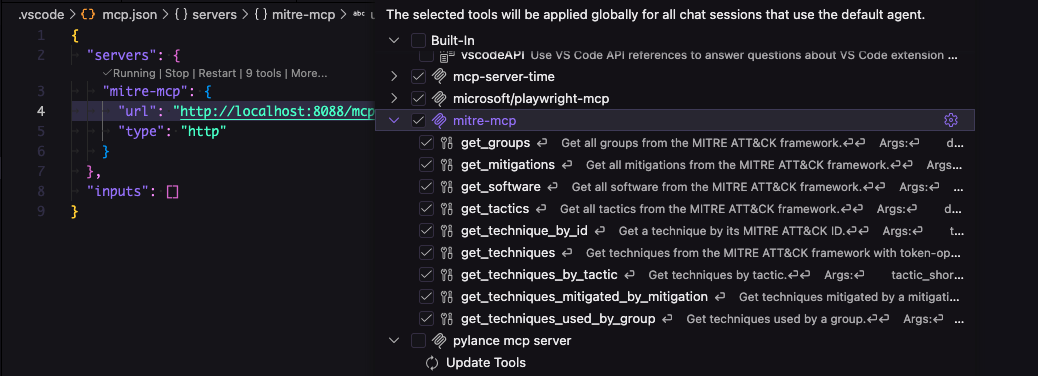
get_techniques— List all techniques with filtering optionsget_technique_by_id— Look up specific technique by ID (e.g., T1055)get_techniques_by_tactic— Get techniques for a specific tactic (e.g., persistence)get_tactics— List all tactical categoriesget_groups— List all threat actor groupsget_techniques_used_by_group— Get techniques used by a specific group (e.g., APT29)get_software— List malware and tools with filteringget_mitigations— List all security mitigationsget_techniques_mitigated_by_mitigation— Get techniques addressed by a specific mitigation
Use cases
- Threat intelligence: query adversary tactics and techniques used by specific threat actor groups
- Detection engineering: identify techniques and find mitigations to build detection rules
- Threat hunting: correlate observed behaviors against ATT&CK techniques and discover related tactics
- Incident response: map observed attack activity to ATT&CK techniques and understand adversary TTPs
- Security assessment: evaluate organizational coverage against techniques used by relevant threat groups
MITRE ATT&CK MCP server FAQ
It's an MCP server that exposes the MITRE ATT&CK framework—a comprehensive knowledge base of adversary tactics, techniques, groups, software, and mitigations—to AI assistants like Claude. It enables security professionals to query threat intelligence data directly within their AI workflows.
Yes, the server is open-source (licensed under the LICENSE file in the repository) and free to install and use. MITRE ATT&CK data itself is also publicly available.
Install via PyPI: `pip install mitre-mcp`. Start the HTTP server with `mitre-mcp --http` (default: localhost:8000), then add the MCP endpoint to your client config: `{"mcpServers": {"mitreattack": {"url": "http://localhost:8000/mcp"}}}`. Configuration files are at `~/Library/Application Support/Claude/claude_desktop_config.json` (macOS), `%APPDATA%\Claude\claude_desktop_config.json` (Windows), or `~/.config/Claude/claude_desktop_config.json` (Linux).
No authentication is required by default for loopback (localhost) connections. For non-loopback binds (e.g., `--host 0.0.0.0`), set `MITRE_HTTP_AUTH_TOKEN` with a bearer token or place an authenticating reverse proxy in front of the server.
It provides access to all MITRE ATT&CK domains: Enterprise (tactics, techniques, groups, software, mitigations), Mobile, and ICS. Data is automatically cached for 14 days and refreshed on demand.
The server uses pre-built indices for O(1) technique lookups, delivering 80–95% faster performance than scanning. Enterprise domain loads eagerly at startup; Mobile and ICS domains lazy-load on first use.
README (reference)
Source of truth, from the repository.
mitre-mcp: MITRE ATT&CK MCP Server
 <a href="https://pepy.tech/projects/mitre-mcp"><img src="https://static.pepy.tech/badge/mitre-mcp" alt="PyPI Downloads"></a>



Production-ready Model Context Protocol (MCP) server that exposes the MITRE ATT&CK® framework to LLMs, AI assistants, and automation workflows. Built with the official MCP Python SDK and mitreattack-python library for secure, high-performance access to adversary tactics, techniques, groups, software, and mitigations.
Available in the MCP Registry (search for io.github.luongnv89/mitre-mcp).
Highlights
- LLM-native experience – Seamless integration with Claude, Windsurf, Cursor, and any MCP-compatible client
- Secure-by-default – Validated inputs, TLS verification, disk-space checks, and structured error handling
- High performance – O(1) technique lookups using pre-built indices (80-95% faster than scanning)
- Flexible deployment – stdio for local clients or HTTP server for web-based integrations
Table of Contents
- Features
- Available MCP Tools
- Quick Start
- Web Frontend
- Documentation
- Configuration
- Performance
- Programmatic API
- Development
- Troubleshooting
- FAQ
- License
Features
- Comprehensive MITRE ATT&CK Coverage - All techniques, tactics, groups, software, and mitigations
- Multi-Domain Support - Enterprise, Mobile, and ICS ATT&CK domains
- Intelligent Caching - Atomic, per-user caching with conditional refreshes, stale-serve with background refresh, and configurable expiry (default: 14 days)
- Fast Startup - Enterprise loads eagerly; mobile and ICS domains lazy-load on first use
- Performance Optimized - O(1) lookups using pre-built indices (80-95% faster)
- Dual Transport Modes - stdio for local clients, HTTP for web integrations
- CORS-Enabled HTTP Server - Async notifications and cross-origin request support
- Comprehensive Testing - pytest suite with an enforced coverage gate
- Pre-commit Quality Checks - Automated formatting, linting, type checking, and security scanning
- Input Validation - Secure-by-default with validated inputs and sanitized responses
- Programmatic API - Python and Node.js clients (see API-INTEGRATION.md)
Available MCP Tools
| Tool Name | Description |
|---|---|
get_techniques | List all techniques with filtering options |
get_technique_by_id | Look up specific technique by ID (e.g., T1055) |
get_techniques_by_tactic | Get techniques for a specific tactic (e.g., persistence) |
get_tactics | List all tactical categories |
get_groups | List all threat actor groups |
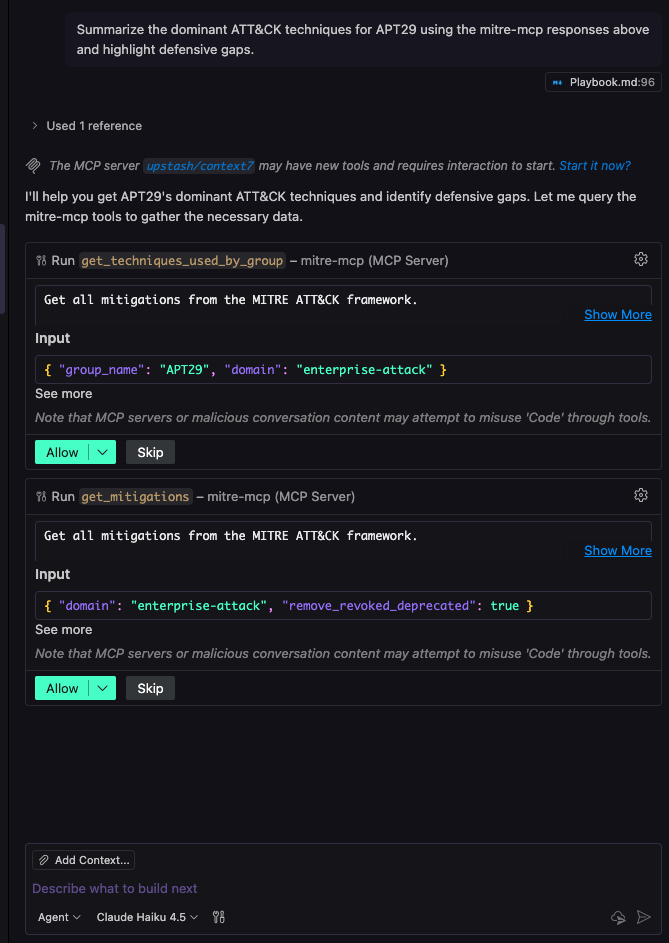
get_techniques_used_by_group | Get techniques used by a specific group (e.g., APT29) |
get_software | List malware and tools with filtering |
get_mitigations | List all security mitigations |
get_techniques_mitigated_by_mitigation | Get techniques addressed by a specific mitigation |
All list and relationship tools accept limit/offset paging parameters
(default page size 20, maximum 200 — see MITRE_DEFAULT_PAGE_SIZE and
MITRE_MAX_PAGE_SIZE in CONTRIBUTING.md) and return a pagination
block (total, offset, limit, has_more).
Quick Start
Installation
- Create and activate a virtual environment:
python3 -m venv .venv
source .venv/bin/activate  # On Windows: .venv\Scripts\activate.bat
- Install from PyPI:
pip install mitre-mcp
- Verify installation:
mitre-mcp --help
HTTP Mode (Recommended)
Start the server:
mitre-mcp --http
Expected output:
2025-11-17 22:40:10,991 - mitre_mcp.mitre_mcp_server - INFO - Starting MITRE ATT&CK MCP Server (HTTP mode on localhost:8000)
======================================================================
MITRE ATT&CK MCP Server is ready (Streamable HTTP mode)
Server URL: http://localhost:8000
MCP Endpoint: http://localhost:8000/mcp

Add this to your MCP client configuration:
{
  "mcpServers": {
    "mitreattack": {
      "url": "http://localhost:8000/mcp"
    }
  }
}
======================================================================
Configure your MCP client:
Add this JSON to your client's configuration file:
{
  "mcpServers": {
    "mitreattack": {
      "url": "http://localhost:8000/mcp"
    }
  }
}
Configuration file locations:
- macOS (Claude Desktop):
~/Library/Application Support/Claude/claude_desktop_config.json - Windows (Claude Desktop):
%APPDATA%\Claude\claude_desktop_config.json - Linux (Claude Desktop):
~/.config/Claude/claude_desktop_config.json - VSCode: Configure in your MCP extension settings
Custom host and port:
mitre-mcp --http --host 0.0.0.0 --port 8080
Then use http://your-server-ip:8080/mcp in your client configuration.
Security — a non-loopback bind is unauthenticated by default. Binding
--host 0.0.0.0(or any non-loopback address) exposes the MCP endpoint to the whole network: the data is public, but the endpoint is an open CPU and memory amplifier. Either setMITRE_HTTP_AUTH_TOKENso every request must carryAuthorization: Bearer <token>:MITRE_HTTP_AUTH_TOKEN=$(openssl rand -hex 32) mitre-mcp --http --host 0.0.0.0 --port 8080or place an authenticating reverse proxy in front of a loopback-only server — nginx example (TLS + basic auth →
127.0.0.1:8000):server { listen 443 ssl; server_name mcp.example.com; ssl_certificate /etc/nginx/certs/mcp.example.com.pem; ssl_certificate_key /etc/nginx/certs/mcp.example.com.key; location / { auth_basic "mitre-mcp"; auth_basic_user_file /etc/nginx/.htpasswd; proxy_pass http://127.0.0.1:8000; proxy_set_header Host $host; } }The server logs a warning at startup whenever it binds a non-loopback host without
MITRE_HTTP_AUTH_TOKENset.
Why HTTP mode?
- Multiple clients can connect simultaneously
- Better concurrency and async support
- Easier debugging with HTTP tools
- CORS support for web-based clients
- No path configuration needed
stdio Mode (Alternative)
For local-only clients that require stdio transport:
mitre-mcp
Client configuration:
{
  "mcpServers": {
    "mitreattack": {
      "command": "/absolute/path/to/.venv/bin/python",
      "args": ["-m", "mitre_mcp.mitre_mcp_server"]
    }
  }
}
Note: Use absolute paths. HTTP mode is recommended for most use cases.
Force Data Download
Force a fresh download of MITRE ATT&CK data:
mitre-mcp --http --force-download
Example Screenshots
VSCode Configuration:
Tool Invocation:
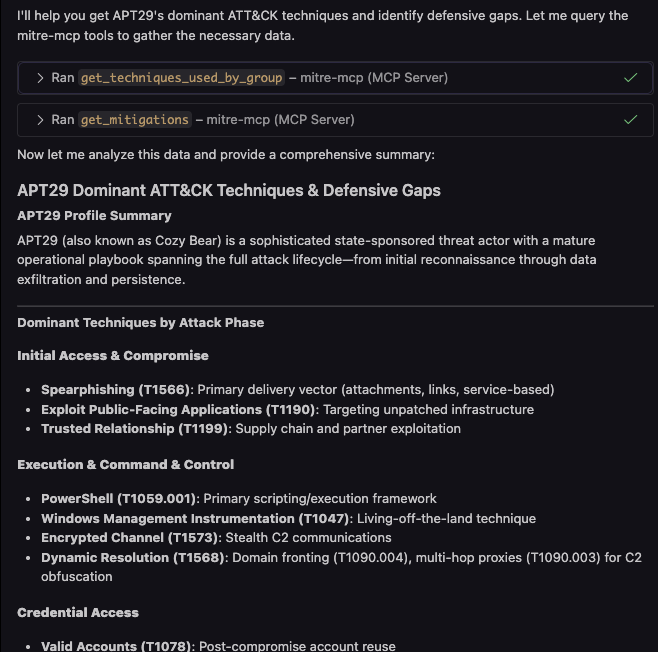
Results:
Web Frontend
A React chat UI lives in frontend/. A hosted copy is at
https://montimage.github.io/mitre-mcp/. That public HTTPS page can call
cloud LLM providers (Gemini, OpenRouter). It cannot reach anything
on this machine — mitre-mcp on localhost:8000, Ollama, LM Studio, or
any other loopback endpoint. The browser blocks public sites from the
loopback address space (net::ERR_SSL_PROTOCOL_ERROR if it upgrades the
MCP URL to https://localhost:8000/mcp, CORS / private-network errors for
http://localhost:…/v1/models).
Use the local UI whenever the MCP server or the LLM runs on your computer.
Local setup (MCP server + chat UI)
Two terminals, from a clone of this repository.
1. Install and start the MCP server (Python >= 3.11):
uv sync --locked --extra dev
source .venv/bin/activate
mitre-mcp --http
Wait for MCP Endpoint: http://localhost:8000/mcp. The first start
downloads ATT&CK data into ~/.cache/mitre-mcp.
2. Start the chat UI (Node 24):
cd frontend
npm ci
npm run dev
Open http://localhost:5173/ — not the GitHub Pages URL.
3. Settings (gear in the chat header):
| Setting | Local value |
|---|---|
| MCP host / port | localhost / 8000 (dev proxies /mcp to the server) |
| LLM provider | Ollama, Gemini, OpenRouter, or OpenAI-compatible |
For a local OpenAI-compatible server (LM Studio, llama.cpp, vLLM, …):
- Provider: OpenAI-compatible
- Endpoint URL:
http://localhost:<port>/v1(example:http://localhost:20128/v1) - Model: an id the endpoint lists at
/v1/models - API key: leave empty unless that server requires one
The endpoint must allow CORS from http://localhost:5173. If Ollama is
not running, do not leave Ollama selected — the default probe hits
localhost:11434 and Vite logs http proxy error: /api/tags.
For more details, see frontend/README.md.
Documentation
We provide three comprehensive guides tailored to different use cases:
1. Beginner's Guide
Beginner-Playbook.md - For those new to MITRE ATT&CK or cybersecurity
Ideal for:
- Non-technical users
- Security awareness training
- Basic threat intelligence
- General cybersecurity education
2. Advanced Playbook
Playbook.md - For security professionals using MCP clients
Ideal for:
- Security analysts
- Threat hunters
- Incident responders
- Security engineers
Includes 10 ready-to-use scenarios:
- Threat Intelligence
- Detection Engineering
- Threat Hunting
- Red Teaming
- Security Assessment
- Incident Response
- Security Operations
- Security Training
- Vendor Evaluation
- Risk Management
3. API Integration Guide
API-INTEGRATION.md - For developers building automation and custom integrations
Ideal for:
- Backend developers
- Automation engineers
- Data pipeline developers
- Custom tooling projects
Includes:
- Complete Python and Node.js client implementations
- Protocol requirements and examples
- Testing and debugging tools
- Common integration patterns
Configuration
Environment Variables
Set before starting mitre-mcp to customize behavior:
| Variable | Default | Purpose |
|---|---|---|
MITRE_ENTERPRISE_URL, MITRE_MOBILE_URL, MITRE_ICS_URL | Official MITRE CTI GitHub URLs | Override ATT&CK bundle locations or point to internal mirror |
MITRE_DATA_DIR | ~/.cache/mitre-mcp | Store cached bundles in custom directory |
MITRE_DOWNLOAD_TIMEOUT | 120 | HTTP timeout in seconds for bundle downloads |
MITRE_CACHE_EXPIRY_DAYS | 14 | Maximum age before cached data is refreshed |
MITRE_REQUIRED_SPACE_MB | 200 | Disk space threshold checked before downloading |
MITRE_DEFAULT_PAGE_SIZE / MITRE_MAX_PAGE_SIZE | 20 / 200 | Default and maximum records returned by list tools |
MITRE_MAX_DESC_LENGTH | 500 | Trimmed description length in responses |
MITRE_LOG_LEVEL | INFO | Logging verbosity (DEBUG, INFO, WARNING, etc.) |
MITRE_CORS_ORIGINS | localhost origins | CORS allowed origins for HTTP mode (comma-separated list; * is an explicit opt-in) |
MITRE_HTTP_AUTH_TOKEN | unset (no auth) | Bearer token required on every HTTP request when set; recommended for non-loopback binds |
To let a hosted UI (e.g. the Netlify deployment) call the server cross-origin, set MITRE_CORS_ORIGINS to its origin, e.g. MITRE_CORS_ORIGINS="https://mitre-mcp.netlify.app,http://localhost:5173". Credentials are never allowed in any CORS configuration.
Data Caching
The server automatically caches MITRE ATT&CK data to improve performance:
- On first run, downloads and stores data in the per-user cache directory
(
$XDG_CACHE_HOME/mitre-mcp, or~/.cache/mitre-mcpby default) - On subsequent runs, uses cached data if less than 14 days old
- Automatically refreshes data older than 14 days, using conditional
requests — a
304 Not Modifiedanswer reuses the cached bundles. Expired-but-present data is served immediately while the refresh runs in the background; startup never blocks on it and a failed refresh keeps the existing cache. - Cache files are written atomically (temp file + rename), so a failed download never corrupts a good cache
- Only the enterprise domain is parsed at startup; the mobile and ICS bundles are lazy-loaded on first use, so cold starts stay fast when they are never queried
- Use
--force-downloadto force fresh download
Performance
| Scenario | Improvement | Notes |
|---|---|---|
| Enterprise technique lookup | 80-95% faster | Pre-built O(1) indices for groups, mitigations, and techniques |
| ATT&CK data downloads | 20-40% faster | HTTP connection pooling with TLS session reuse |
| Warm cache startup | <2s | Cached bundles reused for instant LLM queries |
Benchmarks: macOS 14 / Apple M3 Pro with Python 3.11. Use MITRE_LOG_LEVEL=DEBUG for timing logs.
Programmatic API
For automation, custom integrations, and batch processing, see API-INTEGRATION.md.
Quick example (Python):
from clients.python.mini_mcp_client import MitreMCPClient


async def main():
    client = MitreMCPClient(host="localhost", port=8000)

    # Get all tactics
    tactics = await client.call_tool("get_tactics", {"domain": "enterprise-attack"})

    # Get techniques for a group
    techniques = await client.call_tool(
        "get_techniques_used_by_group", {"group_name": "APT29", "domain": "enterprise-attack"}
    )
Available clients:
- Python:
clients/python/mini-mcp-client.pywith full CLI - Node.js:
clients/nodejs/mini-mcp-client.jswith full CLI
See API-INTEGRATION.md for complete documentation.
Development
Clone and Install
git clone https://github.com/montimage/mitre-mcp.git
cd mitre-mcp
python -m venv .venv
source .venv/bin/activate
pip install -e ".[dev]"
Install Pre-commit Hooks
pre-commit install
This sets up automatic code quality checks before each commit.
Run Tests
pytest                      # Full test suite with coverage
pre-commit run --all-files  # All quality checks
Code Quality Tools
Formatting:
- black - Python code formatter
- isort - Import organizer
- prettier - YAML/JSON/Markdown formatter
Linting & Type Checking:
- flake8 - Python linter
- mypy - Static type checker
- pydocstyle - Docstring checker
Security:
- bandit - Security vulnerability scanner
- File validators - YAML, JSON, TOML, private key detection
Testing:
- pytest - test suite with coverage gate before commit
- Installation test - Package verification
- Import verification - Module importability
- CLI test - Entry point validation
Troubleshooting
Download fails with "Insufficient disk space"
- Free at least 200 MB in the data directory or set
MITRE_DATA_DIR=/path/to/storage
Data never updates
- Cached bundles refresh automatically after 14 days
- Force refresh:
mitre-mcp --force-downloador delete~/.cache/mitre-mcp
Tool calls return errors
- Ensure technique IDs follow
T####orT####.###format - Keep names/tactics under 100 characters
MCP client cannot discover server
- Verify client configuration points to correct Python path
- Test manually: run
mitre-mcpand verify server starts - For HTTP mode: ensure
urlfield is set correctly
Chat UI: POST https://localhost:8000/mcp net::ERR_SSL_PROTOCOL_ERROR
- The GitHub Pages UI is HTTPS, so it rewrites
localhosttohttps://localhost:8000.mitre-mcp --httphas no TLS. Open http://localhost:5173 instead (see Web Frontend).
Chat UI: CORS / “loopback address space” when calling a local LLM
- Same cause: a public origin cannot fetch
http://localhost:…. Run the frontend locally and point the OpenAI-compatible provider athttp://localhost:<port>/v1.
Module not found: mcp.server.fastmcp
- Reinstall the pinned MCP SDK:
pip install "mcp>=1.28.1,<2"(ormcp[cli]>=1.28.1,<2if you also want the CLI extra) in your virtual environment — thefastmcpdistribution does not providemcp.server.fastmcp; the package's declared pin does
FAQ
Does mitre-mcp work offline?
- Yes. Once bundles are cached, the server works offline until cache expires.
Which Python versions are supported?
- Python 3.11 through 3.14 (see
pyproject.toml).
How often is data refreshed?
- By default every 24 hours. Adjust
MITRE_CACHE_EXPIRY_DAYSor use--force-download.
Is HTTP mode safe for production?
- HTTP mode serves on localhost:8000 by default. Use firewall or reverse proxy if exposing externally.
License
MIT License - See LICENSE file for details.
About Montimage
mitre-mcp is developed and maintained by Montimage, a cybersecurity company specializing in network monitoring, security analysis, and AI-driven threat detection solutions. We develop innovative tools that help organizations protect their digital assets and ensure network security.
For questions or support: luong.nguyen@montimage.eu
Related MCP servers

echorune radar
Live weather anywhere, with the radar drawn as text characters, not an image.

EasyAccessPDF
PDF accessibility checks (veraPDF PDF/UA-1), auto-fix and Markdown conversion. EU-hosted.

Stateful Windows RPC attack-surface research for AI agents—24 tools on NtObjectManager for CVE methodology and context-handle chaining.

Code intelligence MCP: symbols, call graphs, change impact + affected tests, routes, search.

Keel
Control plane MCP that dedups scanner output, rate-limits hosts, and runs non-destructive proofs.

Sense
Symbol graph, blast radius, and semantic search for AI coding agents—structural codebase understanding on your machine.