Mako MCP Server
io.github.mako-ai/mako
AI-native SQL client for querying databases, building dashboards, and creating data apps in your browser.
What is the Mako MCP server?
Mako is an AI-native SQL client that lets you explore databases, write queries in natural language, and build interactive dashboards and React apps. It replaces traditional database tools like DataGrip and BI platforms like Metabase with a fast, browser-based, AI-powered experience supporting 9+ databases and 8+ data connectors.
Mako is a modern SQL client built for the AI era. Connect to any database (PostgreSQL, MongoDB, BigQuery, ClickHouse, MySQL, Redshift, etc.), query with plain English via AI, and turn results into interactive dashboards with cross-filtering and scheduled refresh. It also supports dbt transforms, React app generation, and team collaboration—all from your browser without desktop bloat.
How to install Mako
Copy-paste configuration for popular MCP clients.
Tools & capabilities
Tools this server exposes to the agent.
AI Query Generation— Write queries in natural language; schema-aware AI generates optimized SQL instantlyAI Dashboards— Build interactive dashboards from conversation with cross-filtering, scheduled data refresh, and Parquet materialization powered by DuckDBdbt Transforms— Build, run, and schedule dbt Core projects in-app with file IDE, jobs, run history, and lineageReact Apps— Ask the agent to build live React apps wired to your data through secure, credential-free bindingsVersion History— Every console and dashboard save is an immutable snapshot you can browse and restoreDatabase Explorer— Explore schema and data across 9+ supported databasesSQL Validation— Validate SQL queries before executionData Connectors— Sync external SaaS data (Stripe, PostHog, Close.com, Calendly, GraphQL, REST APIs) into the data warehouse
Use cases
- Write SQL queries in plain English and get instant results without manual SQL syntax
- Build interactive dashboards with cross-filtering and scheduled data refresh from natural language descriptions
- Explore and analyze data from multiple databases (PostgreSQL, BigQuery, MongoDB, etc.) in a single interface
- Create live React apps connected to your database data without writing backend code
- Build and schedule dbt transformation projects with a visual IDE and job history
Mako MCP server FAQ
Mako is an AI-native SQL client that replaces traditional database tools and BI platforms. You connect to any database, query in plain English via AI, build interactive dashboards, and create React apps—all from your browser.
Mako is open source and self-hostable. A cloud version is available at app.mako.ai; check their website for pricing details.
Mako is available as an MCP server via remote HTTP at https://app.mako.ai/api/mcp. Add this URL to your Cursor or Claude MCP configuration to connect.
Mako supports PostgreSQL, MongoDB, BigQuery, ClickHouse, MySQL, Redshift, Google Cloud SQL, Cloudflare D1, and Cloudflare KV, plus 8+ data connectors (Stripe, PostHog, Close.com, Calendly, GraphQL, REST, etc.).
Yes, you connect Mako to your database by providing connection credentials. Mako also supports IP whitelisting (static IP: 34.79.190.46) for restricted databases.
Yes, Mako supports team collaboration with shared connections, version-controlled queries, and real-time collaboration features.
README (reference)
Source of truth, from the repository.
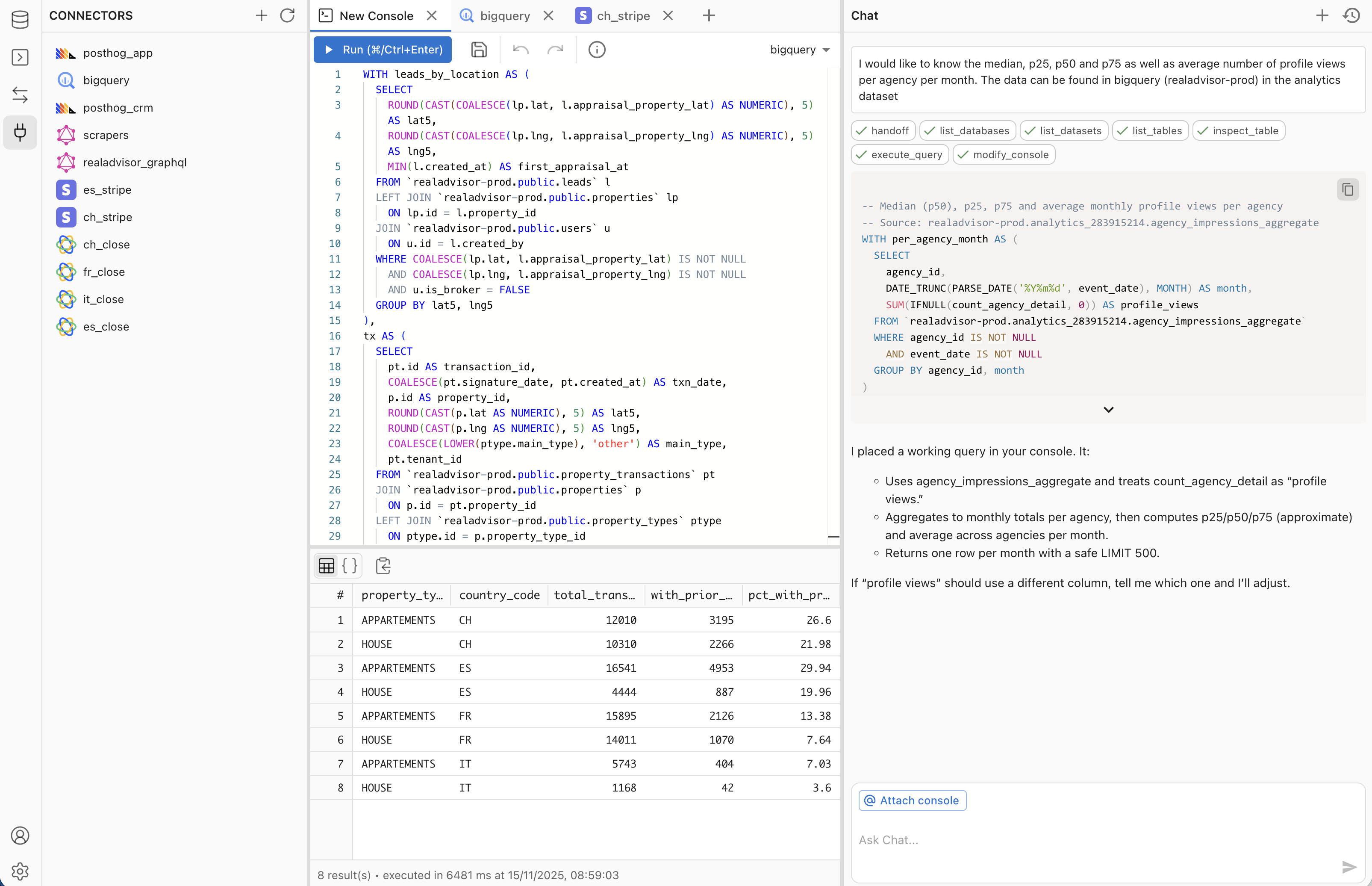
The Cursor for Data. Connect to any database, query with AI, and build live dashboards -- all from your browser.
Stop wrestling with complex SQL and slow, bloated database tools. Write queries in plain English, get instant results, and turn them into interactive dashboards with cross-filtering and scheduled refresh.
🚀 Why Mako?
A modern SQL client built for the AI era, replacing slow desktop tools with a fast, collaborative, AI-powered experience.
- ✨ AI Query Generation: Write queries in natural language. Our schema-aware AI generates optimized SQL instantly.
- Replaces: DataGrip, DBeaver, Postico
- 📊 AI Dashboards: Build interactive dashboards from conversation. Cross-filtering, scheduled data refresh, Parquet materialization -- powered by DuckDB in the browser.
- Replaces: Metabase, Looker, manual BI pipelines
- 🧱 dbt Transforms: Build, run, and schedule dbt Core projects in-app -- file IDE, jobs, run history, lineage, and GitHub sync.
- Replaces: dbt Cloud
- ⚛️ React Apps: Ask the agent to build live React apps wired to your data through secure, credential-free bindings.
- Replaces: Lovable, v0, internal-tool builders
- 🕓 Version History: Every console and dashboard save is an immutable snapshot you can browse and restore.
- Replaces: Lost SQL files, manual backups
- 🖥️ Mako Desktop: Native app that bundles a local agent so
localhostdatabases work out of the box.- Replaces: SSH tunnels and bastion hops for local DBs
- 👥 Team Collaboration: Share connections, version-control queries, and work together in real-time.
- Replaces: Passing credentials around, lost SQL files
- ⚡ Blazing Fast: No Java or Electron bloat. Opens instantly in your browser and runs smooth.
- Replaces: Slow desktop database tools
📸 Screenshots
AI-powered console — ask in plain English, get a verified query and live results.
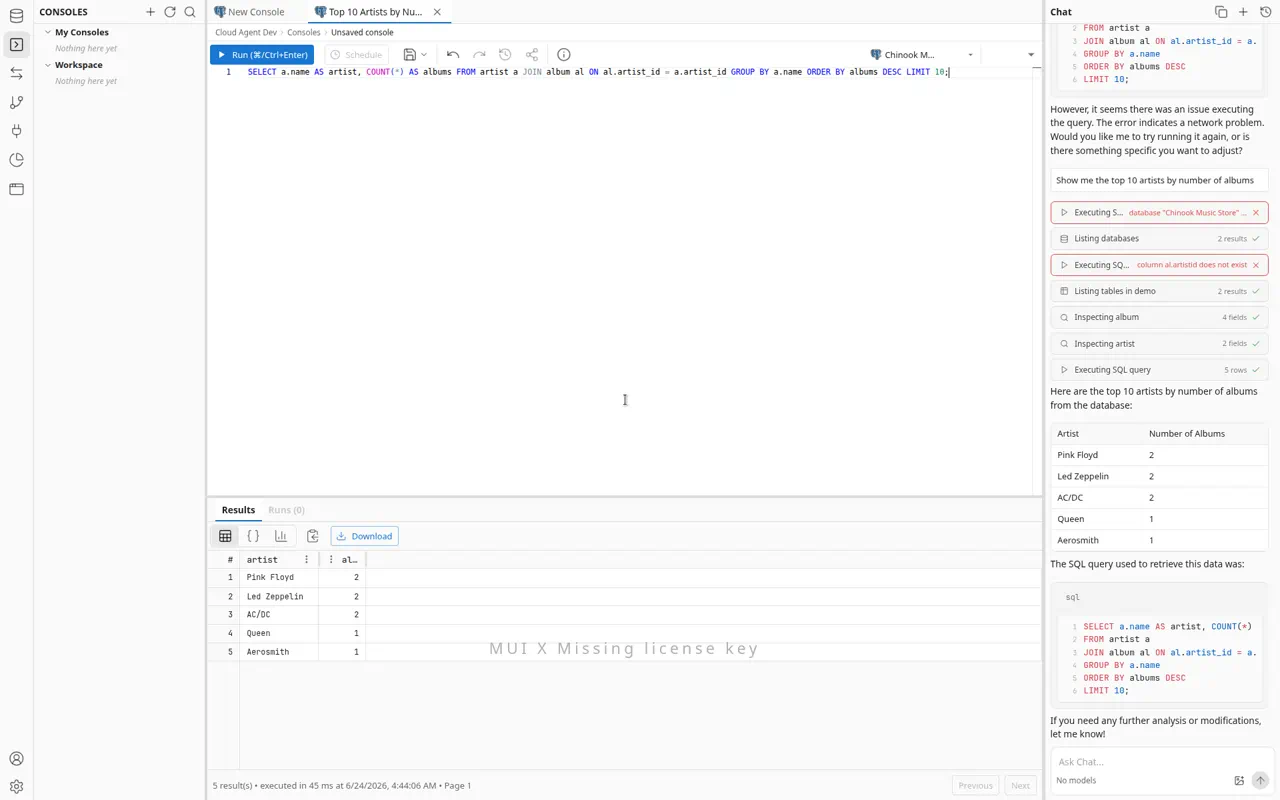
Transforms (dbt) — build, run, and schedule dbt Core projects with a file IDE, jobs, run history, and lineage.
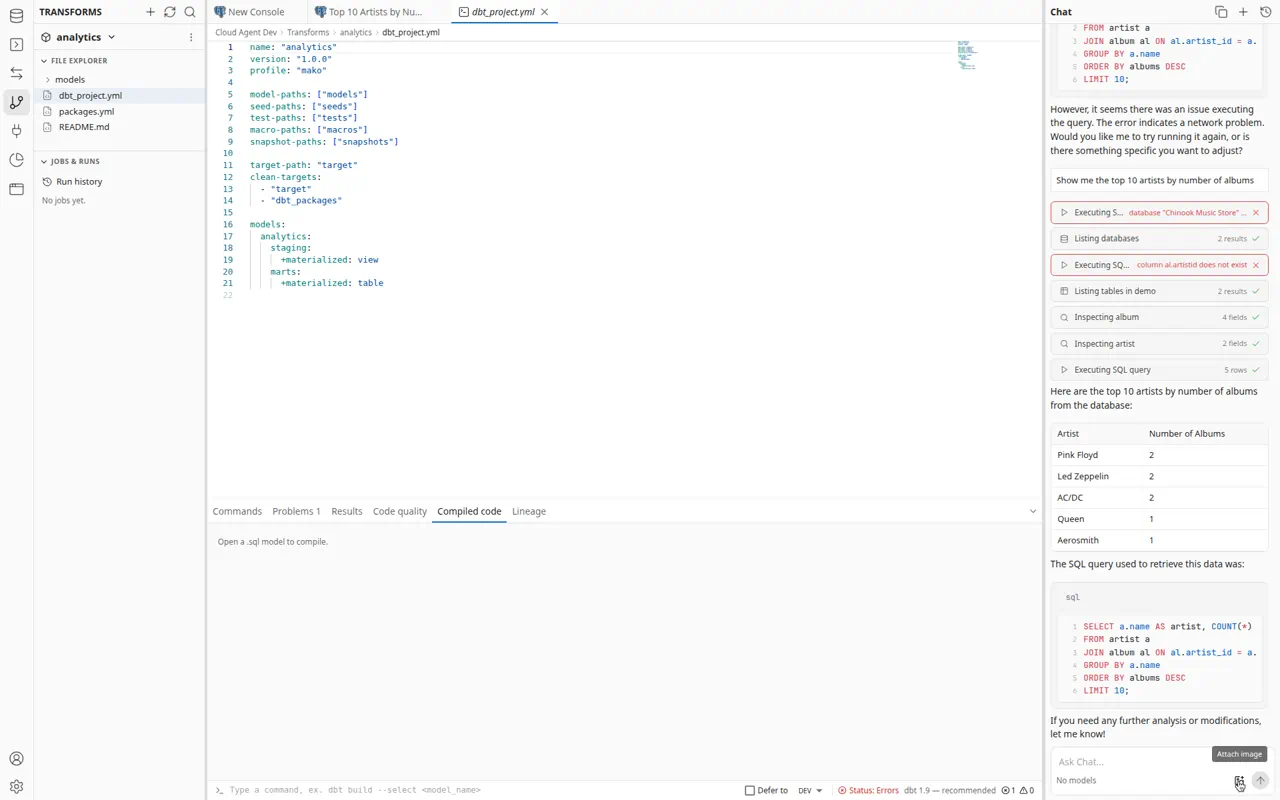
Apps — build live React apps wired to your data, rendered in a sandboxed preview.
🔌 Integrations
Databases
| Integration | Status | Description |
|---|---|---|
| PostgreSQL | ✅ Live | Connect to PostgreSQL for relational data queries |
| MongoDB | ✅ Live | Connect to MongoDB for flexible document-based data |
| BigQuery | ✅ Live | Analyze large datasets with Google BigQuery |
| ClickHouse | ✅ Live | Fast OLAP queries on ClickHouse |
| MySQL | ✅ Live | Query MySQL databases with natural language |
| Redshift | ✅ Live | Query Amazon Redshift data warehouses |
| Cloud SQL | ✅ Live | Connect to Google Cloud SQL (Postgres) |
| Cloudflare D1 | ✅ Live | Query Cloudflare D1 SQLite databases |
| Cloudflare KV | ✅ Live | Browse and query Cloudflare Workers KV |
Data Connectors
Sync external SaaS data into Mako's data warehouse for querying and dashboards.
| Integration | Status | Description |
|---|---|---|
| Stripe | ✅ Live | Track payments, subscriptions, and billing data |
| PostHog | ✅ Live | Analyze product analytics and user behavior |
| Close.com | ✅ Live | Sync CRM data (leads, opportunities, activities) |
| Claap | ✅ Live | Sync recordings and workspace data |
| Calendly | ✅ Live | Sync events, invitees, and event types |
| GraphQL | ✅ Live | Query any GraphQL API with custom endpoints |
| REST | ✅ Live | Query any REST API with custom endpoints |
| BigQuery | ✅ Live | Sync BigQuery datasets into the warehouse |
🏗️ Architecture
┌─────────────────────────────────────────────────────────┐
│  Frontend (React + Vite)                                │
│  ┌──────────┐ ┌──────────────┐ ┌─────────────────────┐ │
│  │ Console  │ │  Dashboards  │ │   AI Chat (Vercel   │ │
│  │ (Monaco) │ │  (DuckDB +   │ │    AI SDK)          │ │
│  │          │ │   Mosaic)    │ │                     │ │
│  └──────────┘ └──────────────┘ └─────────────────────┘ │
│           ▲          ▲                   ▲              │
│           │     Parquet/Arrow            │              │
│           │     via OPFS cache           │              │
└───────────┼──────────┼──────────────────┼──────────────┘
            │          │                  │
┌───────────┼──────────┼──────────────────┼──────────────┐
│  API (Hono + Node.js)                                  │
│  ┌──────────────────────────────────────────────────┐  │
│  │ Unified Agent (expertise modes: Query /          │  │
│  │   Dashboard / Sync Flow / React App / Transforms │  │
│  │   / Explore, switched via enable_mode)           │  │
│  └──────────────────────────────────────────────────┘  │
│  ┌──────────────┐ ┌───────────────┐ ┌──────────────┐  │
│  │  DB Drivers   │ │  Connectors   │ │  Dashboard   │  │
│  │  (9 drivers)  │ │  (8 sources)  │ │  Engine      │  │
│  │              │ │               │ │  (DuckDB     │  │
│  │              │ │               │ │   + Parquet) │  │
│  └──────────────┘ └───────────────┘ └──────────────┘  │
│                          ▲                             │
│                    ┌─────┴──────┐                      │
│                    │  Inngest   │ (scheduled refresh,   │
│                    │            │  incremental sync)    │
│                    └────────────┘                      │
└────────────────────────────────────────────────────────┘
            │                │
     ┌──────┴──────┐  ┌─────┴──────────┐
     │  MongoDB    │  │  User DBs      │
     │  (metadata, │  │  (PG, BQ, CH,  │
     │   warehouse)│  │   MySQL, etc.) │
     └─────────────┘  └────────────────┘
Key technology choices:
- DuckDB (both server-side via
@duckdb/node-apiand browser-side via@duckdb/duckdb-wasm): powers dashboard SQL execution, Parquet artifact generation, and in-browser cross-filtering with OPFS caching - Mosaic (
@uwdata/mosaic-core): coordinates cross-filtering across dashboard widgets - Apache Arrow / Parquet: server materializes query results into Parquet, served to browser as Arrow IPC for zero-copy rendering
- Inngest: event-driven job queues for scheduled dashboard refresh and incremental data sync
- Hono: lightweight, fast HTTP framework for the API
- Monaco Editor: VS Code's editor for the SQL console
- Vercel AI SDK: multi-provider LLM abstraction (OpenAI, Anthropic, Google)
📊 Dashboard Engine
Dashboards are a core feature. The AI agent creates interactive dashboards from natural language:
- Agent creates a dashboard spec with widgets, layouts, and SQL queries
- Server materializes query results into Parquet artifacts (stored on filesystem, GCS, or S3)
- Browser loads Parquet data into DuckDB-WASM, cached in OPFS for instant reloads
- Mosaic cross-filtering lets users click on one chart to filter all others
- Inngest cron keeps data fresh with scheduled re-materialization and stale-run detection
Dashboard Artifact Storage
Dashboard materialization stores Parquet artifacts on the backend. Three storage backends:
filesystem-- default; stores files on local diskgcs-- Google Cloud Storages3-- S3-compatible bucket
DASHBOARD_ARTIFACT_STORE=filesystem

# Optional shared settings
DASHBOARD_ARTIFACT_PREFIX=dashboards
DASHBOARD_ARTIFACT_DIR=/absolute/path/to/artifacts  # filesystem only
Google Cloud Storage
DASHBOARD_ARTIFACT_STORE=gcs
GCS_DASHBOARD_BUCKET=your-bucket-name
DASHBOARD_ARTIFACT_PREFIX=dashboard-artifacts/prod
See the docs for full GCS/S3 provisioning instructions.
🛠️ Quick Start
-
Clone & Install
git clone https://github.com/mako-ai/mako.git cd mako pnpm install -
Configure Environment Copy
.env.example(if available) or create.env:# Local development connects to the shared `dev` database, an Atlas DB that is # refreshed nightly from production. Grab the `dev` connection string from the # team vault. (`staging` backs non-migration PR previews; never point local at # `production`.) DATABASE_URL=mongodb+srv://<user>:<password>@<cluster>.mongodb.net/dev ENCRYPTION_KEY=your_32_character_hex_key_for_encryption WEB_API_PORT=8080 BASE_URL=http://localhost:8080 CLIENT_URL=http://localhost:5173 -
Start Services
# Start the local notebook Python kernel so notebook `code` cells run # locally. Requires the KERNEL_* vars from .env.example in your .env. # (The dev database is hosted MongoDB Atlas, set via DATABASE_URL.) pnpm run docker:up # Start the full stack (API + App + Inngest) pnpm run dev -
Analyze
- Open http://localhost:5173 to access the app.
- Add a Data Source (e.g., Stripe or Close.com).
- Use the chat interface to ask questions about your data.
🌐 IP Whitelisting
If your database requires IP whitelisting, add the following static IP to your allowlist:
34.79.190.46
This IP is used by Mako's cloud service for all outbound database connections.
💻 Development Commands
| Command | Description |
|---|---|
pnpm run dev | Start API, frontend, and Inngest dev server |
pnpm run app:dev:scan | Start the frontend with React Scan and render debug logging |
pnpm run sync | Run the interactive sync tool |
pnpm run migrate | Run database migrations |
pnpm run docker:up | Start the local notebook Python kernel (run notebook code cells) |
pnpm run test | Run test suite |
pnpm run build | Build all packages |
pnpm run docs:dev | Start documentation site locally |
🔎 React Performance Profiling
Use React Scan when working on render churn, streaming chat responsiveness, Monaco console performance, or explorer/result table interactions:
pnpm run app:dev:scan
This enables the React Scan Vite plugin via VITE_REACT_SCAN=true and turns on Mako's render-debug logs via VITE_RENDER_DEBUG=true. React Scan highlights components that re-render in the browser, while render-debug logs summarize why hot components such as Chat, ResourceTree, Console, and ResultsTable changed.
Keep React Scan off during normal development. The plugin and debug hooks are gated behind env flags so regular pnpm run app:dev runs without profiling overlays or extra debug logging.
🤝 Community & Support
- Documentation: docs.mako.ai
- GitHub: mako-ai/mako
- Website: mako.ai
<p align="center"> Built with ❤️ by the Mako Team. Open Source and self-hostable. </p>
Related MCP servers

China inbound travel MCP: search hotels, flights, attractions, plan itineraries, get travel tips
View repository →
Package risk checks: maintenance, licence, advisories. Paid per call in USDC, no signup.

io.github.makririch/buchpilot
DACH accounting for AI: connect sevDesk & Lexoffice to create invoices, contacts, vouchers.
io.github.makririch/einvoice
XRechnung & ZUGFeRD: create, validate, and convert German e-invoices. EN 16931 compliant.

Advanced analytics, reporting, and safe mutations for Zebrunner. 64 tools, 14 resources, 17 prompts.

Spendlog
MCP server for expense tracking, invoices, budgets, and financial insights directly in Claude