IBM Maximo MCP Server
io.github.markusvankempen/maximo-mcp-server
Connect AI assistants to IBM Maximo for API discovery, OSLC querying, and intelligent code generation.
What is the IBM Maximo MCP server?
The Maximo MCP Server is a Model Context Protocol server that connects AI assistants like Claude, Cursor, and VS Code Copilot directly to IBM Maximo environments. It enables AI to discover APIs, inspect schemas, query live data via OSLC, generate UI code, and perform CRUD operations on Maximo records without manual API documentation.
This server bridges AI assistants and IBM Maximo by exposing 9 tools for schema discovery, live data querying, code generation, and record management. Instead of manually copying API docs, AI can inspect Object Structures, execute OSLC queries, generate Carbon Design tables, and create or update Maximo records. It's ideal for accelerating Maximo development, building dashboards, and automating workflows through natural language.
How to install IBM Maximo
Copy-paste configuration for popular MCP clients.
MAXIMO_URLrequiredBase URL for the Maximo REST API (e.g., https://your-host/maximo/api)
MAXIMO_API_KEYrequiredsecretAPI Key for Maximo authentication
MAXIMO_HOSTBase Host URL for the Maximo instance
Tools & capabilities
Tools this server exposes to the agent.
list_object_structures— List available Maximo Object Structures (APIs)get_schema_details— Get field definitions for an Object Structurequery_maximo— Execute OSLC REST queriesrender_carbon_table— Generate Carbon Design HTML tablesrender_carbon_details— Generate detail view for a recordget_instance_details— Check server connectivitycreate_record— Create a new record in any Maximo Object Structureupdate_record— Partially update fields on an existing record by IDrun_action— Execute Maximo business actions (status changes, approvals)
Use cases
- Generate OSLC API calls and REST queries for Maximo data retrieval
- Build Python, JavaScript, or SQL scripts to export and analyze Maximo records
- Create complete web dashboards and applications with Carbon Design System components
- Create and update Maximo records (Work Orders, Assets, Service Requests) via natural language
- Execute Maximo business workflows and status changes through AI-driven automation
IBM Maximo MCP server FAQ
It's a Model Context Protocol server that connects AI assistants (Claude, Cursor, VS Code Copilot) to IBM Maximo. It exposes 9 tools for API discovery, schema inspection, OSLC querying, code generation, and CRUD operations on Maximo records.
Yes. The server is open-source under Apache 2.0 license. You need a Maximo instance and API key to use it.
Install via npm (npx maximo-mcp-server) and configure your IDE's MCP settings with your Maximo URL and API key. For Cursor/Claude Desktop, add the server to your mcp.json config file with environment variables.
You need a Maximo API key with read access (or read+write for CRUD operations). Set MAXIMO_URL, MAXIMO_API_KEY, and MAXIMO_HOST in your .env file or IDE configuration.
Yes. The server includes write tools (create_record, update_record, run_action) to create Work Orders, Assets, and other records, and to execute business workflows. Use a read-only key for exploration; enable write access only for known workflows.
No, but it's recommended. Downloading maximo_openapi.json from your Maximo instance enables offline schema lookups for faster AI responses. Without it, the server queries Maximo live for schema details.
README (reference)
Source of truth, from the repository.
🏭 Maximo MCP Server
AI-Powered Development for IBM Maximo





Transform your Maximo development workflow with AI-driven schema discovery, live data querying, intelligent code generation, and full write-back capabilities.
Author: Markus van Kempen
Email: mvankempen@ca.ibm.com | markus.van.kempen@gmail.com
Date: 16 September 2026
Getting Started • Documentation • Live Demo • Use Cases
</div>🎯 What is This?
The Maximo MCP Server is a Model Context Protocol server that connects AI assistants (like Antigravity, Cursor, or VS Code Copilot) directly to your IBM Maximo environment. Instead of manually copying API documentation, the AI can:
| Capability | Description |
|---|---|
| 🔍 Discover APIs | Find available Object Structures (MXWO, MXASSET, etc.) |
| 📋 Inspect Schemas | Get exact field names, types, and descriptions |
| 📊 Query Live Data | Execute OSLC REST queries and see real results |
| 🎨 Generate UI | Create Carbon Design System tables and dashboards |
| ✅ Validate Instantly | Test queries before generating final code |
| ✏️ Create Records | Create Work Orders, Assets, Service Requests via AI |
| 🔄 Update Records | Partially update any Maximo record by ID |
| ⚡ Run Actions | Trigger Maximo business workflows (status changes, approvals) |
📚 Documentation
Core Guides
| Document | Description |
|---|---|
| 📖 Maximo MCP Server Guide | Complete setup, configuration, and tool reference |
| 🔌 Maximo API Interaction Guide | OSLC query syntax, code generation patterns, troubleshooting |
| 🎬 Asset Manager Case Study | Step-by-step walkthrough of building a complete app |
| 🧩 Maximo API Explorer Guide | VS Code extension: install, connect, explore, generate apps |
French Translations
| Document | Description |
|---|---|
| 📖 Guide du Serveur MCP Maximo | Version française du guide complet |
| 🔌 Guide d'Interaction API Maximo | Version française du guide API |
Word Documents
All guides are also available in .docx format in the docs/ folder for offline reading and sharing.
⚡ Quick Start
Prerequisites
- Node.js v18 or higher
- Maximo API Key with read access
- AI IDE with MCP support (Antigravity, Cursor, VS Code + Continue)
Installation
Installation
Method 1: Run directly with npx (Recommended)
npx maximo-mcp-server
Method 2: Clone from Source
# Clone the repository
git clone https://github.com/markusvankempen/maximo-mcp-ai-integration-options.git
cd maximo-mcp-ai-integration-options

# Install dependencies
npm install

# Set up environment variables
cp .env.example .env
# Edit .env with your Maximo credentials
Environment Configuration
Edit the .env file with your Maximo credentials:
# .env (never commit this file!)
MAXIMO_URL=https://your-maximo-host.com/maximo/api
MAXIMO_HOST=https://your-maximo-host.com
MAXIMO_API_KEY=your-api-key-here
MAXIMO_OPENAPI_PATH=./maximo_openapi.json
PORT=3002
Download the OpenAPI Schema (Recommended)
The OpenAPI schema file enables offline schema lookups for faster AI responses:
# Download from your Maximo instance
curl -X GET "https://your-maximo-host.com/maximo/oslc/oas/api" \
     -H "apikey:your-api-key-here" \
     -o maximo_openapi.json
Alternatively, download via Swagger UI at: https://your-host/maximo/oslc/oas/api.html (Click "Explore" or "Download")
Method 3: Direct Browser Download (Manual)
If curl fails (e.g., due to SSL/network errors), you can manually download the file:
-
Open this URL in your browser:
https://[YOUR_MAXIMO_HOST]/maximo/oslc/oas/api(Replace[YOUR_MAXIMO_HOST]with your actual server address) -
You may be prompted to log in to Maximo.
-
Once the JSON loads, right-click the page and select "Save Page As...".
-
Save the file as
maximo_openapi.jsonin your project root folder.
Note: This file is ~12MB and contains all Object Structure definitions for your Maximo instance.
IDE Configuration
VS Code with GitHub Copilot (Recommended)
Option 1: Install from the MCP Server Gallery
- Enable
chat.mcp.gallery.enabledin VS Code settings - Open the Extensions view (
⇧⌘X) - Type
@mcp maximoin the search field - Click Install to add the Maximo MCP server
Option 2: Add manually via mcp.json
- Open the Command Palette (
⇧⌘P) → MCP: Open Workspace Folder Configuration - Add the following configuration:
{
  "inputs": [
    {
      "type": "promptString",
      "id": "maximo-url",
      "description": "Maximo REST API Base URL (e.g., https://your-host/maximo/api)"
    },
    {
      "type": "promptString",
      "id": "maximo-api-key",
      "description": "Maximo API Key",
      "password": true
    },
    {
      "type": "promptString",
      "id": "maximo-host",
      "description": "Maximo Host URL (e.g., https://your-host)"
    }
  ],
  "servers": {
    "maximo-mcp-server": {
      "type": "stdio",
      "command": "npx",
      "args": ["-y", "maximo-mcp-server"],
      "env": {
        "MAXIMO_URL": "${input:maximo-url}",
        "MAXIMO_API_KEY": "${input:maximo-api-key}",
        "MAXIMO_HOST": "${input:maximo-host}"
      }
    }
  }
}
- VS Code will prompt you for your Maximo credentials when the server starts.
💡 Tip: This project includes a
.vscode/mcp.jsonfile. If you clone the repo, VS Code will auto-detect the MCP server configuration.
Google Antigravity (Manual Setup Required)
⚠️ Note: The Antigravity MCP Store is curated and does not auto-discover servers from the registry. You must add this server manually.
- Open Antigravity
- Click "..." dropdown at the top of the Agent panel
- Select "MCP Servers" → "Manage MCP Servers" → "View raw config"
- Add to your
mcp_config.json:
{
  "mcpServers": {
    "maximo-mcp-server": {
      "command": "npx",
      "args": ["-y", "maximo-mcp-server"],
      "env": {
        "MAXIMO_URL": "https://your-maximo-host/maximo/api",
        "MAXIMO_API_KEY": "your-api-key-here",
        "MAXIMO_HOST": "https://your-maximo-host"
      }
    }
  }
}
- Save and click Refresh
Cursor / Claude Desktop
# Copy the template
cp config/mcp_config.json.example ~/.cursor/mcp.json
# Or for Claude Desktop:
cp config/mcp_config.json.example ~/Library/Application\ Support/Claude/claude_desktop_config.json
Edit with your Maximo credentials:
{
  "mcpServers": {
    "maximo-mcp-server": {
      "command": "npx",
      "args": ["-y", "maximo-mcp-server"],
      "env": {
        "MAXIMO_URL": "https://your-maximo-host/maximo/api",
        "MAXIMO_API_KEY": "your-api-key-here"
      }
    }
  }
}
Verify Connection
In your AI IDE, ask:
"Is the Maximo MCP server connected?"
The AI will call get_instance_details and confirm connectivity.
🎬 Live Demo
Asset Manager Application
We built a complete Maximo Asset Manager web application using only natural language prompts and the MCP server.
<div align="center">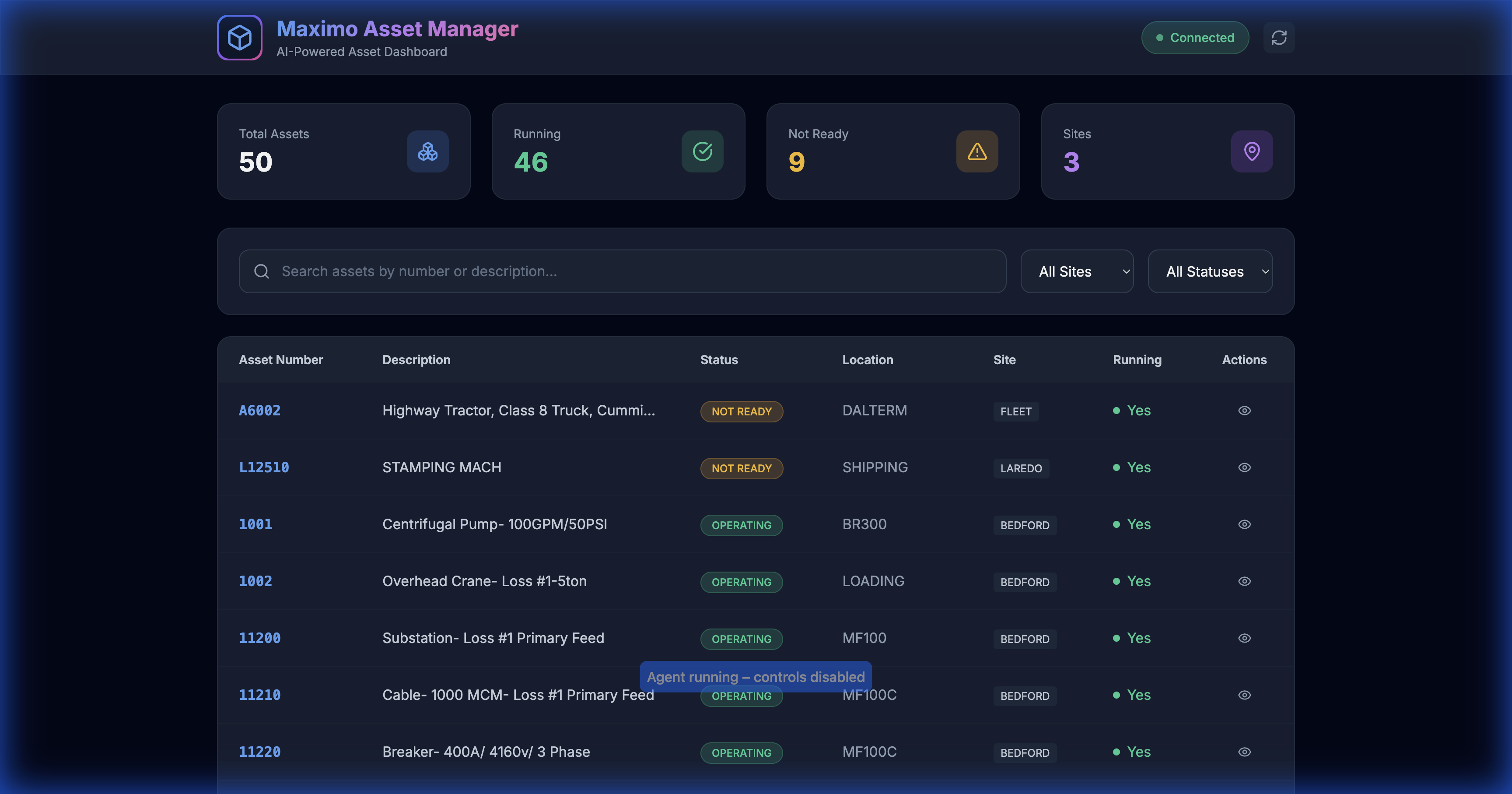
50 assets loaded with real-time filtering and search
</div>Demo Features
| Feature | Screenshot |
|---|---|
| Full Dashboard | 50 assets, 4 stat cards, 3 sites |
| Search Filter | 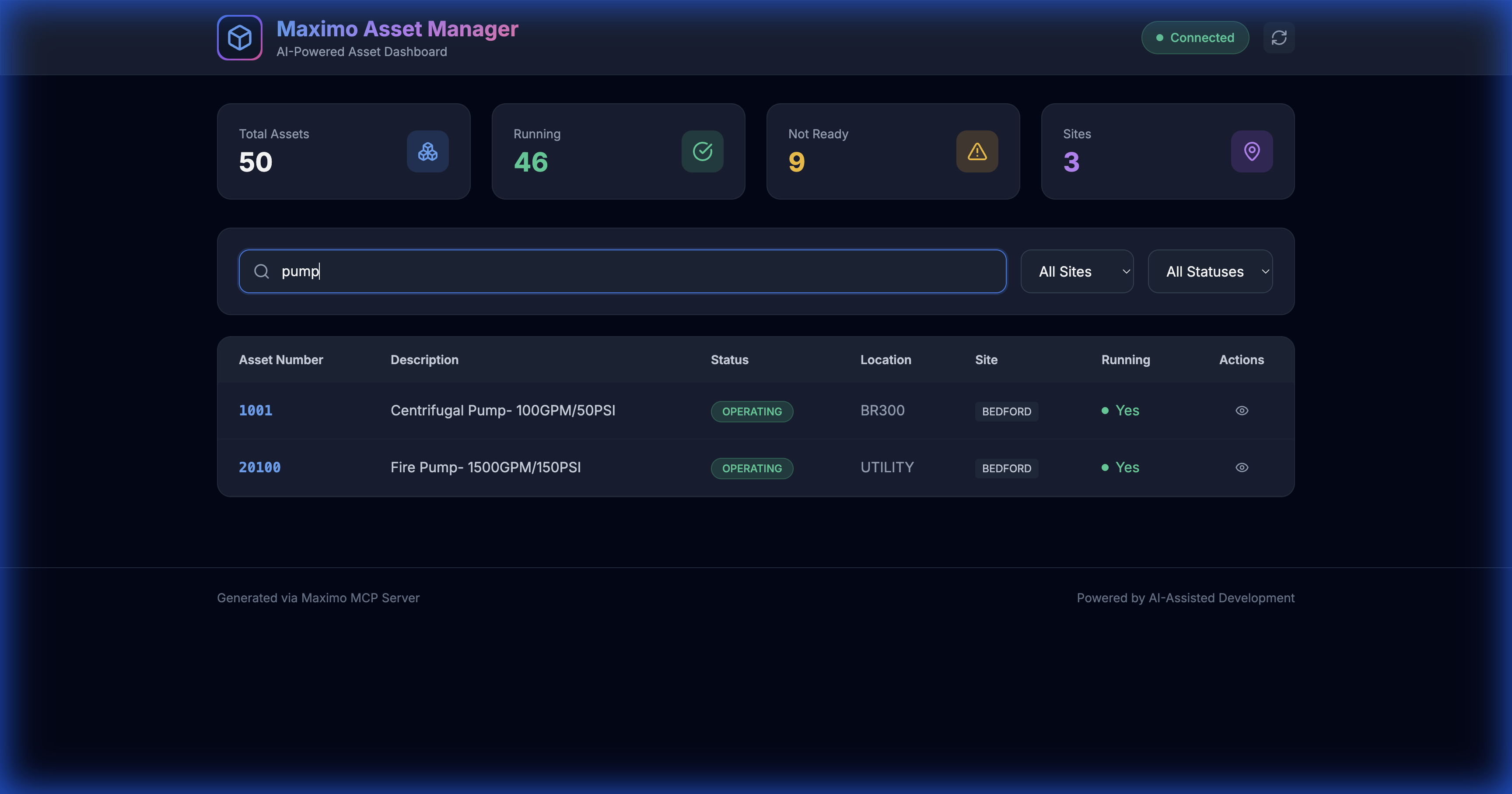 |
| Site Filter | 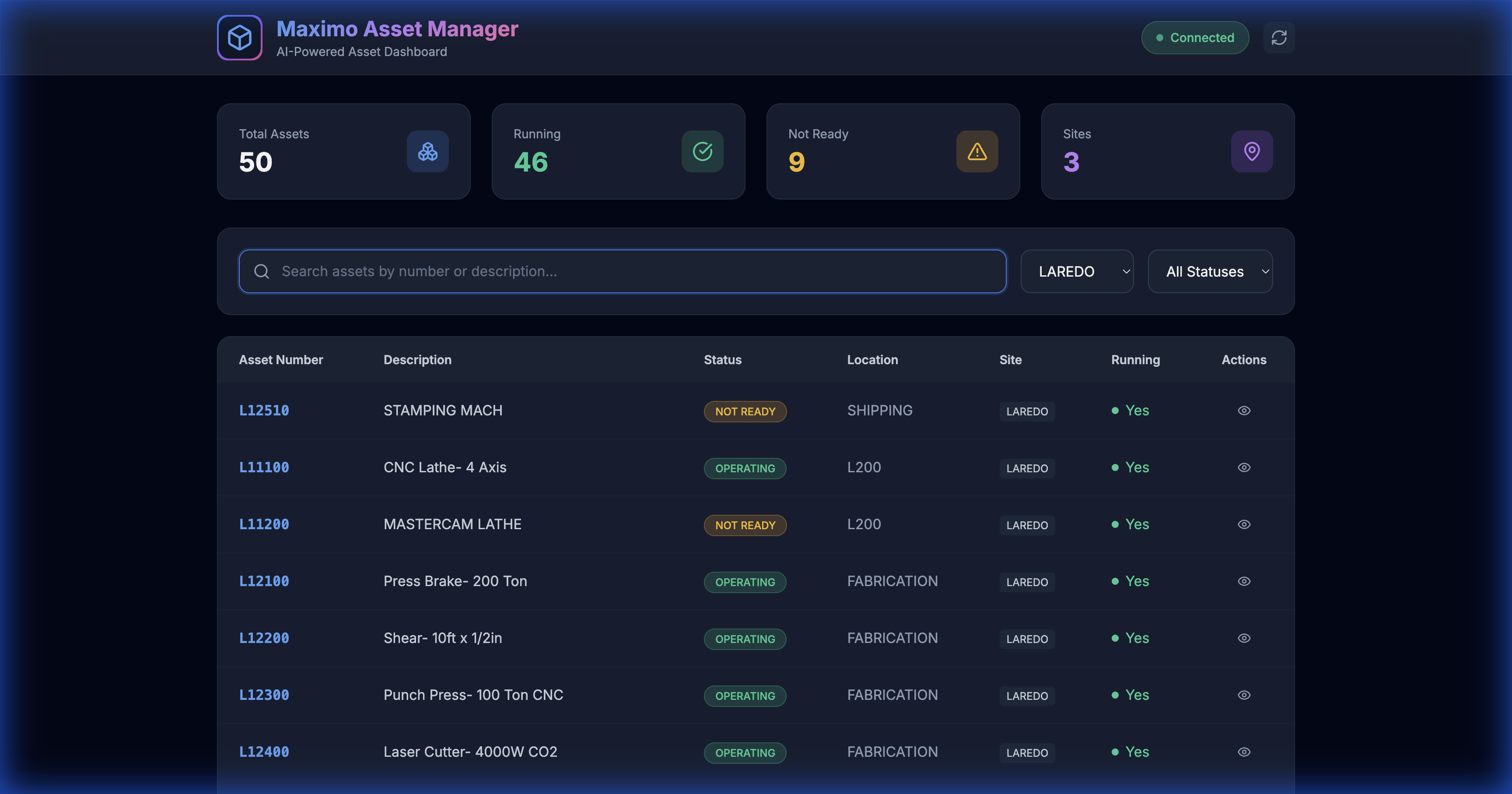 |
🎥 Screen Recording
A complete video demonstration is available: assets_demo_recording.webp
Try It Yourself
# Start the local proxy server
node server.js

# Open in browser
open http://localhost:3002/demos/assets.html
🛠 Available MCP Tools
The server exposes 9 tools to the AI — 6 read tools and 3 write/CRUD tools:
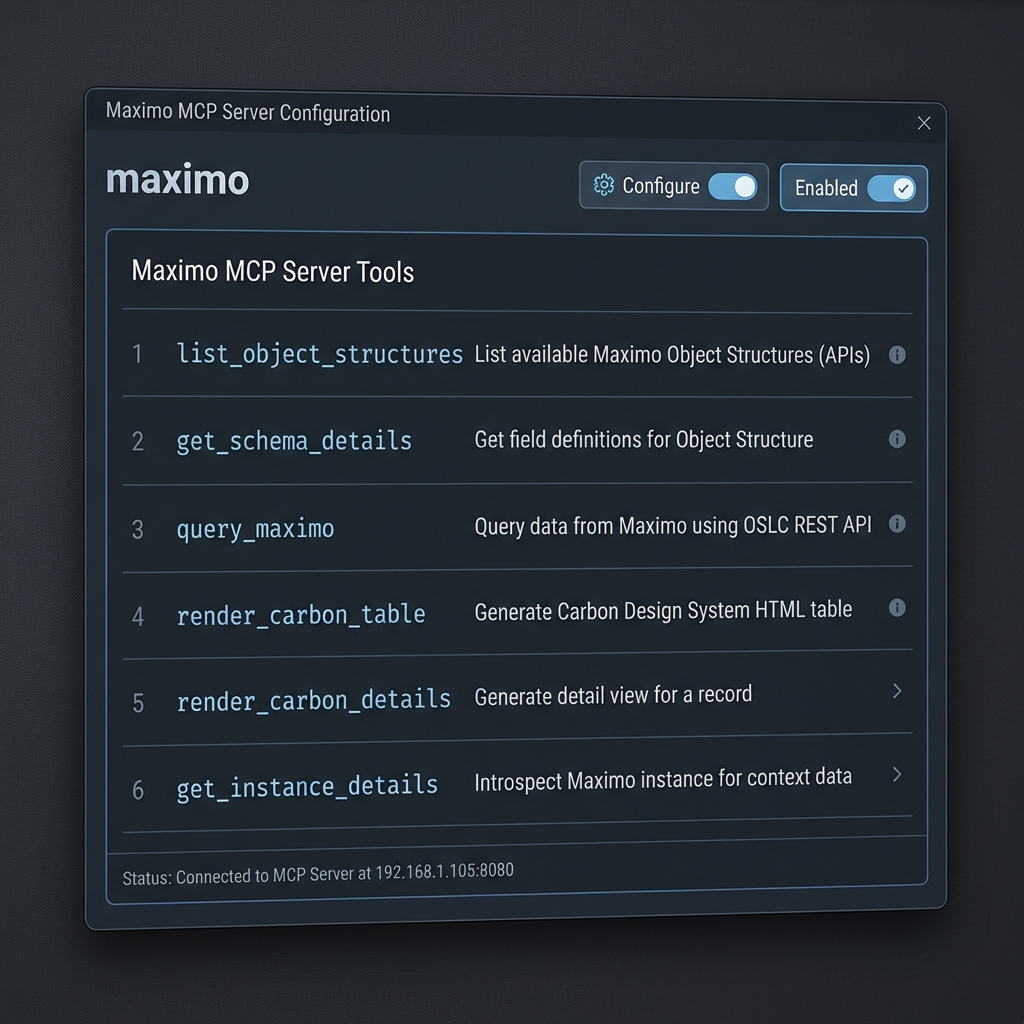
Read Tools
| Tool Name | Description |
|---|---|
list_object_structures | List available Maximo Object Structures (APIs) |
get_schema_details | Get field definitions for an Object Structure |
query_maximo | Execute OSLC REST queries |
render_carbon_table | Generate Carbon Design HTML tables |
render_carbon_details | Generate detail view for a record |
get_instance_details | Check server connectivity |
Write Tools (CRUD)
⚠️ Write tools modify live data. Use a read-only API key for exploration; only enable write access for known workflows.
| Tool Name | Description |
|---|---|
create_record | Create a new record in any Maximo Object Structure |
update_record | Partially update fields on an existing record by ID |
run_action | Execute Maximo business actions (status changes, approvals) |
💡 Use Cases
1. Generate API Calls
"Get me the last 10 approved work orders from BEDFORD site"
The AI calls get_schema_details(MXWO), understands the fields, and generates:
GET /maximo/api/os/mxwo
    ?oslc.where=status="APPR" and siteid="BEDFORD"
    &oslc.select=wonum,description,status,reportdate
    &oslc.orderBy=-reportdate
    &oslc.pageSize=10
    &lean=1
2. Generate Python Scripts
"Write a Python script to export all Priority 1 work orders to CSV"
import requests
import csv

response = requests.get(
    "https://your-host/maximo/api/os/mxwo",
    params={"oslc.where": "wopriority=1", "lean": 1},
    headers={"apikey": "YOUR_KEY"}
)

with open("priority1_workorders.csv", "w") as f:
    writer = csv.DictWriter(f, fieldnames=["wonum", "description"])
    writer.writeheader()
    writer.writerows(response.json()["member"])
3. Generate SQL Queries
"Write SQL to find overdue work orders"
SELECT wonum, description, status, targcompdate
FROM workorder
WHERE status NOT IN ('COMP', 'CLOSE', 'CAN')
  AND targcompdate < CURRENT_DATE;
4. Build Complete Applications
"Create an HTML dashboard to display assets"
Result: A complete web application with:
- Dark theme with glassmorphism
- Search and filter functionality
- Interactive detail panels
- Pre-loaded data from Maximo
See the Asset Manager Case Study for the full walkthrough.
5. Create & Update Records (CRUD)
"Create a corrective maintenance work order for the BEDFORD site, priority 1, description 'Pump failure inspection'."
The AI calls get_schema_details(MXWO) to confirm field names, then create_record:
POST /maximo/api/os/MXWO?lean=1
apikey: YOUR_KEY
Content-Type: application/json

{ "description": "Pump failure inspection", "siteid": "BEDFORD", "worktype": "CM", "wopriority": 1 }
"Now approve work order 1025 with memo 'Reviewed and approved'."
POST /maximo/api/os/MXWO/1025?action=changeStatus&lean=1
apikey: YOUR_KEY
Content-Type: application/json

{ "status": "APPR", "memo": "Reviewed and approved" }
See the full guide: Maximo MCP Server Guide — CRUD Workflows
🧩 VS Code Extensions
This project includes two VS Code extensions for interactive Maximo API development — no AI agent required.
Maximo API Explorer
A full-featured VS Code extension for discovering, testing, and generating code for Maximo REST APIs.
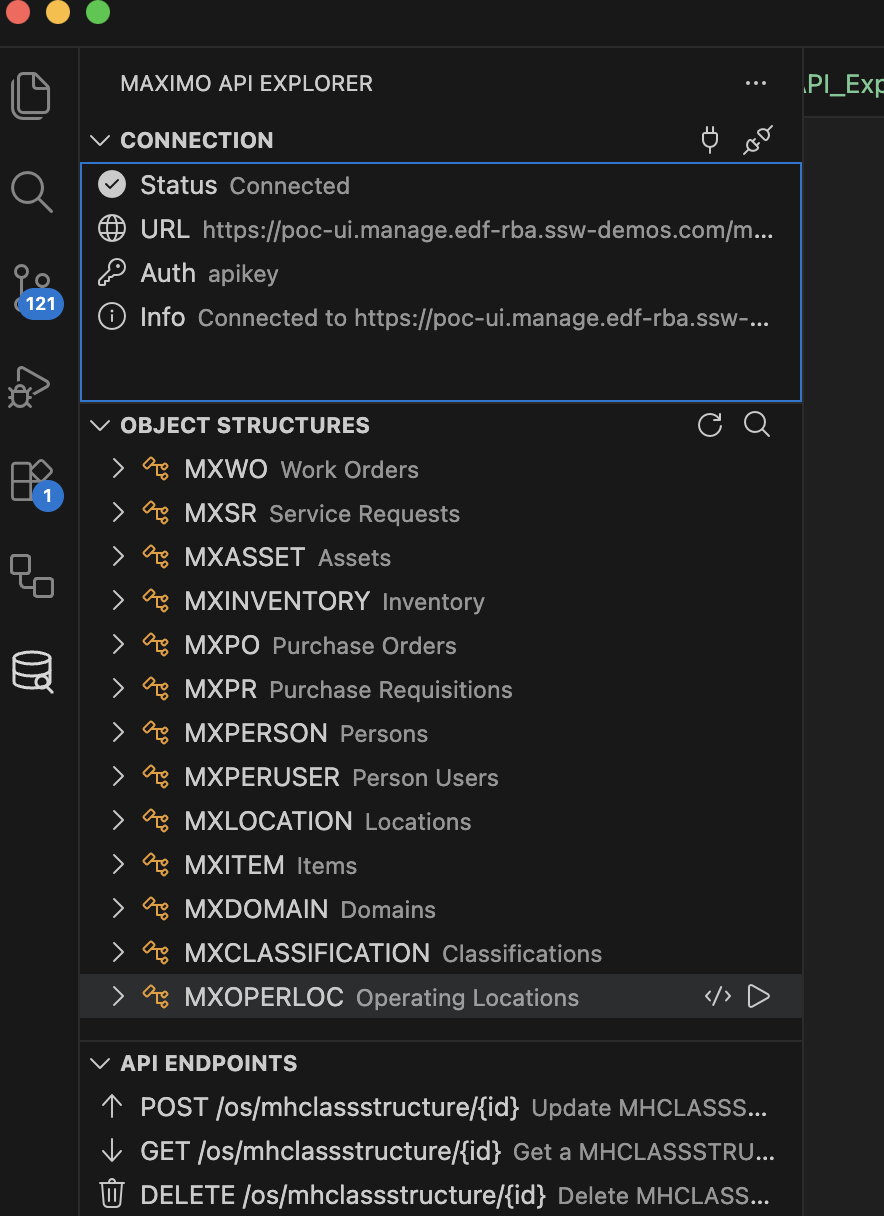
Connected to a live Maximo instance showing Object Structures (MXWO, MXSR, MXASSET, etc.) and API Endpoints.
| Feature | Description |
|---|---|
| Sidebar Tree View | Browse all Object Structures (MXWO, MXASSET, MXSR, etc.) with attributes, types, and relationships |
| Interactive API Tester | Build OSLC queries visually, send raw requests, inspect schemas — all in a WebView panel |
| Code Snippet Generator | Generate ready-to-use API calls in cURL, Python, JavaScript, TypeScript, and Java |
| Carbon App Generator | Scaffold complete Work Order Browser and Asset Manager web apps with one click |
| Export for AI Agents | Export schemas and docs to .maximo/ for use with Copilot, Cursor, or any AI assistant |
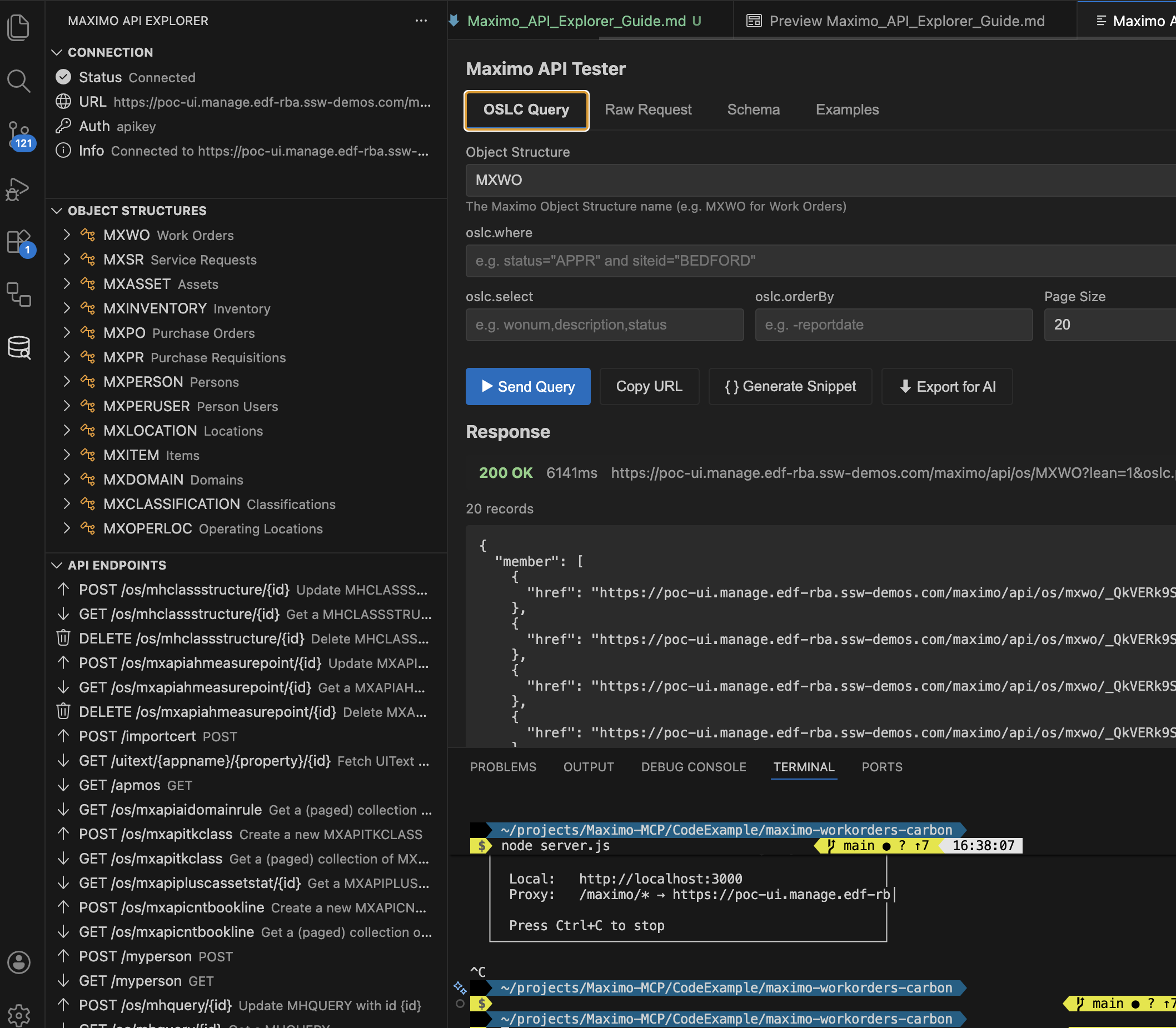
OSLC Query Builder with live JSON response (200 OK, 20 records from MXWO).
Quick Start
cd maximo-api-explorer
npm install && npm run compile
# Press F5 in VS Code to launch the Extension Development Host
See the full guide: Maximo API Explorer Guide
Maximo Cursor Explorer
A fork of the API Explorer optimized for Cursor's AI features:
| Feature | Description |
|---|---|
| .cursorrules Generator | Auto-generate rules giving Cursor AI deep Maximo API knowledge |
| AI Context Export | Export schemas to .cursor/context/ for use with @file references |
| Prompt Templates | Pre-built prompts for OSLC queries, CRUD services, dashboards, and more |
| All Standard Features | Everything from the API Explorer, plus a dedicated Cursor AI tab |
cd maximo-cursor-extension
npm install && npm run compile
# Press F5 in VS Code to launch
📁 Project Structure
Maximo-MCP/
├── maximo-mcp-server.js       # 🔌 MCP Server implementation
├── server.js                  # 🌐 Local proxy server for CORS
├── package.json               # 📦 Dependencies & scripts
├── README.md                  # This file
├── .env.example               # Environment template
│
├── docs/                      # 📚 Documentation
│   ├── Maximo_MCP_Server_Guide.md         # Complete MCP guide
│   ├── Maximo_API_Interaction_Guide.md    # API interaction patterns
│   ├── Asset_Manager_App_Case_Study.md    # Build walkthrough
│   ├── Maximo_API_Explorer_Guide.md       # VS Code extension guide
│   ├── Maximo_MCP_Server_Guide_FR.md      # French translation
│   └── Maximo_API_Interaction_Guide_FR.md # French translation
│
├── maximo-api-explorer/       # 🧩 VS Code Extension
│   ├── package.json                       # Extension manifest
│   ├── src/extension.ts                   # Activation & commands
│   ├── src/api/                           # API client & discovery
│   ├── src/auth/                          # Authentication manager
│   ├── src/views/                         # Sidebar tree & WebView panel
│   ├── src/snippets/                      # Multi-language code generator
│   ├── src/templates/                     # Carbon app generators
│   └── src/export/                        # AI context exporter
│
├── maximo-cursor-extension/   # 🤖 Cursor-Optimized Extension
│   ├── package.json                       # Extension manifest
│   ├── src/extension.ts                   # Activation & commands
│   ├── src/cursor/                        # .cursorrules, prompts, context
│   └── src/...                            # Same structure as api-explorer
│
├── CodeExample/               # 📦 Standalone Carbon App Example
│   └── maximo-workorders-carbon/          # Work Order Browser (reference)
│
├── demos/                     # 🎨 Demo Applications
│   ├── assets.html                        # Asset Manager app
│   ├── carbon_workorders.html             # Carbon table demo
│   └── index.html                         # API visualization demo
│
├── images/                    # 📸 Screenshots & Recordings
│   ├── assets_demo_recording.webp         # Full demo recording
│   ├── assets_loaded.png                  # Dashboard screenshot
│   ├── api-explorer-sidebar.png           # Extension sidebar & tree view
│   ├── api-explorer-tester.png            # OSLC Query Builder & JSON response
│   ├── api-explorer-carbon-app.png        # Generated Work Order Browser app
│   ├── api-explorer-snippets.png          # Carbon App Templates (Examples tab)
│   └── ...                                # More screenshots
│
└── config/                    # ⚙️ Configuration Templates
    └── mcp_config.json.example            # MCP config template
🔒 Security Best Practices
| Practice | Description |
|---|---|
| 🔐 Local Execution | MCP server runs on your machine; API keys never leave your environment |
| 📖 Read-Only Keys for Dev | Use limited-permission API keys for exploration and development |
| ✏️ Separate Write Keys | Only enable write permissions on API keys used for known CRUD workflows |
| 🔒 Environment Variables | Never hardcode credentials in config files |
| 🌐 HTTPS Only | Always use encrypted connections to Maximo |
| 🧪 Test Non-Production First | Always validate CRUD operations on a dev/test instance before production |
🤝 Contributing
Contributions are welcome! Please read our contributing guidelines before submitting PRs.
- Fork the repository
- Create a feature branch (
git checkout -b feature/amazing-feature) - Commit your changes (
git commit -m 'Add amazing feature') - Push to the branch (
git push origin feature/amazing-feature) - Open a Pull Request
📄 License
This project is licensed under the Apache License 2.0 - see the LICENSE file for details.
🙏 Acknowledgments
- Model Context Protocol for the MCP specification
- IBM Maximo for the enterprise asset management platform
- Carbon Design System for the UI components
Related MCP servers
MCP server demo — tickets, schema discovery, auth, and PII gating. stdio + HTTP.

Quantum OpenQASM MCP
IBM Quantum OpenQASM 2.0 MCP — list backends, submit QASM, poll jobs, get histograms.
Slack ↔ WxO MCP Gateway
Lifts WxO Slack limits: every-message wake-up, multi-channel MCP. https://markusvankempen.github.io/
WxO Agent MCP
Invoke a Watson Orchestrate agent via MCP. Configure with WO_AGENT_ID.
Watson Orchestrate
Manage IBM Watson Orchestrate tools, agents, connections from Cursor, Copilot, Claude.
Zendesk MCP
Zendesk MCP: 14 tools for AI agents — create, search, assign, comment, and close support tickets.