io.github.mcpware/ui-annotator-mcp MCP Server
io.github.mcpware/ui-annotator-mcp
Hover-labeled UI elements in any browser—no extensions, no code changes. AI-friendly element naming for seamless design collaboration.
What is the io.github.mcpware/ui-annotator-mcp MCP server?
The UI Annotator MCP server is a reverse proxy that injects hover annotations onto any web page, displaying element names, CSS selectors, and dimensions in real time. It bridges communication between humans and AI assistants by providing a shared vocabulary for UI elements, eliminating ambiguity when describing design changes.
UI Annotator solves the friction of describing UI changes to AI assistants. Instead of saying "move that button next to the search bar," you hover elements to see their names, then tell Claude "move SearchButton below NavBar." The server runs as a reverse proxy on localhost:7077, works in any browser without extensions or code changes, and exposes MCP tools so your AI assistant understands exactly which elements you're referencing.
How to install io.github.mcpware/ui-annotator-mcp
Copy-paste configuration for popular MCP clients.
Tools & capabilities
Tools this server exposes to the agent.
annotate— Returns the proxy URL for a given application URL so the user can open it in any browserget_elements— Returns all detected UI elements with their names, CSS selectors, positions, and dimensionshighlight_element— Flash-highlights a specific element by name so the user can visually confirm which component is being referencedrescan_elements— Forces a DOM rescan after page changes to update the element listinspect_mode— Toggles inspect mode remotely, allowing click-to-copy element names and pausing page interactions
Use cases
- Describe UI changes to Claude using real component names instead of vague descriptions
- Identify and reference specific elements on a page without knowing CSS selectors or DOM structure
- Collaborate with non-technical stakeholders (PMs, designers, QA) by giving them a simple hover-to-label interface
- Verify which elements an AI assistant is targeting before it makes code changes
- Rapidly iterate on UI design by hovering to confirm element names, then requesting changes in natural language
io.github.mcpware/ui-annotator-mcp MCP server FAQ
It runs a reverse proxy that injects hover annotations onto any web page. Hover any element to see its name, CSS selector, and dimensions. It also exposes MCP tools so AI assistants can query the page structure and understand which elements you're referencing by name.
Yes, UI Annotator is open source under the MIT license and free to use.
Run `npx @mcpware/ui-annotator` to start the proxy server on localhost:7077. Then open any page via the proxy URL (e.g., http://localhost:7077/localhost:3847). You can also add it as an MCP server in Claude Code with `claude mcp add ui-annotator -- npx @mcpware/ui-annotator`.
No. UI Annotator works as a reverse proxy—zero browser extensions required. It works in Chrome, Firefox, Safari, Edge, and any other browser.
No. The proxy intercepts and modifies the HTML on the fly, injecting the annotation script automatically. Your app code stays unchanged.
None. Just run `npx @mcpware/ui-annotator` and open the proxy URL in your browser. The only optional configuration is the `UI_ANNOTATOR_PORT` environment variable (defaults to 7077).
README (reference)
Source of truth, from the repository.
UI Annotator MCP





English | 廣東話
Bridge the gap between what you see and what AI can reference — in any browser, zero extensions.
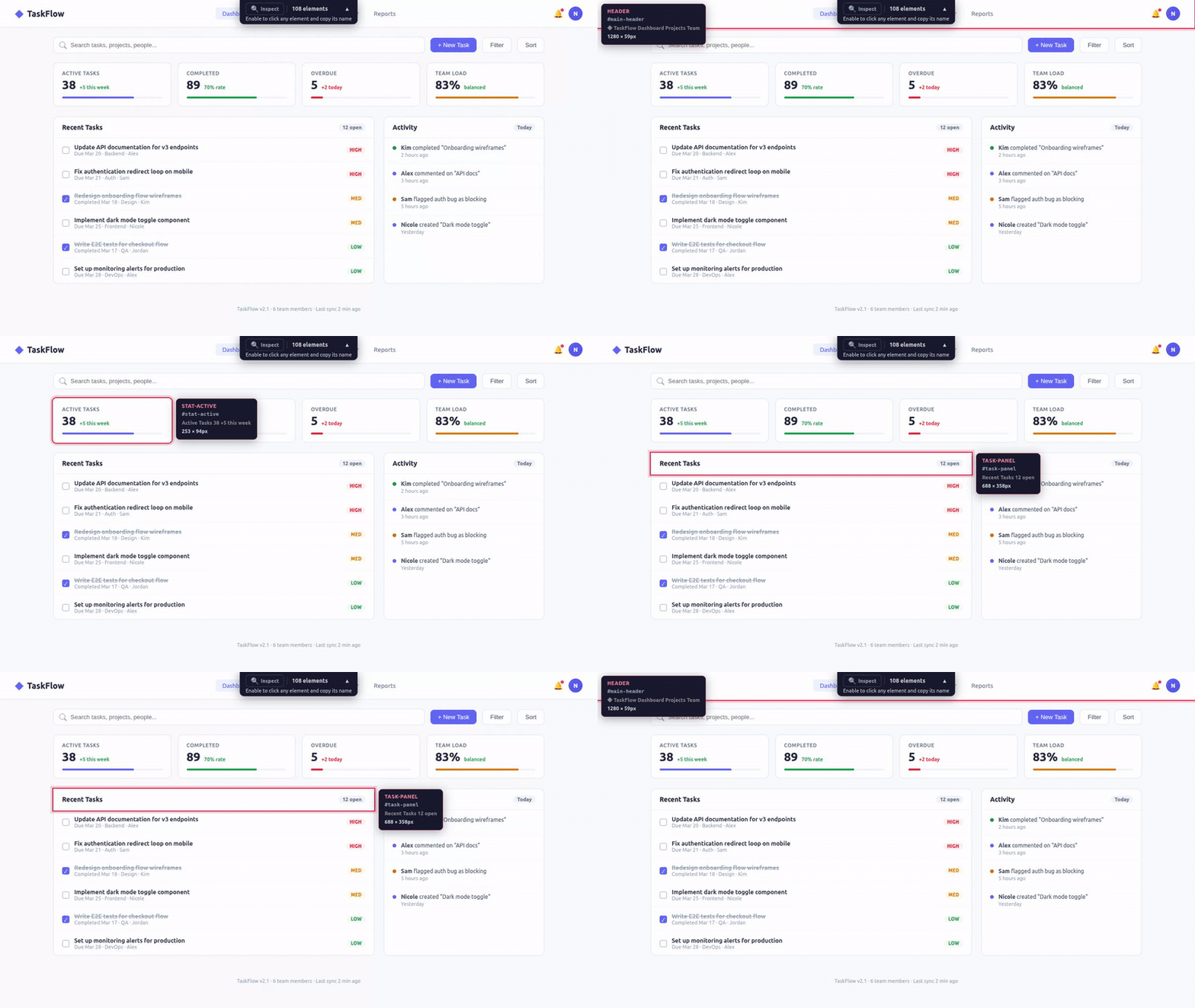
The only tool that puts visible labels on every web element. Hover any element, see its name. Tell your AI assistant "make the sidebar wider" — it knows exactly which element you mean. No screenshots, no CSS selectors, no miscommunication.
Why It Matters
Dramatically improves AI-driven UI design and iteration. The pain: telling AI "move that button next to the search bar" never works because the AI can't see your page. UI Annotator fixes this — hover over any element and its component name appears as a label. Now you say "move SearchButton below NavBar" and Claude edits the right component instantly. No browser extensions, works with any framework. The workflow becomes: open page → hover to identify elements → describe changes using real component names → Claude edits → refresh and repeat. Turns a frustrating back-and-forth into a fluid design loop.
The Problem
When reviewing a web UI with an AI coding assistant, the hardest part isn't the code change — it's describing which element you want changed.
"That thing on the left... the second row... no, the one with the icon..."
You don't know what it's called. The AI doesn't know what you're pointing at. You waste time on miscommunication instead of shipping.
The Solution
Open your page through the annotator proxy. Hover any element — instantly see its name, CSS selector, and dimensions. Now you both speak the same language.
# Start the MCP server
npx @mcpware/ui-annotator

# Open in ANY browser
http://localhost:7077/localhost:3847
That's it. No browser extensions. No code changes. No setup. Works in Chrome, Firefox, Safari, Edge — any browser.
How It Works
Your app (localhost:3847)
        │
        ▼
┌─────────────────────┐
│  UI Annotator Proxy  │ ← Reverse proxy on port 7077
│  (MCP Server)        │
└─────────────────────┘
        │
        ▼
Proxied page with hover annotations injected
        │
        ├──► User sees: hover overlay + tooltip with element names
        └──► AI sees: structured element data via MCP tools
The proxy fetches your page, injects a lightweight annotation script, and serves it back. The script scans the DOM, identifies named elements, and reports them to the MCP server. Your AI assistant queries the server to understand what's on the page.
Features
Hover Annotations
Hover any element to see:
- Element name (pink) — the human-readable identifier
- CSS selector (monospace) — the technical reference
- Content preview — what text the element contains
- Dimensions — width × height in pixels
Inspect Mode
Click the Inspect button in the toolbar (or let your AI toggle it). In inspect mode:
- Click any element → copies its name to clipboard
- All page interactions are paused (clicks don't trigger buttons/links)
- Click Inspect again to return to normal mode
Collapsible Toolbar
The toolbar sits at the top center of the page showing:
- Inspect toggle button
- Element count
- Helpful subtitle explaining what to do
- Collapse button (▲) to minimize when not needed
MCP Tools for AI
| Tool | What it does |
|---|---|
annotate(url) | Returns proxy URL for user to open in any browser |
get_elements() | Returns all detected UI elements with names, selectors, positions |
highlight_element(name) | Flash-highlights a specific element so user can confirm |
rescan_elements() | Force DOM rescan after page changes |
inspect_mode(enabled) | Toggle inspect mode remotely |
Why Not Just Use DevTools?
| Browser DevTools | UI Annotator | |
|---|---|---|
| Target user | Frontend developers who know the DOM | Anyone — QA, PM, designer, junior dev |
| Learning curve | Need to understand DOM tree, CSS selectors, box model | Hover and read — zero learning |
| Communication | "The div.flex.gap-4 inside the second child of..." | "The sidebar" |
| Language | CSS/HTML technical terms | Human-readable names |
| Setup | Teach people to open DevTools + navigate the DOM | Open a URL |
| AI integration | None — AI can't see what you're inspecting | MCP — AI sees the same element names you do |
DevTools is for debugging. UI Annotator is for communication — giving humans and AI a shared vocabulary for UI elements.
Why Not Use Existing Tools?
None of these do what UI Annotator does — live visual labels on every element via reverse proxy:
| Tool | Approach | Why we're different |
|---|---|---|
| browser-use (82K⭐) | AI automation framework | Automates browsers, doesn't label elements for humans. Different use case entirely. |
| Chrome DevTools MCP (31K⭐) | DOM snapshot + element UIDs | AI can inspect, but humans don't see visual annotations. No shared vocabulary. |
| Playwright MCP (29K⭐) | Accessibility tree snapshot | Returns structured text, no visual overlay. Truncates important context. |
| OmniParser | Screenshot + CV detection | Screenshot-based, not live DOM. ~40% accuracy on hard benchmarks. |
| MCP Pointer (526 users) | Chrome extension + MCP | Requires Chrome extension. Human clicks to select — no hover overlay. |
| Agentation | npm embedded in your app | Requires code changes. React 18+ dependency. Not zero-config. |
| Vibe Annotations | Chrome extension | Extension-based, developer-only annotation workflow. |
Feature Comparison
| Feature | UI Annotator | MCP Pointer | Agentation | Cursor | Chrome DevTools MCP |
|---|---|---|---|---|---|
| Visual hover annotation | Yes | No | Partial | Yes (IDE only) | No |
| Shows element names | Yes | Yes | Yes | No (high-level) | Programmatic |
| Shows dimensions | Yes | Yes | Yes (Detailed) | Yes | Programmatic |
| MCP server | Yes | Yes | Yes | No | Yes |
| Zero browser extensions | Yes | No | Yes | N/A | No |
| Zero code changes | Yes | Yes | No | N/A | Yes |
| Any browser | Yes | Chrome only | Desktop only | Cursor only | Chrome only |
| Zero dependencies | Yes | Chrome ext | React 18+ | Cursor | Chrome |
| Click to copy element name | Yes | No | No | No | No |
Architecture
Zero external dependencies
- Reverse proxy: Node.js built-in
httpmodule - MCP server:
@modelcontextprotocol/sdk(stdio transport) - Communication: HTTP POST (browser → server) + GET polling (server → browser)
- No WebSocket, no Express, no browser extension
How the proxy works
- User requests
localhost:7077/localhost:3847 - Proxy fetches
http://localhost:3847 - For HTML responses:
- Injects
fetch()/XMLHttpRequestinterceptor (rewrites API paths through proxy) - Rewrites
href="/..."andsrc="/..."attributes to route through proxy - Injects annotation script before
</body>
- Injects
- For non-HTML (CSS, JS, images): passes through directly
- Strips
Content-Security-Policyheaders to allow injected script
How annotation works
- Script scans DOM for elements with
id,class, semantic roles, or interactive roles - On hover: positions overlay border (follows
border-radius) + positions tooltip (always within viewport) - Reports all detected elements to server via
POST /__annotator/elements - Polls
GET /__annotator/commandsevery second for server instructions (highlight, rescan, inspect toggle) MutationObserverauto-rescans when DOM changes
Quick Start
With Claude Code
# Add as MCP server
claude mcp add ui-annotator -- npx @mcpware/ui-annotator

# Then in conversation:
# "Annotate my app at localhost:3847"
# → AI returns proxy URL, you open it, hover elements, discuss changes by name
Manual
npx @mcpware/ui-annotator
# Proxy starts on http://localhost:7077
# Open http://localhost:7077/localhost:YOUR_PORT
Environment Variables
| Variable | Default | Description |
|---|---|---|
UI_ANNOTATOR_PORT | 7077 | Port for the proxy server |
More from @mcpware
| Project | What it does | Install |
|---|---|---|
| Instagram MCP | 23 Instagram Graph API tools — posts, comments, DMs, stories, analytics | npx @mcpware/instagram-mcp |
| Claude Code Organizer | Visual dashboard for Claude Code memories, skills, MCP servers, hooks | npx @mcpware/claude-code-organizer |
| Pagecast | Record browser sessions as GIF or video via MCP | npx @mcpware/pagecast |
| LogoLoom | AI logo design → SVG → full brand kit export | npx @mcpware/logoloom |
License
MIT
Related MCP servers

io.github.mcpware/claude-code-organizer
Organize Claude Code and Codex CLI config, memories, skills, MCP servers, and agents in one cross-harness dashboard.
io.github.mcpware/instagram-mcp
23 tools for Instagram Graph API: manage posts, DMs, stories, reels, and analytics from AI agents.
io.github.mcpware/logoloom
AI logo design to complete brand kit—SVG, PNG, ICO, WebP, social media sizes, all locally.
io.github.mcpware/pagecast
Record browser interactions as polished GIF or MP4 demos with auto-zoom tooltips and cinematic effects.

Census (ACS by ZIP)
U.S. Census (ACS) data by ZIP: income, demographics, housing, education, from a local store.
EDGAR (SEC filings)
SEC filings in your agent: issuers, Reg CF/D/A raises, XBRL financials, insider trades.