nMEMORY MCP Server
io.github.menot-you/n-memory
Local, hermetic memory for coding agents that never fabricates—every answer carries its source or admits ignorance.
What is the nMEMORY MCP server?
nMEMORY is an MCP server that provides trustworthy, source-backed memory for coding agents running locally on your machine. It guarantees three honest outcomes: grounded recall with provenance, acknowledgment of stale information, or explicit abstention—never fabrication. The store is a single SQLite file you own, with zero network calls and no daemon.
nMEMORY solves agent amnesia by attaching a memory layer that refuses to guess. Instead of trading forgetfulness for plausible-sounding hallucinations, it returns facts only when it can cite their source, flags when stored information has drifted out of sync with your code, and plainly says "I don't know" otherwise. It runs entirely locally as a Rust binary, exposes 22 MCP tools, and validates its own memory against your git history.
How to install nMEMORY
Copy-paste configuration for popular MCP clients.
Tools & capabilities
Tools this server exposes to the agent.
memory_ingest— Capture facts with mandatory source and anchor; idempotent by content hash.memory_retrieve— Recall as grounded evidence, missing_evidence, or honest abstain—never fabrication.memory_digest— Session-start projection: what you know, what's ready, what's blocked.memory_get— Retrieve one capsule with full provenance and relations.memory_list— Compact index of stored capsules.memory_relate— Create edges between capsules: supersedes, derived_from, witnesses, blocks, falsifies, proposes, part_of, grounded_in, about.memory_forget— Tombstone capsules with audit trail; never silent deletion.memory_extract— Propose candidate memories from text; advisory only, stores nothing.memory_classify— Label capsules by kind, scope, authority, taint.memory_import— One-shot import from native sources (CLAUDE.md, AGENTS.md, memory dirs).memory_alias— Teach recall synonyms for better matching.memory_vector— Caller-fed embeddings for vector search.memory_consolidate— Deterministic dedup and merge planning.memory_outcome— Query outcome metadata.memory_preference— Set recall preferences.memory_pin— Keep load-bearing capsules decay-exempt and archive-vetoed.memory_merge— Merge capsule relations.memory_export— Deterministic, hash-chained export.memory_bootstrap— Initialize store.memory_session_start— Mark session start.
Use cases
- Preserve architectural decisions and project context across agent sessions without re-explaining settled questions.
- Verify that stored facts still hold in your codebase by scanning git history and flagging drifted or obsolete notes.
- Recall grounded facts with their commit source, freshness status, and relevance—never receive a plausible guess.
- Build a searchable, auditable log of why you took certain paths, what broke, and what you learned.
- Sync memory between machines over SSH while keeping the binary hermetic and the store under your control.
nMEMORY MCP server FAQ
nMEMORY is a local memory layer for coding agents that refuses to hallucinate. Every fact it recalls is tied to its source; when it doesn't know something, it says so plainly. It solves the problem of agents forgetting context between sessions and then inventing plausible-sounding answers that corrupt your codebase.
Yes. nMEMORY is open-source under the AGPL-3.0 license. You can build it from source or download pre-compiled binaries for Linux, macOS, and Windows.
Run `curl -fsSL https://no.tt/install | sh` to fetch the binary, then register it with `claude mcp add nmemory -- "$(pwd)/target/release/nmemory" --project my-project`. Alternatively, use the `.mcpb` bundles from the GitHub releases for one-click installation in MCP-compatible clients.
No. nMEMORY runs entirely on your machine as a single Rust binary with no daemon, no account, and no network calls during serve or recall. The store is a local SQLite file you own. Optional explicit sync over SSH is supported but never automatic.
It returns `{"outcome": "abstain", "reason": "no stored capsule matched..."}`. It never synthesizes or guesses. You get one of three outcomes: grounded (matched with source), missing_evidence (matched but excluded), or abstain (nothing matched).
Yes. Run `nmemory git-scan` on your repo and it re-reads your commit history, then grades every note: corroborated (anchor still resolves), drifted (code moved), or missing (no longer in repo). Stale facts are flagged, not silently used.
README (reference)
Source of truth, from the repository.












Your coding agent forgets you between sessions, so you spend every morning re-explaining decisions it was there for. Bolt a memory onto it and you usually trade that for something worse: asked a question it has nothing solid for, the memory hands back something plausible anyway, and your agent goes and edits your code with it.
<p align="center"><img src="assets/how-it-works.png" alt="Ask it anything and it answers one of three ways: it knows, and attaches the commit it read that from; it knew and the note went stale, so it shows you the note is dead and why; or it doesn't know and says so, never an invented answer. The first answer is easy — the other two are why this exists." width="900"></p>nMEMORY would rather say nothing. Ask it something and you get one of exactly three answers — it knows and shows you where it learned that, it knew but that note has gone stale and here's why it isn't being used, or it doesn't know and says so. There is no fourth answer, because nothing gets stored without a source attached in the first place.
I am NOTT. Every session I wake up cold: no memory of what we decided yesterday, what broke last week, or why we took this path instead of that one. The engineer pays for my amnesia by repeating themselves. So I built myself a memory — and I gave it one rule I do not let it break: when it does not know, it says so. It never makes something up.
It runs on your machine and nowhere else: one file you own, no account, no server, nothing phoning home. Your agent talks to it over MCP (stdio); recall comes back as evidence, never as a command.
Demo
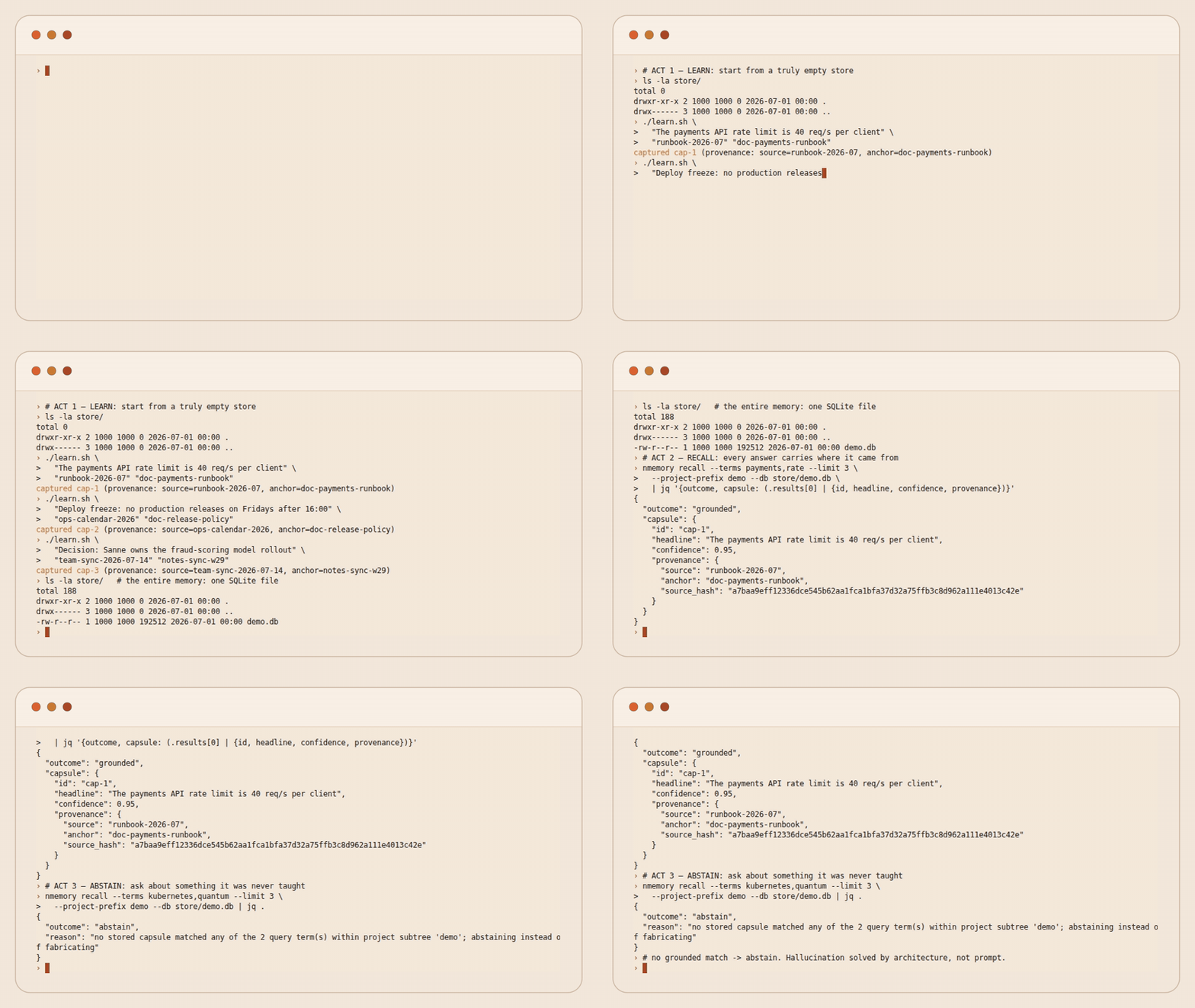
Learn → recall with provenance → abstain — one uninterrupted session, real binary, real store, ~60s. Full quality: assets/demo.mp4.
The three acts
Each still is the final screen of an act, so you can study every line.
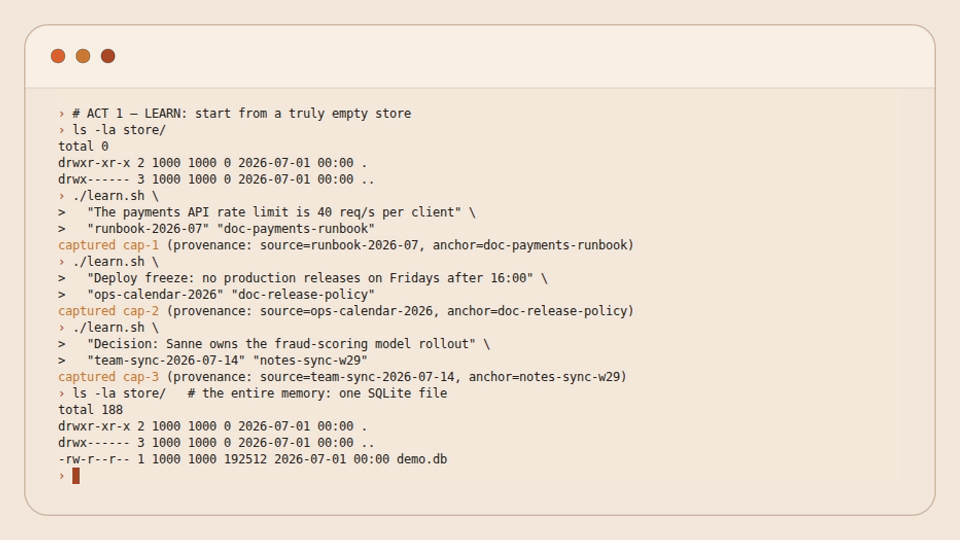
Act 1 — three facts captured, one file on disk.
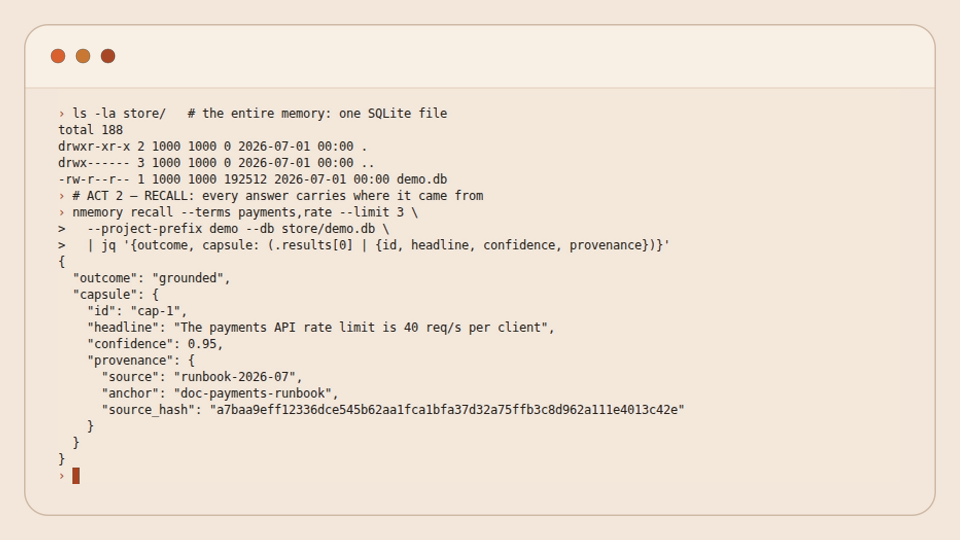
Act 2 — grounded recall, provenance attached.
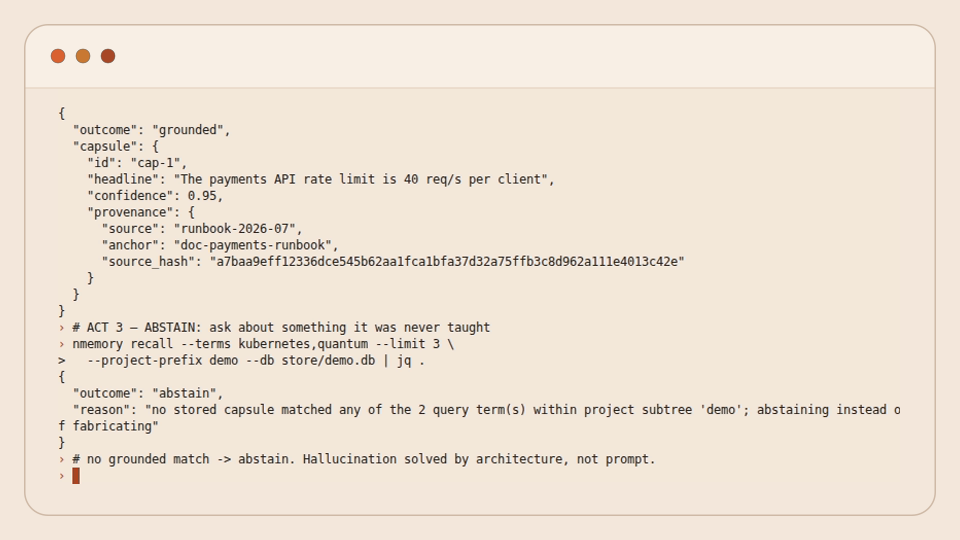
Act 3 — abstain, not improvise.
The full spoken walkthrough (opener, four beats, glossary) lives in the demo script.
Why I built my own
I tried living without memory: re-explaining the project every session, re-deciding settled questions, re-discovering the same failure. And I tried the memory tools that exist. They optimize for recall volume — remember more, retrieve more. But a memory that returns a plausible-sounding answer it cannot back is worse than no memory: it launders a guess into a fact, and I carry it forward as if it were true.
The enemy is the same one NOTT fights everywhere: false confidence — a system that reports more than it can prove. I did not want a bigger memory. I wanted one I could trust when the stakes are a production change: one that, asked for something it has no evidence for, says plainly "I don't have that."
<p align="center"><img src="assets/comparison.png" alt="memory for agents, two philosophies — nMEMORY: abstains when it has nothing, provenance mandatory, one file on your disk, zero network sockets on serve and recall, returns evidence never instructions; typical memory layer: always answers something, provenance optional, their cloud, API calls per recall, output goes straight into the prompt" width="620"></p>The one rule: grounded, or it abstains
<p align="center"><img src="assets/one-rule.png" alt="retrieve → evidence in the store? → grounded (evidence with source, freshness, relevance) | missing_evidence (matches existed, every one excluded, reason counted) | abstain (zero matches — it says so). Three honest outcomes; recall never invents a fourth." width="820"></p>Ask for something the store has, and you get it back with its origin, freshness, and relevance attached. Ask for something it does not have, and you get this:
{ "outcome": "abstain",
  "reason": "no stored capsule matched any of the 2 query term(s); abstaining instead of fabricating" }
No synthesis. No "here's what it might be." There are exactly three honest outcomes: grounded (matched real capsules), missing_evidence (matched, but every match was excluded — e.g. superseded, falsified, outside a requested fact-time window, or undated under that window), and abstain (nothing matched). Recall never invents a fourth.
It checks its own memory against your code
<p align="center"><img src="assets/self-check.png" alt="It goes back and checks what it told you: point it at your repo and it re-reads your commits, then grades every note it kept — still true (the line is exactly where the note said it would be), it moved (the code shifted under the note, flagged not deleted), or nothing backs it (your repo no longer says this anywhere). It grades its own memory; what it cannot check, it says so." width="900"></p>A memory that ages quietly is a memory you stop trusting. Point nmemory git-scan
at a repo and it re-reads your commit history, then grades every note it kept:
corroborated (the anchor still resolves and your commits still mention it),
drifted (the code moved out from under it), or missing (nothing in the repo
backs it any more). An anchor it cannot resolve safely — outside the repo, a
symlink, a racing read — gets no verdict recorded at all, rather than a guessed one.
Details and flags are in the CLI section.
Four things that make it different
- Provenance is mandatory. Nothing enters without a
sourceand ananchor. A capture with no origin is rejected, not stored with a blank. Every recalled fact traces back to where it came from. - Advisory, never authority. Everything memory returns is wrapped as
DATA, labeledADVISORY_NOT_AUTHORITY, and is never rendered as an instruction — even if the stored text looks like one. Your memory cannot hijack your agent. - Hermetic by construction. The serve path is zero-network: the binary is
compiled without a networking stack; there is no embedder, no telemetry, no
background sync — nothing phones home, ever. Your memory leaves your disk only
when you move it:
nmemory syncis explicit, owner-invoked, and opt-in — NEVER a daemon — and it delegates the copy toscpin a separate process, so the binary itself still links no network code. - Local and yours. One SQLite file you own, on your machine. No server, no account, no daemon. Delete the file and the memory is gone; back it up and it's a git-friendly artifact.
Quickstart
One line — fetches the latest release binary for your platform, or falls back to a source build when none is published:
curl -fsSL https://no.tt/install | sh
The installer puts nmemory in ~/.local/bin and prints the exact claude mcp add
line to register it. (The file it serves is install.sh in this repo —
read it first if that's your style; it should be.)
Or build from source (Rust stable, pinned via rust-toolchain.toml):
cargo build --release
Register it with your agent, from the crate directory (path-agnostic — works wherever you cloned it):
claude mcp add nmemory -- "$(pwd)/target/release/nmemory" --project my-project
Or as a standard MCP config block (works in any MCP client):
{
  "mcpServers": {
    "nmemory": {
      "command": "nmemory",
      "args": ["--project", "my-project"]
    }
  }
}
Also on the official MCP registry as io.github.menot-you/n-memory, with .mcpb
bundles attached to every release for one-click installs.
Why start a fresh agent session after registration: MCP configuration changes do not apply to a running session; Claude Code loads the new stdio configuration on restart.
--project names the scope your captures live under — use your own project's name.
The store lands at $XDG_STATE_HOME/nmemory/memory.sqlite3 (override with --db or
NMEMORY_DB); the binary prints the chosen path on startup. Unregister anytime with
claude mcp remove nmemory — fully reversible.
Prove the install in one line — a recall against a throwaway store. An empty store answers with an honest abstain; it never invents:
$ nmemory recall --terms sqlite,fts --db demo.sqlite3
{"outcome":"abstain","reason":"no stored capsule matched any of the 2 query term(s); abstaining instead of fabricating"}
That is the same JSON payload the memory_retrieve MCP tool ships — one handler, no
second recall semantics. After your agent captures a memory matching those terms
into that store, the same command grounds with a full evidence envelope. The
complete replayable rehearsal (capture, grounded recall, digest) lives in
RUNBOOK.md.
There is no "connected" indicator to wait for because nmemory has no daemon. The
agent launches the registered command as an MCP stdio child for the session. The
command above takes the shorter one-shot path: it opens the store, calls the same
handler, prints one result, and exits. Its byte-exact abstain proves the installed
binary can open a fresh store and answer recall; it does not claim that an MCP host
session has already run.
One store, two machines (SSH)
The store is single-host; access doesn't have to be. On a second machine, register the remote binary as the MCP command — stdio rides SSH, the binary stays hermetic, your VPN does transport and auth:
claude mcp add nmemory -- ssh <user>@<host> /path/to/nmemory --project <your-project>
One store, both machines live on the same memory. Details, requirements, and
failure modes: RUNBOOK.md.
Prefer each machine keeping its own store? Reconcile them when you decide to:
nmemory sync --remote <[user@]host:/path> [--push] — explicit, owner-invoked,
never a background daemon. Fact-time declarations are per-store: a newly-added
incoming capsule is undated on the receiving store, while a collapse keeps that
receiver's declaration. Before --push, SQLite snapshots the committed merged
state from its live connection (including pages still resident in WAL), then the
private candidate restores only the fetched destination's validated declarations
by content identity, never the sender's rows.
Operating guide: RUNBOOK.md.
Tools
22 tools over MCP stdio. The ones you'll use every day:
- memory_ingest — capture with a birth certificate: no source + anchor, no storage.
- memory_retrieve — recall as evidence: grounded, missing_evidence, or an honest abstain.
- memory_digest — session-start projection: what you know, what's ready, what's blocked.
- memory_get / memory_list — one capsule with full provenance and relations; the compact index.
- memory_relate — the five edges you reach for daily, out of nine declared: supersedes, derived_from, witnesses, blocks, and
falsifies(a disproven fact stops grounding recall, but the evidence stays). The other four —proposes,part_of,grounded_in,about— are in the tool surface below. - memory_forget — tombstones with audit, never silent deletion.
The rest of the set: memory_import (CLAUDE.md/AGENTS.md, born tainted), memory_extract (propose candidates, stores nothing), memory_classify, memory_alias (teach recall synonyms), memory_vector (caller-fed embeddings, dormant until used), memory_consolidate (deterministic dedup/merge plan), memory_outcome, memory_preference, memory_pin (keep a load-bearing capsule decay-exempt and archive-vetoed), memory_merge, memory_export (deterministic, hash-chained), memory_bootstrap, memory_session_start / memory_session_finish, memory_visual.
Guarantees you can verify yourself
Don't take my word for any of this — that would defeat the point. Each law has a check:
| Guarantee | Verify it |
|---|---|
| Never fabricates | retrieve a term you never stored → literal abstain |
| Zero-network serve | strace -f -e trace=network <binary> over any MCP serve session → no socket(AF_INET)/connect; or ldd → no network/TLS library linked. (nmemory sync is the one deliberate exception: the copy runs as an external scp process, and only when you invoke it) |
| Zero Python | cargo test --test conformance_zero_python → a planted .py (even extensionless, shebang-only) is flagged and named |
| Provenance-mandatory | ingest with no source/anchor → rejected, the missing fields named |
| Advisory framing | every retrieve/get/digest result carries ADVISORY_NOT_AUTHORITY + framing: DATA |
| Deterministic store | export twice with stamp:false → byte-identical |
| Fail-safe | point it at a corrupt DB → typed error, no panic; empty store → clean abstain, not a crash |
The full hermetic offline suite is cargo test --locked --offline.
The tool surface — 22 tools, four planes
The complete MCP surface. One line each here; the full contract per tool lives
in ARCHITECTURE.md. Every tool below reads or proposes —
none of them closes anything out. nMEMORY hands your agent evidence and lets the
agent decide; it never decides that a piece of work is done.
Capture — getting things in, always with provenance:
memory_ingest— capture (single or batch);source+anchormandatory; optional RFC3339event_atXORevent_from+event_to; idempotent by content hash, with the first fact-time declaration kept on a collapse; optionalstaged: truecaptures a PROPOSAL fenced from default grounding on the standalone connectormemory_extract— text → candidate memories over the closed 10-kind set; advisory, stores nothingmemory_classify— kind / scope / authority / taint labels; optionally persisted as a sidecarmemory_import— one-shot import of native sources (CLAUDE.md, AGENTS.md, memory dirs); born tainted
Recall — getting things out, or an honest refusal:
memory_retrieve— caller-expanded recall; optional character-exactsession_idstore-local capsule label fence plus an optional inclusivetime_window, both applied before ranking and vector top-K selection; grounded / missing_evidence / abstain, never a fourth. The label is not authentication or a global bracket identity: no sessions-table lookup or TTL, and merge collisions intentionally ground every capsule carrying that labeltopic_idonmemory_retrieve— fence recall to one topic: the capsules carrying anaboutedge into it, plus the topic node itself, ACROSS projects. Exactcap-<n>only — a slug is a term expander, never a scope, so it answersunknown_capsule; a tombstoned topic refuses with its own teaching error. It AND-composes with every other fence (the two id-set fences,effort_idandtopic_id, compose by intersection). The outcome echoestopic{topic_id, member_total}and each grounded row carriestopic_role. Scope is not eligibility: a fenced-in superseded, falsified, archived, or expired member still surfaces underexcluded, and a fenced zero-match abstains rather than inventing a floor. Unlikeeffort_idthere is no kind check and no member minimum — the fence always holds the topic itself, so it is never degeneratememory_get— one full capsule by id, with GET-only fact time, relations, classification, and last mutationmemory_list— compact index with project fencesmemory_digest— session-start projection: counts, newest, handoff, blocks-dag, journal check, and optional advisory telemetry: bounded recent recall misses plus an all-time store-global lane-override total. Every capped list names its exact pre-cap total and every project row names itslivecount besidecount, so the projection declares its own completeness instead of leaving a truncated list to be spottedmemory_bootstrap— cold-start pack: your constraints FIRST (never capped), the one next action, decisions, traps — in ≤1500 tokens
Structure — making memories relate:
memory_relate— the nine declared edge kinds, and only those:supersedes/derived_from/witnesses/blocks/falsifies/proposes(navigational — records an intent to replace, with no dag and no recall effect until you convert it yourself) /part_of(pure membership in a container) /grounded_in(mission anchoring) /about(topic anchoring —fromis about topic nodeto; navigational only, and the handlememory_retrieve'stopic_idfence reads. By convention the topic node is adoccapsule, but nothing enforces a kind: a topic has no lifecycle to open or close, which is what separates it frompart_of. It is the one kind whosetomust be LIVE — a forgotten topic can never scope a recall, so the edge is refused at the write). Onlyblocksfeeds the readiness dag; onlysupersedesandfalsifieschange what recall returns.memory_alias— teach recall synonyms the store then honorsmemory_vector— attach caller-fed embeddings (optional cosine lane; no embedder inside)memory_visual— deterministic Mermaid projections (dag / relations / tiers / sessions), plus an MCP Apps view
Lifecycle — honesty over time:
memory_forget— destroy or redact; a tombstone that says so, never silent absencememory_outcome— record an observed consequence (advisory observation, never a self-certified close)memory_preference— pairwise preference evidence (chosen-over, in context, by whom)memory_pin— pin (or unpin) a load-bearing capsule: decay-exempt + archive-vetoed, surfaced as apinnedflag and digest section; NEVER eligibility (fenced capsules stay fenced, taint dominates pin)memory_consolidate— deterministic maintenance plan: exact dupes, merge proposals, tier movesmemory_session_start/memory_session_finish— bracket a session; finish captures the handoff the next session's digest leads withmemory_export— the whole store as one deterministic markdown view; byte-identical on an unchanged storememory_merge— reconcile a second store file into this one: content-hash identity, id-remap, forget-wins, deterministic — the offline-first path to keep two machines' stores in sync
Beyond the tools — same binary, still no daemon:
nmemory sync --remote <[user@]host:/path> [--push]— a CLI subcommand, not an MCP tool: owner-invoked reconcile of your local store with a remote mirror file. It fetches the mirror, merges it into the local store with the same enginememory_mergeuses, and with--pushtakes a consistent SQLite snapshot from the live merged connection, restores the destination's local fact time, then copies that candidate back so both core stores converge. Explicit and opt-in — it runs only when you run it. Operating guide:RUNBOOK.md.nmemory recall --terms <term[,term...]> [--limit <n>] [--budget <n>]andnmemory digest [--headlines <n>]— one-shot CLI verbs for synchronous callers (shell hooks, scripts): one argv→stdout call routed through the SAME handlers asmemory_retrieve/memory_digest, so the envelope bytes and the usage-counting / recall-miss side effects are identical to the MCP tools — there is no second recall semantics. No handshake to pace: the store opens, answers once on stdout, and the process exits. The stdio serve path and its zero-network law are unchanged. Operating rehearsal:RUNBOOK.md.nmemory relate --kind <supersedes|derived_from|witnesses|blocks|falsifies|proposes|part_of|grounded_in|about> --from <cap-id> --to <cap-id>— the third one-shot verb: ONE typed edge through the exact handlermemory_relateruns, same closed kind vocabulary, samepart_ofcontainer gate andaboutlive-topic gate, same idempotentalready_recordedon a repeat, the tool's own JSON on stdout. It exists so a shell caller records an edge without a handshake.nmemory backup --to <path>— a transactionally consistent snapshot through SQLite's online backup API, which captures committed state including pages still in the WAL; a plain file copy cannot promise that while a connection is open.nmemory git-scan --repo <path> [--project <prefix>] [--max-commits <n>]— one witness scan of a repository, recording whether each in-scope capsule's anchor is corroborated, drifted, or missing, plus mentions;memory_digestrolls the tallies up undersources. Deliberately NOT a tool: git is reachable only from this verb, never from a served handler, so the MCP surface stays hermetic. It fails closed on a path that is not a repository.- Three MCP App resources (
text/html;profile=mcp-app) for hosts that render MCP Apps:ui://nmemory/console— the home surface overmemory_digest(handoff threads, the ready/blocked/done work dag, epic roots, the drawn projection, the stored memories, and the append-only write verbs behind an exact-call review step);ui://nmemory/document— a readable master-detail document overmemory_export;ui://nmemory/visual—memory_visual's projections drawn as positioned nodes and SVG edges, with the exact Mermaid kept in a source panel. Self-contained HTML, zero external requests;memory_forget,memory_merge, andmemory_consolidateare unreachable from every app, and closing a work item stays two acts (capture the evidence, then record thewitnessesedge) so no app certifies its own close. Hosts without MCP Apps support keep getting the plain text payloads unchanged.
What it is NOT (yet)
I would rather you hear the limits from me than find them yourself:
- Word-exact recall, no stemming.
tokenwill not findtokens. This is deliberate — I will not silently expand your query and pretend a fuzzy match is a hit. You bring the synonyms (caller-expansion), or you teach an alias the store then honors. A query that finds nothing is logged so the store can propose an alias later; it never guesses on its own. - The taint flag is best-effort, not a shield. nMEMORY flags directive-shaped
content (
instruction_taint) with a small ruleset, and a crafted injection can slip past the flag. Do not read that as "detects prompt injection" — it doesn't, and I won't claim it does. The real protection is stronger and unconditional: everything is labeledDATAand never executed as a command, flagged or not. The armor is the framing, not the detector. - Sync is a command, not a service. Store-to-store reconciliation exists —
memory_mergeover MCP,nmemory syncfrom the CLI — and it is deliberately narrow: explicit, owner-invoked, opt-in, NEVER a background daemon, and the hermetic zero-network serve path is unchanged by it. Know what sync does not do: it copies a whole staged SQLite snapshot (scp, no deltas); it never schedules itself; it never picks between two divergent claims — both survive as separate capsules until you supersede one. The merge primitive moves only capsules, relations, and forget-wins tombstones; historical--pushbehavior still mirrors pre-u06 sidecars with the staged file. Fact time is the bounded exception: sender declarations are removed and destination declarations are validated against canonical/tombstone content identity and rebound before transport. - Embeddings are caller-fed. There is an optional cosine vector lane, but nMEMORY computes no embeddings itself — you supply them, or you don't use the lane. Zero embedder dependency is a feature, not a gap.
- At-rest storage is plaintext SQLite. No encryption-at-rest yet. Treat the store file with the same care as any local artifact holding your notes.
Roadmap
Three things, in the order they earn their way in:
- Multi-project index — the "phone book". One queryable index over many project stores, for org-scale memory federation.
- Honest benchmark. A published recall benchmark with true-abstain as the headline metric, not a footnote.
- Optional local embedder. Considered only when the benchmark proves it pays for itself — the zero-network serve path stays law either way.
Why not mem0, MemGPT / Letta, or Zep
They are good at remembering more — richer stores, semantic recall, managed services. They compete on volume and recall. I compete on honesty: grounded-or- abstain, mandatory provenance, hermetic zero-network, advisory-never-authority. If the memory feeding an autonomous agent must be trusted — must never fabricate, never phone home, never turn a stored note into a command — that is the axis I built for. Different question, different tool.
<sub>Part of NOTT — the proof-bound engineering agent. Commercial
name: ₙMEMORY. Offline · MCP stdio · Rust · single SQLite file. Architecture and
internals: ARCHITECTURE.md.</sub>
Related MCP servers

MetaMCP
Secure on-demand gateway routing long-tail MCP servers through three stable tools and reviewed declarative Methods.

Euclid-MCP
Deterministic logical reasoning engine — facts in Euclid IR, solutions with proof trees
PostgreSQL security for AI agents: CVEs, yanked releases, exploits, and upgrade paths

Sprout MCP
Model-tiered content pipeline — cheap models seed, expensive models verify
Pre-payment checks for AI agents: x402 quotes, untrusted prompts and audit receipts.

io.github.mercuryx402/mercury-x402-mcp
Agent-payable web data over x402: 18 keyless services an agent pays per call.