Neo4j GDS Agent MCP Server
io.github.neo4j-contrib/gds-agent
Run Neo4j Graph Data Science algorithms through Claude, Cursor, and other LLMs via MCP.
What is the Neo4j GDS Agent MCP server?
The Neo4j GDS Agent MCP server exposes Neo4j Graph Data Science (GDS) algorithms to LLMs, enabling them to perform graph analysis tasks like centrality, community detection, path finding, similarity, embeddings, and ML pipelines. It works with Claude, Cursor, OpenAI Codex, VS Code/Copilot, and Gemini CLI, connecting to self-managed Neo4j or AuraDB Graph Analytics sessions.
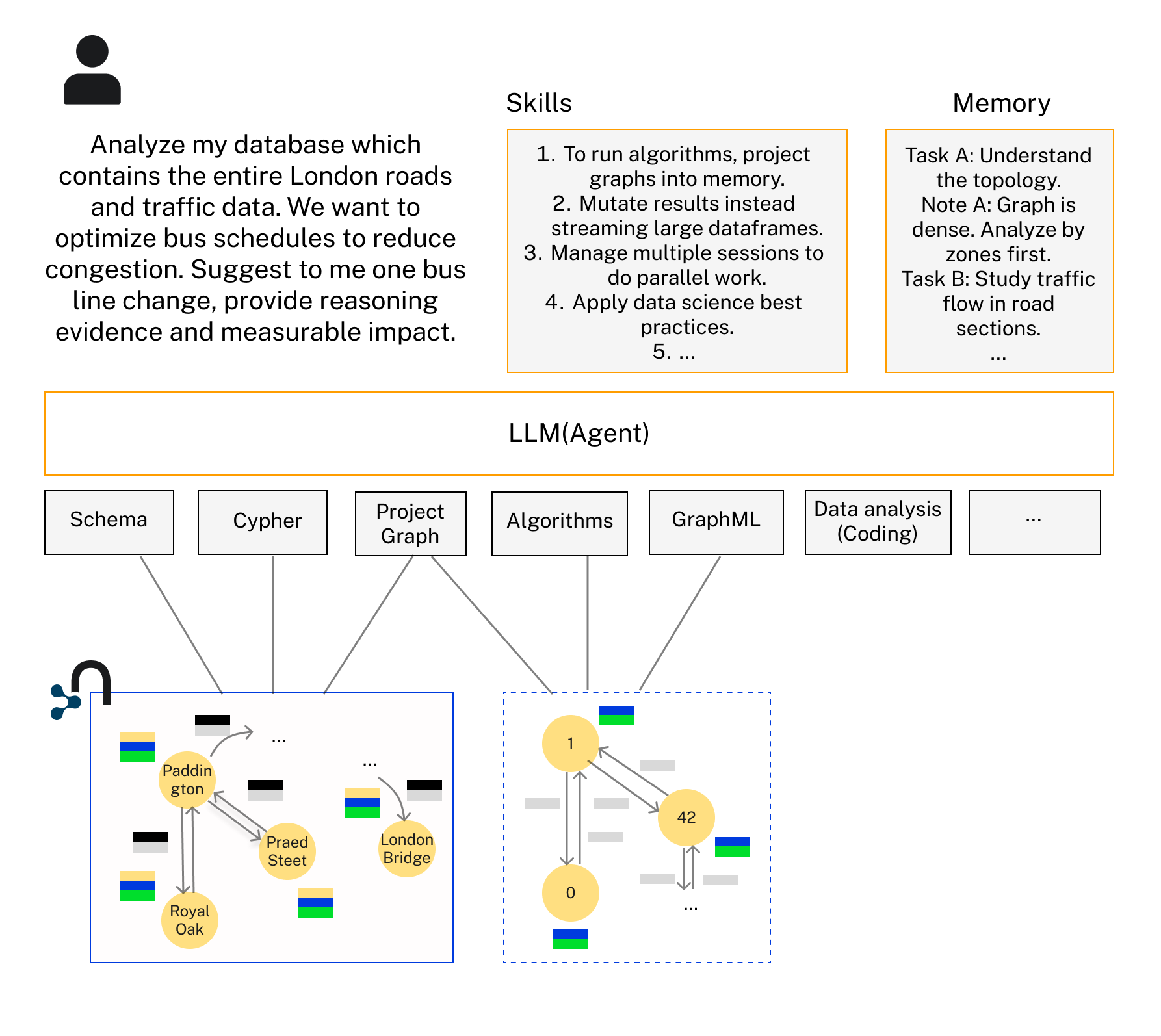
The GDS Agent lets LLMs reason about and perform data science work on graph data in Neo4j. It provides MCP tools for GDS algorithms and an agent skill that teaches best practices for graph data science workflows. You can ask any graph question about your Neo4j database and collaborate with the agent to solve complex analytical tasks.
How to install Neo4j GDS Agent
Copy-paste configuration for popular MCP clients.
NEO4J_URIrequiredNeo4j connection URI (neo4j:// or neo4j+s://)
NEO4J_USERNAMErequiredNeo4j username
NEO4J_PASSWORDrequiredsecretNeo4j password
NEO4J_DATABASENeo4j database name
AURA_API_CLIENT_IDAura API client ID (enables Aura Graph Analytics session mode)
AURA_API_CLIENT_SECRETsecretAura API client secret
AURA_API_PROJECT_IDAura project ID (only if the API client can access multiple projects)
Tools & capabilities
Tools this server exposes to the agent.
Centrality algorithms— Compute node importance metrics in graphsCommunity detection— Identify clusters and communities in graph dataPath finding— Find optimal paths and routes in graphsSimilarity algorithms— Measure similarity between nodesNode embeddings— Generate vector representations of nodesML pipelines— Build and execute machine learning workflows on graphsGraph projection— Project Neo4j data into GDS graph space for analysisSession management (Aura mode)— Create, list, and delete GDS Aura Graph Analytics sessions
Use cases
- Analyze network centrality to identify key nodes in social networks or infrastructure graphs
- Detect communities and clusters in large graphs to understand structural patterns
- Find shortest paths and optimal routes for logistics or navigation problems
- Generate node embeddings for downstream machine learning tasks
- Build end-to-end ML pipelines on graph data without leaving your LLM interface
- Compare similarity between entities in your graph to find related items or duplicates
Neo4j GDS Agent MCP server FAQ
It's an MCP server that exposes Neo4j Graph Data Science algorithms to LLMs like Claude and Cursor, allowing them to perform graph analysis, community detection, embeddings, and ML workflows on your Neo4j database.
The GDS Agent itself is open-source and free. However, you need a Neo4j database with the GDS plugin (self-managed) or a GDS Aura Graph Analytics session (AuraDB), which may incur costs depending on your Neo4j deployment.
For Cursor: use the one-click badge or add it via `npx skills add neo4j-contrib/gds-agent -a cursor`. For Claude Desktop: download the `.mcpb` file from releases and double-click it, then upload the skill zip in Settings → Skills. For Claude Code: use `/plugin marketplace add neo4j-contrib/gds-agent`.
You need Neo4j database credentials (URI, username, password). For AuraDB Graph Analytics sessions, you also need Aura API credentials (client ID and secret). All are set as environment variables.
Yes. It's designed to work alongside `mcp-neo4j-cypher` in read-only mode, which lets the agent inspect data and verify results. Claude Code and Gemini CLI bundle both automatically.
By default it uses STDIO for local MCP clients. For HTTP-native clients, run with `--transport http --host 127.0.0.1 --port 8000 --path /mcp`.
README (reference)
Source of truth, from the repository.
GDS Agent
The GDS Agent let LLMs reason and do data science work on your graph data in Neo4j, by using two artifacts:
- Tools — an MCP server exposing Neo4j Graph Data Science (GDS) algorithms: centrality, community detection, path finding, similarity, node embeddings, and ML pipelines.
- Skills — an agent skill (
neo4j-graph-data-scientist) teaching the agent how and when to use those tools and best practices for doing data science on graphs.
It works with any MCP-capable harness — Claude Code, Claude Desktop, claude.ai, OpenAI Codex, Cursor, VS Code/Copilot, Gemini CLI — and programmatically from agent frameworks. It uses the GDS plugin on self-managed Neo4j and GDS Aura Graph Analytics sessions on AuraDB, over STDIO or HTTP transport.
Once set up, you can ask any graph question about your Neo4j graph and get answers. You can collaborate with the agent as a graph data scientist to solve complex tasks.
Install
| Harness | Tools (MCP) | Skill | Guide |
|---|---|---|---|
| Claude Code | /plugin marketplace add neo4j-contrib/gds-agent → /plugin install gds-agent@neo4j-gds | bundled with the plugin | setup |
| Claude Desktop | download the .mcpb from releases, double-click | upload the skill zip in Settings → Skills | setup |
| OpenAI Codex | codex mcp add neo4j-gds -- uvx gds-agent | npx skills add neo4j-contrib/gds-agent -a codex | setup |
| Cursor | one-click badge | npx skills add neo4j-contrib/gds-agent -a cursor | setup |
| VS Code / Copilot | one-click badge or .vscode/mcp.json | npx skills add neo4j-contrib/gds-agent -a copilot | setup |
| Gemini CLI | gemini extensions install https://github.com/neo4j-contrib/gds-agent | bundled with the extension | setup |
| Your own agent | any MCP client (stdio/HTTP) | inject SKILL.md as instructions | setup |
Most local setups need uv installed (the server runs via uvx gds-agent from PyPI). Generic MCP clients run uvx gds-agent over stdio with the environment variables below.
Configuration reference
Set as environment variables (or the credential form of your harness's installer):
| Variable | Required | Purpose |
|---|---|---|
NEO4J_URI | yes | neo4j:// or neo4j+s:// connection URI |
NEO4J_USERNAME / NEO4J_PASSWORD | yes | database credentials |
NEO4J_DATABASE | no | database name (defaults to neo4j) |
AURA_API_CLIENT_ID / AURA_API_CLIENT_SECRET | session mode | Aura API credentials for Aura Graph Analytics |
AURA_API_PROJECT_ID | no | only if the API client can access multiple projects |
SESSION_MEMORY_GB / SESSION_TTL_HOURS | no | session defaults (8 GB / 24 h) |
GDS_AGENT_MAX_RESULT_ROWS / _CHARS / _CELL_CHARS | no | tool output limits (500 / 100000 / 200) |
By default the server uses STDIO transport for local MCP clients. For HTTP-native clients, run the server with streamable HTTP:
gds-agent --transport http --host 127.0.0.1 --port 8000 --path /mcp
The equivalent environment variables are GDS_AGENT_TRANSPORT, GDS_AGENT_HOST, GDS_AGENT_PORT, and GDS_AGENT_PATH. The Neo4j MCP-style NEO4J_TRANSPORT and NEO4J_MCP_SERVER_* names are also supported.
GDS Aura Graph Analytics (sessions)
The server detects whether the connected Neo4j has the GDS plugin installed or whether to use a GDS Aura Graph Analytics session. Detection runs gds.session.list() on startup; if it succeeds, session mode is used and graph projections fall back to gds.graph.project.remote.
Session mode requires Aura API credentials (see the configuration reference above) in the same .env file or env block as the database credentials.
Sessions are managed explicitly by the agent: three extra tools become available in session mode (list_sessions, create_session, and delete_session). A session must first be created with create_session, project_graph_cypher then projects each graph into the session named by its required sessionName parameter, and algorithm calls are routed to the right session automatically by graphName. Most workflows need a single session holding all graphs; multiple sessions allow running analyses in parallel. To resize a session (e.g. after an OOM), delete it and create it again with a larger memoryGB. All sessions created by the server are named with an mcp_ prefix. Aura sessions are charged separate to the DB.
The skill
[skills/neo4j-graph-data-scientist](skills/neo4j-graph-data-scientist/SKILL.md) is consumed from this one location by the Claude Code plugin, the Gemini extension, npx skills, and the release skill zip. It covers GDS-specific workflow best practices with a troubleshooting reference guide, as well as general data science best practices. It is designed for the gds-agent and mcp-neo4j-cypher MCP servers.
Read-only Cypher alongside GDS
The GDS server deliberately executes no arbitrary Cypher — its only Cypher entry point is graph projection. To let the agent also read the underlying data (inspect properties, aggregate, verify algorithm results), pair it with the [mcp-neo4j-cypher](https://github.com/neo4j-contrib/mcp-neo4j) server in read-only mode.
The Claude Code plugin and the Gemini CLI extension already bundle it: one install configures both servers with the same credentials, and NEO4J_READ_ONLY=true removes its write tool. NEO4J_RESPONSE_TOKEN_LIMIT caps read-query responses (tokens) so large results don’t overwhelm the model; omit it for no Cypher-side limit. On any other harness, register a second server alongside gds-agent:
"neo4j-cypher": {
  "command": "uvx",
  "args": ["mcp-neo4j-cypher@0.6.0", "--transport", "stdio"],
  "env": {
    "NEO4J_URI": "neo4j://localhost:7687",
    "NEO4J_USERNAME": "neo4j",
    "NEO4J_PASSWORD": "<your-password>",
    "NEO4J_READ_ONLY": "true",
    "NEO4J_RESPONSE_TOKEN_LIMIT": "20000"
  }
}
Example dataset
To load a London underground example dataset:
- Fork and clone the repository
- Install the Neo4j database with GDS plugin: Download the Neo4j Desktop from Neo4j Download Center Install the GDS plugin from the Neo4j Desktop Create a new database and start it
- Populate .env file with necessary credentials:
 NEO4J_URI=bolt://localhost:7687  # or your database URI
 NEO4J_USERNAME=neo4j  # or your db username
 NEO4J_PASSWORD=your_password
- Load the London Underground dataset with the following command (uv resolves the script's dependencies automatically):
uv run import_data.py --undirected
Connect to your DB and querying the graph from Neo4j workspace, you should see: London Underground Graph
Start the server for dev
- When inside the
/mcp_serverdirectory, runuv sync --devand runuv run gds-agentto start the MCP server standalone, or runclaudeto start claude-cli with the agent. - To try the plugin (MCP server + skill) from your working tree:
claude --plugin-dir .from the repository root.
Releases
Version numbers are kept in lockstep across pyproject.toml and all distribution manifests by scripts/bump_version.py. Pushing a v* tag triggers the release workflow.
How to contribute
Open a pull request from a branch of your forked repository into the main branch of this repo, for example mygithubid:add-new-algo -> neo4j-contrib:main.
The CI build in github action requires all codestyle checks and tests to pass.
To run and fix codestyle checks locally, in the /mcp_server directory, run:
uv sync --dev
to setup the python environment. And then,
uv run pytest tests -v -s
uv run ruff check
uv run ruff format
for all tests and codestyle fixes.
Feature request and bug reports
To report a bug or a new feature request, raise an issue.
If it is a bug, include the full stacktrace and errors.
When available, attach relevant logs in mcp_server_neo4j_gds.log. This file is located inside the /mcp_server/src_mcp_server_neo4j_gds directory if the gds agent is running from source, or inside the logging path for Claude (e.g /Library/Logs/Claude for Claude Desktop on Mac). Include relevant minimal dataset that can be used to reproduce the issue if possible.
Additional resources
The GDS agent can be used with other MCP servers, such as those that provide additional Neo4j toolings: https://github.com/neo4j-contrib/mcp-neo4j Arxiv paper including details about the architecture and benchmark results: https://arxiv.org/abs/2508.20637.
Related MCP servers

Manage Neo4j Aura database instances via natural language through Claude and other MCP clients.
io.github.neo4j-contrib/mcp-neo4j-cypher
Run Cypher queries against Neo4j databases using natural language.
Create, validate, and visualize Neo4j graph data models with interactive tools and Arrows.app integration.
io.github.neo4j-contrib/mcp-neo4j-memory
Store and retrieve personal knowledge graphs in Neo4j across sessions and clients.

Opinionated sprint tracker. Read/update tickets, sprints, velocity from Claude/Cursor/Zed.