io.github.nickjlamb/pubcrawl MCP Server
io.github.nickjlamb/pubcrawl
PubMed, Europe PMC, FDA/UK drug labels, and clinical trials access for AI assistants.
What is the io.github.nickjlamb/pubcrawl MCP server?
PubCrawl is an MCP server that connects AI assistants to PubMed, Europe PMC, FDA and UK drug labelling, and ClinicalTrials.gov. It provides 14 tools for searching literature, retrieving drug labels, comparing US and UK prescribing information, and finding clinical trials—all grounded in official APIs with verifiable citations (PMIDs, NCT IDs, DOIs).
PubCrawl gives Claude, Cursor, and other MCP clients direct access to the primary sources clinicians and researchers use: peer-reviewed literature, drug labelling, and clinical trial data. Every result cites its source and links back to DailyMed, the eMC, PubMed, or ClinicalTrials.gov. It requires no API keys (though an optional free NCBI key raises rate limits) and is fully typed, tested, and benchmarked for accuracy on every release.
How to install io.github.nickjlamb/pubcrawl
Copy-paste configuration for popular MCP clients.
NCBI_API_KEYsecretNCBI API key for higher rate limits (10 req/s vs 3 req/s). Optional — get one free at https://www.ncbi.nlm.nih.gov/account/
Tools & capabilities
Tools this server exposes to the agent.
search_pubmed— Search PubMed with filters for date range, article type, and sort order. Returns PMIDs, titles, authors, journals, and DOIs.search_europepmc— Search Europe PMC—a broader corpus than PubMed that also indexes preprints (bioRxiv, medRxiv) and patents. Filter to preprints or open-access only.get_abstract— Get the full structured abstract for an article, broken into labeled sections (background, methods, results, conclusions) with keywords and MeSH terms.get_full_text— Retrieve the full text of open-access articles from PubMed Central, with parsed sections, figure/table captions, and reference counts.find_related— Find similar articles using PubMed's neighbor algorithm, ranked by relevance score.format_citation— Generate a formatted citation in APA, Vancouver, Harvard, or BibTeX style.trending_papers— Find recent papers on a topic, with optional filtering to high-impact journals (Nature, Science, Cell, NEJM, Lancet, JAMA, etc.).resolve_drug_name— Convert a brand drug name to its generic (or a generic to its US brand names), with drug class and common indications.get_uspi— Pull US Prescribing Information sections via openFDA (cited to DailyMed)—indications, dosing, warnings, contraindications, and more.get_smpc— Retrieve UK Summary of Product Characteristics from the eMC—the UK equivalent of US prescribing information, with numbered SmPC sections.compare_labels— Side-by-side comparison of US (USPI) and UK (SmPC) labelling for the same drug, pairing equivalent sections and flagging differences.search_by_indication— Find drugs approved for a medical condition. Searches FDA labelling via openFDA, then cross-references UK availability on the eMC.search_trials— Search ClinicalTrials.gov for clinical trials. Filter by condition, intervention, recruitment status, and phase. Returns NCT IDs, sponsors, enrollment, and links.get_trial— Get full details for a clinical trial by NCT ID—eligibility criteria, study design, arms, primary/secondary outcomes, locations, and associated PubMed IDs.
Use cases
- Search PubMed and Europe PMC for recent clinical trials or preprints on a drug or disease, with filtering by date, article type, and open-access status.
- Compare US and UK drug labelling side-by-side to identify regulatory differences in indications, contraindications, and warnings across markets.
- Retrieve and cite full abstracts and full texts of peer-reviewed articles, formatted in APA, Vancouver, Harvard, or BibTeX style.
- Find clinical trials by condition, intervention, or phase, and retrieve detailed eligibility criteria and primary outcomes for a specific NCT ID.
- Look up drug names, classes, and indications, and search for all drugs approved for a given medical condition in the US and UK.
io.github.nickjlamb/pubcrawl MCP server FAQ
PubCrawl is an MCP server that gives AI assistants (Claude, Cursor, etc.) direct access to PubMed, Europe PMC, FDA/UK drug labelling, and ClinicalTrials.gov. Every result is grounded in official APIs and cites its source (PMID, NCT ID, DOI).
Yes. No API keys are required. An optional free NCBI API key (created at ncbi.nlm.nih.gov/account) raises PubMed rate limits from 3 to 10 requests per second.
Edit your Claude Desktop config file (macOS: ~/Library/Application Support/Claude/claude_desktop_config.json; Windows: %APPDATA%\Claude\claude_desktop_config.json) to add: {"mcpServers": {"pubcrawl": {"command": "npx", "args": ["-y", "@pharmatools/pubcrawl"]}}}. Restart Claude and PubCrawl appears under + → Connectors.
Cursor uses the same MCP config format as Claude Desktop. Add the same configuration block to your Cursor MCP settings, restart, and the server will be available.
PubCrawl calls official APIs: NCBI E-utilities (PubMed), Europe PMC, openFDA and DailyMed (US drug labels), the UK eMC (UK drug labels), and ClinicalTrials.gov. No data is invented; every result links back to its source.
No authentication is required. An optional free NCBI API key can be added via the NCBI_API_KEY environment variable to raise PubMed rate limits.
README (reference)
Source of truth, from the repository.
An MCP server that gives AI assistants access to PubMed, Europe PMC, FDA & UK drug labelling, and ClinicalTrials.gov.
A peer-reviewed pub crawl through the literature — the label — and the trial.









Quick start · Tools · Examples · Architecture · Roadmap · Contributing
</div>✨ What is PubCrawl?
PubCrawl connects your AI assistant (Claude Desktop, Cursor, or any MCP-compatible client) directly to the primary sources clinicians and researchers actually use — so you can ask a question in plain English and get an answer grounded in PubMed, Europe PMC, FDA/UK drug labelling, and ClinicalTrials.gov, with real PMIDs, NCT IDs, and DOIs you can verify.
Every tool is a thin, deterministic wrapper over an official API. Nothing is invented; every result cites its source.
The thing no other MCP server does
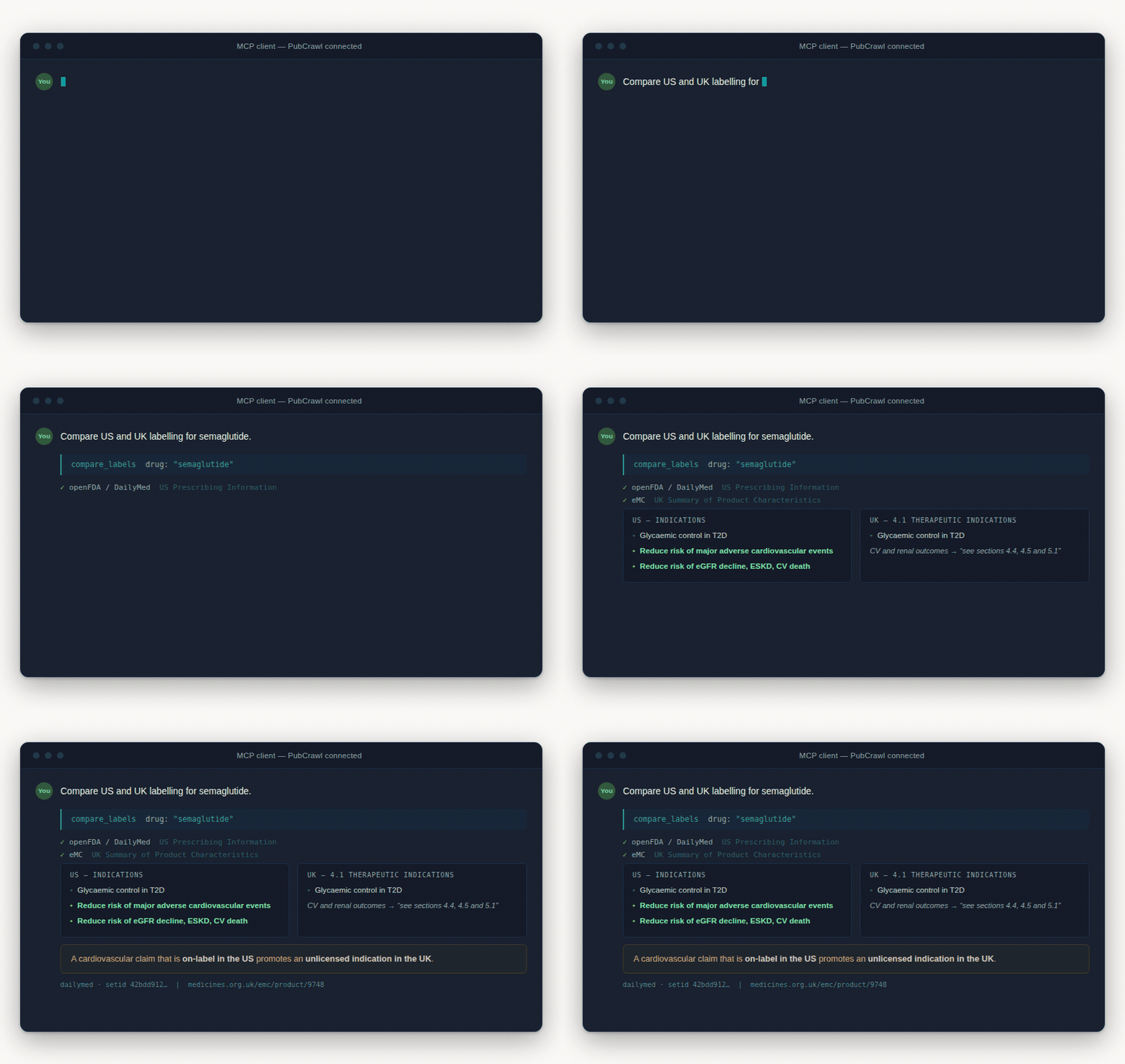
Ask "compare US and UK labelling for semaglutide" and PubCrawl pulls both live labels and maps equivalent sections — US Indications and Usage ↔ UK 4.1 Therapeutic indications, and so on — so the differences are visible instead of assumed:
| US Prescribing Information | UK SmPC | |
|---|---|---|
| Indications | glycaemic control · reduce risk of MACE in T2D with established CVD · reduce risk of sustained eGFR decline, ESKD and CV death in T2D with CKD | glycaemic control only — CV and renal outcomes appear as cross-references to §4.4/4.5/5.1, not as indications |
| Contraindications | personal or family history of MTC or MEN 2 · hypersensitivity | hypersensitivity only |
A cardiovascular claim that is on-label in the US promotes an unlicensed indication in the UK. If you write, review, or check medical copy for both markets, that gap is the whole job — and compare_labels is the only MCP tool that surfaces it.
Everything else
- 🔬 14 tools across literature, drug labelling, and clinical trials
- 🧾 Verifiable by design — results link back to DailyMed, the eMC, PubMed, and ClinicalTrials.gov
- 📰 Preprints via Europe PMC — surface work ahead of formal publication
- 🆓 No API keys required (an optional free NCBI key raises PubMed rate limits)
- 🧪 Fully typed, tested, and CI-checked — literature retrieval gated by OpenGATE, and labelling & trials by the in-repo fidelity benchmark, on every release
Built by PharmaTools.AI.
🚀 Quick start (60 seconds)
1. Add PubCrawl to your client config — no install step needed, npx fetches it on first run.
For Claude Desktop, edit claude_desktop_config.json:
- macOS:
~/Library/Application Support/Claude/claude_desktop_config.json - Windows:
%APPDATA%\Claude\claude_desktop_config.json
{
  "mcpServers": {
    "pubcrawl": {
      "command": "npx",
      "args": ["-y", "@pharmatools/pubcrawl"]
    }
  }
}
2. Restart your client. PubCrawl appears under + → Connectors.
3. Ask away:
"Compare the US and UK labelling for atorvastatin, and find recent Phase 3 trials for it."
That's it. → More examples · API key & other options
🧰 Tools
📚 Literature
| Tool | What it does |
|---|---|
search_pubmed | Search PubMed with filters for date range, article type, and sort order. Returns PMIDs, titles, authors, journals, and DOIs. |
search_europepmc | Search Europe PMC — a broader corpus than PubMed that also indexes preprints (bioRxiv, medRxiv) and patents. Each result includes an abstract snippet, citation count, open-access status, and a preprint flag. Filter to preprints or open-access only. |
get_abstract | Get the full structured abstract for an article — broken into labeled sections (background, methods, results, conclusions) with keywords and MeSH terms. |
get_full_text | Retrieve the full text of open-access articles from PubMed Central, with parsed sections, figure/table captions, and reference counts. |
find_related | Find similar articles using PubMed's neighbor algorithm, ranked by relevance score. |
format_citation | Generate a formatted citation in APA, Vancouver, Harvard, or BibTeX style. |
trending_papers | Find recent papers on a topic, with optional filtering to high-impact journals (Nature, Science, Cell, NEJM, Lancet, JAMA, etc.). |
💊 Drug labelling
| Tool | What it does |
|---|---|
resolve_drug_name | Convert a brand drug name to its generic (or a generic to its US brand names), with drug class and common indications. Deterministic, via RxNorm/openFDA — no AI. |
get_uspi | Pull US Prescribing Information sections via openFDA (cited to DailyMed) — indications, dosing, warnings, contraindications, and more. |
get_smpc | Retrieve UK Summary of Product Characteristics from the eMC — the UK equivalent of US prescribing information, with numbered SmPC sections. |
compare_labels | Side-by-side comparison of US (USPI) and UK (SmPC) labelling for the same drug, pairing equivalent sections (US Indications ↔ UK 4.1). A missing side is always explained, cut sections are flagged truncated, and us_drug / uk_drug pin a different name per market (Farxiga / Forxiga). |
search_by_indication | Find drugs approved for a medical condition. Searches FDA labelling via openFDA, then cross-references UK availability on the eMC. |
🧫 Clinical trials
| Tool | What it does |
|---|---|
search_trials | Search ClinicalTrials.gov for clinical trials. Filter by condition, intervention, recruitment status, and phase. Returns NCT IDs, sponsors, enrollment, and links. |
get_trial | Get full details for a clinical trial by NCT ID — eligibility criteria, study design, arms, primary/secondary outcomes, locations, and associated PubMed IDs. |
💬 Examples
Once connected, just ask naturally:
Literature
- "Search PubMed for recent clinical trials on semaglutide."
- "Search Europe PMC for preprints on GLP-1 receptor agonists, most cited first."
- "Get the abstract for PMID 38127654, then find related papers and cite them all in Vancouver style."
- "What are the trending papers on CRISPR gene therapy this month, high-impact journals only?"
- "Pull the full text of that PMC article and summarise the methods section."
Drug labelling
- "Get the FDA prescribing information for metformin — just the indications and warnings."
- "Pull the UK SmPC for atorvastatin."
- "Compare US and UK labelling for lisinopril and highlight the differences."
- "What's the generic name and drug class for Ozempic?"
- "What drugs are approved for type 2 diabetes in both the US and UK?"
Clinical trials
- "Find recruiting Phase 3 trials for pembrolizumab in breast cancer."
- "Get the eligibility criteria and primary outcomes for NCT03086486."
Cross-source (where PubCrawl shines)
- "For semaglutide: summarise the US label's cardiovascular indication, then find the pivotal trial and its NEJM publication."
🏗 Architecture
Three layers — tools register the MCP interface, lib clients talk to each external API, and shared cache + parsers keep it fast and consistent.
<picture> <source media="(prefers-color-scheme: dark)" srcset="docs/architecture-dark.svg"> <img src="docs/architecture-light.svg" alt="PubCrawl architecture: an MCP client connects over stdio or streamable HTTP to the PubCrawl server, whose 14 tools are grouped into literature, drug labelling and clinical trials. Each family calls the official APIs directly — NCBI E-utilities, Europe PMC, openFDA and DailyMed, the UK eMC, and ClinicalTrials.gov — behind a shared LRU cache, XML/JATS/SPL parsers and rate limits. Every result returns with its own identifier: PMID, NCT or DOI. No model sits in this path; nothing is invented." width="100%"> </picture>Each tool file exports a register*Tool(server) function with a zod schema and an async handler. All network calls are rate-limited, cached, and time-bounded. See CLAUDE.md for a full architecture walkthrough and CONTRIBUTING.md to add a tool.
🔧 Configuration
Install options
# Zero-install (recommended): npx fetches it on demand — see Quick start above.

# Or install globally:
npm install -g @pharmatools/pubcrawl

# Config for a global install:
#   { "mcpServers": { "pubcrawl": { "command": "pubcrawl" } } }
NCBI API key (optional)
Without a key, PubMed requests are limited to 3/second. A free key raises this to 10/second.
- Create a free NCBI account at https://www.ncbi.nlm.nih.gov/account/
- Account Settings → API Key Management → create a key
- Add it to your config:
{
  "mcpServers": {
    "pubcrawl": {
      "command": "npx",
      "args": ["-y", "@pharmatools/pubcrawl"],
      "env": { "NCBI_API_KEY": "your_key_here" }
    }
  }
}
HTTP transport
PubCrawl also ships a stateless Streamable HTTP transport for browser-based and hosted clients:
npm run start:http # serves POST /mcp and GET /health on PORT (default 3000)
🗺 Roadmap
Highlights of what's planned — see ROADMAP.md for the full list.
get_europepmc_fulltext— read preprints & OA articles surfaced bysearch_europepmcget_adverse_events— openFDA FAERS adverse-event lookups- EMA / EPAR labelling to complement the US + UK
compare_labels - MeSH query helper for sharper PubMed searches
- MCP resources & prompts for common review workflows
Ideas welcome — open an issue.
🛠 Development
git clone https://github.com/nickjlamb/pubcrawl.git
cd pubcrawl
npm install

npm run dev      # TypeScript watch mode
npm run build    # compile to dist/
npm start        # run the stdio server
npm test         # Vitest unit suite
npm run lint     # ESLint
Unit tests live in tests/ and cover the parsing, caching, citation, formatting and label-pairing logic with fixture payloads (no network calls). CI runs lint → test → build on every push and pull request. New to the codebase? Start with CONTRIBUTING.md.
Measuring fidelity
npm run bench            # labelling + trials fidelity benchmark against the live sources
npm run bench -- --ci    # what the release gate runs: exit 1 if a verified case fails
Two gates run on every release and weekly. OpenGATE's retrieval scorer checks PubMed and Europe PMC records against hand-verified anchors. The in-repo fidelity benchmark does the same for drug labelling and trials: compare_labels is held to a gold set of US/UK anchors (a phrase must appear on one side and must not on the other, so real divergences are surfaced rather than smoothed over) plus a verbatim check that refetches the raw openFDA record and eMC page and confirms every returned sentence is a substring of the source. No LLM judge anywhere in either gate.
📦 Releases & changelog
Versions follow Semantic Versioning. See the CHANGELOG for a full history and Releases for notes and assets.
🤝 Contributing
Contributions are welcome and appreciated — bug reports, new data sources, new tools. Read the contributing guide to get started, then open an issue or a pull request.
📚 Citation
If PubCrawl supports work you publish, please cite it — see CITATION.cff, or:
@software{lamb_pubcrawl,
  author    = {Lamb, Nick},
  title     = {PubCrawl: verifiable biomedical literature, drug labelling and clinical trials for AI assistants},
  year      = {2026},
  publisher = {Zenodo},
  doi       = {10.5281/zenodo.22101559},
  url       = {https://doi.org/10.5281/zenodo.22101559}
}
📄 License
<div align="center"> <sub>Data from NCBI E-utilities, Europe PMC, openFDA, DailyMed, the UK eMC, and ClinicalTrials.gov. PubCrawl is not affiliated with these providers.</sub> </div>Related MCP servers

Pseudonymise patient identifiers and PII in clinical text locally with HIPAA Safe Harbor support.
Explain why two scientific papers disagree, every claim grounded in a verbatim source quote.
Deployment-readiness checks for document-QA and extraction AI: grounding, extraction, CI gate.
Check whether an AI answer is grounded in its context — deterministic, no LLM judge.

io.github.nickjlucker/greynoise
MCP server for GreyNoise API - Check if IPs are internet background noise or targeted attacks

QueryPilot
Safe SQL gateway for AI agents: SELECT-only validation, access policies, masking, audit trail, evals