io.github.nickzren/opentargets MCP Server
io.github.nickzren/opentargets
Access Open Targets Platform biomedical data—targets, diseases, drugs, variants, and evidence—via 68 curated GraphQL tools.
What is the io.github.nickzren/opentargets MCP server?
The Open Targets MCP server exposes the Open Targets Platform GraphQL API as a set of 68 tools for searching genes, diseases, drugs, genetic variants, and target-disease evidence. It integrates data from 22+ biomedical sources including genetics, functional assays, expression, pathways, and safety databases, enabling drug discovery, target validation, and evidence mining workflows.
This server bridges Claude and other MCP clients to the Open Targets Platform, a comprehensive biomedical knowledge base. Use it to search for drug targets by gene symbol or Ensembl ID, explore disease-target associations with scored evidence, discover repurposing candidates, analyze genetic variants and GWAS studies, and access safety and pharmacogenomics data. It includes 65 curated domain tools plus 3 raw GraphQL tools for edge cases.
How to install io.github.nickzren/opentargets
Copy-paste configuration for popular MCP clients.
Tools & capabilities
Tools this server exposes to the agent.
get_target_info— Retrieve core target identity record with Ensembl IDs, synonyms, and genomic coordinatesget_disease_info— Fetch disease/EFO summary with therapeutic area contextget_drug_info— Access ChEMBL-backed drug profile and mechanism of action datasearch_entities— Unified entity search with synonym handling and ID mappingget_target_associated_diseases— Find high-confidence target-disease links with association scoresget_disease_associated_targets— Retrieve prioritised target list for a diseaseget_target_known_drugs— List approved and investigational drugs for a targetget_target_disease_evidence— Explore target-disease association evidence across genetics, expression, and literatureget_drug_repurposing_candidates— Multi-hop disease-to-target-to-drug candidate prioritizationget_target_expression— Access baseline expression data across tissues and cell typesget_target_pathways_and_go_terms— Retrieve pathway and gene ontology annotationsget_target_interactions— Query protein-protein interactionsget_target_safety_information— Access safety profiles and adverse event dataget_target_genetic_constraint— Retrieve genetic constraint metricsget_target_mouse_phenotypes— Query mouse model phenotype dataget_disease_phenotypes— Retrieve HPO phenotypes associated with a diseaseget_disease_known_drugs— List drugs indicated for a diseaseget_drug_adverse_events— Access adverse event reports for a drugget_drug_pharmacogenomics— Retrieve pharmacogenomics data for a drugget_variant_info— Query genetic variant details
Use cases
- Search for drug targets by gene symbol (e.g., EGFR) and retrieve expression, pathways, safety, and mouse phenotype data for validation
- Discover repurposing candidates by finding disease-associated targets and their known drugs
- Analyze genetic variants and GWAS credible sets to prioritize targets for complex diseases
- Retrieve adverse event and pharmacogenomics data for drug safety profiling
- Explore target-disease associations with scored evidence from genetics, expression, and literature sources
io.github.nickzren/opentargets MCP server FAQ
It's an MCP server that exposes the Open Targets Platform—a comprehensive biomedical knowledge base integrating 22+ data sources—as 68 tools. You can search genes, diseases, drugs, variants, and evidence to support drug discovery and target validation workflows.
Yes. The server is open-source (MIT license) and accesses the free Open Targets Platform GraphQL API. No authentication or API key is required.
Install mcpm (pip install mcpm), then run: mcpm install opentargets. Restart Claude Desktop. Alternatively, use uvx to run it once without installation: uvx --from git+https://github.com/nickzren/opentargets-mcp opentargets-mcp
Open Targets aggregates genetics (ClinVar, UK Biobank, FinnGen), functional data (CRISPR, DepMap), drugs (ChEMBL, FDA/EMA), expression (GTEx, HPA), pathways (Reactome, Signor), literature (Europe PMC), safety (FAERS), and mouse models (MGI, IMPC).
No. The server connects to the free Open Targets Platform API (https://api.platform.opentargets.org) with no authentication required.
Yes. Clone the repo and run locally with uv sync and uv run python -m opentargets_mcp.server, or use Docker Compose (docker-compose up -d --build). Supports stdio, SSE, and HTTP transports.
README (reference)
Source of truth, from the repository.
Open Targets MCP Server






A Model Context Protocol (MCP) server that exposes the Open Targets Platform GraphQL API as a set of tools for use with Claude Desktop and other MCP-compatible clients.
<!-- mcp-name: io.github.nickzren/opentargets -->Quick Install
Option 1: Run once with uvx (no install)
uvx --from git+https://github.com/nickzren/opentargets-mcp opentargets-mcp
Option 2: Claude Desktop (MCPM)
# Install mcpm package manager
pip install mcpm

# Install the server
mcpm install opentargets
Option 3: Local install (dev or self-host)
git clone https://github.com/nickzren/opentargets-mcp
cd opentargets-mcp
pip install uv
uv sync

# Run (stdio transport by default)
uv run python -m opentargets_mcp.server
Option 4: Docker
git clone https://github.com/nickzren/opentargets-mcp
cd opentargets-mcp

# Build and run with Docker Compose
docker-compose up -d --build
Note: the default transport is http for docker deployments.
See the configuration section below for details and how to set ports and other environment variables.
Claude Desktop Manual Import (optional)
mcpm import stdio opentargets \
  --command "$(uv run which python)" \
  --args "-m opentargets_mcp.server --transport stdio"
Then restart Claude Desktop to start using the Open Targets tools.
Features
Core Capabilities
- Target Analysis: Search genes/proteins by Ensembl ID or symbol. Access expression data, genetic constraints, pathways, protein interactions, safety profiles, and mouse phenotypes
- Disease Analysis: Query diseases by ontology ID (mostly MONDO). Find associated targets, phenotypes (HPO), and research projects
- Drug Discovery: Search drugs by ChEMBL ID. Access safety data, adverse events, indications, and mechanism of action
- Evidence Mining: Explore target-disease associations with scored evidence from multiple sources
- Variant Analysis: Query genetic variants, GWAS credible sets, and pharmacogenomics data
- Study Exploration: Access GWAS studies with L2G predictions and fine-mapped loci
- Smart Search: Entity resolution with synonym handling, autocomplete, and ID mapping
- Cross-Entity Workflows: Multi-hop tools that chain disease, target, and drug evidence for prioritization
- Raw GraphQL Power Tools: Run single and batch raw GraphQL operations with structured status envelopes
Why This Server
This implementation is designed for practical Open Targets workflows:
- Curated breadth: 65 curated tools plus 3 advanced GraphQL tools (68 total), spanning target, disease, drug, evidence, variant, study, metadata, and cross-entity workflow tasks.
- Safer automation: strict ID resolution, typed parameter handling, and resilient retry behavior.
- Lower token overhead: optional
fieldsfilters on core domain tools to return only what you need. - Flexible power mode: raw GraphQL tools are available for edge cases.
Data Sources
The Open Targets Platform integrates evidence from 22+ primary data sources:
- Genetics: Open Targets Genetics, ClinVar, UK Biobank, FinnGen, Gene2Phenotype, Orphanet, COSMIC
- Functional: CRISPR screens, DepMap, GeneBass
- Drugs: ChEMBL, FDA/EMA approvals, chemical probes
- Expression: GTEx, Human Protein Atlas, Expression Atlas
- Pathways: Reactome, Signor, IntAct
- Literature: Europe PMC text mining
- Safety: FAERS, pharmacogenomics data
- Models: Mouse (MGI, IMPC) phenotypes
Architecture
graph LR
    subgraph "Clients"
        A[Claude Desktop]
        B[Python Scripts]
        C[AI Agents]
    end

    subgraph "MCP Server"
        D[Open Targets<br/>MCP Server]
        E[Tool Categories<br/>Target • Disease • Drug<br/>Evidence • Search • Variant • Study]
    end

    subgraph "Open Targets"
        F[GraphQL API]
        G[22+ Data Sources]
    end

    A <-->|MCP Protocol| D
    B <-->|Direct API| D
    C <-->|Function Calls| D
    D <-->|GraphQL| F
    F <--> G

    E --> D

    style D fill:#e1f5fe
    style F fill:#fff3e0
The MCP server acts as a bridge between client applications and the Open Targets Platform. It translates tool calls into GraphQL queries and provides structured access to biomedical data from 22+ integrated sources.
Prerequisites
- Python 3.10+ with pip
Usage
Running the Server Standalone
# Using the convenience script (installs uv if missing, then syncs dependencies)
./run.sh

# Or run directly with uv (stdio transport by default)
uv run python -m opentargets_mcp.server

# Installed entrypoints
opentargets-mcp --help

# Specify transport explicitly
uv run python -m opentargets_mcp.server --transport [stdio|sse|http]
Configuration
- Environment variables: Transport/bind use
MCP_TRANSPORT,FASTMCP_SERVER_HOST, andFASTMCP_SERVER_PORT(defaults:stdio,0.0.0.0,8000). API endpoint usesOPEN_TARGETS_API_URL(default:https://api.platform.opentargets.org/api/v4/graphql). For local-only development, preferFASTMCP_SERVER_HOST=127.0.0.1. - Validated settings: environment configuration is parsed with a typed settings model at startup (
src/opentargets_mcp/settings.py), so invalid values fail fast. - Name resolution: strict; unresolved names raise a clear error (use
search_entitiesto find canonical IDs). - Tool selection guidance: the server sends a short policy to clients to prefer curated tools, use
fieldsto trim output, and reserve raw GraphQL for edge cases. - Pagination guardrails: tool wrappers enforce
page_index >= 0,page_size >= 1, and a globalpage_size <= 500. - Command line:
opentargets-mcp --transport [stdio|sse|http] --host 0.0.0.0 --port 8000 --api <url>provides flexible transport and endpoint selection. - Verbose logging: add
--verboseto elevate the global log level to DEBUG when troubleshooting. - CLI helpers:
--list-toolsprints all registered tools, and--versionprints the package version. - Rate limiting:
OPEN_TARGETS_RATE_LIMIT_RPSandOPEN_TARGETS_RATE_LIMIT_BURSTcan enable global server-side rate limiting.--rate-limitingandOPEN_TARGETS_RATE_LIMIT_ENABLED=trueare also supported.
Transport Modes
The server supports multiple transport protocols powered by FastMCP:
stdio transport (default)
# For Claude Desktop (via mcpm) and local CLI tools
opentargets-mcp --transport stdio
SSE transport
# For web-based MCP clients with Server-Sent Events
opentargets-mcp --transport sse --host 0.0.0.0 --port 8000
HTTP transport
# For streamable HTTP MCP clients
opentargets-mcp --transport http --host 0.0.0.0 --port 8000
Using with MCP Clients
- Claude Desktop: Use mcpm installation (stdio) or direct server connection (sse)
- Web MCP clients: Use SSE or HTTP transports with public URL (tunnel required)
- Custom integrations: Any transport mode depending on your client implementation
Example Scripts
uv run python examples/target_validation_profile.py EGFR
uv run python examples/disease_to_drug.py "schizophrenia"
uv run python examples/drug_safety_profile.py "osimertinib"
uv run python examples/genetic_target_prioritization.py "inflammatory bowel disease"
AI Agent Example
The ReAct Agent provides an interactive terminal interface for exploring Open Targets data:
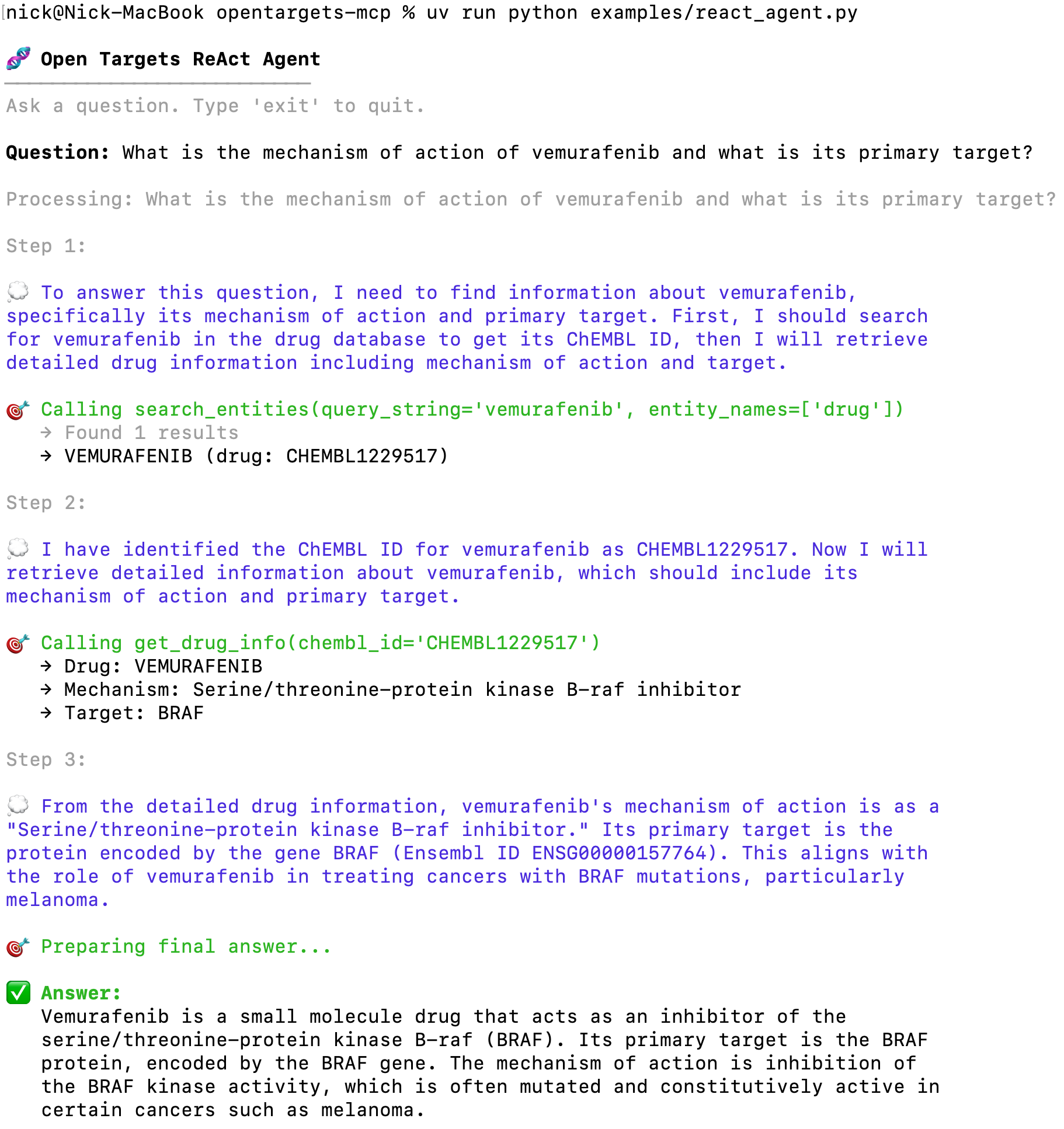
# Copy the example .env file and add your OpenAI API key
cp .env.example .env
# Then edit .env and set your OPENAI_API_KEY

# Run agent
uv run python examples/react_agent.py
The agent uses a ReAct (Reasoning and Acting) pattern to break down complex biomedical queries into steps, making it easy to explore drug targets, diseases, and their relationships.
Available Tools
The server wraps 68 operations from the Open Targets Platform: 65 curated tools plus 3 advanced GraphQL tools. Every tool returns structured JSON that mirrors the Open Targets GraphQL schema, and you can inspect the full machine-readable list with the MCP list_tools request.
Most domain tools accept either a canonical identifier (e.g., ENSG..., MONDO_..., CHEMBL...) or a human-readable name/symbol. Disease identifiers are largely MONDO since the 26.06 alignment to EFO 3.88; EFO_... IDs that were replaced no longer resolve. Colon notation (MONDO:0004979) is accepted and normalised. When a name is provided, the server automatically resolves it to the best matching Open Targets ID.
Many core tools accept an optional fields list (dot-paths) to filter the response payload.
search_entities also returns search.triples for compact {id, entity, name} consumption.
For edge cases, prefer curated tools + fields first; use raw GraphQL only when no curated tool fits.
Quick-start shortcuts
get_target_info– Core target identity record (Ensembl IDs, synonyms, genomic coordinates)get_disease_info– Disease/EFO summary with therapeutic area contextget_drug_info– ChEMBL-backed drug profile and mechanism datasearch_entities– Unified entity search with synonym handlingget_target_associated_diseases– High-confidence target-disease links with scoresget_disease_associated_targets– Prioritised target list for an EFO diseaseget_target_known_drugs– Approved and investigational agents for a targetget_target_disease_evidence– Evidence details across genetics, expression, and literatureget_drug_repurposing_candidates– Multi-hop disease -> target -> drug candidate prioritizationgraphql_batch_query– Run one GraphQL query across many variable sets
Full catalog by category
- Target identity & biology (20 tools) —
get_target_info,get_target_class,get_target_alternative_genes,get_target_associated_diseases,get_target_known_drugs,get_target_literature_occurrences,get_target_expression,get_target_pathways_and_go_terms,get_target_homologues,get_target_subcellular_locations,get_target_genetic_constraint,get_target_mouse_phenotypes,get_target_hallmarks,get_target_depmap_essentiality,get_target_interactions,get_target_safety_information,get_target_tractability,get_target_chemical_probes,get_target_tep,get_target_prioritization. - Disease analytics (8 tools) —
get_disease_info,get_disease_associated_targets,get_disease_phenotypes,get_disease_otar_projects,get_disease_known_drugs,get_disease_ontology,get_disease_literature_occurrences,get_disease_similar_entities. - Drug profiling (10 tools) —
get_drug_info,get_drug_cross_references,get_drug_linked_diseases,get_drug_linked_targets,get_drug_adverse_events,get_drug_pharmacovigilance,get_drug_warnings,get_drug_pharmacogenomics,get_drug_literature_occurrences,get_drug_similar_entities. - Evidence synthesis (2 tools) —
get_target_disease_evidence,get_target_disease_biomarkers. - Search & discovery (4 tools) —
search_entities,search_suggestions,get_similar_targets,search_facets. - Metadata & ontology utilities (5 tools) —
get_api_metadata,get_association_datasources,get_gene_ontology_terms,get_interaction_resources,map_ids. - Workflow tools (1 tool) —
get_drug_repurposing_candidates. - Batch lookups (3 tools) —
get_targets_batch,get_diseases_batch,get_drugs_batch. - Variant interpretation (6 tools) —
get_variant_info,get_variant_credible_sets,get_variant_pharmacogenomics,get_variant_evidences,get_variant_intervals,get_variant_protein_coordinates. - Study exploration (6 tools) —
get_study_info,get_studies_by_disease,get_study_credible_sets,get_credible_set_by_id,get_credible_set_colocalisation,get_credible_sets. - Advanced GraphQL (3 tools) —
graphql_schema,graphql_query,graphql_batch_query.
Response changes for Open Targets 26.06
Release 26.06 changed several upstream shapes. Tools were updated to match, so responses differ from earlier versions of this server:
get_target_expressionnow returnstarget.baselineExpression, a paginated{count, rows}connection, instead oftarget.expressions. Rows are per-datasource quantitative distributions (median,min,max,q1,q3,specificity_score,distribution_score) keyed ontissueBiosample/celltypeBiosample, and no longer carrytissue/rna/protein. The tool takespage_index(default0) andpage_size(default25); a single target can have well over a thousand rows.fieldskeeps its position as the first optional argument.- Drug
synonymsandtradeNamesare objects rather than plain strings. Each entry is{label, source}, affectingget_drug_info,get_drug_cross_referencesandget_drugs_batch. - Disease identifiers largely moved from EFO to MONDO with the alignment to
EFO 3.88. Replaced
EFO_...IDs no longer resolve;efo_idparameters keep their name but accept any supported disease ontology ID, in either colon or underscore notation. get_target_known_drugshonourspage_index, andknownDrugs.countis the upstream total rather than the page length. Rows no longer carrymechanismOfAction; useget_drug_infofor a drug's mechanisms.get_disease_known_drugsrejectscursorandfree_text_query: the API exposes no paging or filtering on that field.get_target_subcellular_locationsreturnstargetModifier, naming the protein form a location applies to.- When the API rejects a query, the tool error now carries the upstream
GraphQL message instead of a generic failure, and a
200response containing GraphQL errors raises rather than returning partial data. The rawgraphql_querytool still reports partial data with awarningstatus.
Each grouping matches the data domains described in the Open Targets docs (targets, diseases, drugs, evidence, variants, and studies). For high-volume workloads, respect the platform's throttling guidance from the Open Targets API FAQ and cache downstream where possible.
Development
# Run lint checks (same as CI/release)
uv run ruff check src tests

# Run tests
uv run pytest tests/ -v

# Inspect registered tools from CLI
uv run opentargets-mcp --list-tools
Related MCP servers

Agentic Ads
Ad network for AI agents — monetize MCP servers with contextual ads. 70% revenue share.
AgentWatch
Multi-agent observability: cascade failure detection, heartbeats, and forensic replay

DEX meta-aggregator for AI agents. Best prices from 15+ aggregators across 13 chains.
View repository →
Read-only VMware ESXi diagnostics: CPU Ready, disk latency, snapshots, real space, hardware health.

FFmpeg as a service for AI agents: typed video editing tools, async jobs, downloadable outputs.
View repository →
MCP server for Keepsake — the personal CRM for nurturing your relationships