no_human MCP Server
io.github.no-human-ai/no_human
AI coding factory that plans, codes, reviews adversarially, and proves fixes work—free and open-source on your machine.
What is the no_human MCP server?
The no_human MCP server is an AI coding factory that automates software development from ticket to reviewed pull request. It exposes task management capabilities (task_add, task_status) over stdio, allowing you to file tasks with your local no_human instance and check their status. The system enforces quality gates including adversarial review, tamper detection, and proof that bug fixes actually work.
no_human is a free, open-source AI coding system that runs locally and automates the full development cycle: planning, coding, independent review, and testing. It integrates with Jira, Linear, and monday.com to pull tickets, scopes work with you before starting, runs your tests locally or via CI, and uses a second AI model to adversarially review code before it ships. It catches deleted tests, weakened assertions, and unproven fixes—with transparency at every gate.
How to install no_human
Copy-paste configuration for popular MCP clients.
Tools & capabilities
Tools this server exposes to the agent.
task_add— File a new task with your local no_human instancetask_status— Check the status of a task
Use cases
- Automate bug fixes and feature implementation from GitHub/Jira tickets with independent AI review
- Run adversarial code review as a GitHub Action on pull requests, posting pass/fail checklists with file:line citations
- Integrate your Jira, Linear, or monday.com board with no_human to pull tickets and auto-deliver reviewed PRs
- Verify that test fixes actually fail on old code and pass on new code before merging
- Detect and block attempts to delete tests, add test skips, or weaken assertions without justification
no_human MCP server FAQ
It exposes task_add and task_status tools over stdio, letting you file tasks with your local no_human instance and check their status. no_human itself is an AI coding factory that automates development from ticket to reviewed pull request, with quality gates like adversarial review and tamper detection.
Yes, it is free and open-source under the MIT license. You run it locally on your machine and provide your own Anthropic API key or Claude subscription token.
Install the no-human package via pip (uv tool install no-human or pipx install no-human), then configure it with nh init. The MCP server exposes task_add and task_status tools over stdio for use in Claude or Cursor.
You need an Anthropic API key (sk-ant-api...) or Claude subscription OAuth token (sk-ant-oat...). For tracker integrations (Jira, Linear, monday.com), you provide credentials in your config file.
Yes. no_human integrates with Jira Cloud, Linear, and monday.com via REST or GraphQL APIs. Tickets are polled from your tracker and synced to the no_human board; with write-back enabled, completed tasks update the ticket status and add the PR link.
A second AI model, in a session that never saw the coder's transcript, is told to refute 'done'. It returns a pass/fail checklist citing file and line for every blocking finding, never a numeric self-score.
README (reference)
Source of truth, from the repository.
no_human
<!-- mcp-name: io.github.no-human-ai/no_human -->From ticket to reviewed pull request.<br>Free and open-source, on your machine.
English · 简体中文 · 日本語 · 한국어 · Español · Français · Deutsch · Português (Brasil)




getnohuman.com · Quickstart · Docs · Watch it work a sprint · Discord



<a href="https://getnohuman.com/"><img src="docs/assets/hero-loop-poster.jpg" alt="The no_human board: one task waiting on a question in Needs answer, four tasks working in parallel, one pull request ready for review." width="880"></a>
<sub>▶ <a href="https://getnohuman.com/">Watch the loop</a> — a ticket in, a reviewed pull request out; the whole loop in 57 seconds.</sub>
</div>The AI coding factory you <ins>can trust</ins>:
- A plan before any code, from the ticket plus what it finds in your repo. When planning fails, the coder is told it is working without one; when the change is judged trivial the plan is skipped without telling the coder, by design — the skip is still stated in the run's event stream.
- An adversarial review. A different model, in a session that never saw the coder's transcript, told to refute "done". You get a pass/fail checklist citing file and line — never a numeric self-score.
- A tamper guard. Deleted tests, new skips, an assertion turned into a tautology — counted mechanically before the review gate runs, then justified against your acceptance criteria or the attempt stops.
- Proof the fix fixed the bug. The tests offered as evidence must fail at
the merge base and pass on the new tree — the reproduction gate runs both.
Out of the box that binds a Python bug fix;
repro_gate.mode: requiredbinds every kind and every change. - Your tests run, locally and optionally through your CI — and a PR that found no test command says NOT RUN on its face.
- An honest stop. When it cannot finish it stops and says why — a specific question when your answer would unblock it, a structured record when it has simply run out of budget — never an invented plausible diff.
What the gate caught
no_human builds no_human. Over 65 days on its own board, none of this reached a pull request:
- 505 of 1,709 attempts the coder called done were sent back by the second model, each with a pass/fail checklist citing file and line.
- 44 attempts were stopped before the review even ran, for deleting or weakening a test.
- 46 bug-fix proofs were refused because the test offered as evidence passed on the old code too.
Install
One line (CLI + board)
uv tool install no-human   # or: pipx install no-human — the wheel ships the board
nh init && nh doctor       # token, config, first repo; then prove the install is real
Desktop app
Each release ships a SHA-256 alongside the artifact. Platform notes and the first-run walk-through: docs/quickstart.md.
From source
git clone https://github.com/no-human-ai/no_human.git && cd no_human
uv sync                 # installs the `nh` entry point into .venv
(cd web && npm install && npm run build)   # builds the board (cold first install can take minutes)
uv run nh init          # token, config, first repo (about 2 minutes)
uv run nh doctor        # verify the install is real before relying on it
The web build is not optional if you want the board: a source checkout ships
no web/dist, so without it nh start serves the API only and renders no UI.
Needs Python 3.12+, uv, git, and Node with
npm for the board build.
Product highlights
<table> <tr> <td width="36%" valign="middle"> <h3>A plan before any code</h3> <p>Acceptance criteria you can check, written from the ticket and your repo.</p> </td> <td width="64%"> <img src="docs/assets/readme/highlight-plan.png" alt="The task's plan: what we understood as three acceptance criteria, the two files to change, the approach, the test plan, what is out of scope, and the verification command." width="100%" /> </td> </tr> <tr> <td width="36%" valign="middle"> <h3>An independent reviewer</h3> <p>A second model that never saw the coder's session, told to refute "done". Pass or fail; every finding that blocks cites file and line.</p> </td> <td width="64%"> <img src="docs/assets/readme/highlight-verdict.png" alt="The reviewer's verdict: PASSED, each acceptance criterion ticked with the file and line that satisfies it, one non-blocking nit with the diff it points at." width="100%" /> </td> </tr> <tr> <td width="36%" valign="middle"> <h3>Your tests, on the PR's face</h3> <p>Run locally or through your CI. No test command found reads <b>NOT RUN</b>, never blank.</p> </td> <td width="64%"> <img src="docs/assets/readme/highlight-tests.png" alt="The task's Test results panel: CLEAN, 5 passed of 5 total, with the pytest output underneath." width="100%" /> </td> </tr> <tr> <td width="36%" valign="middle"> <h3>A tamper guard</h3> <p>Deleted tests, new skips and tautological assertions are counted before review. Unjustified, the attempt stops.</p> </td> <td width="64%"> <img src="docs/assets/readme/highlight-tamper.png" alt="A stopped attempt: a red TAMPER DETECTED banner, the reviewer verdict FAILED, and the blocking finding that three tests were deleted without an acceptance criterion to justify it." width="100%" /> </td> </tr> <tr> <td width="36%" valign="middle"> <h3>Proof the fix fixed the bug</h3> <p>The tests offered as evidence must fail on the old code and pass on the new. The gate runs both, and the event log shows the verdict.</p> </td> <td width="64%"> <img src="docs/assets/readme/highlight-repro.png" alt="The task's event log: tests pass, status reviewing, the reviewer's tamper check reading none, the reproduction gate reading pass, required, then lint, commit and the pull request opening." width="100%" /> </td> </tr> <tr> <td width="36%" valign="middle"> <h3>An honest stop</h3> <p>When it needs you, it parks with one specific question instead of guessing.</p> </td> <td width="64%"> <img src="docs/assets/readme/highlight-question.png" alt="The board's Needs answer lane: one task parked with its question, 'Dedupe by user, or by digest id?', and an Answer question button; the Working and Review PR lanes beside it." width="100%" /> </td> </tr> <tr> <td width="36%" valign="middle"> <h3>Your tracker's tickets, on your board</h3> <p>Pick Jira or Linear tickets from the backlog (monday.com boards are polled). Each one is scoped with you before it starts.</p> </td> <td width="64%"> <img src="docs/assets/readme/highlight-backlog.png" alt="The Backlog synced from Jira: four matching tickets selected, and a Start 4 tasks button." width="100%" /> </td> </tr> </table><sub>Stills: the real board on a demo workload.</sub>
Run one task
Run nh with no arguments for the shell: your lanes, a live event tail, and an
intake you describe a task to in plain English. Every command below still works.
nh                                   # the shell
nh start                             # board + worker on 127.0.0.1:8420
nh task add https://github.com/org/repo/issues/42 --repo ~/git/repo
nh status                            # needs-you / working / waiting / done
nh review <id>                       # the reviewer's evidence checklist
nh diff <id>                         # the diff it wants to ship
nh approve <id>                      # your approval squash-lands the PR (git.approve_identity)
nh reject <id> --reason "..."        # send it back with feedback
Integrations
Point no_human at the tracker you already use and it pulls the tickets to your board — a tracker's filter lives in your config, never in a task's own text, and a transport error logs and retries on the next tick instead of crashing the pool.
| Tracker | How tickets arrive | Filter you configure |
|---|---|---|
| Jira Cloud | Polled via REST search/jql (HTTP Basic email:token) | integrations.jira.jql |
| Linear | Polled via the GraphQL API | integrations.linear.team_key + state_types + label |
| monday.com | Polled via GraphQL v2 | integrations.monday.board_id + status_column + todo_labels |
With write-back on (write_back, off by default), the ticket moves with the
task — matched by status category, type, or the label you name, never a
hard-coded transition id — and gets the PR link; a task that needs a human is commented on, never
transitioned. GitHub and
GitLab issues import as tasks by URL, and PRs or MRs open on your own host;
Slack and Teams get a message when a task needs you; Jenkins and CircleCI can
run your test layers and gate the loop. Setup for each:
docs/adapters.md.
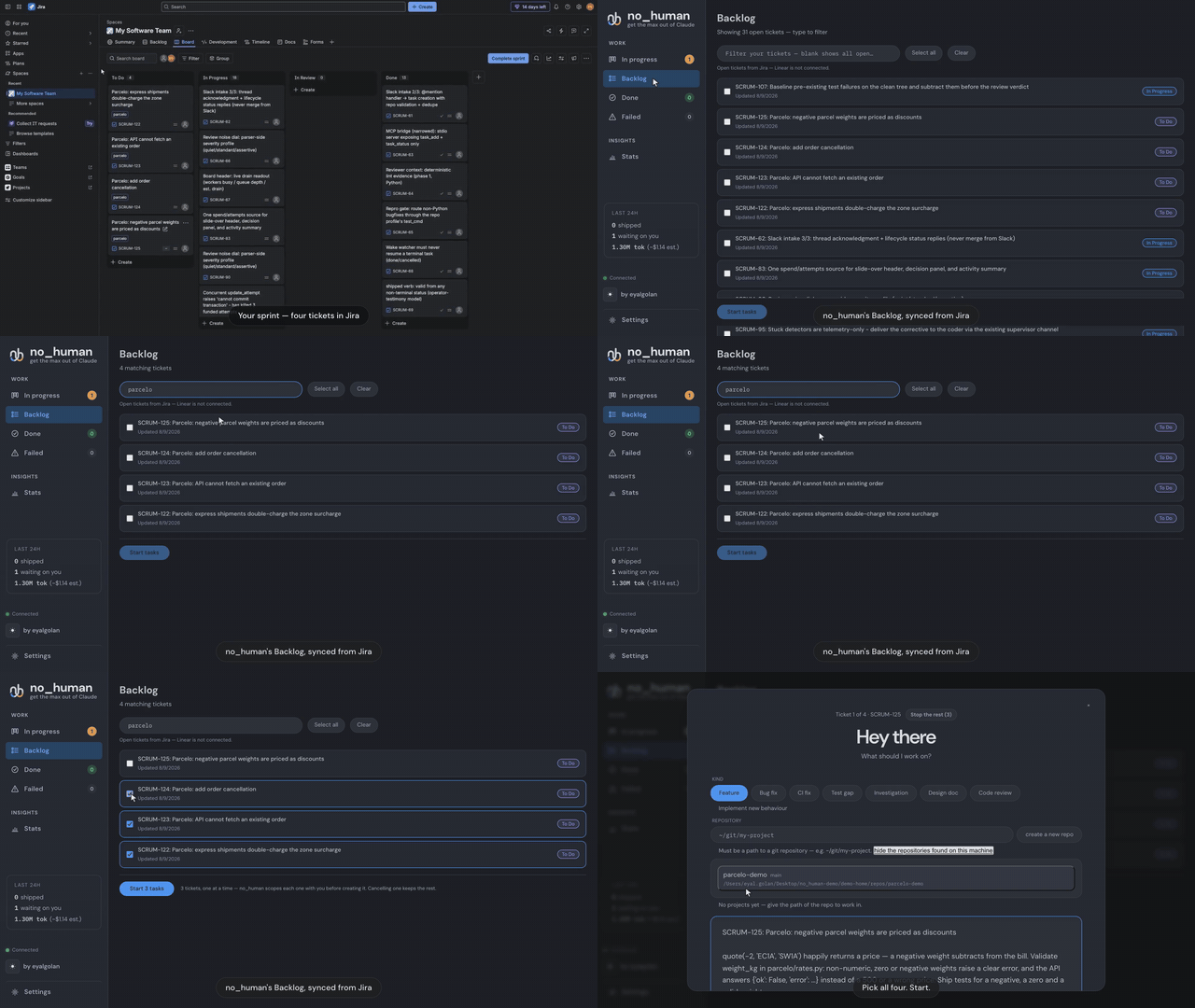
Watch the Jira flow end to end — tickets synced from a Jira board, scoped, implemented, and delivered as a review-passed pull request (click for the full video with every step):
GitHub Action
Run the same adversarial reviewer and tamper guard as a pull-request check —
one shot, no daemon, no ~/.no_human database, and not the queueing nh review CLI path. It judges the diff alone: unlike a local run, it collects no
lint, wiring or type evidence and does not explore the repository. It posts a single pass/fail checklist comment with
file:line citations, found by its own marker and updated in place on every
run rather than creating a new one each time.
# .github/workflows/review-gate.yml
name: no_human review gate
on:
  pull_request:

permissions:
  contents: read
  pull-requests: write

jobs:
  review:
    runs-on: ubuntu-latest
    steps:
      - uses: actions/checkout@v4
        with:
          fetch-depth: 0
          ref: ${{ github.event.pull_request.head.sha }}
      - uses: no-human-ai/no_human@main # no versioned tag yet — see below
        with:
          credential: ${{ secrets.ANTHROPIC_API_KEY }}
          github_token: ${{ github.token }}
permissions.contents: read lets actions/checkout read this repository;
pull-requests: write is what lets the Action post/update its own comment.
Neither grants anything broader. The checkout step's explicit
ref: ${{ github.event.pull_request.head.sha }} matters too: on a
pull_request event, actions/checkout otherwise checks out an ephemeral
merge commit rather than the PR's actual head, and the Action reviews and
cites line numbers against whatever tree is on disk — it refuses to run
rather than review the wrong one, so omitting ref: here turns into a red,
actionable exit 2, not a silent misreview.
This Action has no versioned release yet — no-human-ai/no_human's tags
today run v0.1.0 through v0.2.3, none of which contain action.yml. A
v1 tag will be cut at the first release that ships it. Until then, pin to
@main for the latest revision, or better, pin to the exact commit SHA
you've reviewed (no-human-ai/no_human@<sha>) so a later change to main
can't alter what your workflow runs.
credential takes either shape of your own Anthropic credential — an
ANTHROPIC_API_KEY (sk-ant-api...) or a Claude subscription OAuth token
minted with claude setup-token (sk-ant-oat...) — auto-detected from its
prefix, or pinned explicitly with credential_mode: oauth /
credential_mode: api_key. Whichever shape you pass, the other credential
path is scrubbed from the job's environment before the reviewer runs, and the
value itself is masked in the log the moment it is read.
A credential is required, and there is no silent fallback. If
secrets.ANTHROPIC_API_KEY (or whatever secret you wire into credential)
is empty, unset, or a shape the Action can't recognize even in auto mode,
the run fails loudly at exit code 2 — naming the credential input and
the secret it expects — before the reviewer, or any GitHub API call, ever
runs. The same fail-closed rule applies if the reviewer itself errors out or
the model call is rejected: those runs exit 2 too. The Action never posts
a PASS, and never exits 0, for a credential or reviewer failure — but a
green check does not always mean the gate reviewed code: a fork pull
request skips with exit 0 and no reviewer call (see below), and a pull
request with an empty diff (nothing to review) posts a synthetic PASS with
no reviewer or tamper-guard call. If you make this a required check, treat
both of those as "did not review," not as an approval. A diff larger than the
reviewer's single-turn cap is refused with exit 2 instead of being reviewed
as a truncated prefix, so that case is never a green check: lower max_files
or split the pull request.
Forks are skipped, not reviewed. A pull request whose head is not this
repository — including one from an already-deleted fork — never reaches the
reviewer or the model; the Action exits 0 with a comment-free explanation
instead of running review code against an unvetted head in a job that can see
your secrets. pull_request_target is refused outright (exit 2), even with a
valid credential, because that trigger is the one shape that can carry a
fork's head into a secret-bearing job.
workflow_run is also a supported trigger, reconstructing the pull request's
number, head commit, and changed files over the GitHub REST API instead of
from a pull_request payload; because that mode has no checked-out repository
tree, the tamper guard does not run, and the posted comment says so explicitly
rather than implying a clean tamper check.
Dependabot pull requests fail closed with exit 2, and that is GitHub's
restriction, not this Action's. A Dependabot-opened pull request has the
same repository as its head — it is not a fork, so the check above does not
skip it — but GitHub itself withholds repository secrets (and downgrades
GITHUB_TOKEN to read-only) from workflow runs it triggers on the
pull_request event, as a platform-level guard against a lockfile update
carrying a malicious install script into a secret-bearing job. credential
therefore arrives empty on those runs, and this Action's own fail-closed rule
(above) makes that a red, actionable exit 2 naming the missing secret, not
a silent skip or a false PASS. If you require this check and want Dependabot
PRs to go green, either exempt them in your branch protection rules or accept
that they need a maintainer's manual re-run/approval like any other check
that needs a secret GitHub won't hand to a bot-triggered job.
Cost is bounded by files, not tokens or time. max_files (default 15)
caps how many changed files are sent to the reviewer, sorted by path,
first-N; the comment reports how many of the total were actually reviewed.
The reviewer runs single_turn, so a passing run is one model call over the
capped diff, and a failing one may add a single bounded refute pass — in rough terms, a few cents to a few tens of cents of your
own Anthropic usage depending on diff size, similar in shape to one local nh review. That is separate from the one-time cost of the runner building the
Docker image itself (a few tens of seconds, GitHub-hosted-runner compute,
not model spend) on each run unless your workflow caches the image. Lower
max_files (or split large pull requests) to spend less.
The Action never merges, pushes, approves, or edits anything about the pull
request beyond its own single comment — enforced in code, not just by
convention: every GitHub API call is checked against a two-endpoint allowlist
(list/create/update that one comment thread) before it is sent. Set
fail_on_findings: false to keep the comment without failing the check, or
dry_run: true to print the verdict to the job log/summary and make no
GitHub API calls at all.
Known limitation: the tamper guard's "full test tree" claim holds for
ASCII test filenames, not non-ASCII ones. The tamper check walks every test
file in the repository (not just the max_files-capped subset sent to the
reviewer) via an unquoted git ls-tree, so a test file whose name contains
non-ASCII bytes is listed in git's C-quoted string form (e.g.
"r\303\251gression_test.py") instead of its real path, and silently drops
out of the guard's before/after comparison — deleting or weakening such a
file will not currently be caught. This Action's own diffed/reviewed file
list is not affected by the equivalent problem (it explicitly re-quotes and
re-verifies every path it hands to the reviewer), but the underlying
tamper-check module is out of scope for this Action to change. If your test
suite has non-ASCII test filenames, treat the tamper guard as best-effort for
those specific files until that's fixed upstream.
Known limitation: two runs racing each other, or a pull request already
carrying 1,000+ other comments, can produce a duplicate. The Action finds
its own prior comment by listing the PR's comments (up to 10 pages of 100)
and picking the lowest-id one carrying its marker; two runs started close
together can both list before either creates, and each will create its own
comment. A later run of either still converges — it lists again, finds the
lowest-id marked comment, and updates that one — but the extra comment is
not deleted. The same "list, then act" gap means a marked comment that would
only appear on page 11 or later (over 1,000 other comments already on the
pull request) reads as absent and gets a new one created rather than
updated. Both are accepted, documented bounds rather than silent failures:
if your workflow can trigger two runs for the same commit, add a
concurrency: group keyed on the pull request to serialize them.
MCP server — hand it work from the agent you are already in
no_human ships an MCP (Model Context Protocol) server: a stdio bridge, built on the official Python MCP SDK, that lets Claude Code, Cursor or any MCP client file work with your local no_human and check on it.
nh mcp-serve # the MCP server, over stdio
Two tools, and no more:
| Tool | What it does |
|---|---|
task_add(title, description, repo_path) | Files a task. no_human then plans it, writes the change, runs your tests, has a second model review it, and opens the pull request. |
task_status(task_id_or_external_id) | Returns that task's current state — status, attempts, the PR link once there is one. |
It talks to your own no_human at http://127.0.0.1:8420 and nothing else: no
auth, because that address is localhost, and no service of ours in between. For
Claude Code, the same server ships as a plugin — this repository is its own
plugin marketplace, so the two tools appear in your session after:
/plugin marketplace add no-human-ai/no_human
/plugin install no-human@no-human-ai
Any other MCP client takes the usual stdio entry:
// .mcp.json
{ "mcpServers": { "no_human": { "command": "nh", "args": ["mcp-serve"] } } }
The plugin also ships the review-this-branch skill, which does not
need the MCP server or ~/.no_human at all: it runs nh gate, a one-shot
CLI verb that puts the fresh-session adversarial reviewer and the tamper
guard directly on your current branch or a GitHub pull request, using your
own Claude credential, and exits with a pass/fail Markdown checklist,
with nothing installed or running beyond the nh CLI itself.
nh gate                        # current branch vs. its merge base with origin's default branch
nh gate --pr <github-pr-url>   # a GitHub pull request's head vs. its merge base
Docs
| quickstart.md | Zero to first task, per platform |
| configuration.md | Every setting and default |
| verification.md | The gates, the bounded loop, the limits |
| security.md | Auth boundary, the never-merge rule, guards |
| blockers.md | Escalation, wake watcher, nh reply |
| adapters.md | Intake, context, VCS and CI backends |
| eval.md | Golden set, replay scoring, shadow mode |
| CHANGELOG.md | What changed, per release |
Development
uv sync
uv run pytest -q
uv run nh --help
Issues and pull requests welcome; run uv run pytest -q before submitting.
If no_human saved you a review cycle, a star helps other people find it:

Community
Questions, bug reports and runs worth showing: join the Discord, post on r/no_human, or open a GitHub issue.
License
MIT — see LICENSE. The licence covers the code, not the name: TRADEMARK.md is the policy on using "no_human" and the logo. Packaging a binary carries obligations the source tree does not, listed in THIRD-PARTY-NOTICES.md.
Related MCP servers

U.S. grid mix, retail electricity prices and Henry Hub gas prices (EIA), paid per call via x402.
MCP server for Depyler: Python-to-Rust transpiler with analysis and verification tools

High-quality Rust SDK for Model Context Protocol (MCP) with full TypeScript SDK compatibility
View repository →MCP server for Ruchy: code analysis, scoring, linting, formatting, and transpilation tools

Bootstrap, verify, and update CLI tools & MCP servers in Claude Code from recipes; audit scopes.

Stinkyboy Bodega
One integration, one wallet. Thousands of callable tools, paid per call in USDC via x402.