io.github.rosasynthesiz/flstudio-mcp MCP Server
io.github.rosasynthesiz/flstudio-mcp
Control FL Studio with Claude: AI-driven mixing, diagnosis, composition, and arrangement through natural language.
What is the io.github.rosasynthesiz/flstudio-mcp MCP server?
The flstudio-mcp server is an MCP server that lets Claude Desktop control FL Studio 2025 directly—mixer, plugins, piano roll, routing, and project—from plain-language requests. It provides mixing diagnosis, plugin configuration, composition tools, and audio analysis, with every change shown, logged, and reversible.
flstudio-mcp bridges Claude and FL Studio, enabling AI-assisted mixing, arrangement, and composition. Ask Claude to diagnose your mix, suggest vocal chains, compose melodies in any scale, or export arrangements to MIDI. It reads your actual plugin library and measured track levels, making recommendations grounded in what you own and how your mix actually sounds.
How to install io.github.rosasynthesiz/flstudio-mcp
Copy-paste configuration for popular MCP clients.
Tools & capabilities
Tools this server exposes to the agent.
Mix Doctor— Scans the entire mix and reports concrete problems (clipping, low headroom, level imbalance, missing high-pass, ungrouped tracks, overlapping EQ boosts) with evidence and proposed fixes applied one at a time through a reversible safety layer.Full-song peak watch— Holds a running peak per track across playback so level decisions are based on the loudest moment of the actual song, not a single instant.Calibrated processing intents— Musical EQ, compression, reverb, and delay moves mapped to real plugin parameters (native and third-party), each applied as one reversible change.Level-aware compression— Sets compression thresholds relative to a track's measured level during playback.Gain staging— Proposes per-track trims toward healthy levels with proper master headroom.Reference match— Compares your mix's level and tonal balance against a reference track.Bulk track control— Solo or mute a whole group (drums, vocals, etc.) in one step with one-call reset.Track & channel coloring— Color a track, channel, or group by name or hex code, reversible like all other changes.Plugin parameter control— Read and set plugin parameters by name on native and third-party plugins, with live parameter list resolution.Chain suggestions & preset recommendations— Drawn from your actual installed plugin library, read directly from FL's plugin database and preset folders.Multi-track MIDI export— Generate a complete arrangement as a standard MIDI file to import.Multi-pattern arrangement— Create, name, clone, and mark sections in the arrangement.Note and chord writing— Write notes and chords into the piano roll with quantize to grid for new and existing notes.Scale composition— Compose in any scale or mode—Western modes, pentatonic, ragas, maqam, and beyond—through the scale composer.Tempo and key estimation— Estimate tempo and key from an audio file.Melody-to-MIDI transcription— Transcribe melody to MIDI using CREPE pitch tracking with a lighter fallback.
Use cases
- Diagnose and fix mixing problems: ask Claude to scan your mix and apply concrete fixes like gain staging, EQ, and compression based on measured levels.
- Build vocal chains: request a vocal chain from your installed plugins and have Claude configure each plugin's parameters for a cohesive sound.
- Compose arrangements: generate melodies, chord progressions, and full arrangements in any scale or mode, then export as MIDI.
- Analyze audio: estimate the tempo and key of a reference track or transcribe a melody to MIDI for further editing.
- Organize and color-code tracks: bulk-manage track groups (drums, vocals, etc.) with one-step solo/mute and color-coding by group.
io.github.rosasynthesiz/flstudio-mcp MCP server FAQ
flstudio-mcp is an MCP server that lets Claude control FL Studio 2025 through natural language. You can ask Claude to diagnose your mix, suggest plugin chains, compose melodies in any scale, or export arrangements—all with every change shown and reversible.
Yes, flstudio-mcp is open-source under the MIT license and free to use. You need FL Studio 2025 (paid) and Claude Desktop (free or paid) to run it.
Install via pip (`pip install fl-studio-mcp`), set up two virtual MIDI ports named `FLStudioMCP RX` and `FLStudioMCP TX`, configure FL Studio's MIDI settings, start the daemon (`fl-studio-mcp-daemon`), and register the server in Claude Desktop's config file with the command `fl-studio-mcp` and environment variable `FLSTUDIO_MCP_TRANSPORT=tcp`.
Windows 10/11 or macOS, FL Studio 2025 or newer, Claude Desktop, Python 3.10+, virtual MIDI ports (loopMIDI on Windows, IAC Driver on macOS), and optionally ffmpeg for audio analysis.
No authentication is required. The server communicates with FL Studio via virtual MIDI ports on your local machine.
Plugins, audio files, and rendering are UI-only—FL's API cannot load plugins or audio files or render audio, so Claude suggests and configures rather than loads. Note writing requires arming the `MCP_Apply` script once per session. Micro-tonal and gamaka-heavy music are approximated to the nearest semitone due to 12-tone MIDI limits.
README (reference)
Source of truth, from the repository.
flstudio-mcp
Control FL Studio with Claude: AI mixing, composition, and mix diagnosis through natural language.




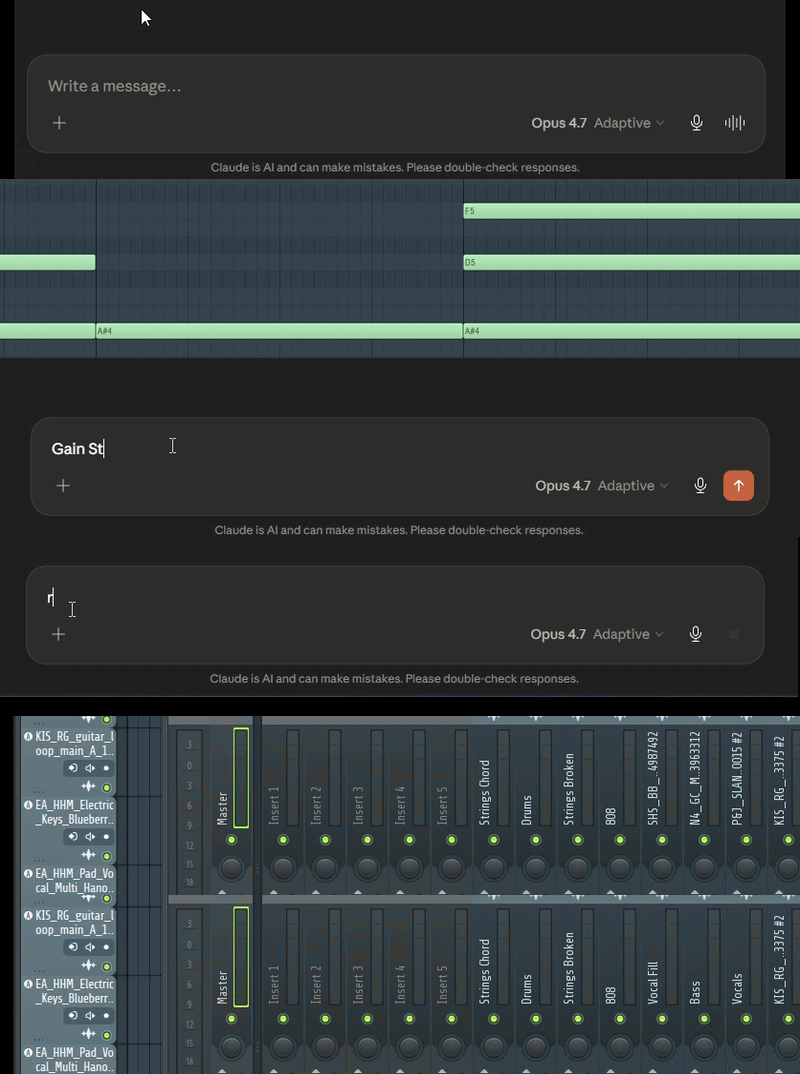
Claude diagnosing and fixing a mix in FL Studio through natural language.
Overview
flstudio-mcp is a Model Context Protocol (MCP) server that lets Claude Desktop drive FL Studio 2025 directly — the mixer, plugins, piano roll, routing, and project — from plain-language requests. Ask for a mix diagnosis, a vocal chain, a chord progression in a particular scale, or a full arrangement, and Claude carries it out through FL's scripting API and a set of calibrated, safety-checked tools.
It is genre- and producer-agnostic: nothing about it assumes a particular style of music.
Quickstart
scripts\install_windows.bat        :: controller + server + note bridge
fl-studio-mcp-daemon               :: start the bridge, keep it running
./scripts/install_macos.sh         # macOS: controller + server + note bridge
fl-studio-mcp-daemon               # start the bridge, keep it running
Wire the two virtual MIDI ports in FL (loopMIDI on Windows, IAC Driver on
macOS), arm MCP_Apply once in the piano roll, then ask Claude in plain
language:
"Scan my mix and tell me what's wrong." — "Set up a vocal chain from my plugins." — "Export this arrangement to MIDI."
Full setup is below.
Capabilities
Mixing & diagnosis
- Mix Doctor — scans the whole mix and reports concrete problems (clipping, low headroom, level imbalance, missing high-pass, ungrouped related tracks, overlapping EQ boosts), each with the exact evidence and a proposed fix. Fixes are applied one at a time, only on approval, through a snapshot → write → readback → rollback safety layer. Master clipping is resolved by trimming the contributing source tracks rather than pulling the master.
- Full-song peak watch — holds a running peak per track across playback, so level decisions are based on the loudest moment of the actual song, not a single instant.
- Calibrated processing intents — musical EQ, compression, reverb, and delay moves mapped to real plugin parameters (native and third-party), each applied as one reversible change.
- Level-aware compression — sets thresholds relative to a track's measured level during playback.
- Gain staging — proposes per-track trims toward a healthy level with proper master headroom.
- Reference match — compares your mix's level and tonal balance against a reference track.
- Bulk track control — solo or mute a whole group (drums, vocals, …) in one step, with a one-call reset.
- Track & channel coloring — color a track, a channel, or a whole group (drums, vocals, …) by color name or hex, reversible like every other change.
Plugin & preset control
- Read and set plugin parameters by name, on native and third-party plugins (the parameter list is resolved live).
- Chain suggestions and preset recommendations drawn from your actual installed library — read directly from FL's plugin database and preset folders on disk, so recommendations are limited to what you own.
Composition
- Multi-track MIDI export — generate a complete arrangement as a standard MIDI file to import.
- Multi-pattern arrangement — create, name, clone, and mark sections.
- Note and chord writing into the piano roll, with quantize to a grid (for new notes and existing ones).
- Composition in any scale or mode — Western modes, pentatonic, ragas, maqam, and beyond — through the scale composer, where Claude supplies the notes for the requested scale.
Audio analysis
- Tempo and key estimation from an audio file.
- Melody-to-MIDI transcription (CREPE pitch tracking, with a lighter fallback).
The server exposes 67 tools across 14 categories, plus 6 live resources (project, mixer, transport, channels, patterns, status) that Claude can read directly.
What sets it apart
flstudio-mcp is built as a mixing and production assistant, not only a note sender. It diagnoses and repairs a whole mix, makes decisions from real measured levels rather than guesswork, and is aware of your actual plugin and preset library when it makes suggestions. Every change that touches the project is shown before it is applied, logged, and reversible.
Limitations
These are properties of FL Studio's scripting API, stated plainly:
- Plugins, audio files, and rendering are UI-only. FL's API cannot load a plugin, load an audio file, or render audio. The plugin and preset tools therefore suggest — you load the chosen plugin or preset, and Claude then configures it. Audio export is done manually (File > Export); Claude can analyze the rendered file afterward.
- Note writing is armed once per session. A generated pyscript writes notes into the piano roll; FL exposes no API to run a pyscript, so you run "MCP_Apply" once from the piano roll's scripting menu at the start of a session.
- Micro-tonal and gamaka-heavy music is approximated. Scales with intervals smaller than a semitone (e.g. Arabic maqam) are rounded to the nearest semitone, and traditions built on gamaka/ornamentation (e.g. Carnatic) get the scale framework — the correct swaras and intervals — not gamaka or micro-tonal rendering. That's a limit of 12-tone MIDI, not of the tools.
Requirements
- Windows 10/11 (tested on Windows 11) or macOS
- FL Studio 2025 or newer
- Claude Desktop (or any MCP client)
- Python 3.10+
- Virtual MIDI ports:
- Windows: loopMIDI (download)
- macOS: the built-in IAC Driver
- Optional: ffmpeg on PATH (for MP3 analysis)
Linux is not yet supported — contributions welcome.
Setup
-
Create two virtual MIDI ports, named exactly
FLStudioMCP RXandFLStudioMCP TX.Windows: create both ports in loopMIDI.
macOS:
- Open Audio MIDI Setup.
- Choose Window > Show MIDI Studio.
- Double-click IAC Driver.
- Enable Device is online.
- Create or rename two ports exactly:
FLStudioMCP RXFLStudioMCP TX
-
Install the controller script and server:
Windows:
git clone https://github.com/rosasynthesiz/flstudio-mcp
cd flstudio-mcp
scripts\install_windows.bat
macOS:
git clone https://github.com/rosasynthesiz/flstudio-mcp
cd flstudio-mcp
chmod +x scripts/install_macos.sh
./scripts/install_macos.sh
This copies the controller script, seeds the note-bridge pyscript (
MCP_Apply), installs the server, and checks that your virtual MIDI ports exist. For audio features, add the optional extras:pip install -e ".[audio]" pip install -e ".[audio,audio-accurate]" -
Configure FL Studio — Options > MIDI Settings:
- Enable
FLStudioMCP RXas an input, set its controller type to FLStudioMCP, and give it a port number. - Enable
FLStudioMCP TXas an output with the same port number. - View > Script output should show
[FLStudioMCP] Ready.
- Enable
-
Start the bridge daemon (recommended) so the MIDI port is held by a stable process:
fl-studio-mcp-daemon -
Register the server with Claude Desktop:
Windows:
%APPDATA%\Claude\claude_desktop_config.jsonmacOS:
~/Library/Application Support/Claude/claude_desktop_config.json{ "mcpServers": { "fl-studio": { "command": "fl-studio-mcp", "env": { "FLSTUDIO_MCP_TRANSPORT": "tcp" } } } }tcproutes through the daemon, which works regardless of how Claude Desktop launches the server. Omit the env var to let the server open the MIDI ports directly instead. -
Arm the note bridge (per session) — open the piano roll and run MCP_Apply once from its scripting menu, so note-writing works.
On macOS, the note bridge re-triggers the armed script with
Cmd+Opt+Y. Grant Accessibility permission to the app running the MCP server or daemon, for example Terminal, iTerm, Claude Desktop, or Cursor: System Settings > Privacy & Security > Accessibility.
Verify the connection by asking Claude to call fl_ping.
Troubleshooting
| Symptom | Fix |
|---|---|
| Virtual MIDI ports not found / not detected | The two ports must be named exactly FLStudioMCP RX and FLStudioMCP TX. Recreate them in loopMIDI (Windows) or IAC Driver (macOS), then re-run the installer. |
No [FLStudioMCP] Ready in FL's Script output | The controller isn't registered: set the FLStudioMCP RX input's Controller type to FLStudioMCP in MIDI Settings, confirm device_FLStudioMCP.py is in Settings\Hardware\FLStudioMCP\, then fully restart FL Studio. |
Claude can't reach FL / fl_ping fails | Make sure the daemon is running (fl-studio-mcp-daemon); check the transport matches (FLSTUDIO_MCP_TRANSPORT=tcp uses the daemon, unset uses direct MIDI); restart Claude Desktop after editing its config. |
| Note-writing does nothing | Run MCP_Apply once from the piano roll's scripting menu this session — it arms the note bridge. |
| macOS note-trigger fails | Grant Accessibility permission to the app running the MCP server or daemon, then click the FL Piano roll and try Cmd+Opt+Y. |
| Audio tools error or are unavailable | Install the optional extras: pip install -e ".[audio]" (or ".[audio,audio-accurate]"). |
Usage examples
Plain-language prompts:
- "Scan my mix and tell me what's wrong."
- "Set up a vocal chain on the lead vocal using my plugins."
- "Suggest a vintage bass preset from my Serum library."
- "Compose an 8-bar melody in D Dorian and write it to the selected channel."
- "Export this arrangement to a MIDI file."
- "What tempo and key is this track?" (on an audio file)
Architecture
A thin controller script runs inside FL Studio and returns only cheap, raw data; all judgement — diagnosis, calibration, planning — happens server-side. A standalone daemon owns the MIDI port so the server works regardless of how the MCP client is launched. Note authoring uses a generated pyscript bridge: the daemon re-triggers the armed MCP_Apply script with the platform run-last-script shortcut after a brief window force-focus. Every project-modifying tool routes through a snapshot → write → readback → rollback safety layer backed by a persisted change log.
Design notes and findings are in docs/.
License
MIT — see LICENSE.
Status & contributing
Beta — the public 1.0 release. Windows and macOS are supported; Linux contributions are welcome. Issues and pull requests: github.com/rosasynthesiz/flstudio-mcp.
<!-- mcp-name: io.github.rosasynthesiz/flstudio-mcp -->Related MCP servers

MCP server for encrypted SQLite databases (SQLCipher 4) - Works with MoneyMoney, KeePass and more
MCP server for SQLCipher 4 encrypted SQLite databases with full CRUD operations and query support

MCP server for letmepost.dev. Publish across 8 social platforms from any agent.

Create interactive web apps, games, and 3D scenes using Rosh — a plain-English language

io.github.roshunsunder/filesift
Local file search for AI agents — semantic + keyword indexing over your codebase.

Scan code for Korean compliance risks — PIPA/개인정보보호법, Network Act, Credit Info. Not legal advice.