Memento MCP Server
io.github.scrypster/memento
Persistent local-first knowledge graph for AI tools — remember decisions and context across sessions without cloud or API keys.
What is the Memento MCP server?
Memento is an MCP server that gives AI tools like Claude and Cursor persistent memory across sessions. It builds a local knowledge graph from conversations, extracting entities and relationships automatically, and provides hybrid search (full-text + semantic) so your AI recalls context without re-explaining. Everything runs on your machine with no cloud or subscriptions required.
Memento solves the problem of AI tools starting fresh every session by maintaining a structured knowledge graph of decisions, entities, and relationships. It runs locally using SQLite or PostgreSQL, integrates with any MCP-compatible AI client, and uses Ollama (or optional OpenAI/Anthropic) for entity extraction and embeddings. Your AI can now recall past decisions, architectural choices, and project context automatically — no manual tagging or context-window tricks needed.
How to install Memento
Copy-paste configuration for popular MCP clients.
Tools & capabilities
Tools this server exposes to the agent.
store_memory— Persist a decision or piece of context with async enrichment; returns in <10msrecall_memory— Retrieve memories by ID, natural-language query, or paginated list with filtersfind_related— Hybrid search combining full-text, semantic vector, and RRF rankingupdate_memory— Edit content, tags, or metadata of an existing memoryforget_memory— Soft-delete or hard-delete a memorytraverse_memory_graph— Follow entity relationships to discover contextually connected memories via multi-hop BFSdetect_contradictions— Find conflicting relationships, superseded memories, and temporal impossibilitiesexplain_reasoning— Surface why specific memories were retrieved for a queryget_session_context— Retrieve recent memories grouped by topic to understand where you left offupdate_memory_state— Move memories through lifecycle states: planning → active → paused/blocked/completed/cancelled → archivedevolve_memory— Create a new version that supersedes an old one while preserving full historyconsolidate_memories— LLM-assisted merge of multiple related memories into one coherent recordget_evolution_chain— View the full version history of a memory from original to latestrestore_memory— Recover a soft-deleted memorylist_deleted_memories— Browse soft-deleted memories that can still be restoredretry_enrichment— Re-run entity extraction on a memory that previously failedcreate_project— Create a project memory with optional pre-created phasesadd_project_item— Add epics, phases, tasks, steps, or milestones under a projectget_project_tree— Retrieve the full nested hierarchy of a projectlist_projects— List all projects, optionally filtered by lifecycle state
Use cases
- Store architectural decisions and technical choices so your AI recalls them in future sessions without re-explaining
- Build a team knowledge graph by pointing multiple AI tools at the same Memento instance, making shared decisions and conventions queryable by anyone
- Search across past conversations using hybrid full-text and semantic search to find related context and contradictions
- Track project progress and decisions through lifecycle states (planning → active → completed) with automatic decay scoring for stale context
- Consolidate related memories into coherent records and view the full evolution history of decisions over time
Memento MCP server FAQ
Memento is an MCP server that gives AI tools persistent memory across sessions. It runs locally on your machine, builds a knowledge graph from conversations, and lets your AI recall decisions and context without cloud APIs or subscriptions.
Yes. Memento is MIT-licensed open-source software. It runs entirely on your machine using SQLite (default) or PostgreSQL, with local Ollama for extraction — no API costs or subscriptions required.
Run `./launch.sh` in the cloned repo — it detects your environment, builds everything, and prints the exact copy-paste command to connect your AI tool. For Claude Desktop, download the config from the web UI at http://localhost:6363/integrations and drop it in ~/Library/Application Support/Claude/.
No. Memento uses local Ollama by default (zero API keys). You can optionally swap to OpenAI or Anthropic for stronger extraction, but it's entirely optional and per-connection.
SQLite (default, zero dependencies) for personal use, or PostgreSQL with pgvector for team/production deployments. Both support hybrid search (full-text + semantic vector).
Yes. Point your whole team's AI tools at the same PostgreSQL database. Memories are tagged with who created them, and you can query by creator. Personal context stays separate; shared architectural decisions become team knowledge.
README (reference)
Source of truth, from the repository.
Memento
Give your AI tools a persistent memory — so every session starts where the last one left off.





Your AI starts fresh every session. Memento fixes that.
It runs on your machine, connects to any MCP-compatible AI tool, and builds a persistent knowledge graph from your conversations — entities, relationships, decisions, and context that survive every session restart.
No cloud. No API keys required. No subscriptions. Your data stays on your machine.
Quick Start
Prerequisites: Docker — or — Go 1.23+ + Node.js 18+ + Ollama
git clone https://github.com/scrypster/memento.git
cd memento
./launch.sh
The script detects your environment, runs preflight checks, builds everything, and prints the exact command to connect your AI tool at the end. First run downloads Ollama models (~5 GB). After that, starts in seconds.
Your first memory
Once connected, try this in Claude:
"We're using PostgreSQL — chose it for pgvector support."
Close the tab. Open a new session. Ask:
"What database are we using?"
Your AI already knows. No re-explaining. No context window tricks.
Close the tab. Open a new session.
You: "What database are we using?"

→ Your AI already knows: "PostgreSQL — you chose it for pgvector support."
  No re-explaining. No context window tricks. It just remembers.
Behind the scenes, Memento built this automatically:
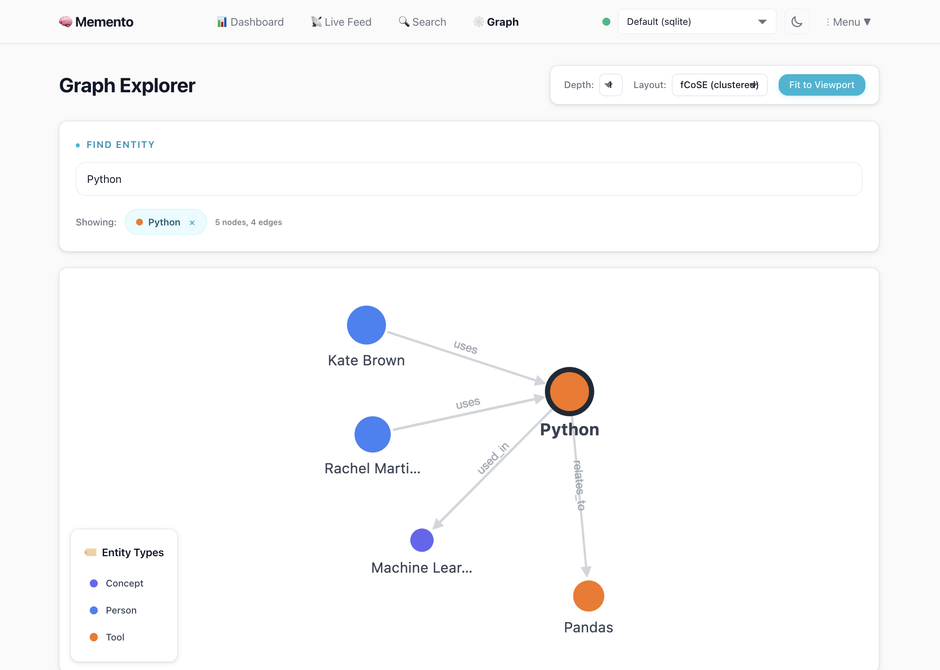
Every entity gets wired into a knowledge graph — people, tools, projects, decisions — with confidence scores and timestamps.
Connect Your Tools
Open http://localhost:6363/integrations — the web UI generates configs, download buttons, and connection testing for every client:
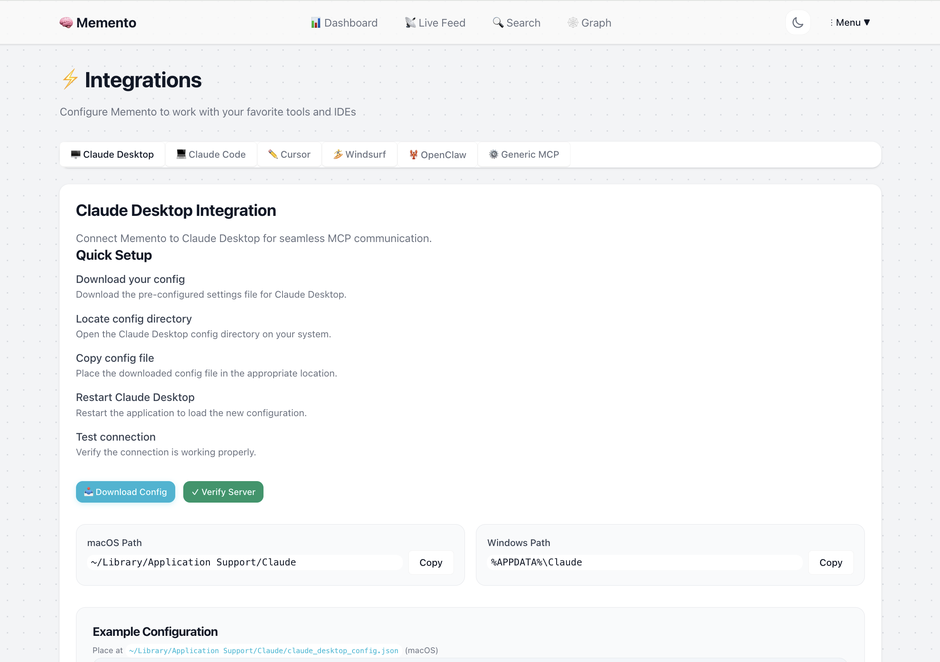
| Client | Setup |
|---|---|
| Claude Code | Run ./launch.sh — it prints the exact copy-paste command at the end. Example form: claude mcp add memento -- `pwd`/memento-mcp |
| Claude Desktop | Download config → drop in ~/Library/Application Support/Claude/ |
| Cursor | Download config → drop in .cursor/mcp.json + optional Cursor Rules file |
| Windsurf | Download config → drop in .codeium/windsurf/mcp_config.json |
| OpenClaw | Add to ~/.openclaw/mcp.json under mcpServers — same pattern as Claude Desktop |
| Generic MCP | Any MCP client — same pattern: command path + MEMENTO_DATA_PATH env var |
The integrations page generates ready-to-paste configs with your actual binary paths and data directories. It also has connection testing, troubleshooting, and per-project workspace scoping.
Make Claude Code proactive (recommended)
The MCP connection makes tools available, but Claude won't use them automatically. Add this to ~/.claude/CLAUDE.md to make Claude store decisions and recall context without being asked:
## Memento MCP — Persistent Memory

The `memento` MCP server provides persistent cross-session memory. Use these tools proactively — don't wait to be asked.

**Store** (`store_memory`) when the user:
- States a preference or working style ("I prefer X", "always use Y format")
- Makes an architectural or technical decision
- Establishes project context that should survive session restarts
- Explicitly says "remember this" or similar

**Recall** (`recall_memory` or `find_related`) when:
- Starting a session for a known project — query for relevant context before diving in
- About to make a recommendation — check for existing preferences first
- The user asks about past decisions, choices, or "what did we decide about X"
- Something seems like it may have been discussed in a prior session

**Don't store:** transient debug output, in-progress exploration, or anything session-specific that won't matter next time.

Memories are searchable immediately after storing. Enrichment (entity/relationship extraction) runs asynchronously via local Ollama.
The web UI at Integrations → Claude Code → Make it proactive generates a version with your specific paths and connection settings, plus a download button.
See the full integration guides: Claude Code | Claude Desktop | Cursor & Windsurf | OpenClaw
Team memory — shared knowledge across your whole engineering team
Point everyone's AI tools at the same Memento instance and your team's decisions, conventions, and context become shared knowledge — queryable by anyone, attributable to anyone.
Every memory is tagged with who stored it. Memento auto-detects this from your git config, or you can set it explicitly:
export MEMENTO_USER=alice # or set in your shell profile
Or in your MCP config:
"env": { "MEMENTO_USER": "alice" }
Once set, you can ask:
What did Bob decide about the auth service this week?
recall_memory(created_by="bob", created_after="2024-01-14T00:00:00Z")
Setup: Each teammate runs Memento pointing at the same PostgreSQL database. Personal context stays personal (use a separate personal connection). Shared architectural decisions, conventions, and project context go into the shared connection.
See the team setup guide for full PostgreSQL configuration.
What Your AI Gets
Once connected, your AI has 20 tools it can call — no prompting required:
Core memory operations
| Tool | What it does |
|---|---|
store_memory | Persist a decision or piece of context — enrichment happens async, returns in <10ms |
recall_memory | Retrieve memories by ID, natural-language query, or paginated list with filters |
find_related | Hybrid search: full-text + semantic vector + RRF ranking |
update_memory | Edit content, tags, or metadata of an existing memory |
forget_memory | Soft-delete a memory (with grace period) or hard-delete permanently |
Search and intelligence
| Tool | What it does |
|---|---|
traverse_memory_graph | Follow entity relationships to discover contextually connected memories (multi-hop BFS) |
detect_contradictions | Find conflicting relationships, superseded-but-active memories, temporal impossibilities |
explain_reasoning | Surface why specific memories were retrieved for a query |
get_session_context | "Where did I leave off?" — recent memories grouped by topic |
Memory lifecycle
| Tool | What it does |
|---|---|
update_memory_state | Move through lifecycle: planning → active → paused / blocked / completed → archived |
evolve_memory | Create a new version that supersedes the old one — preserves full history |
consolidate_memories | LLM-assisted merge of multiple related memories into one coherent record |
get_evolution_chain | View the full version history of a memory from original to latest |
Soft delete and recovery
| Tool | What it does |
|---|---|
restore_memory | Recover a soft-deleted memory |
list_deleted_memories | Browse soft-deleted memories that can still be restored |
retry_enrichment | Re-run entity extraction on a memory that previously failed |
Project management
| Tool | What it does |
|---|---|
create_project | Create a project memory with optional pre-created phases |
add_project_item | Add epics, phases, tasks, steps, or milestones under a project |
get_project_tree | Retrieve the full nested hierarchy of a project |
list_projects | List all projects, optionally filtered by lifecycle state |
Store returns in <10ms. Enrichment — entity extraction, relationship mapping, embedding generation — runs asynchronously. Your AI is never blocked.
What It Looks Like
Auto-extracted entities — zero manual input
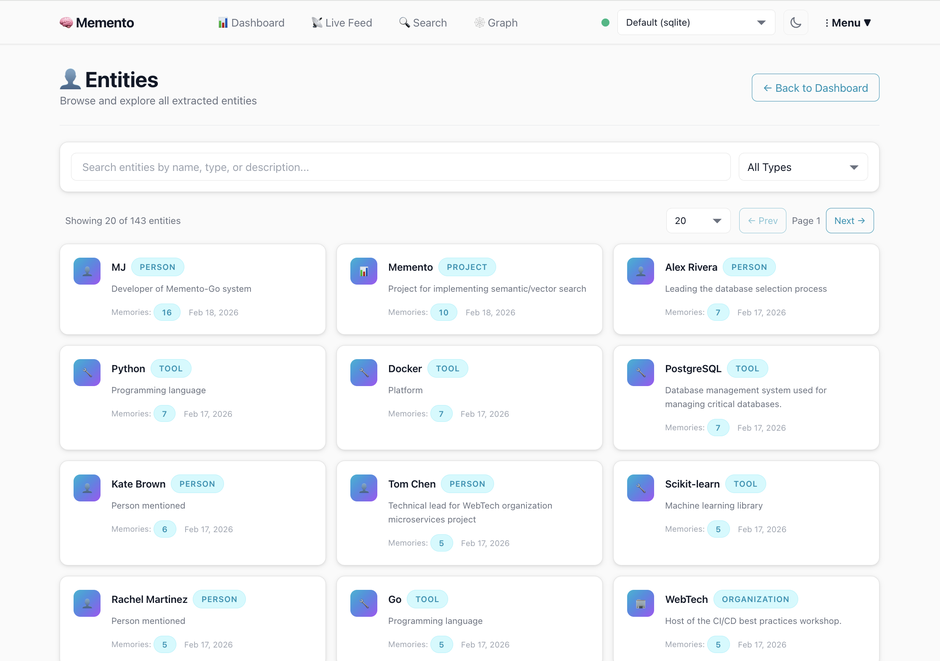
People, projects, tools, organizations, languages, APIs — extracted automatically from your AI conversations. No tagging required.
Relationship intelligence
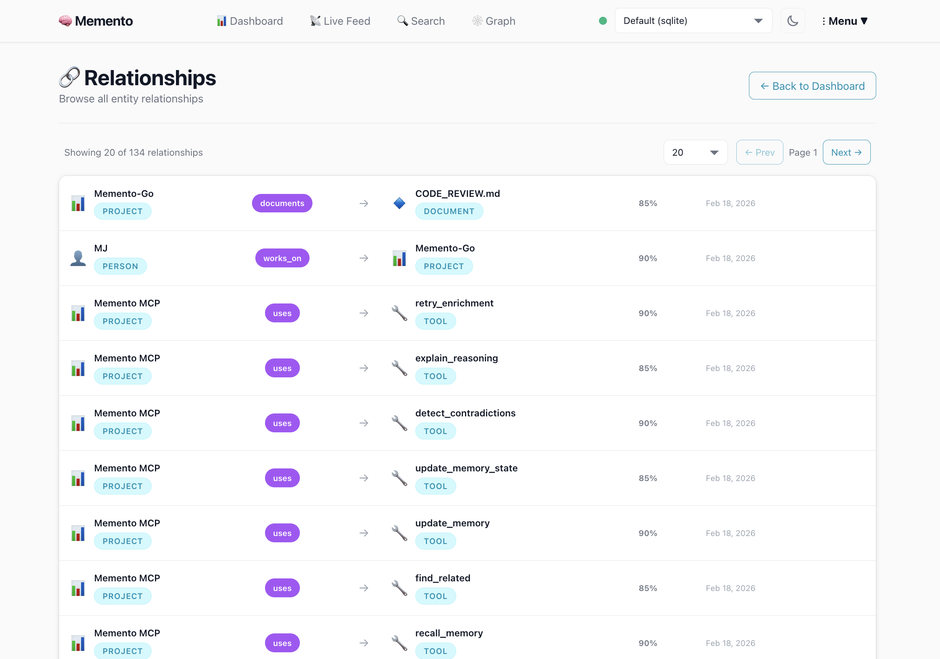
Your AI knows who works_on what, which tools depend_on which services, and what the current state of each decision is — with confidence scores and timestamps.
The dashboard
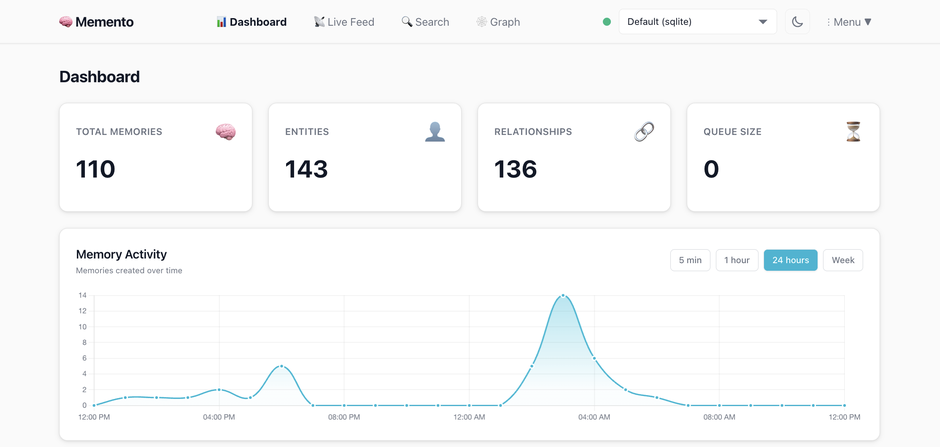
Live enrichment queue, entity browser, relationship explorer, and graph visualizer — all in the web UI.
Why Memento
vs. Mem0
Mem0 requires cloud API keys and a paid plan for production use. Memento runs entirely on your machine with Ollama — no API keys, no cloud, no per-memory pricing. Memento also ships a full web UI with graph visualization, entity browser, and one-click integration setup. Mem0 has no web interface.
vs. Zep / Graphiti
Zep requires Neo4j or FalkorDB for its knowledge graph. Memento uses SQLite (zero deps) or PostgreSQL — no graph database to manage. Zep's open-source version is limited; the full feature set requires Zep Cloud.
vs. Built-in AI memory (ChatGPT, Claude)
Built-in memory is a flat list of facts with no relationships, no search, no graph, and no way to export or control your data. Memento gives you a structured knowledge graph you own, with hybrid search and full lifecycle management.
vs. Writing docs or wikis
Memento captures context automatically as you work — no manual effort. It builds relationships between concepts instead of isolated pages, and it's designed to be queried by LLMs, not just humans.
How It Works
┌─────────────────────────────────────────────────────┐
│  Your AI tool (Cursor / Claude Code / Windsurf / …) │
└─────────────────────────┬───────────────────────────┘
                          │  MCP (JSON-RPC 2.0 over stdio)
┌─────────────────────────▼───────────────────────────┐
│                   MCP Server                        │
│   store · recall · find_related · contradictions…   │
└─────────────────────────┬───────────────────────────┘
                          │
┌─────────────────────────▼───────────────────────────┐
│                Memory Engine                        │
│  ┌──────────────────────────────────────────────┐  │
│  │           Enrichment Pipeline                │  │
│  │  entity extraction → relationship mapping    │  │
│  │  → semantic embeddings → contradiction check │  │
│  └──────────────────────────────────────────────┘  │
└──────────────────┬──────────────────────────────────┘
                   │
       ┌───────────┴───────────┐
       │                       │
┌──────▼──────┐       ┌────────▼────────┐
│   SQLite    │       │  PostgreSQL     │
│  FTS5 index │       │  + pgvector     │
│  (default)  │       │  (scale-out)    │
└─────────────┘       └─────────────────┘
Features
Runs entirely offline
- Ollama runs locally — default setup never makes an external network call
- SQLite database is a single file you own:
~/.memento/memento.db - Swap to OpenAI or Anthropic when you want stronger extraction — opt-in only
Hybrid search
- FTS5 full-text + semantic vector search fused with Reciprocal Rank Fusion (RRF)
- Finds what you mean, not just what you typed
Knowledge graph
- Extracts 22 entity types: people, projects, tools, languages, APIs, databases, concepts, and more
- Maps 44 relationship types with confidence scores
- Interactive graph explorer in the web UI
Memory lifecycle
- Lifecycle states:
planning → active → paused | blocked | completed | cancelled → archived - Decay scoring — stale context loses ranking weight naturally
- Access-frequency boosting — memories you recall often stay prominent
Production-ready backends
- SQLite (zero deps, CGo-free) for personal/local use
- PostgreSQL + pgvector + ivfflat index for team or production deployments
Multi-connection isolation
- Separate memory namespaces per project, client, or workspace
- Route MCP calls to different connections with a single env var
Web UI
- Dashboard with live enrichment queue, entity browser, relationship explorer, graph visualizer
- One-click integration setup for every supported client
- Connection testing, CLAUDE.md generation, Cursor Rules download
- Tracks unrecognized LLM entity types so you can expand your taxonomy over time
LLM Providers
| Provider | Setup | Use when |
|---|---|---|
| Ollama (default) | docker compose up — automatic | Privacy first, no API costs, fully offline |
| OpenAI | Set MEMENTO_LLM_PROVIDER=openai + API key | Stronger extraction quality, cloud OK |
| Anthropic | Set MEMENTO_LLM_PROVIDER=anthropic + API key | Strongest reasoning, cloud OK |
Switch providers per connection — different projects can use different LLMs.
Configuration
| Variable | Default | Description |
|---|---|---|
MEMENTO_PORT | 6363 | Web UI and REST API port |
MEMENTO_STORAGE_ENGINE | sqlite | sqlite or postgres |
MEMENTO_DATA_PATH | ./data | SQLite database directory |
MEMENTO_LLM_PROVIDER | ollama | ollama, openai, or anthropic |
MEMENTO_OLLAMA_URL | http://localhost:11434 | Ollama API endpoint |
MEMENTO_OLLAMA_MODEL | qwen2.5:7b | Extraction model |
MEMENTO_EMBEDDING_MODEL | nomic-embed-text | Embedding model |
MEMENTO_OPENAI_API_KEY | — | OpenAI API key |
MEMENTO_ANTHROPIC_API_KEY | — | Anthropic API key |
MEMENTO_DEFAULT_CONNECTION | — | Default connection name for multi-workspace isolation |
MEMENTO_CONNECTIONS_CONFIG | — | Path to connections.json for multi-workspace setup |
MEMENTO_BACKUP_ENABLED | false | Automated backups |
MEMENTO_BACKUP_INTERVAL | 24h | Backup frequency |
PostgreSQL
docker compose --profile postgres up -d
MEMENTO_STORAGE_ENGINE=postgres
MEMENTO_DATABASE_URL=postgres://memento:memento_dev_password@localhost:5433/memento
Project Structure
memento/
├── cmd/
│   ├── memento-mcp/        # MCP server binary — connect this to your AI client
│   ├── memento-web/        # Web dashboard — entity browser, graph explorer, settings
│   └── memento-setup/      # Interactive setup wizard
├── internal/
│   ├── api/mcp/            # MCP JSON-RPC server — 20 tool handlers
│   ├── engine/             # Memory engine, enrichment pipeline, async workers
│   ├── llm/                # Ollama, OpenAI, Anthropic + circuit breaker
│   └── storage/
│       ├── sqlite/         # SQLite with FTS5 and hybrid vector search
│       └── postgres/       # PostgreSQL with pgvector and ivfflat index
├── web/
│   ├── handlers/           # HTMX handlers
│   ├── templates/          # Dashboard, graph, entities, settings, integrations
│   └── static/templates/   # MCP config snippets generated per client
├── docs/
│   └── integrations/       # Per-client integration guides
├── migrations/             # SQL schema migrations
└── docker-compose.yml
Contributing
Issues and PRs welcome. Open an issue before starting significant work.
go test ./...

go build -o memento-mcp ./cmd/memento-mcp/
go build -o memento-web ./cmd/memento-web/
go build -o memento-setup ./cmd/memento-setup/
License
MIT — see LICENSE.
Built by
MJ Bonanno — software architect and founder of Scrypster.
Remember everything. Forget nothing. Unlike Leonard Shelby, your context is here to stay — searchable, versioned, and backed by a knowledge graph that never fades.
Related MCP servers

Spending controls for AI agents: per-agent budgets, vendor allowlists, full audit trail.
View repository →
fabric-dw
MCP server for administering, querying, and optimizing Microsoft Fabric Data Warehouses and SQL Analytics Endpoints.

Korea Nationwide Data
Nationwide Korea: bus stops in 138 cities, 30-year climate normals, tourism (KR/EN).
Korea Ocean Leisure
Korea tide times (42 stations) plus fishing, mudflat, beach, surf and scuba forecasts.

Promptlint MCP
Static linter for AI prompts: contradictions, redundancy, ambiguity, and fluff.

Publish content to the web by emailing POST@abovo.co. No API key, no signup. SMTP is the API.