Talivia Revenue Analytics MCP Server
io.github.talivia-group/agent
Revenue-first analytics that AI agents can install, verify, and connect to your payment provider.
What is the Talivia Revenue Analytics MCP server?
The Talivia Revenue Analytics MCP server connects AI agents to Talivia's revenue-first analytics platform, enabling agents to install tracking, verify data ingestion, and set up payment attribution within your project. It provides framework-aware setup guidance and live verification that analytics and revenue tracking are working end-to-end.
Talivia shows which traffic sources, campaigns, pages, and customer journeys actually convert to revenue. The MCP server lets coding agents automate the entire setup process—finding or creating websites, installing framework-specific trackers, verifying real events arrive, connecting payment providers, and confirming attribution is ready—without manual documentation jumping or copy-paste snippets.
How to install Talivia Revenue Analytics
Copy-paste configuration for popular MCP clients.
TALIVIA_API_KEYsecretOptional. Run `talivia setup --agent <name>` and check in after browser approval to store a local credential.
Tools & capabilities
Tools this server exposes to the agent.
Account— Check the connected Talivia account and available capabilitiesWebsites— List existing websites or create one after user approvalTracking— Get the exact tracker and a framework-specific installation planVerification— Confirm that real analytics events are reaching TaliviaRevenue— Start a secure payment connection and check attribution readinessCheckout— Get provider-specific guidance for preserving visitor and session attribution
Use cases
- Set up revenue analytics for a SaaS launch or indie product with agent-driven installation and verification
- Connect payment provider attribution to understand which traffic sources and campaigns drive paying customers
- Verify that analytics tracking is working in production before declaring setup complete
- Install framework-specific trackers (Next.js, React/Vite, Astro, HTML) through an agent's native coding tools
- Track customer journeys from referrer and session through to individual payments in one workspace
Talivia Revenue Analytics MCP server FAQ
Talivia is a revenue-first analytics platform that connects visitor traffic to payment revenue, showing which referrers, campaigns, pages, and customer journeys actually convert to paying customers.
Yes, you can start free at talivia.com/login. Talivia Cloud provides the managed service and agent connection.
Use the hosted MCP endpoint (https://talivia.com/mcp) with Claude Code via `claude mcp add --transport http talivia https://talivia.com/mcp`, or the npm package (@talivia/agent) for local stdio servers. Talivia opens in your browser for sign-in and permission approval.
Yes, you need a Talivia account. Authentication and consent happen in your browser, not through chat. MCP access is scoped to permissions you approve.
Talivia connects to supported payment providers or offers a Manual Payment API for custom checkouts. The agent can guide you through the secure payment connection flow.
Yes, Talivia has an open-source version available on GitHub for running revenue analytics on your own infrastructure, though the agent connection is provided by Talivia Cloud.
README (reference)
Source of truth, from the repository.
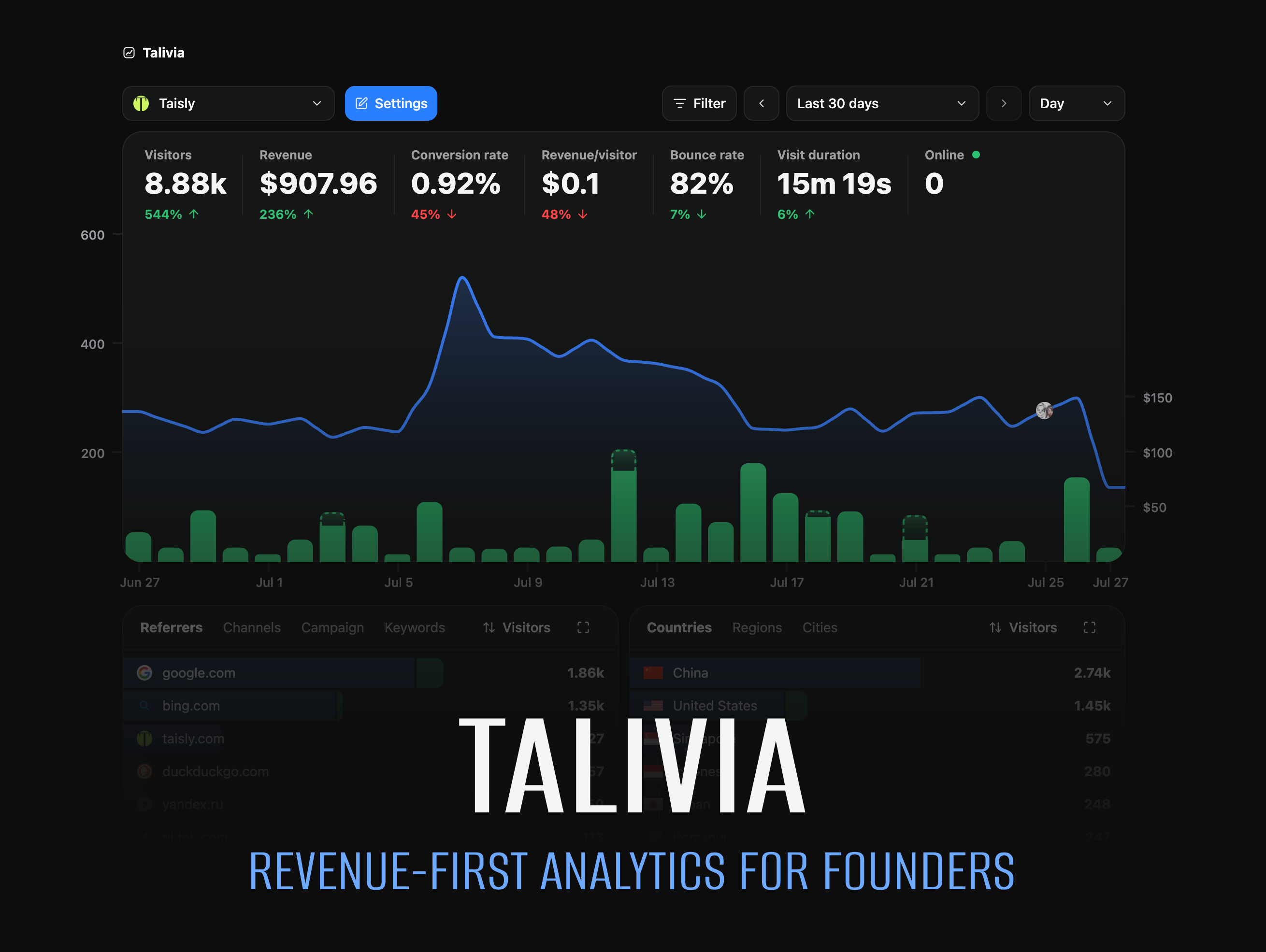
Talivia Agent Kit
Revenue-first website analytics that your AI agent can install, connect, and verify for you.
Talivia shows founders which referrers, campaigns, pages, search keywords, and customer journeys turn visits into revenue. @talivia/agent connects Codex, Claude Code, ChatGPT, OpenClaw, Hermes, and other MCP clients to Talivia so an agent can finish the analytics setup inside your project - not just paste a tracking snippet and hope it works.
Ask your agent to set up Talivia. It can find or create the right website, generate a framework-specific installation plan, add the tracker with its native coding tools, verify that real events are arriving, open a secure payment-provider handoff, and check that revenue attribution is ready.
Start free | Agent Kit | Documentation | npm | GitHub
See which traffic becomes revenue
Most analytics products count visits. Payment dashboards count transactions. Talivia connects the two, so you can answer the questions that matter to a growing product:
- Which referrers, campaigns, and search keywords bring paying customers?
- Which landing pages and customer journeys lead to a purchase?
- How do visitors, conversion rate, revenue per visitor, and revenue change together?
- Which tracked session produced an individual payment?
- Is analytics and checkout attribution actually working in production?
Talivia puts traffic, visitor journeys, events, payment revenue, and attribution in one workspace. Connect a supported payment provider or use the Manual Payment API for a custom checkout.
From one prompt to verified analytics
Give this to a coding agent after connecting Talivia:
Set up Talivia revenue analytics for this project.

1. Connect to my Talivia account and find the correct website.
2. If it does not exist, ask before creating it.
3. Install the Talivia tracker using the right plan for this framework.
4. Build and test the project.
5. Verify that Talivia is receiving real events.
6. Help me connect revenue attribution through Talivia's secure browser flow.
7. Tell me what is working and what still needs attention.
The agent works in your repository. Talivia supplies the exact tracking configuration, secure account workflows, and live verification. Setup is not considered complete merely because code was generated - it is complete when Talivia receives real data.
Why founders and developers use it
- Revenue-first analytics: follow traffic all the way from source and session to payment.
- Less integration work: let an agent navigate the tracker, framework, and checkout setup instead of jumping between documentation pages.
- Real verification: check live ingestion and revenue readiness before declaring the task complete.
- Framework-aware setup: get an installation plan for Next.js, React/Vite, Astro, or plain HTML.
- One account connection: use the same Talivia MCP connection across every website in your account.
- Secure handoffs: approve access and connect payment providers in Talivia's browser UI, not in chat.
Use it for a SaaS launch, indie product, marketing site, developer tool, or any web product where knowing which traffic creates revenue matters more than collecting another pageview count.
Connect Talivia to an AI agent
MCP endpoint
Use the hosted website analytics MCP server when your client supports HTTP MCP and OAuth:
https://talivia.com/mcp
Codex:
codex mcp add talivia --url https://talivia.com/mcp
codex mcp login talivia
Claude Code:
claude mcp add --transport http talivia https://talivia.com/mcp
Talivia opens in your browser for sign-in and permission approval. After that, ask the agent to install or verify Talivia in your project.
npm package
Use the package when an agent expects a local stdio MCP server:
npx -y @talivia/agent setup --agent codex
npx -y @talivia/agent checkin --agent codex
codex mcp add talivia -- npx -y @talivia/agent mcp
Check the connection at any time:
npx -y @talivia/agent status
The package also includes a Codex plugin manifest and SKILL.md, so compatible agents can discover both the Talivia MCP server and the safe setup workflow.
What the agent can do
| Area | Outcome |
|---|---|
| Account | Check the connected Talivia account and available capabilities |
| Websites | List existing websites or create one after user approval |
| Tracking | Get the exact tracker and a framework-specific installation plan |
| Verification | Confirm that real analytics events are reaching Talivia |
| Revenue | Start a secure payment connection and check attribution readiness |
| Checkout | Get provider-specific guidance for preserving visitor and session attribution |
Talivia keeps the product logic on the hosted MCP server, so agents receive the current setup rules without bundling a second analytics implementation into your codebase.
Safe by design
- Talivia authentication and consent happen in your browser.
- MCP access is scoped to the permissions you approve.
- Website permissions are checked on every website-specific action.
- Payment-provider secrets are never requested through chat or MCP tool arguments.
- Connections can be reviewed and revoked in Talivia Settings.
Prefer to self-host? Talivia also has an open-source version for running revenue analytics on your own infrastructure. Talivia Cloud provides the managed service and agent connection described here.
Start with your own traffic
Create a Talivia account, connect an agent, and follow the next visit all the way to the payment.
Related MCP servers

Find fresh, source-backed rare and one-of-one products at independent retailers.
View repository →
Talonic
Extract structured, schema-validated data from PDFs, scans, images, spreadsheets, and forms.

A local-first MCP server that routes development tasks to authoritative project documentation.

io.github.tamasPetki/headless-tracker
Read-only MCP server: your AI sees your crypto portfolio, never your keys. Not financial advice.

Charming
Build personal interactive apps with real URLs and persistent storage, using any AI.
Decrypt .lsa/.lsav files from Xiaomi devices. Upload, status, download, pricing.