io.github.williansaez/abap-adt-mcp MCP Server
io.github.williansaez/abap-adt-mcp
Let Claude read, write, test and check ABAP code on your SAP systems via ADT services.
What is the io.github.williansaez/abap-adt-mcp MCP server?
The abap-adt-mcp MCP server gives Claude, VS Code, Cursor and other MCP hosts access to SAP's ABAP Development Tools (ADT) services, enabling AI-assisted ABAP development on S/4HANA Cloud and on-premise systems. It exposes 173 tools for source code editing, testing, transport management, debugging and static analysis, with built-in policy enforcement to prevent unauthorized writes to production systems.
abap-adt-mcp bridges Claude and other AI models to your SAP development environment. You describe a task in plain language—create a class, fix a bug, run tests, review a transport—and the model picks the right ADT tools in sequence: search, read, edit, activate, test, and report results. Guard rails live in the server itself: a production destination marked read-only refuses every write before it reaches SAP, whatever the host approves. Supports S/4HANA Cloud and on-premise systems with SSO, basic auth, OAuth and certificate-based login.
How to install io.github.williansaez/abap-adt-mcp
Copy-paste configuration for popular MCP clients.
SAP_SYSTEMS_FILEPath to a JSON file mapping destination names to system configs (url, client, authType basic/sso/sso2/oauth, credentials). Recommended; keep the file mode 0600. See systems.example.json
SAP_SYSTEMSsecretInline JSON map of destinations (same shape as SAP_SYSTEMS_FILE). Contains credentials — prefer SAP_SYSTEMS_FILE
SAP_DEFAULT_DESTINATIONDestination name used when a tool call omits `destination` (alternatively mark an entry with "default": true)
SAP_AUTH_TYPEDefault auth type for entries that don't specify one: sso (default), sso2, basic, or oauth
MCP_HTTP_PORTWhen set (1024-65535), serve Streamable HTTP on http://127.0.0.1:<port>/mcp with bearer-token auth instead of stdio
MCP_HTTP_HOSTBind address for the HTTP transport (default 127.0.0.1). Set 0.0.0.0 only inside containers that publish the port
MCP_HTTP_TOKENsecretBearer token for the HTTP transport; auto-generated and written to ~/.abap-adt-mcp/http-token when unset
MCP_HTTP_MAX_SESSIONSMaximum concurrent MCP sessions on the HTTP transport (default 16); further initialize requests get 503
MCP_HTTP_MAX_BODY_BYTESLargest request body the HTTP transport accepts, in bytes (default 4194304); larger bodies are refused with HTTP 413
MCP_HTTP_SESSION_TTL_MINUTESIdle minutes after which an HTTP session (and its SAP sessions/locks) is closed (default 30)
MCP_HTTP_ALLOWED_ORIGINSComma-separated Origin values allowed on the HTTP transport (loopback origins always allowed when bound to loopback; * allows any)
MCP_HTTP_ALLOWED_HOSTSComma-separated Host header values allowed (DNS-rebinding protection; loopback hosts always allowed when bound to loopback)
MCP_EXPORT_ROOTWhen set, exportPackageSources may only write inside this directory
MCP_AUDIT_FILEPath of a JSONL audit trail: one record per tool call (tool, destination, duration, outcome ok/error/denied/unavailable, policy gate, redacted argument summary)
MCP_READ_ONLYSet to 1 to make every destination read-only (server-side; only read-only annotated tools plus login/logout run). Per-destination policies live in systems.json
MCP_ALLOW_DATA_PREVIEWSet to 1 to let tableContents read table and CDS rows on every destination that does not state policy.allowDataPreview itself (reading table data is off by default)
MCP_ALLOW_FREE_SQLSet to 1 to allow runQuery and tableContents with sqlQuery on every destination that does not state policy.allowFreeSql itself (free SQL is off by default; implies table data)
MCP_TOOLSETSToolsets to publish: comma list (core,source,objects,transports,analysis,tests,atc,data,discovery,runtime,refactoring,rap,services,git,debugger,traces) or a preset: all (default) or focused
MCP_DISABLED_TOOLSETSToolsets to hide, comma list (core cannot be disabled)
MCP_MAX_RESPONSE_CHARSCharacter budget for a single tool response before results are paged/truncated (default 40000, minimum 5000). Raise it if your MCP host accepts larger tool outputs
SAP_ALLOW_REENTRANCE_TICKETSet to 1 to enable the reentranceTicket tool (disabled by default: it returns a live SAP logon credential into the conversation)
SAP_URLLegacy single-system mode: base URL of the SAP system, e.g. https://host:44300
SAP_USERLegacy single-system mode: SAP username
SAP_PASSWORDsecretLegacy single-system mode: SAP password
SAP_CLIENTLegacy single-system mode: SAP client number, e.g. 100
SAP_LANGUAGELegacy single-system mode: logon language, e.g. EN
SAP_BROWSER_PATHSSO destinations: path to a Chromium/Chrome/Edge binary for the browser login (auto-detected when unset)
SAP_BROWSER_PROFILE_DIRSSO destinations: directory of the persistent browser profile that keeps the identity-provider session (default ~/.abap-adt-mcp/sso/<host>)
SAP_SSO2_COMMANDLegacy single-system sso2 mode: absolute path to the trusted local ticket provider
SAP_SSO2_ARGSLegacy single-system sso2 mode: JSON array of provider arguments (never put a ticket here)
SAP_SSO2_TIMEOUT_MSLegacy single-system sso2 mode: provider timeout in milliseconds (default 30000; range 1000-300000)
SAP_TLS_INSECURELegacy single-system mode: set to 1 to skip TLS certificate verification for that system only (sandboxes with self-signed certificates)
SAP_OAUTH_TOKEN_URLLegacy single-system mode with SAP_AUTH_TYPE=oauth: OAuth2 token endpoint (client_credentials)
SAP_OAUTH_CLIENT_IDLegacy single-system mode with SAP_AUTH_TYPE=oauth: OAuth2 client id
SAP_OAUTH_CLIENT_SECRETsecretLegacy single-system mode with SAP_AUTH_TYPE=oauth: OAuth2 client secret
SAP_OAUTH_SCOPELegacy single-system mode with SAP_AUTH_TYPE=oauth: optional OAuth2 scope
MCP_PROFILE_GATEPlatform gate for toolsets the destination does not expose (debugger, traces, abapGit, ...): enforce (default, refuse before calling SAP), warn (log only) or off
MCP_SOURCE_CACHE_TTL_SECONDSLifetime of the per-session source cache used by grepPackage, cdsViewInfo and syntaxCheckCode (default 300; 0 keeps entries until logout)
MCP_CACHE_DIRDirectory for the cached SAP cloudification repository used by apiReleaseState (default ~/.abap-adt-mcp/cache)
MCP_API_CLASSIFICATION_FILESExtra classification files for apiReleaseState, comma list: a path inside SAP's cloudification repository (partner/objectClassifications_ACME.json) or an https URL
Tools & capabilities
Tools this server exposes to the agent.
searchObject— Search for ABAP objects by name or patterngetObjectSource— Retrieve source code of an ABAP objectsetObjectSource— Write or modify ABAP source codeeditObjectSource— Edit object source with optional activationunitTestRun— Execute unit tests for a class or packagecreateAtcRun— Run ABAP Test Cockpit (ATC) static analysisatcWorklists— Retrieve ATC findings and worklistsatcQuickfixProposals— Get ATC quickfix suggestionsatcApplyQuickfix— Apply ATC quickfixes automaticallytransportDetails— Show transport request contents and metadatatransportUnifiedDiff— Display unified diff of transport changesresolveTransport— Find or create transport for a changedumps— List short dumps for a user or systemdumpDetails— Retrieve full short dump analysiswhereUsed— Find where an object is referencedsourceTextSearch— Search source code by text patterngrepPackage— Search within a packagecdsViewInfo— Get CDS view metadata and structureobjectStructureElements— List fields and associations of an objectapiReleaseState— Check ABAP Cloud readiness of an object
Use cases
- Create and modify ABAP classes with unit tests in response to natural language requests
- Search and analyze ABAP code across packages to understand dependencies and usage patterns
- Run ATC static analysis and apply quickfixes automatically to improve code quality
- Review and understand short dumps, then propose and implement fixes
- Check ABAP Cloud readiness of custom objects and identify blocking dependencies
- Execute SQL queries and preview table data to validate business logic changes
io.github.williansaez/abap-adt-mcp MCP server FAQ
It is an MCP server that connects Claude, VS Code, Cursor and other MCP hosts to SAP's ABAP Development Tools (ADT). It exposes 173 tools for reading, writing, testing and analyzing ABAP code on S/4HANA Cloud and on-premise systems, with built-in policy enforcement to protect production systems.
Yes. The server is open-source under the MIT license and available on npm as `abap-adt-mcp`. You only need Node.js 22+ and access to your SAP system (the same access you use for Eclipse ADT).
Create `~/.abap-adt-mcp/systems.json` with your SAP system details, then edit Claude Desktop's config file to add the server entry with `npx -y abap-adt-mcp` and environment variables pointing to your systems file. Restart Claude Desktop and it will appear in the tools menu.
Use the same `systems.json` file and register the server via `claude mcp add` (Cursor/Claude Code) or add an entry to `.vscode/mcp.json` (VS Code with Copilot). See docs/HOSTS.md for host-specific instructions.
SSO (browser login, default), basic auth (username/password), OAuth, and certificate-based auth. SSO is recommended for cloud systems; on-premise systems can use basic auth with credentials stored in environment variables.
Yes, but only with a read-only policy. Mark a destination `readOnly: true` and the server enforces it before any SAP call, preventing accidental writes. Recommended: use it on development and test systems; if production access is needed, apply the PRD policy template from the setup guide.
README (reference)
Source of truth, from the repository.
abap-adt-mcp
Let Claude read, write, test and check ABAP code on your SAP systems.
English · Português (Brasil) · Deutsch · Project site





You type a sentence in Claude. You get back an activated class, green unit tests and a transport number. abap-adt-mcp is the server in between: a Model Context Protocol server that gives Claude Desktop, Claude Code, VS Code or any other MCP host the same ADT services Eclipse uses, on every SAP system you configure, S/4HANA Cloud and on-prem alike. 173 tools, one process, and guard rails the server enforces itself: a destination marked read-only refuses every write before it reaches SAP, whatever the host approves.
See it in motion. The project site has seven short films, the setup in three steps and what to ask the model.
Before you connect a production system
- The model acts as your SAP user and can do nothing Eclipse would refuse you. What it reads (source, dumps, table rows where you open them) is sent to the model.
- A destination without a
policyblock is writable in every package your user may edit; table data stays closed until you open it.- Recommended: development and test systems only. If a production destination must exist, give it the
PRDpolicy of step 4: the server enforces it before any SAP call, whatever the host approves, so a careless prompt cannot write where the policy forbids it (For administrators).
See it work
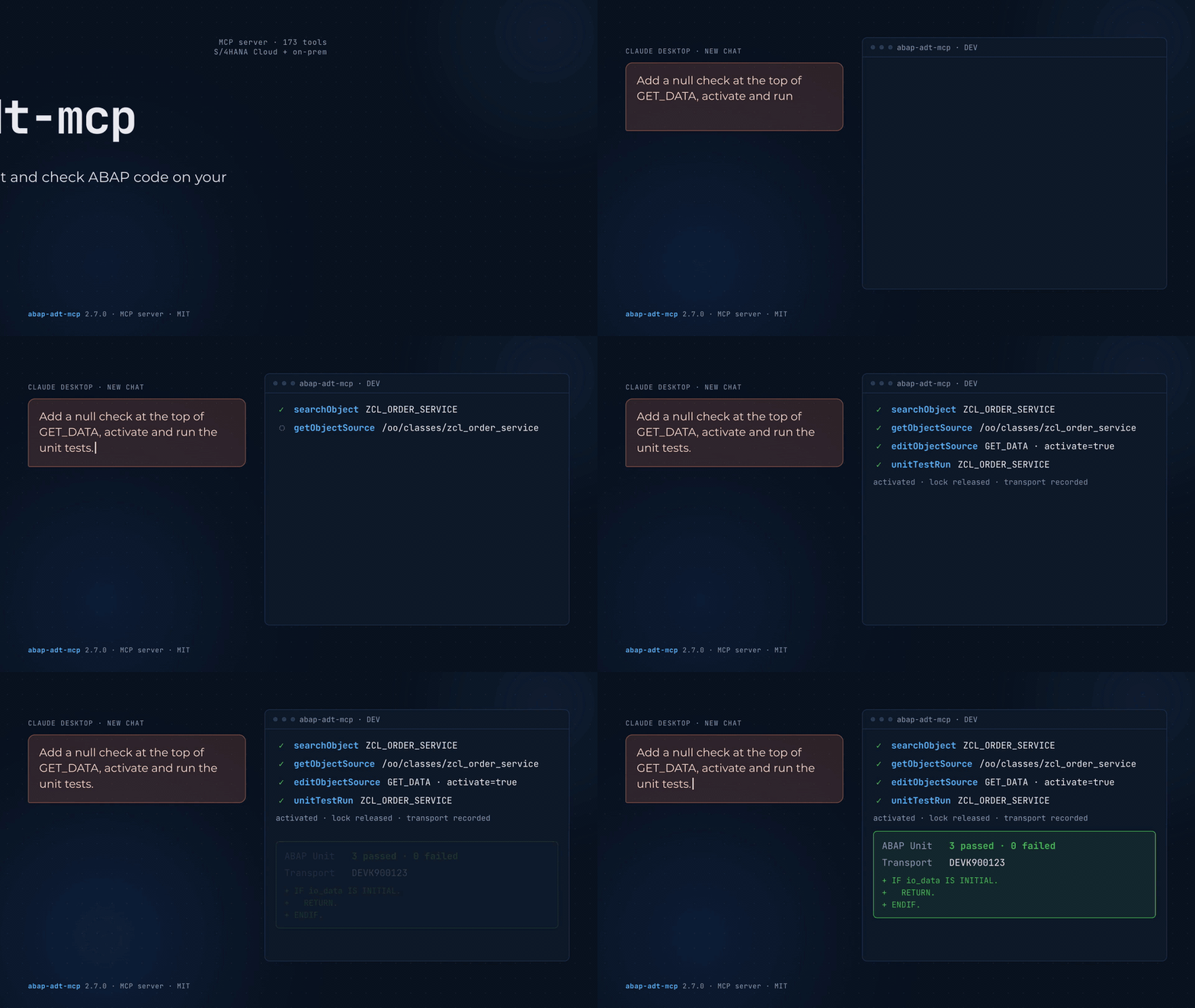
That is the whole idea. You type a sentence. The model picks the tools, the server locks the object, writes, activates and unlocks it, and the unit tests come back green with a transport number attached. Ask for the same change on a production system and the answer is policyDenied before a single SAP call goes out: the guard rails live in the server, not in the chat window.
Seven short films show this and the single jobs behind it, a short dump traced to its line, an ATC run with its quickfixes, a transport review, a class created with its test, an ABAP Cloud readiness check. They are on the project site.
Table of contents
- See it work
- Setup
- What to ask the model
- For administrators
- Authentication
- S/4HANA Cloud versus on-prem
- Other ways to install
- Configuration
- Tool catalog
- Compared with SAP's official ADT MCP Server
- SAP API Policy
- Troubleshooting
- Testing and contributing
- Credits
- License
Setup
Three prerequisites:
- Node.js 22.12 or newer (22 or 24 LTS) from nodejs.org. On a managed laptop the ticket to IT is one line: "Please install Node.js LTS (22 or newer)"; nothing else needs installing.
- Access to the SAP system, the same as for Eclipse ADT: on S/4HANA Cloud the developer business role (
SAP_BR_DEVELOPERin the standard delivery); on-prem, ask your Basis team for the/sap/bc/adtservice inSICFand the usual ADT authorizations. - A Chromium browser (Chrome, Edge or Brave) for the browser login (
authType: sso, the default); not needed forbasic,oauthorsso2.
1. Describe your SAP systems
Create the folder .abap-adt-mcp in your home directory and the file systems.json inside it, one entry per system (a "destination"):
- Windows: the folder is
C:\Users\<your user name>\.abap-adt-mcp. Paste the JSON into Notepad and in Save As set "Save as type" to "All files" and the name tosystems.json, otherwise Notepad savessystems.json.txtand the server finds nothing. - macOS: the folder is
/Users/<you>/.abap-adt-mcp(Finder, Shift-Cmd-G,~); any editor.
{
  "DEV": {
    "url": "https://myXXXXXX.s4hana.cloud.sap",
    "client": "080",
    "authType": "sso",
    "default": true,
    "policy": { "allowedPackages": ["ZFIN"] }
  }
}
DEVis your name for the system and the word you will use in chats;"default": truelets you omit it.url: the address you open the launchpad or Eclipse with, without a path.client: the client your SSO session logs on to (About in the launchpad's user menu shows it). A wrong client shows up later as "not authorized" on objects you can open in Eclipse.authTypedefaults tosso: a browser window opens once for the login, like Eclipse ADT. Other modes: Authentication.policy.allowedPackages: the packages the model may write to, exact names or patterns (ZFIN,Z*). Leave it out and every package you can edit in Eclipse is writable; start with one.
Production and on-prem systems come in step 4, after the first successful call.
2. Register the server in your host
The package is on npm as abap-adt-mcp; npx fetches it. Claude Desktop, no terminal: first block. Claude Code: one command. VS Code, Cursor and others: pointer below. Every entry passes the server two settings: SAP_SYSTEMS_FILE (where systems.json is) and MCP_TOOLSETS=focused, which publishes the 114 everyday development tools instead of all 173 so the tool schemas do not eat the chat's context (drop it when you need the debugger, traces, abapGit, RAP or refactoring).
Claude Desktop, no terminal needed:
- Settings > Developer > Edit Config opens the folder that holds
claude_desktop_config.json; open the file in Notepad or any editor. If Settings has no Developer tab, your Claude Desktop is managed by IT: ask them to add the entry below. - If the file already contains
"mcpServers", add only the"abap-adt-mcp"entry inside it; if it is empty, paste the whole block. - Replace
<you>with your user name (macOS:/Users/<you>/.abap-adt-mcp/systems.json). The forward slashes in the Windows path are deliberate: JSON needs\\for every backslash, forward slashes need nothing. - Quit and reopen the app.
{
  "mcpServers": {
    "abap-adt-mcp": {
      "command": "npx",
      "args": ["-y", "abap-adt-mcp"],
      "env": { "SAP_SYSTEMS_FILE": "C:/Users/<you>/.abap-adt-mcp/systems.json", "MCP_TOOLSETS": "focused" }
    }
  }
}
Claude Code, one line in a terminal (-s user registers the server for every project, not only the current folder):
claude mcp add -s user abap-adt-mcp -e SAP_SYSTEMS_FILE=$HOME/.abap-adt-mcp/systems.json -e MCP_TOOLSETS=focused -- npx -y abap-adt-mcp
The same on Windows PowerShell:
claude mcp add -s user abap-adt-mcp -e SAP_SYSTEMS_FILE=$env:USERPROFILE\.abap-adt-mcp\systems.json -e MCP_TOOLSETS=focused -- npx -y abap-adt-mcp
VS Code with GitHub Copilot: the same entry in .vscode/mcp.json under a top-level servers key instead of mcpServers; docs/HOSTS.md has the file as tested, with ${input:} for secrets.
- Cursor, Cline, Windsurf, the Copilot CLI and Eclipse: docs/HOSTS.md.
- Keep the key
abap-adt-mcp: it is the name the host shows, the prefix of every tool, and what this project's agent skills look for.
3. Say hello
Open a new chat and type (replace DEV with the key you chose; the class is standard SAP, so the prompt is read-only and safe on any system):
List my SAP systems, log in to DEV and show me the source of class CL_ABAP_CHAR_UTILITIES.
A browser window opens for the SSO login (tick "stay signed in" and later logins are silent); the model then calls listSystems, searchObject and getObjectSource, and the reply names your destinations and ends with the class source. The host asks before running a tool you have not approved permanently: that dialog is a courtesy of the host, the policy block is the guarantee. If the server does not appear in the host, Troubleshooting names the log to read.
Two things worth knowing before the first edit:
- A write the policy forbids comes back as a refusal, not as a silent no-op:
kind: "policyDenied",Policy: setObjectSource blocked on destination PRD (readOnly). - Every change the model makes is on your transport and in the object's version history:
objectDiffandrevisionsshow it, and nothing leaves DEV without a transport release you approve.
4. Add production and on-prem systems
The same file with a production entry and an on-prem entry (systems.example.json has every option):
{
  "DEV": {
    "url": "https://myXXXXXX.s4hana.cloud.sap",
    "client": "080",
    "authType": "sso",
    "default": true,
    "policy": { "allowedPackages": ["Z*"] }
  },
  "PRD": {
    "url": "https://myYYYYYY.s4hana.cloud.sap",
    "client": "100",
    "authType": "sso",
    "policy": { "readOnly": true, "allowDataPreview": false, "deniedTools": ["exportPackageSources"] }
  },
  "ONPREM": {
    "url": "https://sap.example.com:44300",
    "client": "100",
    "authType": "basic",
    "user": "DEVELOPER",
    "password": "${env:ONPREM_PASSWORD}",
    "policy": { "allowedPackages": ["Z*", "$*"] },
    "tls": { "ca": "/etc/ssl/corp-ca.pem" }
  }
}
- If a production destination must exist,
PRDis its minimum policy:readOnlyrefuses every write, whatever the model is asked;allowDataPreview: falsekeeps table data closed even where the environment opens it for other destinations;deniedToolsclosesexportPackageSources, the one read that copies whole packages to disk. ${env:VAR}reads a secret from the environment, so it never sits in the file; add the variable where the host starts the server:-e ONPREM_PASSWORD=...onclaude mcp add(or export it in the shell that starts Claude Code), a"ONPREM_PASSWORD": "..."line in theenvblock of Claude Desktop, which does not pass your shell environment on. A file with an inline password must be readable by you only (chmod 600 ~/.abap-adt-mcp/systems.jsonon macOS and Linux; on Windows your profile folder is already private); an SSO-only file needs nothing.tls.canames a corporate CA certificate. Verification can be relaxed per destination only (insecureTls: true, announced at startup), never for the whole process.
That is the whole setup. Next: What to ask the model.
What to ask the model
The server is a toolbox the model picks from: ask in plain language and it chooses the sequence.
| Ask | Tools the model reaches for |
|---|---|
| "Explain what method GET_DATA of ZCL_ORDER_SERVICE does." | searchObject, getMethodSource |
| "Where is table ZTABLE still used, and by which programs?" | whereUsed, sourceTextSearch, grepPackage |
| "Show me the fields and associations of CDS view ZI_PRODUCT." | cdsViewInfo, objectStructureElements |
| "Add a null check at the top of GET_DATA, activate and run the unit tests." | resolveTransport, syntaxCheckCode, editObjectSource (with activate=true), unitTestRun, objectDiff |
| "Create class ZCL_HELLO in package ZDEMO that prints Hello World, with a unit test." | validateNewObject, resolveTransport, createObject, setObjectSource, createTestInclude, unitTestRun |
| "Run ATC on package ZFIN and apply every quickfix that is safe." | createAtcRun, atcWorklists, atcQuickfixProposals, atcApplyQuickfix, atcSummary |
"What changed in transport DEVK900123? Review it and tell me if it is safe to release." | transportDetails, transportUnifiedDiff |
| "Why did the last short dump of user DEVELOPER happen? Propose a fix." | dumps, dumpDetails, getObjectSource |
| "Is ZCL_ORDER_SERVICE ready for ABAP Cloud? Which SAP objects block it?" | apiReleaseState, createAtcRun |
| "Select the ten newest rows of ZTABLE where STATUS = 'X'." | runQuery, or tableContents when the data preview refuses a table |
| "Try this snippet and show me the output." | runSnippet |
| "Which toolsets does DEV support? Is the debugger available there?" | systemProfile |
What the server does on its own, so you do not have to spell it out:
- Write tools lock, write and unlock by themselves;
activate=trueactivates in the same call. - Every error comes back as JSON with
kind,hintandnextTools, so the model recovers instead of retrying blindly; an expired session is re-authenticated and the call retried once. - Large results are paged inside a 40,000-character budget and report
hasMore; long calls send progress notifications. - Table reads run only where the destination allows them:
tableContentsby name needsallowDataPreview,runQueryneedsallowFreeSql. - The create and edit flows travel in the MCP
instructionsfield, and six ready-made workflows ship as MCP prompts (create-object,safe-edit,review-transport,fix-atc,clean-core-check,debug-dump; in Claude Code/mcp__abap-adt-mcp__safe-edit DEV ZCL_ORDER_SERVICE "return early when the input table is empty"). - Every tool carries
readOnlyHint/destructiveHintannotations, so hosts that gate approval by annotation ask only on writes.
The tool-by-tool sequences, argument shapes and recipes are in docs/WORKFLOWS.md.
For administrators
What the server is, in the terms a landscape owner asks about:
- Identity. Every call reaches SAP as the user of the destination, with that user's authorizations; the server removes no SAP check and has no access the user does not have. With
ssoandsso2that user is the person at the keyboard;basicandoauthcarry stored credentials, so prefer named users where accountability matters. The authorizations of a display-only SAP user are listed in docs/CONFIGURATION.md. - Process. One process per person, started by the MCP host, speaking stdio; nothing listens on the network unless you start the optional HTTP transport.
- Network. It talks to the configured SAP hosts, to the identity provider during browser SSO, and to
raw.githubusercontent.comfor SAP's cloudification repository whenapiReleaseStateruns (cached 24 hours;deniedTools: ["apiReleaseState"]keeps that off the network). No telemetry, no update checks;npxitself contacts the npm registry. - What the model sees. The result of every tool call the user approves (source, table rows where opened, dumps, ATC findings, error text after redaction) goes to the MCP host and from there to the model provider under the host's own data terms (the host decides the provider, not this server); the server sends nothing anywhere else.
readOnly,deniedTablesanddeniedToolsbound that set per destination. - Disk.
~/.abap-adt-mcp/:systems.json(yours), the SSO browser profile per host (sso/<host>, mode0700), the cloudification cache, package exports (exports/, only whereexportPackageSourcesmay write), the HTTP token and, when enabled, the audit log. SAP session cookies are never written to disk. - Secrets.
${env:VAR}works in every string ofsystems.json; a file readable by others is refused when it holds inline passwords. Error messages pass through a redaction step (bearer tokens, cookies, passwords,user:password@hostURLs); successful tool results are not redacted, soreadOnly,deniedTablesanddeniedToolsare what bounds them.reentranceTicket(a logon ticket the model could carry elsewhere) stays disabled unlessSAP_ALLOW_REENTRANCE_TICKET=1. - What the policy cannot see. ABAP the model runs (
runSnippet,runClass,unitTestRun) executes with the user's authorizations;deniedTablesscans the snippet text, but dynamic SQL and whatever the code calls are not inspected. Where code execution is unacceptable, list those tools indeniedToolsor usereadOnly. - Untrusted input. Comments, table rows and feeds from SAP can carry text that tries to steer the model. Use a host that asks before tool calls and review the tools in bold in the Tool catalog (the destructive ones) before approving.
- Audit.
MCP_AUDIT_FILE=/var/log/abap-adt-mcp/audit.jsonlappends one JSON line per call: tool, destination, outcome, duration, the policy gate that refused it, and the arguments with secrets redacted. The file is written per workstation by the user's own process; central collection and tamper protection are yours to arrange. docs/CONFIGURATION.md has the record format. - SAP API Policy. SAP calls the ADT services this server uses internal, for development through the channels it endorses, and this project is not among them; unpublished interfaces are used at own risk. Ask your SAP contact and keep the server to development and test systems. Details under SAP API Policy.
- Revocation. A lost laptop or a leaked secret is closed piece by piece (SSO profile, identity-provider session, OAuth secret, SAP password, local files): SECURITY.md, Decommissioning.
- Releases. Only the newest release receives fixes; for a controlled rollout pin the version instead of the unpinned
npx -y abap-adt-mcpof the setup (Other ways to install). Tested modes:sso,sso2and on-prembasic;oauthand Communication-Userbasicare not (Authentication). Vulnerabilities: SECURITY.md, Reporting a vulnerability.
Policy keys
Enforced in the server before any SAP call, per destination in systems.json:
| Key | Effect |
|---|---|
readOnly | Only read-only tools run: every source write, lock, runSnippet, runClass, unitTestRun, createAtcRun and atcSummary are refused. Table reads (where opened) and exportPackageSources stay allowed; close them with the keys below. |
allowDataPreview | Off unless true: tableContents may read the rows of a table or CDS entity by name. An explicit false overrides MCP_ALLOW_DATA_PREVIEW. |
allowFreeSql | Off unless true: runQuery and tableContents with sqlQuery (implies allowDataPreview). |
deniedTables | Patterns the model may not read (["PA*", "HR*", "USR02"]), applied to reads and to the ABAP text it writes or runs; SAP's own display authorization remains the floor. |
deniedTools | Tools refused outright: names, patterns (rapGen*) or toolset:git. |
allowedPackages | Writes only inside these packages (["Z*", "$*"]); an unresolvable package is refused. |
allowedTransports | Writes only on these transports; creating new ones is refused. |
Refusals come back as kind: "policyDenied" naming the gate; listSystems shows every policy and the effective dataAccess. The threat model and the residual risks are in SECURITY.md; the gates tool by tool, with recipes, in docs/CONFIGURATION.md; the standing under SAP's API Policy in docs/API-POLICY.md.
Authentication
Every destination picks its own authType. Details and the SAP-side steps are in docs/AUTH.md.
| Mode | Use it for | What you configure | SAP side |
|---|---|---|---|
sso (default) | S/4HANA Cloud named users, and on-prem systems that answer with a Basic challenge | Nothing: a browser opens once per host; the session is kept in memory. SAP_BROWSER_PATH overrides the browser. | The developer business role your user already needs for Eclipse ADT |
sso2 | Headless on-prem named users, when a trusted local SNC/RFC bridge can issue a short-lived ticket | sso2.command, args, timeoutMs | SNC mapping, ticket acceptance and ADT ICF logon set up by Basis |
basic | On-prem AS ABAP users, S/4HANA Cloud Communication Users | user and password (as ${env:VAR}) | A user with ADT authorizations |
oauth | S/4HANA Cloud unattended clients | oauth.tokenUrl, clientId, clientSecret | Communication User, Communication System with OAuth 2.0, Communication Arrangement for the ADT scenario of your tenant |
- Named business users on S/4HANA Cloud cannot use basic auth: they log in through
sso, or you create a Communication User.oauthandbasicwith a Communication User follow SAP's documentation for technical users but were not exercised by this project against a live tenant; confirm on yours before relying on them. - On an on-prem Basic challenge the browser window asks for the SAP password; if you let the browser save it, it sits in the dedicated profile under
~/.abap-adt-mcp/sso/<host>. - TLS verification stays on for the process. Per destination,
tls.caadds a corporate CA,tls.servernamenames the certificate of a system reached by IP address,tls.cert+key(orpfx+passphrase) present a client certificate, andinsecureTls: trueis announced at startup. OptionalgitUser/gitPasswordkeep abapGit credentials out of the conversation.
S/4HANA Cloud versus on-prem
systemProfile(destination) reports whether a destination is cloud or on-prem and which toolsets the backend lacks; those tools are refused before calling SAP. What docs/TESTPLAN.md recorded on a Public Cloud tenant:
| Topic | S/4HANA Cloud (public edition) | On-prem / private |
|---|---|---|
| Authentication | Named users: browser SSO only. Unattended: OAuth2 from a Communication Arrangement, or basic auth with a Communication User. | Basic auth; client certificates through tls; browser SSO on systems with a Basic challenge; headless sso2 through a local ticket provider. |
| Local objects | $TMP was refused on the tested tenant (authorization object S_ABPLNGVS); use a customer package with ABAP for Cloud Development and its transport, resolveTransport picks it. runSnippet needs packageName, transport and responsible there. | $TMP available, no transport needed; runSnippet defaults to $TMP. |
| Toolsets | RAP generator absent on the tested tenant; debugger, traces and abapGit depend on the tenant and authorizations. dumps/dumpDetails are the root-cause path when the debugger is missing; sourceTextSearch falls back to grepPackage when the tenant has no text index. | Full ADT collection set on a current release. |
| Released APIs | apiReleaseState checks names, an object URL or a whole source; ATC variant ABAP_CLOUD_DEVELOPMENT_DEFAULT. createObject needs responsible. | Optional. |
| Business data | runQuery/tableContents respect display authorizations, and the destination has to allow them. runSnippet needs S_DEVELOP, so development systems only. | Same. |
More in docs/CLOUD.md and, from real sessions, docs/FIELD-NOTES.md.
Other ways to install
- Pin the version.
npx -y abap-adt-mcpfetches the newest release at every start; for a controlled rollout pin it (npx -y abap-adt-mcp@X.Y.Z, or thevX.Y.Zcontainer tag). Releases carry an npm provenance attestation, verifiable withnpm audit signatures. - Claude Code plugin. Two commands register the server and install the two agent skills (
abap-adt-mcpteaches the development flow,abap-adt-mcp-setupwalks through installation):/plugin marketplace add williansaez/abap-adt-mcp, then/plugin install abap-adt-mcp@abap-adt-mcp. The plugin pins the release it ships with and publishes every toolset;systems.jsonfrom step 1 is still yours to write. - Container.
ghcr.io/williansaez/abap-adt-mcp:latest(alsovX.Y.Z), built fromnode:22-alpine, runs as uid 1000. Mountsystems.jsonread-only and pass referenced secrets through; browser SSO needs a local browser, so runssodestinations from npm on the workstation. docs/HOSTS.md has thedocker runline and the file-ownership pitfalls. - MCP registry. Listed as
io.github.williansaez/abap-adt-mcpfor hosts that browse the registry. - From source.
git clone https://github.com/williansaez/abap-adt-mcp.git,npm ci,npm run build, then point the host atnode /absolute/path/abap-adt-mcp/dist/index.js. Asystems.jsonnext to the checkout is picked up automatically.
Configuration
- Sources, in order of precedence:
SAP_SYSTEMS(inline JSON),SAP_SYSTEMS_FILE, asystems.jsonnext to the install, then the legacy single-system variables (SAP_URL,SAP_CLIENT,SAP_USER,SAP_PASSWORD, ...). - Per-destination keys:
url,client,language,authType,default,user/password,sso2,oauth,insecureTls,gitUser/gitPassword,policy,tls; any string may be${env:VAR}. - There is no global
deniedTools,deniedTablesorallowedPackages: those are repeated per entry.
The variables you are most likely to set:
| Variable | Purpose | Default |
|---|---|---|
SAP_SYSTEMS_FILE | Path to the destinations file | Recommended over inline SAP_SYSTEMS |
MCP_TOOLSETS | all, focused, or a comma list of toolsets to publish | all (the setup above chose focused) |
MCP_READ_ONLY | 1 makes every destination read-only | Off |
MCP_ALLOW_DATA_PREVIEW, MCP_ALLOW_FREE_SQL | 1 opens table data or SQL on destinations that do not state the key | Off |
MCP_AUDIT_FILE | JSONL audit trail | Off |
MCP_MAX_RESPONSE_CHARS | Budget of one tool response before paging | 40000 |
MCP_HTTP_PORT | Serve Streamable HTTP on 127.0.0.1:<port>/mcp with a bearer token instead of stdio | Unset (stdio) |
SAP_BROWSER_PATH | SSO: the Chromium binary to use | Auto-detected |
Every variable, with its default and what it touches, the HTTP transport (token, session and body limits, DNS-rebinding protection, what a shared instance means) and the audit record format are in docs/CONFIGURATION.md.
Tool catalog
The per-tool reference (description, parameters, read-only/destructive annotations) is docs/TOOLS.md, generated from the live tools/list response and verified by a contract test in CI. Every tool except listSystems and healthcheck accepts an optional destination.
Tool schemas cost context. MCP_TOOLSETS takes a preset (all, the default, or focused = 114 development tools) or a comma list of the toolset names below; MCP_DISABLED_TOOLSETS removes some; core is always published.
Names in bold carry destructiveHint: true (23 tools): they overwrite, delete, release or run something, and hosts that gate approval by annotation ask before each one.
In the focused preset (114 tools)
| Toolset | Tools |
|---|---|
core (6)<br>Destinations, health & session | login, logout, dropSession, listSystems, healthcheck, systemProfile |
source (16)<br>Source code | lock, unLock, listLocks, forceUnlock, getObjectSource, setObjectSource, editObjectSource, getMethodSource, setMethodSource, prettyPrinterSetting, setPrettyPrinterSetting, prettyPrinter, revisions, objectDiff, getTextElements, setTextElements |
objects (27)<br>Objects & navigation | objectStructure, searchObject, findObjectPath, objectTypes, reentranceTicket, classIncludes, classComponents, deleteObject, activateObjects, activateByName, activatePackage, inactiveObjects, objectRegistrationInfo, creatableTypeDetails, validateNewObject, createObject, nodeContents, mainPrograms, typeHierarchy, objectStructureElements, objectEnhancements, packageTree, exportPackageSources, whereUsed, cdsViewInfo, sourceTextSearch, grepPackage |
transports (18)<br>Transports | transportDetails, transportUnifiedDiff, transportInfo, resolveTransport, createTransport, hasTransportConfig, transportConfigurations, getTransportConfiguration, setTransportsConfig, createTransportsConfig, userTransports, transportsByConfig, transportDelete, transportRelease, transportSetOwner, transportAddUser, systemUsers, transportReference |
analysis (16)<br>Syntax & code analysis | syntaxCheckCode, syntaxCheckCdsUrl, codeCompletion, findDefinition, usageReferences, syntaxCheckTypes, codeCompletionFull, runClass, codeCompletionElement, usageReferenceSnippets, fixProposals, fixEdits, fragmentMappings, abapDocumentation, apiReleaseState, runSnippet |
tests (4)<br>Unit tests | unitTestRun, unitTestEvaluation, unitTestOccurrenceMarkers, createTestInclude |
atc (14)<br>ATC | atcCustomizing, atcQuickfixProposals, atcApplyQuickfix, atcCheckVariant, atcSummary, createAtcRun, atcWorklists, atcUsers, atcExemptProposal, atcRequestExemption, isProposalMessage, atcContactUri, atcChangeContact, atcDocumentation |
data (10)<br>Data access & DDIC | annotationDefinitions, ddicElement, ddicRepositoryAccess, packageSearchHelp, getDomainProperties, setDomainProperties, getDataElementProperties, setDataElementProperties, tableContents, runQuery |
runtime (3)<br>Runtime errors | feeds, dumps, dumpDetails |
Only with MCP_TOOLSETS=all or by toolset name (59 tools)
| Toolset | Tools |
|---|---|
discovery (7)<br>Discovery & metadata | featureDetails, collectionFeatureDetails, findCollectionByUrl, loadTypes, adtDiscovery, adtCoreDiscovery, adtCompatibilityGraph |
refactoring (8)<br>Refactoring | renameEvaluate, renamePreview, renameExecute, extractMethodEvaluate, extractMethodPreview, extractMethodExecute, changePackagePreview, changePackageExecute |
rap (8)<br>RAP generation | rapGenIsAvailable, rapGenGetSchema, rapGenGetContent, rapGenValidateInitial, rapGenValidateContent, rapGenPreview, rapGenGenerate, rapGenPublishService |
services (4)<br>Business services | publishServiceBinding, unPublishServiceBinding, fetchServiceDetails, bindingDetails |
git (10)<br>abapGit | gitRepos, gitExternalRepoInfo, gitCreateRepo, gitPullRepo, gitUnlinkRepo, stageRepo, pushRepo, checkRepo, remoteRepoInfo, switchRepoBranch |
debugger (13)<br>Debugger | debuggerListeners, debuggerListen, debuggerDeleteListener, debuggerSetBreakpoints, debuggerDeleteBreakpoints, debuggerAttach, debuggerSaveSettings, debuggerStackTrace, debuggerVariables, debuggerChildVariables, debuggerStep, debuggerGoToStack, debuggerSetVariableValue |
traces (9)<br>Traces | tracesList, tracesListRequests, tracesHitList, tracesDbAccess, tracesStatements, tracesSetParameters, tracesCreateConfiguration, tracesDeleteConfiguration, tracesDelete |
A tool can be missing for two reasons: its toolset is not published (the refusal names the toolset), or the destination cannot serve it (systemProfile reports what is missing).
Compared with SAP's official ADT MCP Server
SAP's ADT MCP Server ships with ADT for VS Code and Eclipse and publishes under the server key abap-adt with its own tool names. This project publishes under abap-adt-mcp, serves many destinations from one process, enforces policies server-side, and adds compositions such as resolveTransport, editObjectSource, grepPackage, apiReleaseState, runSnippet and objectDiff. The two can run side by side in the same host; docs/ROUTING.md maps SAP's names to ours.
Names as the SAP Help page "Model Context Protocol Tools" lists them (September 2026). SAP's server creates, activates, tests, checks and transports; it does not read or search source, write source, lock, or show dumps: those come only from this server.
| SAP official tool | abap-adt-mcp tool(s) |
|---|---|
abap_lists_destinations | listSystems, systemProfile |
abap_creation-get_all_creatable_objects, abap_creation-get_object_type_details | objectTypes, creatableTypeDetails |
abap_creation-run_validation, abap_creation-create_object | validateNewObject, createObject |
abap_activate_objects | activateByName, activateObjects, activatePackage |
abap_run_unit_tests | unitTestRun, unitTestEvaluation |
abap_transport-create, abap_transport-get | createTransport, resolveTransport, transportInfo, transportDetails, userTransports |
abap_transport-unifiedDifference | transportUnifiedDiff |
abap_generators-list_generators, abap_generators-get_schema, abap_generators-generate_objects | rapGenIsAvailable, rapGenGetSchema, rapGenValidateContent, rapGenPreview, rapGenGenerate |
abap_business_services-fetch_services, abap_business_services-fetch_service_information | fetchServiceDetails, bindingDetails |
abap_atc_run, abap_atc_get_result | createAtcRun, atcWorklists, atcSummary |
abap_atc_execute_deterministic_quickfixes | atcQuickfixProposals, atcApplyQuickfix |
abap_atc_apply_ai_fix, abap_atc_get_ai_fix_result (Joule licence) | No equivalent: the model reads the finding (atcDocumentation) and edits the source itself (editObjectSource) |
| Not in SAP's server: read and search source, write source, locks, dumps, data, where-used, debugger, abapGit, Clean Core check | getObjectSource, searchObject, sourceTextSearch, grepPackage, setObjectSource, editObjectSource, lock, dumps, runQuery, whereUsed, the debugger and abapGit toolsets, apiReleaseState |
SAP API Policy
- What SAP says. The ADT REST services this server calls (
/sap/bc/adt) are the ones Eclipse ADT uses; SAP does not list them on the SAP Business Accelerator Hub. The SAP API Policy (April 2026) restricts unpublished interfaces and the use of APIs by AI agents outside the architectures SAP endorses. SAP's FAQ on the policy calls the ADT APIs internal, for development through endorsed channels only, and a third-party MCP server is not among the channels it lists; the same FAQ allows third-party MCP servers in general and says unpublished interfaces are used at own risk. - What that means for you. Whether SAP accepts your use is a question for your SAP contact, not for this project.
- What to do. Ask that question, and keep the server to development work on development and test systems.
What the server does on its side: it runs as the SAP user who logged on and removes no SAP authorization check, it reads no table data until a destination allows it, it runs the calls to a destination one at a time, and apiReleaseState marks every SAP object it checks as released, classic, notReleased or prohibited. docs/API-POLICY.md has the policy section by section, the questions to put to SAP and a conservative configuration.
Troubleshooting
- The server never appears in the host. Read the host's MCP log: Claude Desktop writes
mcp.logandmcp-server-abap-adt-mcp.logto~/Library/Logs/Claudeon macOS and%APPDATA%\Claude\logson Windows; Claude Code shows the state with/mcp. Claude Desktop reads the config only at start: quit and reopen it after every change.spawn npx ENOENT: Node.js is not installed, or not on the PATH the app sees. Install it, or put the absolute path tonpxincommand(C:/Program Files/nodejs/npx.cmdon Windows,/usr/local/bin/npxor/opt/homebrew/bin/npxon macOS).EBADENGINE: the Node the host found is older than 22.12.No ABAP systems configured:SAP_SYSTEMS_FILEpoints at a missing file (on Windows, check forsystems.json.txt).is not valid JSON: a stray comma, or a Windows path written with single backslashes.
- No browser window, or SSO fails. A Chromium browser must be installed;
SAP_BROWSER_PATHpoints at it when auto-detection fails. To log out of a tenant completely delete the foldersso/<host>under.abap-adt-mcpin your home directory (C:\Users\<you>on Windows). On a machine without a display (a CI runner, a container) the login refuses at once and namesoauthorsso2instead. - Login works, then everything is "not authorized" or "not found". The SSO session landed on another client than
clientsays: setclientto the tenant's logon client. kind: "sessionExpired"keeps coming back. The server already re-authenticated and retried once; ask the model to callloginfor that destination. Lock handles from the old session are invalid: lock again.kind: "locked"by another session.listLocksshows the server's own locks; if the object is not there, the lock belongs to another session (Eclipse or another user) and only that session orSM12releases it.kind: "policyDenied". The destination'spolicyforbids the call and the message names the gate: the guard rail is working.tableContentsandrunQueryare refused on every destination that has not opened them, a destination without apolicyincluded; the message names the key to set.- Tool refused as not available or not enabled. "Not available on destination": the tenant lacks that ADT collection (
systemProfileshows it). "Belongs to toolset ... which is not enabled": add the toolset toMCP_TOOLSETSor useMCP_TOOLSETS=all. - Certificate errors on-prem (
kind: "tlsCertificate"). The hint names the destination and the fix:tls.cafor an unknown issuer (the hint carries theopensslline),tls.servernamefor a name mismatch, renewal inSTRUSTfor an expired certificate. editObjectSourcereports 0 matches, or several. Nothing was written. The anchor must be the exact current text on SAP, indentation included; for several matches include more surrounding lines.runQueryfails on a table the user can display. The data preview refuses tables with restricteddataMaintenance; usetableContents.
More cases, with the exact messages, in docs/TROUBLESHOOTING.md.
Testing and contributing
git clone https://github.com/williansaez/abap-adt-mcp.git
cd abap-adt-mcp
npm ci
npm run build
npm test
- Jest suites cover handlers, error hints, response sizing, toolsets and the catalog contract; CI runs them on Node 22 and 24 and builds the container image.
- After changing a tool, run
npm run tools:docsand commit the regenerateddocs/TOOLS.md, snapshot and README catalog (the translated READMEs included). npm run docs:checkis the documentation gate: no customer identifiers, no em-dashes, no dead links, every environment variable declared inserver.json.- Releases are tag driven: npm through trusted publishing with provenance, the GHCR image and the MCP registry entry.
- Fork, branch, open a pull request; CONTRIBUTING.md has the details. Session reports for docs/FIELD-NOTES.md are welcome, without customer names, tenants or transport numbers.
The English README is the reference for the Portuguese and German versions. The roadmap is in docs/ROADMAP.md and every release in CHANGELOG.md.
Credits
This server grows with the people who run it against real landscapes and send back what they found.
- João Gementi contributed the headless
sso2mode (a named on-prem user who already authenticates through SNC connects without a browser and without a stored password) and tightened the cookie client, which now refuses any request that would carry the SAP session off its configured origin. - Alexandre Leite reported the Secure Login Client scenario that opened milestone 2.1.0 and tested the on-prem authentication paths.
- The original
mcp-abap-abap-adt-apiserver by mario-andreschak is where this project started.
Found something, fixed something, or ran a mode on a landscape nobody here has? Open an issue or a pull request, and see CONTRIBUTING.md.
License
MIT. Built on abap-adt-api by Marcello Urbani. If the project saves you time, you can sponsor the author.
Related MCP servers

VisualTorch
Visualize PyTorch neural network architectures as static diagrams or animated GIF reveals in multiple styles.

ContextLib
A project's long-term memory as plain Markdown files, with an append-only, tamper-evident log.
AgentBrain Handoffs
Exact, durable handoffs between AI coding agents: one turn in the right session, never twice.
Item-by-item inventory that reorders itself: per-SKU forecasts, purchase orders and ETAs.
View repository →
Email marketing y transaccional AI-native: campañas, correos 1-a-1, contactos, flujos y métricas.
View repository →
io.github.wilzer/aidelly
Agent-operated social media for agencies — www.aidelly.ai. Post, approve, analyze on 11 networks.