io.github.xt765/mcp-document-converter MCP Server
io.github.xt765/mcp-document-converter
Convert between PDF, DOCX, HTML, Markdown, and Text documents for AI assistant context injection.
What is the io.github.xt765/mcp-document-converter MCP server?
The MCP Document Converter is an MCP server that converts documents between five mainstream formats: Markdown, HTML, DOCX, PDF, and Text. It supports bidirectional conversion (25 combinations total) through a unified intermediate representation, enabling AI assistants to transform documents while preserving metadata, styles, and structure.
This server provides AI assistants with document conversion capabilities across five popular formats. It uses a plugin architecture with parsers and renderers, supports syntax highlighting in HTML/PDF outputs, preserves document metadata, and can be extended with custom parsers and renderers. Useful for preparing documents for analysis, reformatting content, or converting between formats needed by different tools.
How to install io.github.xt765/mcp-document-converter
Copy-paste configuration for popular MCP clients.
Tools & capabilities
Tools this server exposes to the agent.
convert_document— Convert a document from one format to another. Accepts source path, target format (html, pdf, markdown, docx, text), optional output path, source format (auto-detected if not provided), and options like template, css, and preserve_metadata.list_supported_formats— List all supported document formats for input and output.get_conversion_matrix— Get the complete format conversion matrix showing all supported conversions.can_convert— Check if conversion from a source format to a target format is supported.get_format_info— Get detailed information about a specific document format.
Use cases
- Convert Markdown documentation to HTML or PDF for distribution
- Transform DOCX files to Markdown for version control and collaboration
- Extract text from PDFs and convert to other formats for processing
- Generate multiple output formats from a single source document
- Batch convert documents while preserving metadata and styling
io.github.xt765/mcp-document-converter MCP server FAQ
It's an MCP server that converts documents between Markdown, HTML, DOCX, PDF, and Text formats. It supports all 25 possible conversions between these five formats using a unified intermediate representation.
Yes, it's open source under the MIT License and available on PyPI.
Add it to your MCP configuration file using `uvx mcp-document-converter` or install via pip and reference the command. See the README for detailed configuration examples for Claude Desktop, Cursor, Cherry Studio, and other clients.
No, it does not require any authentication or API keys.
Python 3.10 or higher is required.
Yes, the server has a plugin architecture. You can create custom parsers and renderers by extending BaseParser and BaseRenderer classes, then register them with the ConverterRegistry.
README (reference)
Source of truth, from the repository.
Features
- Multi-format Support: Supports 5 mainstream document formats: Markdown, HTML, DOCX, PDF, and Text
- Bidirectional Conversion: Any format can be converted to any other format (5×5=25 conversion combinations)
- MCP Protocol: Compliant with MCP standards, can be used as a tool for AI assistants like Trae IDE
- Plugin Architecture: Easy to extend with new parsers and renderers
- Syntax Highlighting: HTML and PDF outputs support code syntax highlighting
- Style Customization: Support for custom CSS styles
- Metadata Preservation: Preserves document title, author, creation time, and other metadata during conversion
📚 Documentation
User Guide · API Reference · Contributing · Changelog · License
Architecture
flowchart TB
subgraph Parsers["Parsers"]
MD[Markdown]
DOCX1[DOCX]
HTML1[HTML]
PDF1[PDF]
TXT1[Text]
end
subgraph IR["Intermediate Representation (IR)"]
DT[Document Tree]
META[Metadata]
ASSETS[Assets]
end
subgraph Renderers["Renderers"]
HTML2[HTML]
PDF2[PDF]
MD2[Markdown]
DOCX2[DOCX]
TXT2[Text]
end
MD --> IR
DOCX1 --> IR
HTML1 --> IR
PDF1 --> IR
TXT1 --> IR
IR --> HTML2
IR --> PDF2
IR --> MD2
IR --> DOCX2
IR --> TXT2
Core Components
- DocumentIR (Intermediate Representation): Unified abstraction for all documents, containing document tree, metadata, assets, etc.
- BaseParser (Parser Base Class): Defines the parser interface, parses various formats into DocumentIR
- BaseRenderer (Renderer Base Class): Defines the renderer interface, renders DocumentIR into various formats
- ConverterRegistry (Registry): Manages all parsers and renderers, provides format lookup and auto-matching
- DocumentConverter (Conversion Engine): Coordinates parsers and renderers to complete document conversion
Supported Formats
Input Formats (Parsers)
| Format | Extensions | MIME Type | Features |
|---|---|---|---|
| Markdown | .md, .markdown, .mdown, .mkd | text/markdown | YAML Front Matter, GFM extensions |
| HTML | .html, .htm | text/html | Semantic tag parsing |
| DOCX | .docx | application/vnd.openxmlformats-officedocument.wordprocessingml.document | Styles, tables, images |
| application/pdf | Text extraction and structure recognition | ||
| Text | .txt, .text | text/plain | Auto encoding detection and structure recognition |
Output Formats (Renderers)
| Format | Extension | MIME Type | Features |
|---|---|---|---|
| HTML | .html | text/html | Beautiful styling, code highlighting, responsive design |
| Markdown | .md | text/markdown | Standard Markdown format, YAML Front Matter |
| DOCX | .docx | application/vnd.openxmlformats-officedocument.wordprocessingml.document | Word document format, style preservation |
| application/pdf | Generated with WeasyPrint, pagination support | ||
| Text | .txt | text/plain | Plain text, basic formatting preserved |
Conversion Matrix
flowchart LR
subgraph Sources["Source Formats"]
MD_S[Markdown]
HTML_S[HTML]
DOCX_S[DOCX]
PDF_S[PDF]
TXT_S[Text]
end
subgraph Targets["Target Formats"]
MD_T[Markdown]
HTML_T[HTML]
DOCX_T[DOCX]
PDF_T[PDF]
TXT_T[Text]
end
MD_S --> Targets
HTML_S --> Targets
DOCX_S --> Targets
PDF_S --> Targets
TXT_S --> Targets
Installation
Using pip (Recommended)
pip install mcp-document-converter
From Source
git clone https://github.com/xt765/mcp-document-converter.git
cd mcp-document-converter
pip install -e .
MCP Tools
This server provides the following tools:
convert_document
Convert a document from one format to another.
Arguments:
source_path(string, required): Path to the source document.target_format(string, required): Target format (html,pdf,markdown,docx,text).output_path(string, optional): Path for the output file.source_format(string, optional): Format of the source file (auto-detected if not provided).options(object, optional): Additional options liketemplate,css, andpreserve_metadata.
Configuration
Using in Trae IDE / Claude Desktop
Add the following to your MCP configuration file:
Option 1: Using PyPI (Recommended)
{
  "mcpServers": {
    "mcp-document-converter": {
      "command": "uvx",
      "args": [
        "mcp-document-converter"
      ]
    }
  }
}
Option 2: Using GitHub repository
{
  "mcpServers": {
    "mcp-document-converter": {
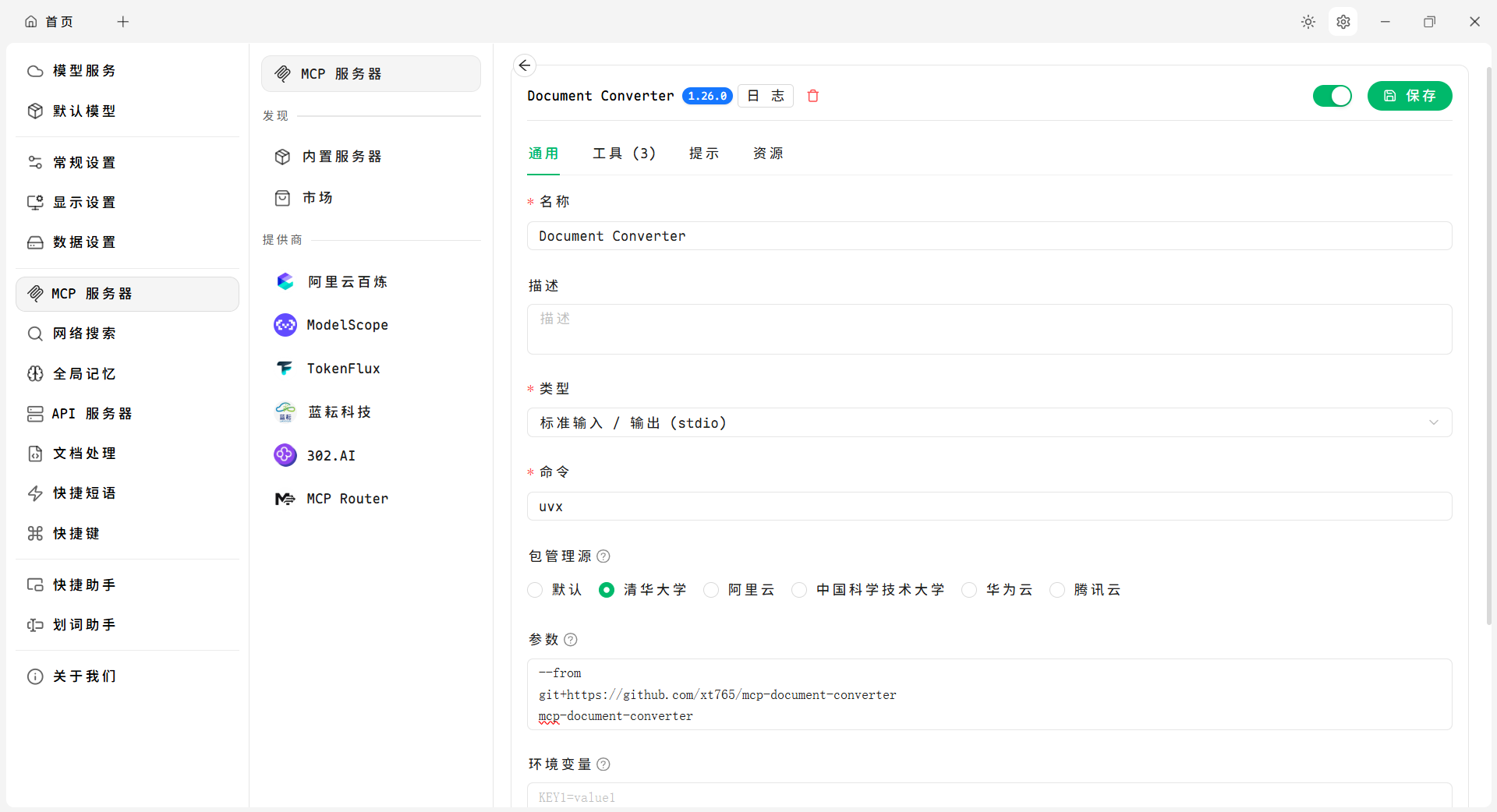
      "command": "uvx",
      "args": [
        "--from",
        "git+https://github.com/xt765/mcp-document-converter",
        "mcp-document-converter"
      ]
    }
  }
}
Option 3: Using Gitee repository (Faster access in China)
{
  "mcpServers": {
    "mcp-document-converter": {
      "command": "uvx",
      "args": [
        "--from",
        "git+https://gitee.com/xt765/mcp-document-converter",
        "mcp-document-converter"
      ]
    }
  }
}
Option 4: Using pip (Manual installation)
First install the package:
pip install mcp-document-converter
Then add to configuration:
{
  "mcpServers": {
    "mcp-document-converter": {
      "command": "mcp-document-converter",
      "args": []
    }
  }
}
Using in Cherry Studio
Cherry Studio is a powerful open-source desktop AI client assistant that supports integrating various tools through the MCP protocol
Configuration Example:
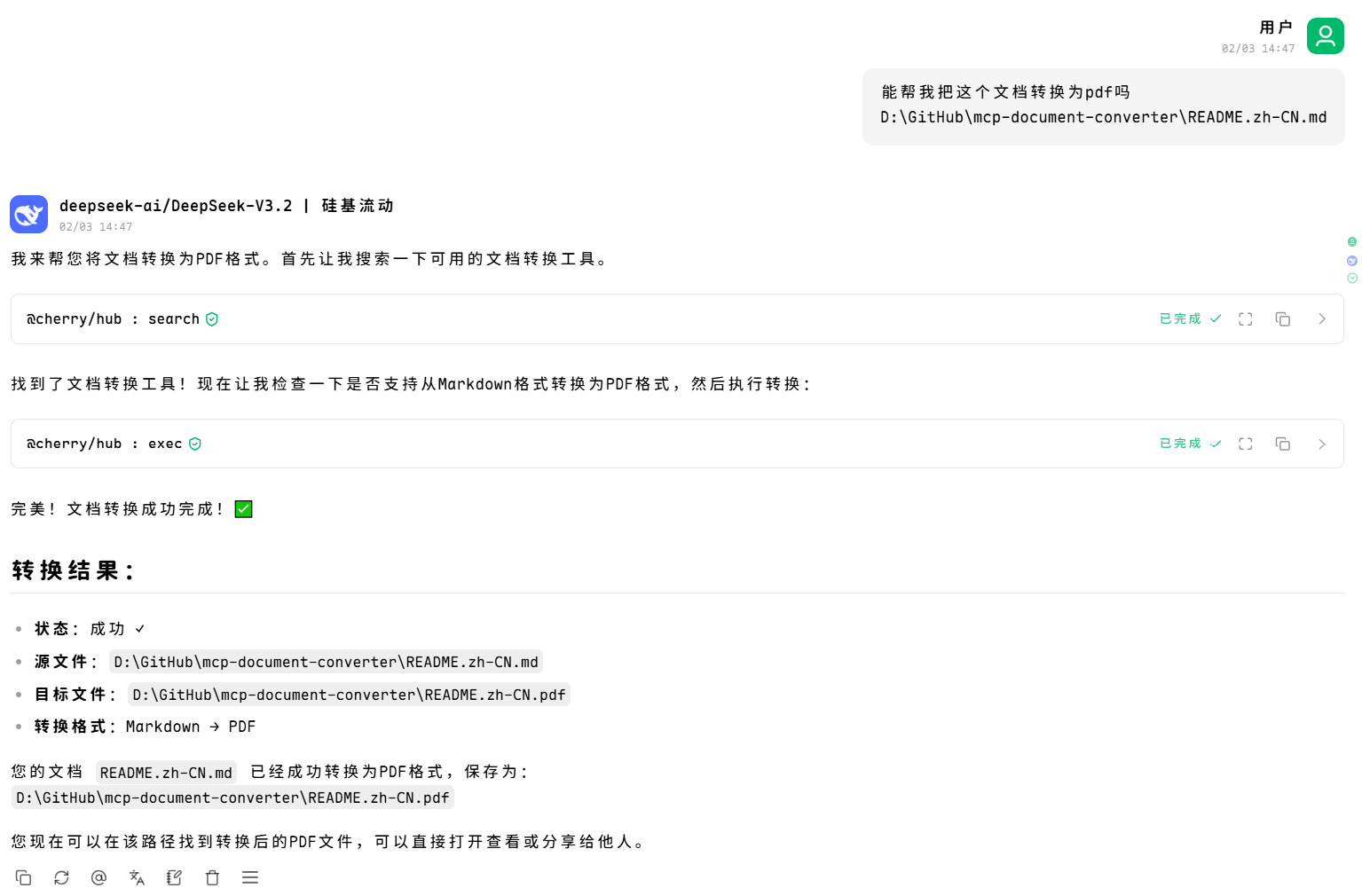
Usage Example:
Usage
As an MCP Tool
After configuration, AI assistants can directly call the following tools:
1. convert_document (Recommended)
Use a unified interface to convert any supported document type.
# Markdown to HTML
convert_document(
    source_path="document.md",
    target_format="html"
)

# HTML to PDF
convert_document(
    source_path="document.html",
    target_format="pdf"
)

# DOCX to Markdown
convert_document(
    source_path="document.docx",
    target_format="markdown"
)

# Conversion with options
convert_document(
    source_path="document.md",
    target_format="html",
    output_path="output.html",
    options={
        "css": "custom.css",
        "preserve_metadata": True
    }
)
2. list_supported_formats
List all supported document formats.
list_supported_formats()
3. get_conversion_matrix
Get the complete format conversion matrix.
get_conversion_matrix()
4. can_convert
Check if conversion from source format to target format is supported.
can_convert(source_format="markdown", target_format="pdf")
5. get_format_info
Get detailed information about a specific format.
get_format_info(format="markdown")
As a Python Library
from mcp_document_converter import DocumentConverter
from mcp_document_converter.registry import get_registry
from mcp_document_converter.parsers import MarkdownParser, HTMLParser
from mcp_document_converter.renderers import HTMLRenderer, PDFRenderer

# Register parsers and renderers
registry = get_registry()
registry.register_parser(MarkdownParser())
registry.register_parser(HTMLParser())
registry.register_renderer(HTMLRenderer())
registry.register_renderer(PDFRenderer())

# Create converter
converter = DocumentConverter(registry)

# Convert document
result = converter.convert(
    source="input.md",
    target_format="html",
    output_path="output.html"
)

if result.success:
    print(f"✅ Conversion successful: {result.output_path}")
else:
    print(f"❌ Conversion failed: {result.error_message}")
Tool Interface Details
convert_document
Convert a document from one format to another.
Parameters:
| Parameter | Type | Required | Description |
|---|---|---|---|
source_path | string | ✅ | Source file path, supports absolute or relative paths |
target_format | string | ✅ | Target format: html, pdf, markdown, docx, text |
output_path | string | ❌ | Output file path (optional, defaults to source filename) |
source_format | string | ❌ | Source format (optional, auto-detected from file extension) |
options | object | ❌ | Conversion options |
Options:
| Option | Type | Default | Description |
|---|---|---|---|
template | string | - | Template name |
css | string | - | Custom CSS styles |
preserve_metadata | boolean | true | Whether to preserve metadata |
extract_images | boolean | true | Whether to extract images |
Example:
{
  "source_path": "/path/to/document.md",
  "target_format": "html",
  "output_path": "/path/to/output.html",
  "options": {
    "css": "body { font-family: Arial; }",
    "preserve_metadata": true
  }
}
Extension Development
Adding a New Parser
from typing import List, Union
from pathlib import Path
from mcp_document_converter.core.parser import BaseParser
from mcp_document_converter.core.ir import DocumentIR, Node, NodeType

class MyParser(BaseParser):
    @property
    def supported_extensions(self) -> List[str]:
        return [".myext"]

    @property
    def format_name(self) -> str:
        return "myformat"

    @property
    def mime_types(self) -> List[str]:
        return ["application/x-myformat"]

    def parse(self, source: Union[str, Path, bytes], **options) -> DocumentIR:
        # Read source file
        content = self._read_source(source)

        # Parse into DocumentIR
        document = DocumentIR()
        document.title = "My Document"

        # Add content nodes
        document.add_node(Node(
            type=NodeType.PARAGRAPH,
            content=[Node(type=NodeType.TEXT, content="Hello World")]
        ))

        return document
Adding a New Renderer
from typing import Any
from mcp_document_converter.core.renderer import BaseRenderer
from mcp_document_converter.core.ir import DocumentIR

class MyRenderer(BaseRenderer):
    @property
    def output_extension(self) -> str:
        return ".myext"

    @property
    def format_name(self) -> str:
        return "myformat"

    @property
    def mime_type(self) -> str:
        return "application/x-myformat"

    def render(self, document: DocumentIR, **options: Any) -> str:
        # Render DocumentIR to target format
        parts = []

        if document.title:
            parts.append(f"# {document.title}")

        for node in document.content:
            # Render each node
            pass

        return "\n".join(parts)
Registering Extensions
from mcp_document_converter.registry import get_registry

# Register new parser and renderer
registry = get_registry()
registry.register_parser(MyParser())
registry.register_renderer(MyRenderer())
Testing
# Run all tests
python tests/test_conversion.py

# Run specific test
python tests/test_conversion.py::test_markdown_to_html
Environment Variables
| Variable | Description | Default |
|---|---|---|
MCP_CONVERTER_LOG_LEVEL | Log level | INFO |
MCP_CONVERTER_TEMP_DIR | Temporary files directory | System temp directory |
Dependencies
Core Dependencies
mcp>= 1.26.0 - MCP protocol implementationpydantic>= 2.12.5 - Data validation
Parser Dependencies
markdown>= 3.5.0 - Markdown parsingbeautifulsoup4>= 4.12.0 - HTML parsingpython-docx>= 1.1.0 - DOCX parsingpypdf>= 6.7.4 - PDF parsingchardet>= 5.0.0 - Encoding detectionpyyaml>= 6.0.0 - YAML parsing
Renderer Dependencies
weasyprint>= 60.0 - PDF renderingpygments>= 2.17.0 - Code highlightingjinja2>= 3.1.6 - Template enginereportlab>= 4.0.0 - PDF generation
Development Dependencies
pytest>= 7.0.0 - Testing frameworkpytest-asyncio>= 0.21.0 - Async testing supportpytest-cov>= 4.0.0 - Coverage reportingbasedpyright>= 1.0.0 - Type checkingruff>= 0.1.0 - Linting and formatting
License
MIT License
Contributing
Issues and Pull Requests are welcome!
Related Projects
- MCP Document Reader - MCP document reader supporting multiple document formats
- Model Context Protocol - Official Model Context Protocol documentation
Related MCP servers

MCP Document Reader
Read DOCX, PDF, Excel, and TXT files directly in Claude and Cursor with a unified MCP tool.

Ukrainian business directory: companies, contacts and registry details (xtrust.info).

io.github.xu-c0/cybersec-mcp
Cybersecurity MCP server: 323 prompts + 7 workflows for red team, blue team, SOC, cloud, OSINT.

io.github.xultrax-web/agent-memory-mcp
Markdown memory for AI agents. Files you can read, edit, grep, and commit. Not a database.

Deterministic, resumable multi-agent workflows across Codex, Claude, Cursor, and Kimi.

ocular
Vision tools for coding agents: screenshots, OCR, UI diffs, errors, tables, and charts.