YADE MCP Server MCP Server
io.github.yusong652/yade-mcp
MCP server for YADE discrete element method engine — run simulations, browse API docs, and execute code through natural conversation.
What is the YADE MCP Server MCP server?
The YADE MCP Server connects AI agents to YADE, an open-source discrete element method (DEM) engine, through the Model Context Protocol. It enables agents to browse YADE's API documentation, execute Python code in live YADE processes, submit long-running simulations as background tasks, and inspect simulation state—all through natural language conversation.
YADE MCP bridges AI agents directly into YADE's simulation environment. You can describe what you want in plain language and the agent will type commands into your YADE console, run full scripts as background tasks, inspect live simulation state, and iterate on results. It maintains a persistent record of all submitted tasks so agents can pick up context across sessions without re-explanation.
How to install YADE MCP Server
Copy-paste configuration for popular MCP clients.
Tools & capabilities
Tools this server exposes to the agent.
yade_browse_api— Walk the YADE Python class tree to explore available classes and methodsyade_query_api— BM25 keyword search across the YADE API documentationyade_execute_code— Run Python code synchronously in the live YADE process and return resultsyade_execute_task— Submit a YADE script as a long-running background taskyade_check_task_status— Inspect a running or finished task, including output and statusyade_interrupt_task— Gracefully stop a running background taskyade_list_tasks— List all submitted tasks with their metadata
Use cases
- Run discrete element method simulations by describing them in natural language while the agent handles parameter tuning and iteration
- Submit long-running YADE scripts as background tasks and have the agent monitor progress, catch errors, and resubmit if needed
- Inspect live simulation state and generate plots on demand while a task runs in the background
- Learn YADE by asking the agent to explain API classes, methods, and best practices based on your console activity
- Maintain simulation project context across sessions by querying task history and previous results
YADE MCP Server MCP server FAQ
YADE MCP is a Model Context Protocol server that connects AI agents (Claude, Gemini, GitHub Copilot, etc.) to YADE, an open-source discrete element method engine. It lets agents run simulations, browse API docs, and execute code through natural conversation.
Yes, YADE MCP is open-source under the MIT license and free to use. YADE itself is also open-source and free.
Install via PyPI (`pip install yade-mcp`), then register it in your client config with `uvx yade-mcp` as the command. You also need to install the bridge (`yade-mcp-bridge`) inside YADE and call `yade_mcp_bridge.start()` in the YADE Python console.
No API keys are required. You only need YADE installed locally and the bridge running inside your YADE process.
Yes. Use `yade_execute_task` to submit scripts as background tasks. The agent can monitor progress with `yade_check_task_status`, interrupt with `yade_interrupt_task`, and list all tasks with `yade_list_tasks`.
YADE MCP works with any MCP client. It has been verified with Claude Code, Codex CLI, Gemini CLI, GitHub Copilot CLI, OpenCode, and toyoura-nagisa.
README (reference)
Source of truth, from the repository.
yade-mcp
<!-- mcp-name: io.github.yusong652/yade-mcp --> <p align="center"> <img src="https://raw.githubusercontent.com/yusong652/yade-mcp/assets/assets/header.gif" alt="yade-mcp header" width="720"> </p>


O.engines += [LLM()] # yet another engine.
yade-mcp connects AI agents to YADE — the open-source discrete element method engine — through the Model Context Protocol. Browse API docs, run simulations, and execute code, all through natural conversation.
Your agent doesn't just call tools — it sits at your YADE console, runs long simulations on its own, and stays in sync with what you're doing.
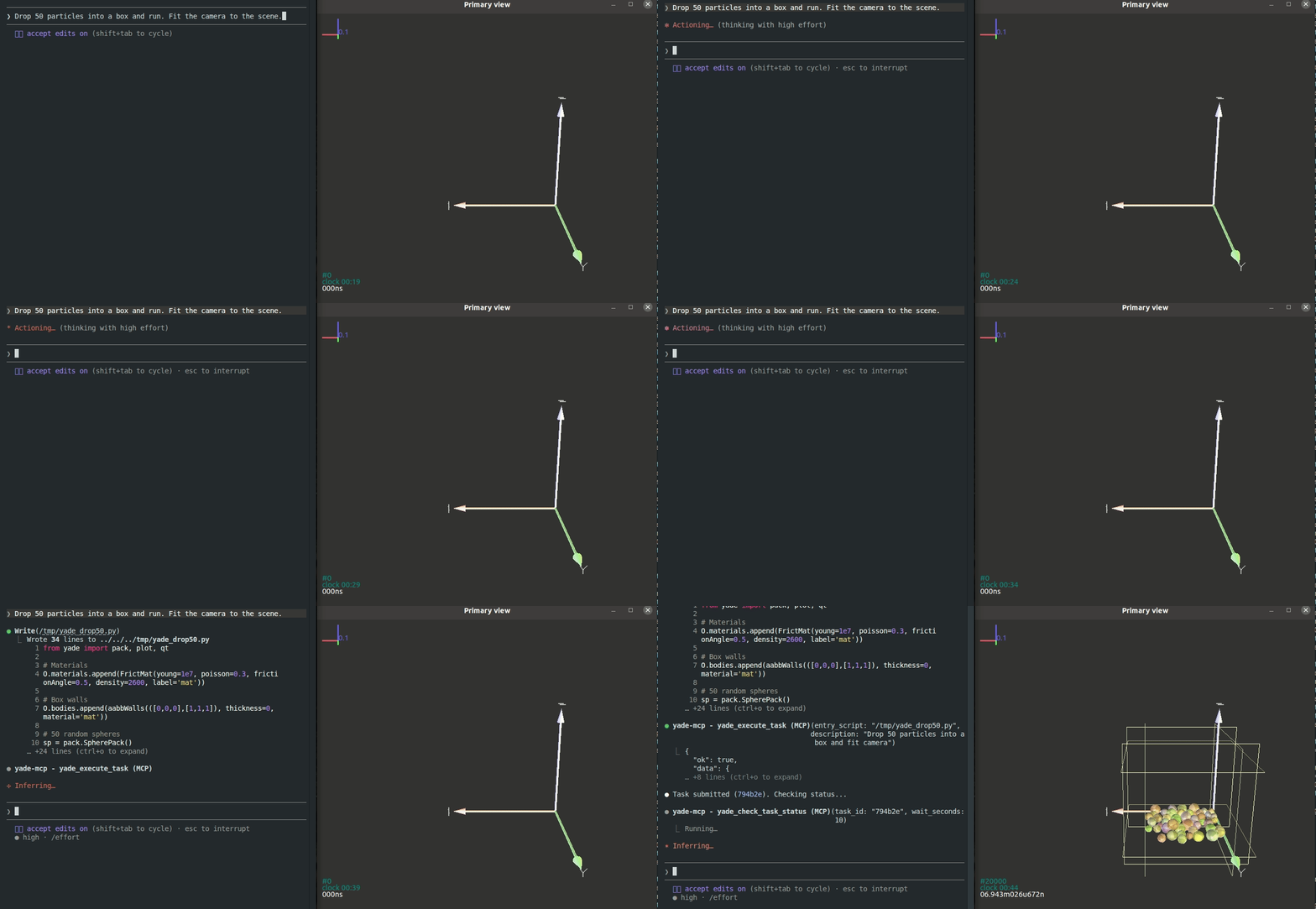
Works with any MCP client — verified with Claude Code, Codex CLI, Gemini CLI, GitHub Copilot CLI, OpenCode, and toyoura-nagisa.
Features
Your agent types, YADE runs
Powered by yade_execute_code
Describe what you want in plain language. The agent types commands into your YADE console — inspecting particles, tweaking parameters, stepping the engine, analyzing results. It reads each output, debugs, and iterates, the same way you do at the console yourself.
Set it running, walk away
Powered by yade_execute_task + yade_check_task_status + yade_interrupt_task
Run a full YADE script as a background task — just like firing off yade script.py, except you don't have to babysit it. The agent watches on its own: tailing the live output, catching errors as they appear, stopping the run gracefully when something looks off, fixing the script, and resubmitting — until the simulation actually finishes.
New session, no cold start
Powered by yade_list_tasks + yade_check_task_status
Every task you've submitted — the script, the live output, the final state — stays on record. When the context window fills up or you come back the next day, a fresh agent walks into a project that already remembers itself: it lists what's been run, reads what each task produced, and picks up without you re-explaining anything.
A live shell into the running simulation
Powered by yade_execute_code
While a task runs, the agent has a live shell into the simulation — ask it to inspect any variable, dump any object's state, or render a fresh plot on demand, without editing the script or stopping the run.
You type, the agent's in sync
Beyond submitted tasks, every line you type into the YADE console — the variables you peeked at, the parameters you tested, the dead ends you walked away from — flows into the agent's context too. When you turn to chat, it already has the trail of what you've been trying. Learning YADE and want feedback on what you just typed? Stuck on an unexpected error? Just ask — the agent saw what you typed and how YADE answered.
Tools (7)
Two documentation tools (no bridge) and five execution tools (bridge required):
| Tool | Purpose | Bridge |
|---|---|---|
yade_browse_api | Walk the YADE Python class tree | No |
yade_query_api | BM25 keyword search across the API | No |
yade_execute_code | Run Python in the live YADE process; returns synchronously | Yes |
yade_execute_task | Submit a script as a long-running background task | Yes |
yade_check_task_status | Inspect a running or finished task (output, status) | Yes |
yade_interrupt_task | Gracefully stop a running task | Yes |
yade_list_tasks | List submitted tasks with metadata | Yes |
Quick Start
Prerequisites
Agentic Setup (Recommended)
Copy this to your AI agent and let it self-configure:
Fetch and follow this bootstrap guide end-to-end:
https://raw.githubusercontent.com/yusong652/yade-mcp/master/docs/agentic/yade-mcp-bootstrap.md
Manual Setup
1. Register the MCP server in your client config:
{
  "mcpServers": {
    "yade-mcp": {
      "command": "uvx",
      "args": ["yade-mcp"]
    }
  }
}
2. Start the bridge inside YADE:
In a YADE Python console, install the bridge using YADE's own interpreter:
import sys, subprocess
subprocess.check_call([sys.executable, "-m", "pip", "install", "--user", "yade-mcp-bridge"])
On PEP 668 externally-managed environments (pip refuses --user), see the bootstrap guide for a portable form.
Restart YADE, then in the Python console:
import yade_mcp_bridge
yade_mcp_bridge.start()
Verify
Restart your AI agent (Claude Code, Codex CLI, Gemini CLI, etc.) and ask it to call yade_execute_code to verify the connection.
Contributing
See CONTRIBUTING.md for development setup and guidelines.
License
MIT — see LICENSE.
Related MCP servers

ITASCA MCP Server
Connect AI agents to ITASCA numerical modeling software—PFC, FLAC, 3DEC, MPoint, MassFlow—for docs, simulations, and code execution.

Measured web UI findings for AI agents — contrast ratios, touch targets, and accessibility checks as text, not guesses from screenshots.

Run AI-generated code safely. gVisor-isolated Python/JS sandboxes for any MCP client. Pay per run.


Generate AI UGC videos with talking heads, B-roll, and subtitles.
View repository →