Tidewave Phoenix MCP Server
io.github.tidewave-ai/tidewave-phoenix
Runtime-level MCP server for Phoenix development: execute code, read logs, query the DB, and access docs.
What is the Tidewave Phoenix MCP server?
Tidewave Phoenix is an MCP server that provides runtime-level tools for developing Phoenix applications with coding agents. It enables agents to execute code in the context of a running Phoenix app, read live logs, query the development database, locate source code, and access documentation for exact dependency versions.
Tidewave Phoenix gives AI agents direct access to your running Phoenix application during development. Agents can evaluate Elixir code like an IEx session, query your database, inspect logs, find source locations across your app and dependencies, and read documentation pinned to your exact package versions. This grounds agent decisions in your actual runtime state rather than assumptions.
How to install Tidewave Phoenix
Copy-paste configuration for popular MCP clients.
No machine-readable install method is published for this server in the registry. Check the repository or website for setup instructions.
Tools & capabilities
Tools this server exposes to the agent.
project_eval— Evaluates Elixir code within your running application, giving the agent access to your runtime, dependencies, and in-memory data.execute_sql_query— Executes SQL queries within your app's development database.get_docs— Get documentation for a given module/function, consulting exact versions locked in your project's mix.lock.get_logs— Reads logs written by the server.get_source_location— Get the source location for a given module/function, across both your app and its dependencies.
Use cases
- Debug failing code paths by running them against live app state and inspecting results
- Verify database state changes after agent-executed actions using SQL queries
- Reproduce bugs by examining live logs and backtraces from the running application
- Navigate to module and function definitions across your app and hex dependencies
- Ground agent decisions in actual runtime behavior instead of assumptions
Tidewave Phoenix MCP server FAQ
Tidewave Phoenix is an MCP server that connects AI agents to your running Phoenix application in development, enabling code execution, database queries, log inspection, and documentation lookup.
Yes, Tidewave Phoenix is open-source under the Apache License 2.0. It is also a component of the Tidewave product, which has its own licensing.
Add the tidewave hex package to your Phoenix app's mix.exs, add the Tidewave plug to your endpoint.ex, then configure your editor to connect to the MCP server at http://localhost:4000/tidewave/mcp (or your app's port). Tidewave provides specific setup instructions for Cursor, Claude Code, VS Code, Neovim, and other editors.
By default, Tidewave only allows requests from localhost for security. You can configure allowed_origins and enable remote access if needed, but this requires understanding the security implications.
Tidewave works with any Phoenix application. It works best with Phoenix LiveView v1.1 or later, with debug_heex_annotations and debug_attributes enabled in config/dev.exs.
Yes, Tidewave can be used as an MCP in any Elixir project. You can use it with bandit or other web servers in dev mode.
README (reference)
Source of truth, from the repository.
Tidewave Phoenix
Tidewave Phoenix is an MCP server that provides runtime-level tools for developing Phoenix apps using coding agents.
Your agent will be able to use this MCP server to talk to your running Phoenix app in development to:
- execute code in the context of the running app (like an IEx session for agents)
- read the app's live logs
- query your development database
- get source locations of modules and functions
- read documentation pinned to the exact hex package versions your project depends on
This MCP server is an open-source component of Tidewave, the agentic development environment for Phoenix and Rails.
You can use this project as a standalone MCP server or integrated with the Tidewave product by following the installation instructions below.
Installation
1. Add the Tidewave hex package to your app
Option 1: Manually
Add the tidewave package to your mix.exs:
def deps do
  [
    {:tidewave, "~> 0.6", only: :dev},
    {:phoenix, ...},
  ]
end
Then, for Phoenix applications, go to your lib/my_app_web/endpoint.ex and right above the if code_reloading? do block, add:
+  if Mix.env() == :dev do
+    plug Tidewave
+  end

   if code_reloading? do
[!TIP] Tidewave works best with Phoenix LiveView v1.1 or later. Once you update it, make sure to enable the following options in your
config/dev.exs:config :phoenix_live_view, debug_heex_annotations: true, debug_attributes: trueThose are enabled by default for Phoenix v1.8+ apps.
Option 2: Using Igniter
Alternatively, you can use igniter to automatically install Tidewave MCP into an existing Phoenix application:
# install igniter_new if you haven't already
mix archive.install hex igniter_new

# install tidewave
mix igniter.install tidewave
Umbrella projects
For umbrella projects, you can follow the manual steps above in the application that defines your Phoenix endpoint (typically apps/your_app_web).
In non-Phoenix applications
Tidewave can be used as a MCP in any Elixir project. For example, you can use bandit (and tidewave) in dev mode in your mix.exs:
{:tidewave, "~> 0.6", only: :dev},
{:bandit, "~> 1.0", only: :dev},
And then adding an alias in your mix.exs:
aliases: [
  tidewave:
    "run --no-halt -e 'Agent.start(fn -> Bandit.start_link(plug: Tidewave, port: 4000) end)'"
]
Now run mix tidewave
2. Add the Tidewave MCP to your agent/editor
Add the Tidewave MCP server to your editor or MCP client configuration as the type "http" (streamable), pointing to the /tidewave/mcp path and port your web application is running at. For example, http://localhost:4000/tidewave/mcp.
We also have specific instructions for:
Usage
As with any other MCP server, your agent will call the tools exposed by the Tidewave MCP whenever it sees fit. But you can also prompt it to call them explicitly.
Available MCP tools
project_eval
Evaluates Elixir code within your running application, giving the agent access to your runtime, dependencies, and in-memory data. It's like an IEx for the agent.
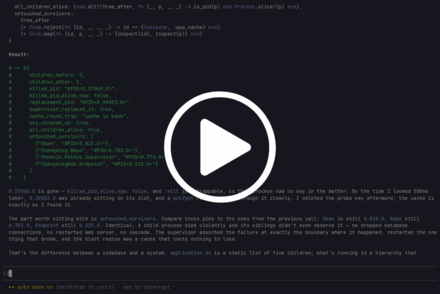
Your agent can use it when it would rather run code than assume behavior, grounding its next step in what the running app actually does. For example, calling a function to see what comes back or reproducing a failing code path against live app state to debug it.
execute_sql_query
Executes a SQL query within your app's development database.
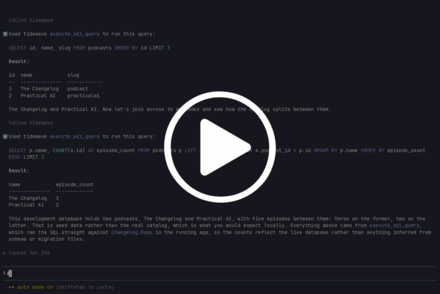
Your agent can use it to run any SQL against your development database. Useful for the agent to verify the result of an action.
get_docs
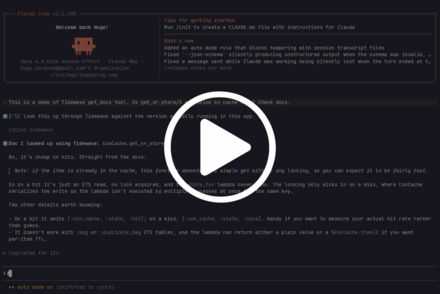
Get the documentation for a given module/function. It consults the exact versions locked in your project's mix.lock, ensuring you get correct information.
get_logs
Reads logs written by the server.
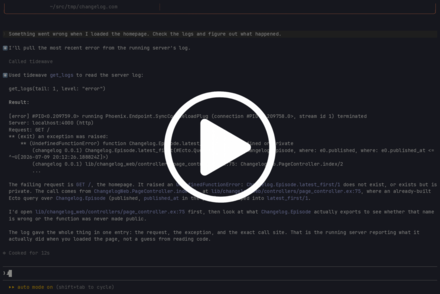
Your agent can use it to see what happened after a request. For example, reading the request log and backtrace when something misbehaves.
get_source_location
Get the source location for a given module/function, across both your app and its dependencies.
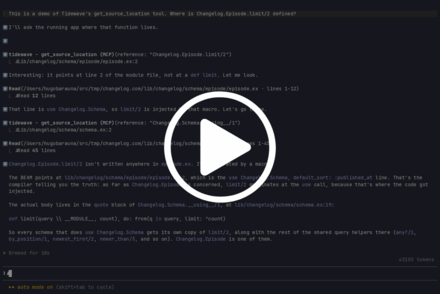
Your agent can use it to jump straight to where a module/function is defined, by file and line, instead of grepping for it, including when the definition lives in a hex dependency.
Troubleshooting
Using multiple hosts/subdomains
If you are using multiple hosts/subdomains during development, you must use *.localhost, as such domains are considered secure by browsers. Additionally, add the following immediately @session_options definition in your lib/your_app_web/endpoint.ex:
@session_options [
  # ... your configuration
]

if code_reloading? do
  @session_options Keyword.merge(@session_options, same_site: "None", secure: true)
end
The above will allow your application to run embedded within Tidewave across multiple subdomains, as long as it is using a secure context (such as admin.localhost, www.foobar.localhost, etc).
Content security policy
If you have enabled Content-Security-Policy, Tidewave will automatically enable "unsafe-eval" under script-src in order for contextual browser testing to work correctly. It also disables the frame-ancestors directive. This is done only in the environments that Tidewave is loadead (development by default).
Configuration
You may configure the Tidewave plug using the following syntax:
plug Tidewave, options
The following options are available:
-
:allow_remote_access- Tidewave only allows requests from localhost by default, even if your server listens on other interfaces, for security purposes. Read our security guidelines for more information and when to allow remote access (if you know what you are doing) -
:allowed_origins- a list of values matched against theOriginheader to prevent cross origin and DNS rebinding attacks. Each value must be a string of shape[scheme:]//host[:port], where both scheme and port are optional. The host may also start with "*". Example:["//localhost:8000", "//*.test"] -
:inspect_opts- custom options passed toKernel.inspect/2when formatting some tool results. Defaults to:[charlists: :as_lists, limit: 50, pretty: true] -
:team- set your Tidewave Team configuration, such asteam: [id: "my-company"] -
:toolbar- controls whether the Tidewave toolbar is injected into your HTML pages. Defaults totrue -
tmp_dir- temporary directory Tidewave uses for screenshots and recordings. It must be a relative directory to the current application root. Defaults totmp, storing files undertmp/tidewave/screenshotsandtmp/tidewave/recordings
License
Copyright (c) 2025 Dashbit
Licensed under the Apache License, Version 2.0 (the "License"); you may not use this file except in compliance with the License. You may obtain a copy of the License at http://www.apache.org/licenses/LICENSE-2.0
Unless required by applicable law or agreed to in writing, software distributed under the License is distributed on an "AS IS" BASIS, WITHOUT WARRANTIES OR CONDITIONS OF ANY KIND, either express or implied. See the License for the specific language governing permissions and limitations under the License.
Related MCP servers

Tidewave Rails
Runtime-level MCP server for Rails development: execute code, read logs, query databases, and access documentation.

AI-driven penetration testing - 22 security tools behind safety-hardened MCP endpoints

tierproxy
Multi-provider proxy infrastructure for AI/ML. Geo, sessions, cost-aware routing, usage tools.

GIMP 3 MCP
Let AI assistants paint, edit and export images in a running GIMP 3, with 80 tools.

Stealth Chromium engine that bypasses bot detection by spoofing fingerprints at the C++ level, not JavaScript.

TILL
Swiss accounting your agent can actually use: the TILL ledger over MCP.